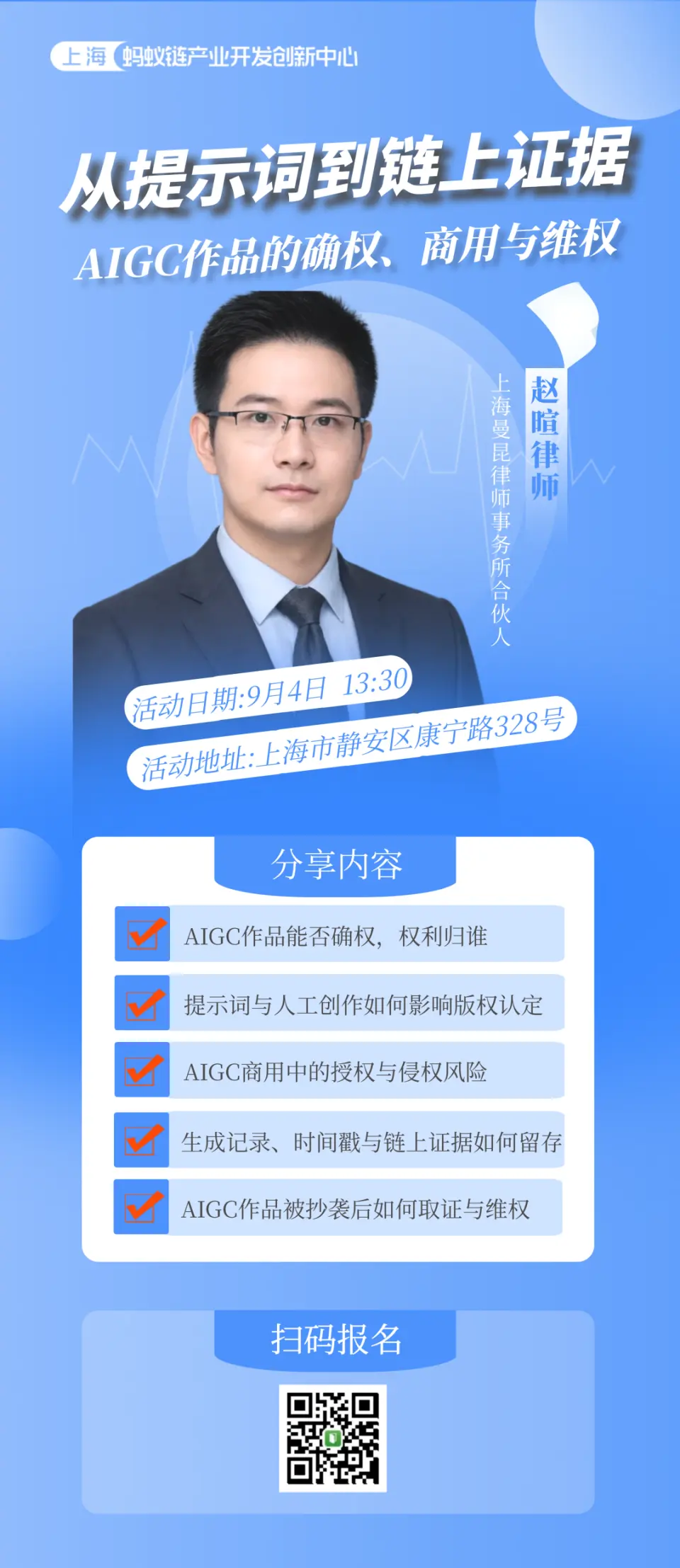
On September 4, 2026,Zhao Xuan, a partner at Mankun Law Firm,will be invited to participate in a special eventhosted by the Shanghai AntChain Industrial Development and Innovation Center,where,on the theme "From Prompts to On-Chain Evidence: Rights Confirmation, Commercial Use and Rights Enforcement for AIGC Works,"he will share key legal issues arising in the process from creation and commercial use to rights enforcement of AIGC works, in light of current copyright rules and relevant judicial practice.
● Who exactly owns AI-generated works?
AIGC works often involve prompt input, parameter adjustment, local redrawing and manual modification, and how much of the final output constitutes human creative expression directly affects the determination of copyright.
In this sharing session, Zhao Xuan will discuss questions includingwhether rights can be confirmed in AIGC works, to whom the rights may belong, and how prompts and human creative acts affect the determination of copyright, among others.
●Dozens of versions of the prompt were written—why is it still necessary to retain the creative process?
AIGC generates content quickly, and many creation records exist only in the platform's backend. Once a dispute arises, if only the final product is retained, proving originality may not be easy.
Therefore, in addition to the final product,the prompts, generation times, iterative versions, source files, modification records, and relevant platform records may all become important materials for proving the creative process.
●Once recorded on-chain, is it certain to become valid evidence?
Blockchain evidence preservation is increasingly appearing in scenarios involving the confirmation of rights in digital content and the enforcement of intellectual property rights.
In practice, in judicial practice, whether electronic evidence can be admitted often still depends on a comprehensive assessment ofthe source of the evidence, the generation process, the entity preserving the evidence, technical reliability, the integrity of the content, and whether it can corroborate other evidenceand other factors.
This event will also further discuss how thegeneration records, timestamps, and on-chain evidence of AIGC works should be preserved so that they can be of value when a dispute actually arises.
●What are the risks of using AI works for commercial purposes?
The copyright issues surrounding AIGC are not limited to the scenario where one's own work is copied.
When enterprises begin to use AI images, AI videos and virtual characters in advertising, brand design, game assets or commercial orders, they also need to consider another question:Could the generated content infringe the copyright, trademark rights, portrait rights or other lawful rights and interests of others?
For enterprises, what AIGC compliance truly needs to address is not whether AI can be used, but ratherwhat content can be used, how it may be used, who reviews it, and who bears responsibility once problems arise.
● Event Information
Event time:September 4, 2026, 13:30
Event venue:328 Kangning Road, Jing'an District, Shanghai
Organizer:Shanghai AntChain Industrial Development and Innovation Center