

⚡ Week in Review: June 24 – July 1, 2026
I. Key Developments and New Regulations This Week
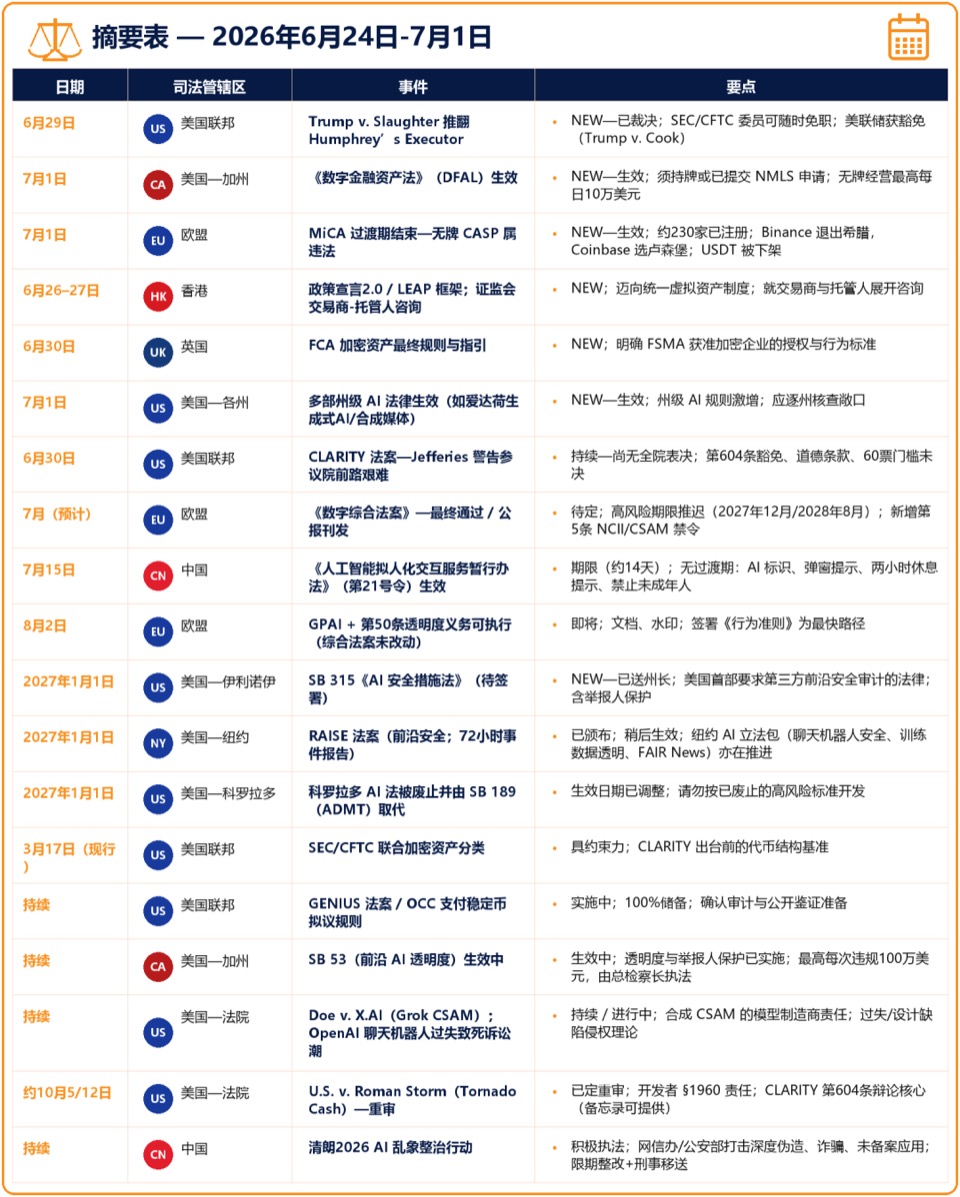
This week saw a dense cluster of developments: the U.S. Supreme Court issued a structural ruling on regulatory agency independence, two hard compliance deadlines took effect on July 1 (the EU’s Markets in Crypto-Assets Regulation (MiCA) and California’s crypto licensing regime), and Hong Kong and the United Kingdom also introduced new frameworks for digital assets. Part I covers only those developments that actually occurred between June 24 and July 1, 2026; all recurring deadlines, pending measures, and previously reported litigation are summarized in the table in Part II.
U.S. Federal — Regulators and Courts
Supreme Court Overrules Humphrey’s Executor Precedent; SEC and CFTC Commissioners Lose Removal Protections (June 29)
In Trump v. Slaughter, the U.S. Supreme Court held, in a 6–3 majority opinion authored by Chief Justice Roberts, that statutory restrictions limiting the removal of commissioners of multi-member agencies to “for cause” scenarios are unconstitutional, thereby overruling the 91-year-old precedent set in Humphrey’s Executor. The same reasoning extends to the two primary regulators in the crypto space: commissioners of the Securities and Exchange Commission (SEC) and the Commodity Futures Trading Commission (CFTC) may now be removed by the President at will. A companion 5–4 decision (Trump v. Cook) preserved the independence of the Federal Reserve. It is anticipated that the enforcement stances of the SEC and CFTC in the crypto and artificial intelligence sectors will become more rapid and more susceptible to political influence, while ongoing rulemaking processes will enjoy diminished protection. Any strategies predicated on the assumption that the current regulatory stance will remain unchanged should be reevaluated.
United States — California
Digital Financial Assets Law (DFAL) Takes Effect—Crypto Licensing Becomes Mandatory (July 1)
California’s Digital Financial Assets Law (DFAL) took effect on July 1: exchanges, custodians,stablecoinissuers, and Bitcoin ATM operators providing services to California residents are now required to hold DFPI A license or a complete NMLS application must be in place; otherwise, civil penalties of up to USD 100,000 per day may be imposed. Indicative thresholds include USD 100,000 in tangible net worth and USD 500,000 in surety bonds, subject to adjustment based on risk profile. Enterprises must also conduct due diligence on assets before making them available to California residents.
United States — State-Level (AI)
Multiple state-level AI laws took effect on July 1.
A batch of state-level AI regulations took effect on July 1—for example, Idaho’s law on generative AI in public education, and laws incorporating synthetic media into the definition of “video voyeurism.” The overall trend is an increasing number of sector-specific AI rules across states taking effect on the fixed date of July 1; clients should review compliance exposure on a state-by-state basis. (See the summary table for details on pending measures such as Illinois SB 315 and New York’s RAISE Act.)
European Union — Web3
MiCA transition period ends—the deadline has officially arrived (July 1).
MiCA became fully applicable across the European Union on July 1. Entities still operating under national transitional mechanisms must now obtain authorization or exit the market. Of approximately 3,000 pre-MiCA virtual asset service providers (VASPs), only about 230 have registered with ESMA; up to 10 million users may need to switch platforms, and proposed fines for non-compliant major stablecoin issuers could reach 12.5% of annual turnover. Developments this week: Binance withdrew its license application in Greece, Coinbase designated Luxembourg as its home Member State, several platforms delisted USDT, while USDC remained listed.
Hong Kong — Web3
Release of the Policy Statement on Development of Virtual Assets 2.0 / LEAP Framework; SFC launches consultation on dealers and custodians (June 26–27).
On June 26, the Hong Kong Government released the Policy Statement on Development of Virtual Assets 2.0, centered on the “LEAP” framework (streamlining laws and regulations, expanding tokenized products, advancing application scenarios, and developing talent and partnerships), aiming to establish a comprehensive and unified regulatory regime covering exchanges, stablecoin issuers, dealers, and custodians. On June 27, the Securities and Futures Commission (SFC) launched a consultation to bring virtual asset trading dealers and custodians within the regulatory scope. The licensing regime for stablecoin issuers, implemented by the Hong Kong Monetary Authority (effective from August 1, 2025), continues to advance, with an expected launch in the second half of 2026.
United Kingdom — Web3 (Cross-Border)
FCA publishes final rules on crypto assets (June 30).
The UK Financial Conduct Authority (FCA) has issued final rules and guidance for crypto assets firms, establishing authorization and conduct standards for firms authorized to operate under the Financial Services and Markets Act (FSMA). This is particularly relevant for multi-jurisdictional digital asset clients concurrently conducting business under the EU’s Markets in Crypto-Assets Regulation (MiCA) and holding Hong Kong licenses.
II. Summary Table — Ongoing and New Developments
Items marked “NEW” represent developments occurring between June 24 and July 1, 2026; items marked “Ongoing” were previously reported and are retained here for tracking purposes. Deadlines are indicated by date.
III. Compliance Action Recommendations
Actions Currently Required for AI Enterprises
• China — July 15 (approximately 14 days): Conduct a gap analysis against the Interim Measures for Anthropomorphic Interaction Services in Artificial Intelligence—covering AI pop-up notifications, two-hour rest reminders, dependency detection, and the prohibition of companionship features directed at minors. There is no transition period. Verify that filings with the Cyberspace Administration of China (CAC) and public reporting channels are operational.
• European Union — August 2 (no changes to the Omnibus Act): Continue to advance GPAI documentation, capability assessments, and systemic risk assessments on schedule, and consider signing the Code of Conduct; note the ongoing promotion of Article 5’s NCII/CSAM ban within the Omnibus Act.
• United States — Regulatory Landscape (New): In light of Trump v. Slaughter, which allows for the at-will removal of SEC/CFTC leadership, do not assume that current enforcement priorities will persist—build compliance based on statutes and existing guidance rather than relying on the stance of any individual commissioner.
• United States — State-Level Exposure: Reassess obligations in light of state-level AI laws that took effect on July 1, as well as the upcoming third-party audit regime under Illinois SB 315 and the New York RAISE Act (both effective January 1, 2027); confirm that transparency and incident reporting requirements under California SB 53 are fully implemented and operational.
• United States — Litigation Exposure: Review security upgrades and content moderation processes, document model safety decisions and override operations, and incorporate CSAM prevention controls and incident logging into any generative processes (see Grok CSAM case; wave of OpenAI infringement lawsuits).
Actions Currently Required for Web3 Enterprises
• United States — California DFAL (Immediate, Urgent): If involving California residents, confirm possession of a DFPI license or submission of a complete NMLS Application — Operating without a license faces daily penalties of USD 100,000. Implement capital requirements (net assets of USD 100,000), a surety bond of USD 500,000, and pre-listing asset due diligence.
• European Union — MiCA (current, urgent): The transition period has ended. Confirm that authorization has been obtained, or execute a written exit/customer migration plan; the choice of home Member State (see this week’s Binance and Coinbase cases) is critical. USDT is effectively unavailable on compliant EU platforms, with USDC being the default option.
• Hong Kong — LEAP / New Consultation: Study the Policy Statement 2.0 and the SFC consultations on dealers/custodians; assess licensing eligibility for businesses such as exchanges, stablecoins, trading, and custody, and prepare responses to the consultations. Maintain a firewall with mainland China.
• United Kingdom / Cross-border: Benchmark the FCA’s new final rules against MiCA and Hong Kong requirements to avoid conflicts of obligations in multi-jurisdictional operations.
• United States — CLARITY Act and Developer Liability: No full Senate vote yet—do not expect imminent exemptions. Map tokens against the CFTC/SEC division of labor and distinguish between “development” and “operation”; frontend maintenance, fee collection, and active support may transform code creation into actionable conduct under §1960(b)(1)(C) (the Storm theory).
This briefing is for reference only and does not constitute legal advice. Certain litigation matters involve sensitive topics (self-harm and child exploitation) and are summarized only at the level of factual allegations. If you require assistance with AI legal governance or compliance in Web3 and digital assets, please feel free to contact our lawyers. Thank you!
Mankun Law PLLC
1. This Week — News & New Laws
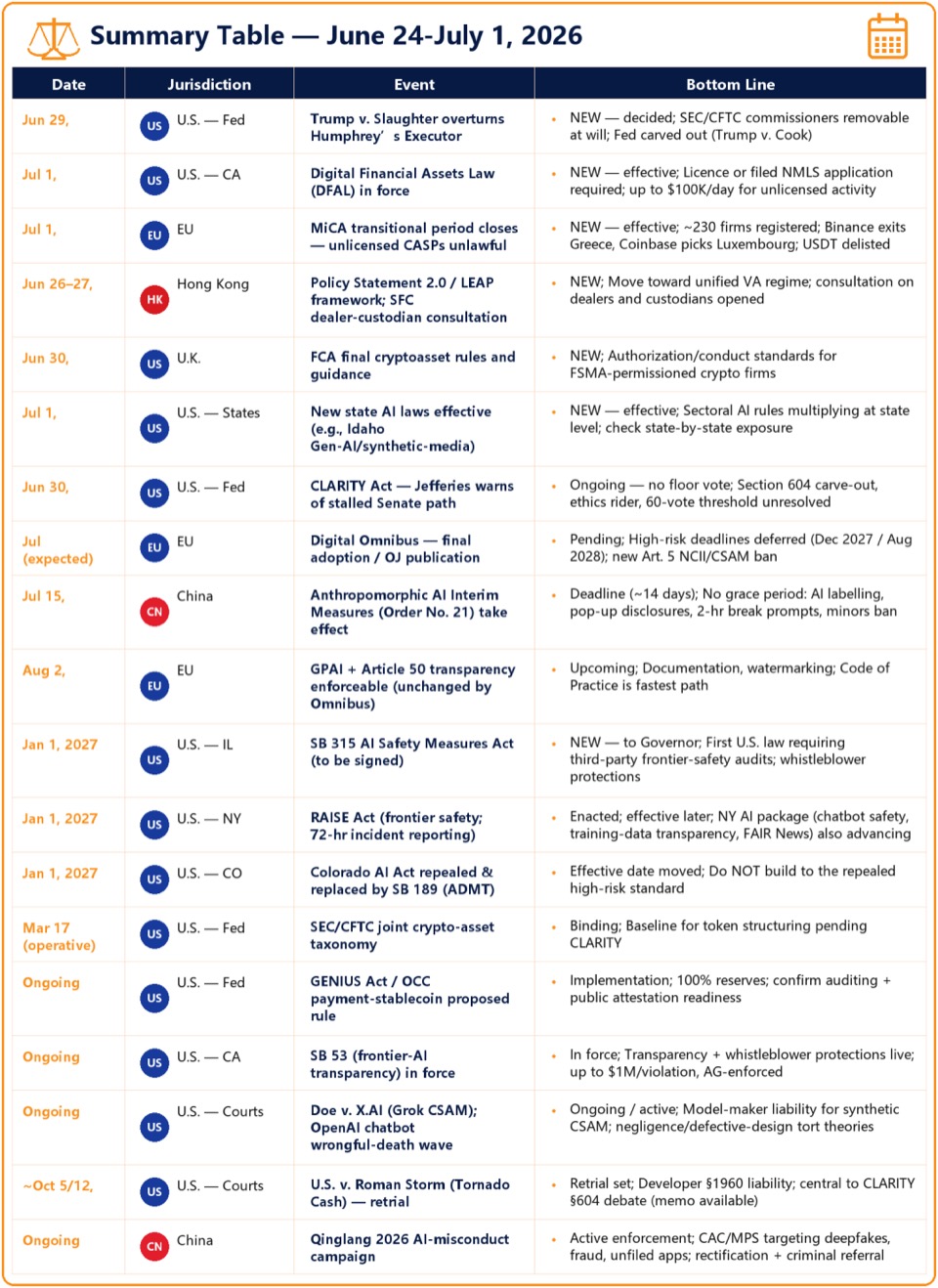
A busy week: a structural Supreme Court ruling on regulator independence, two hard July 1 deadlines going live (EU MiCA and California crypto licensing), and new digital-asset frameworks from Hong Kong and the UK. Section 1 covers only developments that occurred within June 24–July 1; all recurring deadlines, pending measures, and previously reported litigation are consolidated in the Summary Table (Section 2).
U.S. Federal — Regulators & Courts
Supreme Court overturns Humphrey’s Executor; SEC and CFTC lose removal protection (June 29).
In Trump v. Slaughter, a 6-3 majority (Roberts, C.J.) held that for-cause removal restrictions on multimember-agency commissioners are unconstitutional, overruling the 91-year-old Humphrey’s Executor precedent. The same logic reaches crypto’s two principal regulators: SEC and CFTC commissioners now serve at the President’s pleasure. A companion 5-4 decision (Trump v. Cook) preserved Federal Reserve independence. Expect faster, more politically-directed swings in SEC/CFTC crypto and AI enforcement, and thinner insulation for pending rulemakings — weigh this in any strategy relying on current agency posture persisting.
U.S. — California
Digital Financial Assets Law (DFAL) goes live — crypto licensing now mandatory (July 1).
California’s DFAL entered into force July 1: every exchange, custodian, stablecoin issuer, and Bitcoin-ATM operator serving California residents must now hold a DFPI licence or have filed a complete NMLS application, or face civil enforcement of up to $100,000 per day. Indicative thresholds: $100,000 tangible net worth and a $500,000 surety bond, subject to risk-based adjustment. Firms must also vet assets before listing them to California residents.
U.S. — States (AI)
New state AI laws take effect July 1.
A wave of state AI statutes took effect July 1 — for example, Idaho’s laws on generative AI in public education and on synthetic media within the “video voyeurism” definition. The pattern is sectoral state AI rules multiplying on fixed July 1 effective dates; clients should re-check state-by-state exposure. (Pending measures such as Illinois SB 315 and the NY RAISE Act are tracked in the table.)
European Union — Web3
MiCA transitional period closes — the deadline arrives (July 1).
MiCA reached full EU-wide application on July 1. Firms still under national transitional regimes must be authorized or wind down. Only about 230 of ~3,000 pre-MiCA VASPs have cleared the ESMA register; up to 10 million users may need a new venue, and proposed fines reach 12.5% of annual turnover for non-compliant major stablecoin issuers. This week: Binance withdrew its Greek licence bid, Coinbase named Luxembourg its home state, and venues delisted USDT while USDC retained listings.
Hong Kong — Web3
Policy Statement 2.0 / LEAP framework issued; SFC consults on dealers and custodians (June 26–27).
On June 26 the Government issued Policy Statement 2.0 on the Development of Digital Assets, built around the “LEAP” framework (Legal-and-regulatory streamlining; Expanding tokenized products; Advancing use cases; People/partnership development), aiming at a comprehensive, unified regime spanning exchanges, stablecoin issuers, dealers, and custodians. On June 27 the SFC launched a consultation to bring virtual-asset dealers and custodians within the regulatory perimeter. Stablecoin issuer licensing under the HKMA (live since Aug 1, 2025) continues toward an H2 2026 launch.
United Kingdom — Web3 (cross-border)
FCA publishes final cryptoasset rules (June 30).The FCA released final rules and guidance for cryptoasset firms, setting the authorization and conduct standards for firms permissioned under FSMA. Relevant for clients running multi-jurisdiction digital-asset operations alongside EU MiCA and Hong Kong licensing.
2. Summary Table — Ongoing & New Developments
“NEW” marks developments in the June 24–July 1 window; “Ongoing” items were reported previously and are retained for tracking. Deadlines noted by date.
3. Call to Compliance Actions
What AI Companies Should Do Now
China — July 15 (~14 days): Complete a gap analysis against the Anthropomorphic AI Interim Measures — pop-up AI disclosures, two-hour break prompts, dependency detection, and a ban on companion features for minors. No grace period. Verify CAC registration and a live public reporting channel.
EU — Aug 2 (unchanged by the Omnibus): Keep GPAI documentation, capability evaluations, and systemic-risk assessments on track and consider signing the Code of Practice; note the Article 5 NCII/CSAM prohibition now moving through the Omnibus.
U.S. — Regulatory posture (new): With SEC/CFTC leadership now removable at will after Trump v. Slaughter, do not assume current enforcement priorities are durable — build to the statutes and operative guidance, not a given commissioner’s stance.
U.S. — State exposure: Re-map obligations against newly effective July 1 state AI laws and the incoming Illinois SB 315 third-party-audit regime and NY RAISE Act (both Jan 1, 2027); confirm California SB 53 transparency and incident reporting are operational.
U.S. — Litigation exposure: Audit safety-escalation and content-moderation protocols, document model-safety decisions and overrides, and add CSAM-prevention controls and incident logging to any generative pipeline (Grok CSAM action; OpenAI tort wave).
What Web3 Companies Should Do Now
U.S. — California DFAL (now, urgent): If you touch California residents, confirm you hold a DFPI licence or have a complete NMLS application on file — unlicensed activity risks $100K/day. Stand up capital ($100K net worth), a $500K surety bond, and pre-listing asset diligence.
EU — MiCA (now, urgent): The transitional window has closed. Confirm authorization or execute a documented wind-down / customer-migration plan; the home-state choice (see Binance and Coinbase this week) matters. USDT is effectively off-limits on compliant EU venues; USDC is the default.
Hong Kong — LEAP / new consultations: Review Policy Statement 2.0 and the SFC dealer/custodian consultation; assess licensing eligibility across exchange, stablecoin, dealing, and custody activities, and prepare consultation responses. Keep mainland firewalls intact.
• U.K. / cross-border: Map the new FCA final rules against MiCA and Hong Kong requirements to avoid conflicting obligations in multi-jurisdiction operations.
U.S. — CLARITY & developer liability: No Senate floor vote yet — do not count on near-term relief. Map tokens to the CFTC/SEC divide and separate “building” from “operating”; front-end maintenance, fee capture, and active support can convert code authorship into chargeable conduct under §1960(b)(1)(C) (the Storm theory).
This briefing is prepared for informational purposes only and does not constitute legal advice. Certain litigation matters involve sensitive subjects (self-harm and child exploitation) and are summarized at the litigation-fact level. If you are seeking AI legal governance or Web3 & digital-assets compliance, feel free to reach out to our lawyers. Many thanks!
Mankun Law PLLC
Author
Joanna Fan, Partner at Mankun Law Firm, licensed to practice in China and New York State (USA), and Head of Mankun Law PLLC. Holds a Bachelor of Laws from Southwest University of Political Science and Law and an LL.M. from Penn State Law. Qualified to practice law in both China and the United States. Long-term focus on cross-border corporate, investment and financing, outbound investment, and dispute resolution services, with continued deep engagement in the intersection of Web3 and AI, focusing on digital asset compliance, cross-border blockchain structures, fintech regulation, and global licensing strategies, providing legal support for enterprises going global and digital innovation businesses.
About Mankun
Founded in 2015, Mankun Law Firm is a boutique law firm dedicated to serving Web3.0 and the next-generation internet, with deep expertise in emerging economic sectors such as blockchain, artificial intelligence, and tech finance.
The firm is headquartered in Shanghai, with branch offices in Hong Kong, Shenzhen, Silicon Valley, and other locations. Its core members come from renowned law firms, judicial authorities, technology companies, and digital asset institutions. Leveraging a unique multi-dimensional perspective encompassing law, industry, and regulation, the firm provides high-quality legal services to clients that combine depth in China with global breadth.
Drawing on a profound understanding of the new economy, continuous attention to and research on regulatory policies, and extensive practical experience, the Mankun team is adept at providing comprehensive legal services to clients in emerging sectors such as Web3 blockchain, artificial intelligence (AI), crypto payments (PayFi), decentralized finance (DeFi), tokenization of real-world assets (RWA), NFT digital collectibles, and crypto funds. From the perspectives of business models and legal practice, these services include business structure design, project financing and investment, operational compliance, commercial dispute resolution, establishment of anti-money laundering (AML) compliance systems, coordination with global law enforcement investigations, digital asset tracing and recovery, criminal risk prevention and control, and criminal defense.