01Web3 and Blockchain
Commercial structures, token and platform arrangements, product rules, transactions and cross-border compliance.
Legal services for the Web3 and new economy
Mankun Law Firm advises businesses on Web3, digital assets, artificial intelligence, fintech and cross-border operations.
Services
02AI Products and Data Compliance
Launch reviews, model and content governance, data flows, user terms and global operating requirements.03RWA and Crypto Funds
Integrating underlying assets, fund structures, licensing, and exit strategies into a practical, executable business model.04Fintech and Crypto Payments
Aligning capital flows, customer touchpoints, account structures, and product frameworks to clarify and establish compliant pathways for cross-border operations.05Licensing and Regulatory Response
Financial licensing, AML/KYC/KYT systems, regulatory inquiries and cross-border cooperation.06Disputes and Criminal-Risk Response
Digital-asset disputes, account freezes, asset tracing, evidence strategy and crypto-related criminal defence.07CRS Tax Compliance
Reporting diagnosis, overseas-asset reconciliation, legacy non-filing resolution and cross-border residency planning for Chinese tax residents.Built around real business decisions
Legal analysis follows the product, transaction, funds, data and responsibility chain.
Years focused on the new economy
Shanghai · Hong Kong · Shenzhen · Silicon Valley
Cross-border response capability
Our People
 01
01Founder and Managing DirectorLiu HonglinWeb3 strategy · Project complianceView profile →
 02
02Equity Partner, Man Kun Law Firm (Shenzhen)Jayden ShaoAI business and compliance · Stablecoin and cross-border payment complianceView profile →
 03
03Partner, Mankun Law Firm (Shenzhen)Deng XiaoyuCriminal defence and complaints · Sentence-execution mattersView profile →
Latest English publications
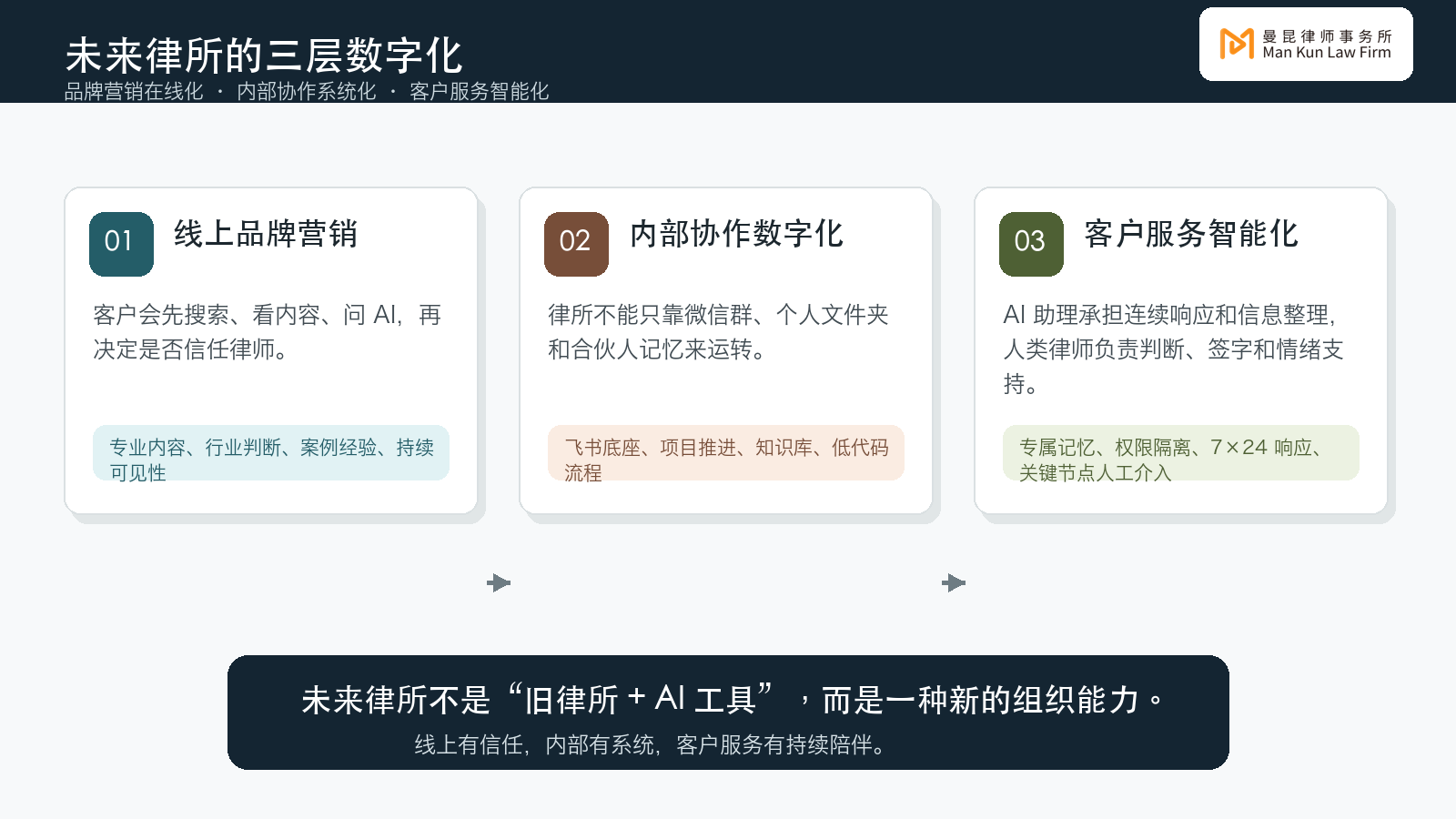
The Law Firm of the Future Does Not Grow in Old Soil
Read article→Drawing on his years of practice spanning legal internet ventures, law practice growth, and digital tools, culminating in the founding of Mankun Law Firm, attorney Liu Honglin, founder of Mankun Law Firm, explores the form of the law firm of the future. The future law firm will not emerge through the natural evolution of traditional firms; it must grow anew within new client relationships, modes of collaboration, and service processes.
Research
Mankun Updates | Welcome Attorney Su Zitao to Mankun Law Firm, Further Strengthening Legal Services in Financial Dispute Resolution, Corporate Compliance, and Regulatory Response
Read article→Mankun Law Firm is pleased to announce that Attorney Su Zitao has officially joined the firm. A graduate of China University of Political Science and Law, Attorney Su brings over five years of experience at leading law firms, with a focus on financial dispute resolution, corporate compliance, and regulatory response. He also conducts ongoing research into domestic and international regulation of Web3 and digital assets. His arrival will enhance Mankun’s ability to integrate services across traditional finance and emerging digital assets, providing clients with comprehensive solutions that encompass litigation and arbitration, responses to regulatory investigations, and the establishment of compliance frameworks.
Updates
Mankun Updates | Welcome Attorney Yu Hongyuan to Mankun Law Firm, Focusing on Digital Assets, AI Compliance, and Cross-Border Finance
Read article→Mankun Law Firm (Shenzhen) welcomes Attorney Yu Hongyuan, significantly enhancing its legal service capabilities in the fields of digital assets, artificial intelligence governance, and cross-border finance. With dual Master of Laws degrees from China and Germany, Attorney Yu specializes in comparative multi-jurisdictional regulation and compliance implementation. He will provide professional support to technology enterprises and financial institutions, covering stablecoin compliance, AI data governance, cross-border business structure design, and risk assessment, thereby assisting enterprises in achieving steady development within the global digital economy.
Updates
Mankun Updates | Welcome Attorney Jiang Heng to Mankun Law Firm: Leveraging Financial Risk Control Expertise to Enhance Web3 Cross-Border Compliance Services
Read article→Shanghai Mankun (Shenzhen) Law Firm welcomes senior attorney Jiang Heng. Attorney Jiang brings five years of legal practice experience and seven years of experience in financial risk control, with a focus on financial compliance, commercial dispute resolution, and corporate fund risk management. He excels at integrating traditional finance with Web3.0 business rules, providing integrated services for establishing AML/KYC compliance frameworks and resolving civil and commercial disputes in scenarios such as cross-border fund collections and payments, OTC fiat-to-crypto and crypto-to-fiat conversions, and account risk control, thereby helping enterprises achieve steady growth in complex regulatory environments.
Updates
Mankun Updates | Welcome Attorney Liu Ying to Mankun Law Firm, Further Strengthening Criminal Defense and Web3 Criminal Legal Services
Read article→Mankun Law Firm is pleased to announce that Attorney Liu Ying has officially joined the firm. With ten years of frontline experience in economic crime investigation with public security organs, and having previously served in Alibaba’s Security Department and Huobi, Attorney Liu possesses a multidisciplinary practical background spanning criminal investigation, internet platform security, and the Web3 digital assets industry. His arrival will significantly enhance Mankun’s professional capabilities in criminal defense, criminal complaints, corporate criminal risk prevention and control, and the handling of Web3-related criminal cases, providing clients with comprehensive legal solutions that integrate perspectives from criminal investigation, platform risk management, and industry operations.
Updates
Mankun Criminal Defense | Trading App Shows “800% Profit,” Yet There May Be Not a Single Coin On-Chain: How to Identify Fake Crypto Platforms?
Read article→Drawing on online romance investment fraud cases reported by the Hong Kong Police Force, this article provides an in-depth analysis of how fake crypto asset trading platforms induce users by forging app interfaces, manipulating backend data, and allowing small-scale withdrawals. The article emphasizes that “seeing assets” does not equate to “having control,” and proposes verifying platform authenticity across five dimensions: operating entity, regulatory status, download channels, funding paths, and asset control. It also guides users on how to preserve key evidence to safeguard their legitimate rights and interests upon detecting anomalies.
ResearchContact Mankun
Founded in Shanghai in 2015. Shanghai · Hong Kong · Shenzhen · Silicon Valley.
Phone+86 21 6854 4557