I. Facts of the Case
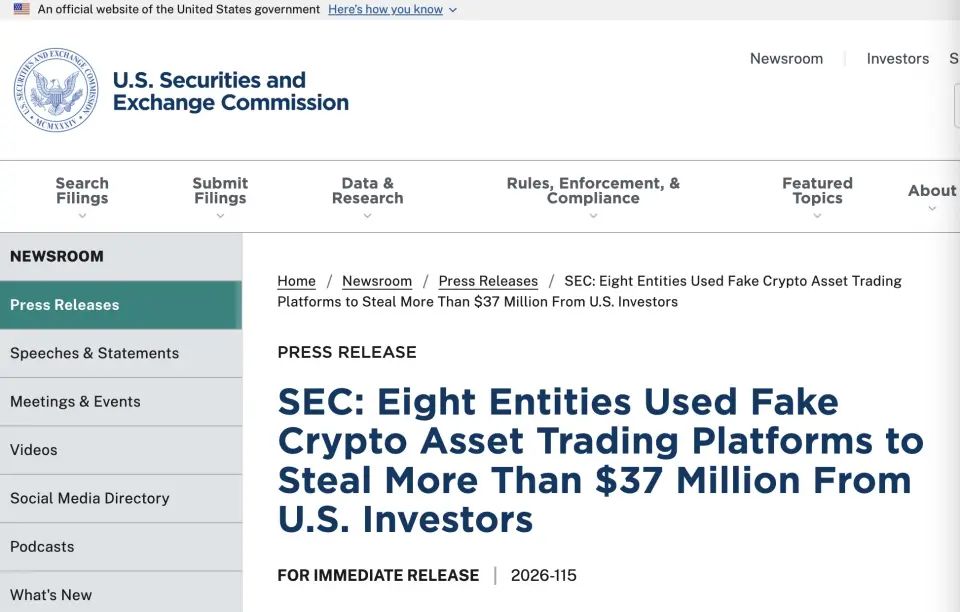
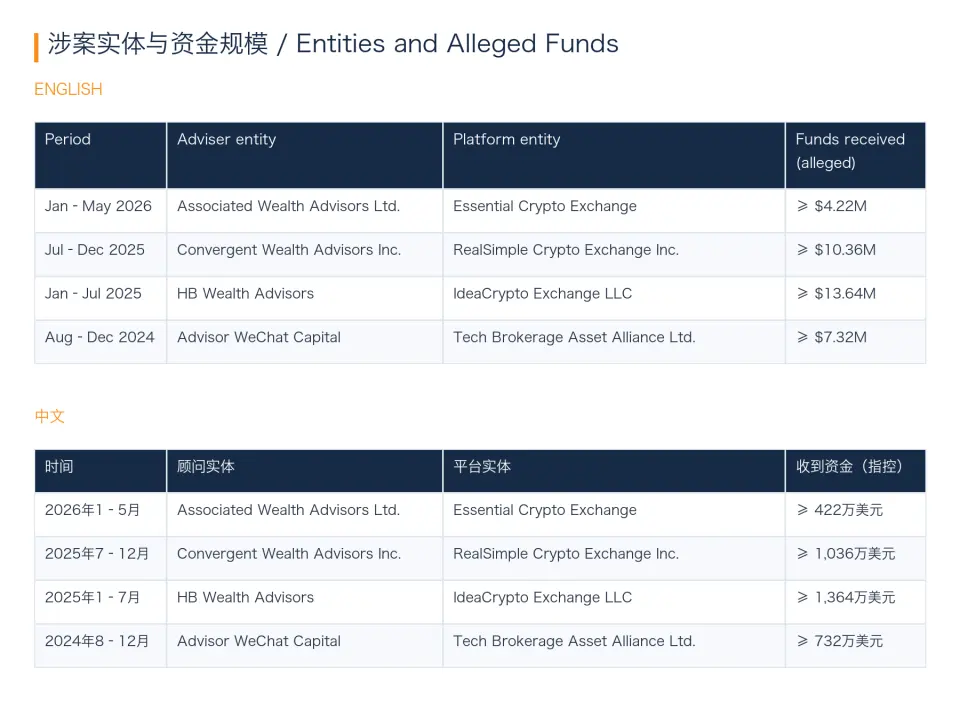
On November 19, 2026, the U.S. Securities and Exchange Commission (SEC) filed suit in the U.S. District Court for the District of Colorado against eight entities registered in Colorado. The SEC alleges that, between August 2024 and May 2026, these entities defrauded more than 1,500 U.S. investors of approximately 37400 thousand. The SEC believes these entities were controlled by persons located outside the United States. No individuals were named as defendants in this case.
Modus operandi. Social media advertisements directed investors into WhatsApp groups. The purported "investment advisers" first recommended U.S. stocks to build trust, then steered investors to affiliated fraudulent platforms to participate in "exclusive" crypto asset offerings. The perpetrators operated four successive "adviser + platform" pairings, each lasting several months. When investors sought to withdraw funds, they were required to pay "fees" first.
Abuse of U.S. registrations and filings. These entities were indeed registered in Colorado, filed Form D and Form ADV with the SEC, and registered with the U.S. Department of the Treasury's Financial Crimes Enforcement Network (FinCEN) as money services businesses (MSBs). These filings did exist, but their contents were false. The perpetrators presented them to investors together with forged "SEC certificates," claiming they had obtained regulatory approval.
Flow of funds. Investors purchased crypto assets on legitimate U.S. exchanges, transferred them to self-custody wallets, and then transferred them to addresses controlled by the advisers. The funds were moved across chains and ultimately pooled on the Tron network. A further approximately 1900 thousand was paid in fiat currency.
Claims and relief sought. The SEC requests that the court issue a permanent injunction, order disgorgement of ill-gotten gains plus prejudgment interest, impose civil penalties, enter industry bars, and prohibit the relevant entities from filing as exempt reporting advisers. The SEC has demanded a jury trial. The complaint does not mention any asset freeze.
Cross-border cooperation. The SEC thanked the Securities and Futures Commission of Hong Kong, the Monetary Authority of Singapore, the China Securities Regulatory Commission, the Swiss Financial Market Supervisory Authority (FINMA), and other authorities for their assistance.
II. Potential Consequences for Related Parties
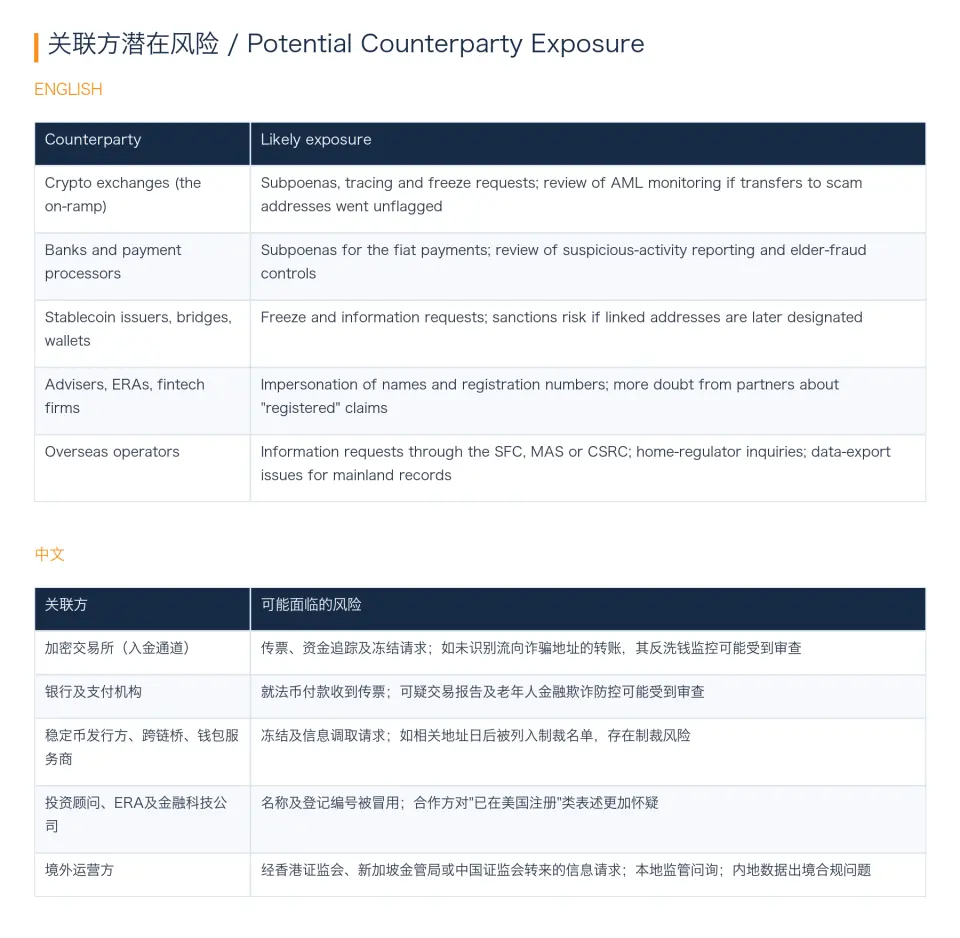
This case did not sue any third-party institution. However, institutions through which the fraudulent funds flowed may receive regulatory inquiries, and their internal controls may also face stricter scrutiny.
Can the victims sue related parties? This would be relatively difficult. According to the judgment of the U.S. Supreme Court (Central Bank of Denver, 1994), there is no private right of action for aiding and abetting under Rule 10b-5. Victims may attempt to sue banks or exchanges under state law on grounds such as negligence or aiding and abetting fraud, but such litigation generally requires proof that the defendant had actual knowledge and provided substantial assistance. More realistic pressure comes from regulators' questions as to why warning signs were not identified.
The SEC itself may pursue liability against aiders and abettors. Under Section 20(e) of the Securities Exchange Act and Section 209(f) of the Investment Advisers Act, the SEC may sue any person who knowingly or recklessly provides substantial assistance to fraud. For institutions acting in good faith, this scenario is unlikely to arise, but this also shows that records of how warning signs were handled should be retained.
III. Compliance Recommendations for Each Party
Crypto exchanges and wallet service providers. Watch for the following patterns: a new customer (often elderly) makes a first large purchase of crypto, transfers it to a newly created self-custody wallet, and then sends it to the same address. Set risk warnings and a brief holding period for first large withdrawals. Compare addresses against published enforcement and sanctions lists, promptly submit suspicious activity reports (SARs), and establish workflows for responding to freeze and subpoena requests.
Banks and payment institutions. Verify corporate clients' registration information directly with regulators: the SEC Investment Adviser Public Disclosure (IAPD) system, EDGAR, the FinCEN money services business search, and state corporate registration systems; do not rely on certificates provided by the client itself. Warning signs include: dormant shell companies that have changed their names, "Delinquent" status, and unverifiable registered agents or addresses. Flag conduct involving early withdrawal of pension funds or borrowing followed by transfers to crypto exchanges.
Stablecoin issuers and Web3 infrastructure. Test the ability to freeze tokens in accordance with the law and set response time limits. Develop a written sanctions-address screening policy.
Investment advisers, ERAs and fintech companies. Never describe Form D, Form ADV or MSB registration as a "license" or "SEC approval." File as an exempt reporting adviser (ERA) only where the eligibility conditions are genuinely met; providing paid investment advice to retail clients does not meet those conditions. Ensure that filing information is accurate and monitor for anyone misusing the firm's name.
Offshore operators. Map all points of connection to the United States (entities, users, advertising, banks); each one may subject you to SEC jurisdiction. Conduct know-your-business (KYB) due diligence on U.S. shell companies you deal with. Develop a response plan for requests forwarded through local regulators, including compliance with mainland China's cross-border data transfer rules.
Investors. Verify advisers or platforms only on regulators' official websites, and never use links sent by promoters. If you are asked to pay a fee before withdrawal, stop immediately. If you have already suffered losses, preserve records and report to the SEC, the FBI IC3 or local police as soon as possible.
Sources
SEC Press Release 2026-115, Nov. 19, 2026
SEC complaint, D. Colo.
This article provides general information for reference only. It does not constitute legal advice and does not create an attorney-client relationship. All facts stated herein are allegations in the SEC complaint and have not been determined by a court.