

Entrepreneurship in Web3, Open Discussions Every Wednesday!
Special Disclaimer:
This article is an original work by Mankun Law Firm. It represents only the personal views of the author and does not constitute legal consultation or legal advice on specific matters. For reprint permissions, please contact Mankun Law Firm staff at: MankunLawFirm
Introduction
Entrepreneurship in Web3, Open Discussions Every Wednesday!
"Entrepreneurship in Web3.0" is an interview program for Chinese Web3.0 entrepreneurs initiated by Mankun Law Firm. Every Wednesday evening, we invite industry leaders, frontline institutions, and renowned entrepreneurs to share their insights. We aim to support the compliant development of China's Web3.0 industry through positive discourse, rational discussion, and experience sharing.
In this episode, we have invited Yan Zifan (Roman Yan), Co-founder and CMO of Qiyihuo Technology Co., Ltd., to share insights on topics such as the application scenarios of "Rarefy," Rarefy's selection criteria for Profile Picture (PFP) projects, and his understanding of NFTs from the ground up.
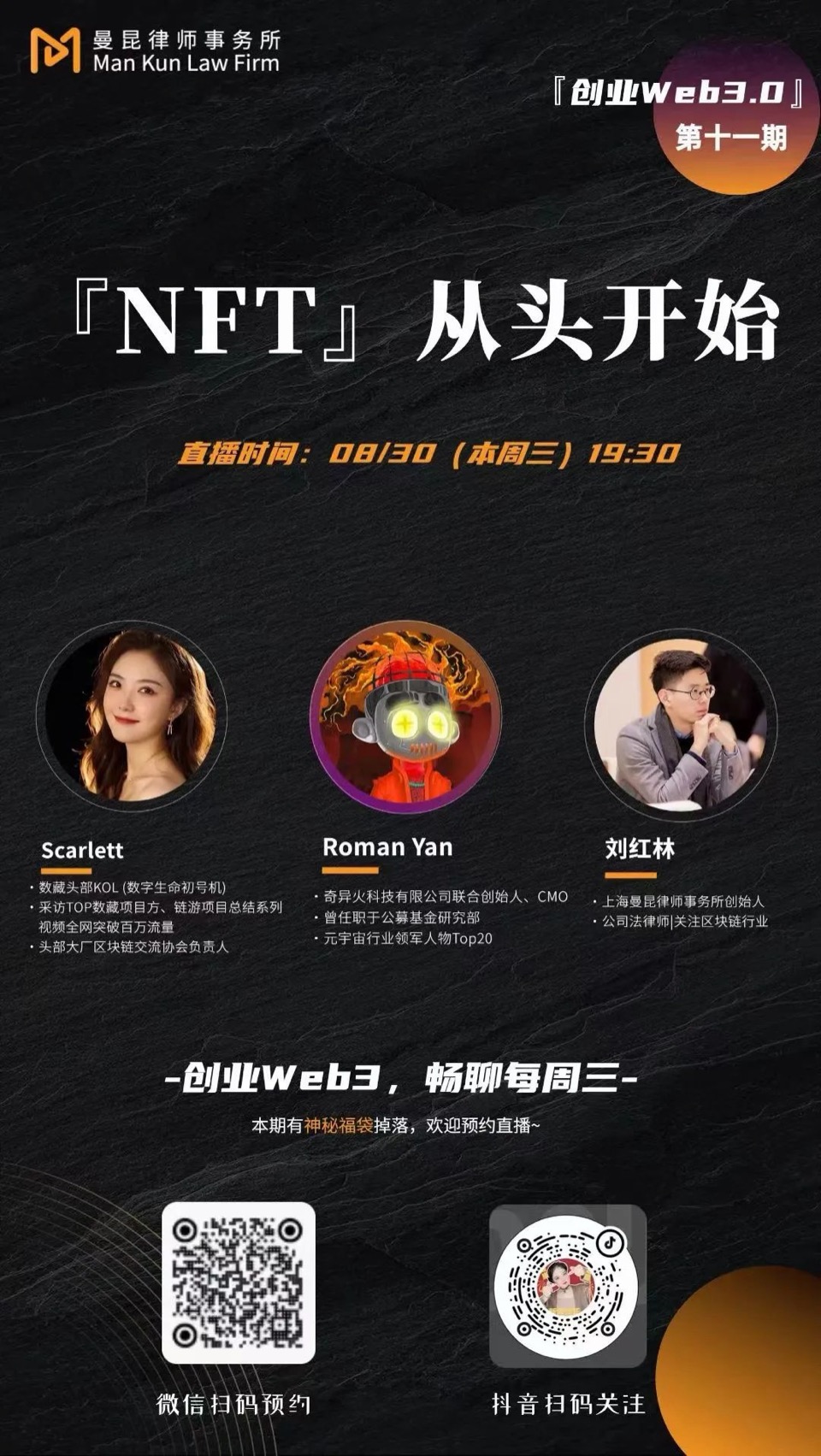
Welcome our guestRoman Yan, please introduce yourself to everyone!
Hello everyone, I am Roman. Most people probably know me through Rarefy and Rarety. However, I initially worked in the secondary market and transitioned into the Web3.0 sector from the financial industry. My previous financial background laid the foundation for my current industry analysis and judgment. Around 2015 and 2016, due to fluctuations in the domestic stock market, I shifted from the secondary market to the primary market, such as private equity funds. During this process, I gradually observed blockchain technology, and more specifically, the cryptocurrency market. In 2017, I became involved in related projects. Starting from 2018, based on my assessment of the overall market, I analyzed the origins and evolution of the technology and its integration with applications. I also collaborated with certain government departments and enterprises in China to implement various projects.
The blockchain projects I initially engaged with were primarily B2B. The emergence of NFTs brought more consumer-facing (C-end) participants into this field, which was the original intention behind my creation of Rarefy. At that time, there were no platforms in China capable of supporting our NFT operations, so we decided to build one ourselves. Rarefy (Crypto Space) was registered in 2021 and officially launched in March of that year, making it one of the earliest NFT platforms in China. It has been operating for over two years. During the operation of Rarefy, we received numerous collaboration invitations from brands. Seizing this opportunity, we launched Rarety in early 2022, an NFT-as-a-Service (NFTaaS) product specifically designed for enterprise brands. We are proud to have developed Rarety as a B2B SaaS-level product, serving nearly a thousand scenarios in physical retail and branding. Well-known global brands such as Red Star Macalline, Nubia, BYD, 36Kr, and Noah Wealth Management are among our clients. We have assisted them in integrating brand marketing, Web3 operational concepts, and C-to-M (Consumer-to-Manufacturer, i.e., personalized customization) supply chains. This summarizes my personal background and the process of establishing Rarefy and Rarety.
Q1: How did the theme "NFTStarting from Scratch" for this live session come about?
The Web3.0 sector is characterized by distinct phases and significant disruptive potential, with a very rapid pace of development. Both overseas and domestically, new topics, events, publications, and research reports emerge almost every week. Therefore, I believe that in the field of Web3.0, every day is a new beginning. Similarly, for Rarefy and Rarety, we are still in the initial startup phase.
Q2: Is it easy to transition from traditional industries to Web3.0?
Transitioning to Web3.0 is not overly complex; strong learning capabilities are sufficient. Unlike traditional industries, which require years of accumulated experience to understand market conditions and the upstream and downstream dynamics, the Web3.0 sector is still in its growth stage. Consequently, it places a greater emphasis on exploratory and innovative abilities. By understanding the fundamental principles of Web3.0 and combining them with personal experience and background, one can develop a unique methodology, create a product, and obtain market feedback to identify a suitable niche. Furthermore, for users in the real economy or entrepreneurs, when the internet and Web3.0 become commonplace and unavoidable aspects of daily life, embracing the internet and entering the Web3.0 field will no longer be a difficult task.
Q3: Could you share some successful cases involving Rarefy and Rarety?
Certainly. We have served leading enterprises such as BYD and Red Star Macalline, as well as many well-known traditional physical brands like Adidas and Niu Technologies. These enterprises or brands sought to utilize Rarety for brand marketing, starting with brand promotion to attract more consumers into the ecosystem.
In line with today's theme, "NFTs, Starting from Scratch," let us discuss why startup brands should collaborate with Rarety. Beyond brand marketing, we assist brands in precisely identifying their target users, enhancing interaction between the brand and its users, and increasing repurchase rates, thereby improving user loyalty. This provides these brands with strategies to more smoothly embrace Web3.0.
Regarding specific cases, I will share one domestic example and one international example.
First, the international case involves a client in the e-cigarette industry. Due to certain policy restrictions, the client could not continue operations in their home country and thus expanded into the Middle Eastern market. They issued 5,000 unique scents, each of which could be named by its holder. Holders of a specific scent were entitled to a proportional share of all sales revenue generated from that scent. The primary users were key opinion leaders (KOLs) or influencers on TikTok, who promoted the sales rights or agency rights for the scents they held during their live streams. This created a brand binding relationship different from traditional models and achieved diversification of revenue streams.
The domestic case involves a perfume brand. The concept is similar to the e-cigarette example above: the scents of the perfumes were tokenized as unique digital assets in the form of NFTs. After rights confirmation, users owned the digital rights to their specific scents. In this model, users effectively became partners or primary distributors of the brand, earning revenue shares through subsequent sales.
These are the examples I wished to share regarding how brands can integrate with Web3.0. In summary, brands can use Rarety to combine physical products with NFTs, providing a novel mode of direct interaction between the brand and its users. Our role is to facilitate the integration of brands with Web3.0 and develop products, provided that the brand has clearly identified its users' pain points.
Q4: From a commercial perspective, what is the basis for Rarefy and Rarety's pricing? On the client delivery side, how much effort do Rarefy and Rarety require for maintenance?
At the supply chain level, there is currently no software that can directly provide customized services. Technically, we integrate AIGC (Artificial Intelligence Generated Content) methods. After a customer places an order, production is initiated at the factory based on sales demand (make-to-order). Consequently, our average transaction value is relatively high. However, for such customized products, returns or exchanges are not accepted except in cases of quality issues.
From a marketing perspective, our model may resemble that of a marketing planning or advertising agency. However, we actually control the business model and supply chain, while outsourcing other parts to sales teams. We stimulate consumer desire through incentives such as coupons and priority customization, and we also organize offline events to engage with users.
Q5: Did you encounter any particularly difficult moments when helping traditional brands break into new markets? How did you guide these brands to embrace Web3.0?
In the early stages, many collaborators adopted the model of issuing NFTs based on signed intellectual property (IP). During this process, many IP holders were not concerned with the underlying logic and principles. Most did not care about what Web3.0 or NFTs were. During this period, as the party providing traffic, we helped collaborators achieve profitability, so rejections were rare.
However, when the collaborator is a brand, difficulties may arise as the brand needs to consider whether the initiative will impact its overall image. For instance, we once served an automotive brand. The owner of this brand was elderly, and after discussing for approximately two hours, he still did not understand what NFTs or Web3.0 were. In this situation, we leveraged the celebrity effect: we cited Tesla, another automotive brand, stating that Tesla had already entered the Web3.0 field and begun engaging with NFTs. This approach guided the automotive brand owner, who ultimately decided to collaborate with us. The cooperation was very pleasant, and we assisted them in achieving stock price growth.
Another challenging type of collaborator consists of those who have some understanding of Web3.0 and NFTs but have heard more negative news about the field, leading to resistance. In such cases, we can stimulate cooperation from a marketing perspective. For example, during negotiations with Chenguang Milk, we proposed a marketing strategy: users could scan a code to receive digital collectibles after purchasing new products, and upon collecting a full series of memorabilia, they could redeem a bottle of milk. This stimulated consumer desire. This is how we approached the collaboration from a marketing angle, establishing basic cooperation with the brand before discussing subsequent rights or operations.
Q6: What are the future development directions for Rarefy and Rarety?
Rarefy remains firmly committed to operating as a compliant trading platform in China. Issuances will be conducted in the form of PFPs or native digital IPs, with corresponding copyright registrations. All projects are managed by the issuers; Rarefy itself does not act as an issuer. Additionally, there may be new gameplay mechanics similar to GameFi.
Rarety serves domestic enterprises and can also provide SaaS systems for C-end users who are small and micro-enterprises. Its primary focus is on providing customized services, integrating with physical supply chains, and offering marketing-related services for physical enterprises.
Additionally, we operate our own underlying blockchain, the Qiyi Chain. On this chain, every user of Rarefy or Rarety shares user and contract addresses with us. This is a new attempt we have made to build a Web3.0 ecosystem.
Q7: What is the plan for Rarefy's overseas expansion?
Currently, our "Crypto Salted Fish" project under Rarefy has plans for overseas expansion. This is our first PFP project and the first PFP project in China—"Crypto Salted Fish" has embarked on its global journey. It utilizes the latest and most cutting-edge Ordinals recursive inscription technology, minting 95 Crypto Salted Fish elements onto the Bitcoin blockchain. It adopts a new Minting mechanic with customizable elements, allowing users to choose different elements to combine and generate their favorite "BitcoinFish." This is a first-of-its-kind initiative in China. Everyone is welcome to follow announcements on the Rarefy platform, our official WeChat account, and the Crypto Salted Fish project community. Additionally, please pay attention to Rarefy's overseas section. Recently, a project was acquired by an overseas strategic partner and will be presented on NFTCC. Furthermore, we will launch an interesting fan-based application in the Southeast Asian market. Please stay tuned for more information.
Q8: For PFP projects,NFThow can effective price discovery be achieved? How can liquidity issues be resolved?
My personal view is that PFP projects rely heavily on community consensus. To achieve value growth or enhance community activity, it is necessary to establish a closed-loop economic model or a positive growth flywheel. However, many current PFP projects have not achieved this. Our response strategies mainly include four approaches:
First, taking Crypto Salted Fish as an example, we develop mini-games to generate advertising revenue, which is distributed to the DAO community for collective management. Additionally, we sell co-branded derivative products to boost activity, thereby achieving a closed loop. Our current overseas expansion efforts are also aimed at realizing this closed loop and a positive growth flywheel.
Second, take the "Er Gou" project as an example. Its community organization is very strong. Players can collaborate with other communities and participate in new launch events for other projects. In such cases, conversion rates are very high, and user activity levels are also relatively high.
Third is integration with the real economy, where players receive certain physical utilities or benefits.
Fourth is the gaming model, where a series of activities are implemented during game development to stimulate user activity.
Q9: What are the different preferences between domestic and overseas players in PFP projects?
First, in terms of user sentiment and preferences, compared to overseas markets, the volume of domestic users willing to pay for high artistic value is not large.
Second, there are significant differences from a project perspective. Overseas markets currently have professional operational institutions that batch-issue and operate high-quality projects using established methodologies. This results in a larger base of high-quality fans and better user sentiment. In contrast, the domestic market is still in an experimental phase, lacking professional teams and operational models. Projects are typically handled by individual issuers, leading to fluctuations in the market and user sentiment.
Q10: From an entrepreneurial perspective, as pioneers in the Web3.0 sector, could you share some practical experiences?
Certainly. First, it is essential to clarify one's capabilities and identify the most suitable niche sector through market assessment.
Second, the Web3.0 field is highly innovative and develops rapidly. Therefore, it is crucial to maintain a sense of hunger, sustain the motivation to learn new things, and learn to view matters from multiple perspectives. These are important characteristics that I believe Web3.0 entrepreneurs should possess.
Author Biography:
Yan Zifan (Roman Yan)
Co-founder and CMO of Qiyihuo Technology Co., Ltd.
Article Editor: Zhuang Siting
Paralegal at Mankun Law Firm. Currently pursuing graduate studies at the International Law School of East China University of Political Science and Law. Research areas include compliance of blockchain digital assets, cybercrime, and other emerging legal services.