An upstream large-scale card dealer came under police investigation for using overseas gift cards to engage in illegal foreign-exchange transactions. Following chat records, bank card transaction records, and card code transaction records, the police quickly identified the downstream merchant that had long purchased cards from it.
This downstream merchant may indeed have done several million yuan of business with the upstream party, and may indeed have known that the other party had long held large quantities of overseas gift cards such as Apple and Amazon cards. Yet its own business appears simple: it buys cards in RMB and sells cards in RMB, and most of its customers are domestic game players, overseas students, or other genuine consumers.
At this point, a very practical question arises:
Since the upstream party has already been found to be engaged in illegal foreign-exchange transactions, will the downstream party that long purchased cards from it also be counted as part of the same criminal chain?
The answer cannot simply turn on whether the parties are upstream and downstream. Article 25 of the Criminal Law provides that a joint crime is a crime committed jointly by two or more persons with common intent. In other words, in determining criminal liability, a business cooperation relationship, fund flows, or even a long-term supply relationship cannot by themselves substitute for proof of the common criminal intent and the specific acts of participation.
Conversely, "I did purchase genuine gift cards" and "the upstream party and I were merely doing business normally" are not a natural firewall against criminal liability either.
What truly needs to be determined is two questions: how much did this downstream party know, and, after knowing this information, what exactly did it do?
First, separate two questions: what is this business, and has this person committed a crime
In a case publicly disclosed by the procuratorial authorities in Henan in 2025, the team concerned acquired US-dollar-denominated gift cards through overseas channels, completed overseas payments in naira, and then sold the gift cards to domestic buyers for RMB, forming a cross-currency value conversion and continuous operating system. The second-instance judgment upheld the original judgment, and the 20 defendants were each sentenced to corresponding penalties for the crime of illegal business operations.
But here one must go one step further. Finding that the entire business constitutes illegal foreign-exchange transactions resolves the question:
"What is the nature of this business?"
Determining whether a particular downstream card dealer constitutes joint crime resolves a different question:
“What exactly did this person do in this business?”
The two cannot substitute for each other.
For example, Company A as a whole may have formed an illegal foreign-exchange model of receiving foreign currency offshore, paying RMB onshore, and using gift cards to balance funds at both ends, but the fact that B merely purchased gift cards from A does not mean that all of A's criminal conduct, the entire illegal business amount, and all of A's subjective knowledge are automatically transferred to B.
The same logic applies to personnel within a company. The 2019 judicial interpretation of the Supreme People's Court and the Supreme People's Procuratorate on underground banks makes clear that when a unit carries out illegal buying and selling of foreign exchange or similar acts, a fine is imposed on the unit, and the directly responsible persons in charge and other directly responsible personnel are convicted and punished, rather than liability being uniformly imposed simply because they "belong to this company." Therefore, in gift card-related cases, an important order of judgment should first be established:
Characterizing the project addresses "what kind of business this is," while individual liability addresses "what this person did."
These are two questions at different levels.
What is truly difficult is often not "whether there was a transaction," but how to determine whether the downstream party actually knew.
In many cases, the most common explanations given by downstream card dealers are:
"I don't know how the upstream obtained the cards."
"He sells cards, I buy cards, that's all."
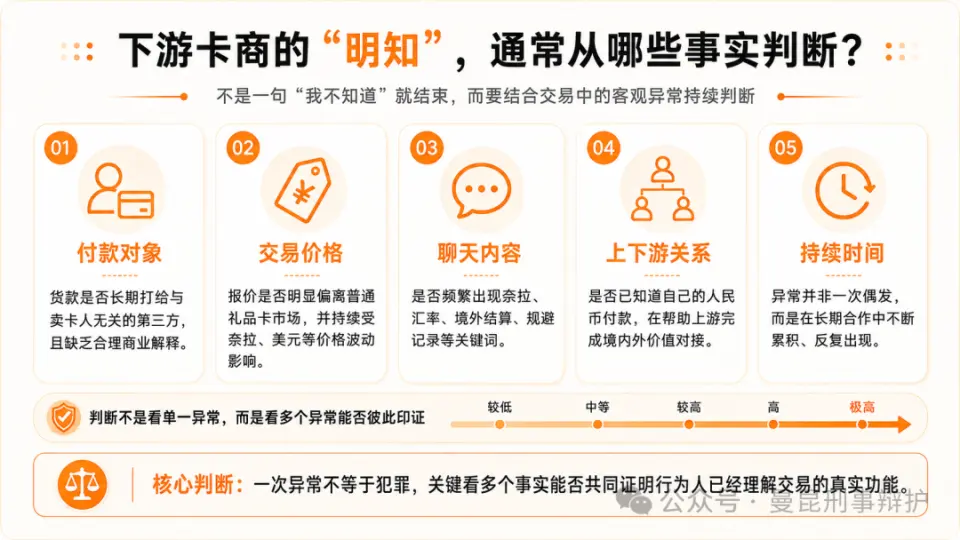
This is of course one possibility. But subjective knowledge in criminal cases is rarely proven solely by a party's single statement of "I knew" or "I didn't know"; it usually requires judgment in light of the objective facts throughout the entire transaction process.
At the beginning, the downstream party may simply have bought cards at normal market prices, with payment made directly to the card seller. But as the cooperation continued, the upstream party began frequently requesting: "Don't send this money to me; send it to another card." Subsequently, there were more and more receiving accounts, and the payer and the actual card seller were inconsistent for a long period; information such as naira, US dollars, exchange rates, and offshore settlement began to appear in chats; gift card quotes clearly changed with the prices of different currencies; and the downstream party even gradually learned that a payment of RMB it made onshore corresponded to a payment of naira at the other end offshore.
Once these facts continue to accumulate, what the judicial authorities must truly determine is no longer:
"Did the upstream party formally tell us that we were operating an underground bank?"
but rather:
given that the downstream party had continuous exposure to this information, what understanding did it actually have of the true function of the entire transaction.
In the Zhengzhou gift card case disclosed by the procuratorial authorities in Henan, the case-handling authorities analyzed the conduct and subjective understanding of the relevant persons by combining chat records, fund flow records, internal division of business, and other materials; among these, there were even chat contents discussing the evasion of traces related to Naira transactions.
However, another extreme must likewise be avoided here. Third-party payment, frequent changes of accounts, abnormal prices, or the use of overseas chat software—none of these facts, standing alone, can directly establish the existence of joint crime.
Entrusted payments, payments made on behalf of a party by related parties, and other complex settlement arrangements may also arise in normal commercial transactions.What truly has probative significance is whether multiple abnormal factors can corroborate one another and ultimately point to the same illegal foreign exchange business.
The existence of genuine gift card transactions does not automatically exclude accomplice liability
There is another very common defense in gift card cases:
"Every one of our transactions involved real cards; it was not circular trading, nor were the transactions fictitious."
Genuine transactions are of course important. If a downstream merchant pays for goods in RMB, the upstream party genuinely delivers Apple Gift Cards, and the downstream party then sells the cards to consumers who genuinely need top-ups, these facts can all help to reconstruct the nature of the transaction.
The issue, however, is that genuine commodity transactions and assisting with illegal foreign-exchange conversion are not absolutely mutually exclusive concepts. In its 2019 answers to reporters' questions concerning the judicial interpretation on underground banks, the Supreme People's Court expressly stated that disguised trading in foreign exchange does not require a direct purchase and sale between RMB and foreign exchange; a conversion of monetary value between RMB and foreign exchange achieved through means such as domestic and overseas "matched transactions" (duiqiao) and cross-border settlement may likewise constitute illegal trading in foreign exchange.
This means that a genuine commodity can perfectly well be embedded in a funds-conversion system. For example, the upstream party needs to convert the value represented by overseas naira into domestic RMB, and therefore uses gift cards to accomplish the intermediate transfer of value; the downstream card dealers are responsible for continuously absorbing these gift cards and, in accordance with the upstream party's instructions, paying RMB to designated accounts.
The gift cards are genuine, and the RMB was genuinely paid. What truly requires further determination is whether the downstream party knew that this "card purchase" transaction simultaneously performed the function of completing, on behalf of the upstream party, the allocation of domestic RMB funds.
If it did not know, and there is no other evidence sufficient to prove a common intent, then it cannot be directly found to constitute an accomplice merely because it objectively occupied some link in the criminal industrial chain.
If it already knew the entire scheme yet still, over a long period, made payments in accordance with the upstream party's instructions, absorbed gift cards, or even helped arrange the funds path, then a "genuine card purchase" cannot automatically sever criminal liability.
Therefore, judicial determination cannot go to either extreme: it is neither the case that "where there is a genuine commodity, it is necessarily safe," nor that "where the upstream party is guilty, the downstream party that purchased goods is necessarily guilty."
If one buys a studio from a criminal suspect, does one also "buy" the past crimes along with it?
Let us consider another, more particular scenario.
Li Si operated a gift card studio and had previously engaged in illegal foreign-exchange settlement by using naira payment on behalf, overseas gift cards and domestic RMB accounts. Later, Li Si exited the business and transferred the studio, computers, office equipment and some customer resources to Zhang San. After taking over, Zhang San no longer conducted the original naira business and only purchased gift cards from domestic card dealers and then sold them to domestic customers. Several months later, Li Si's earlier case was investigated by the public security authorities, and Zhang San also came within the scope of the investigation because he had used the same office premises, some of the equipment and even the business accounts.
At this point, the most important thing is not the statement: "This was done by the former boss and has nothing to do with me." The truly effective method of determination is to divide the timeline.
The date until which Li Si actually operated, and the date from which Zhang San began to control the studio; when the bank cards and payment accounts changed controllers; who used the original business groups and overseas accounts; when the naira payment-on-behalf model ceased; whether the original third-party RMB collection methods continued; and precisely which businesses Zhang San continued and which he terminated after taking over. The Criminal Law requires a common intent for joint crime; therefore, the mere fact that a person later purchased a studio, company or equipment that had previously been used for crime does not, by reason of the continuity of the assets and the operating entity, automatically make that person an accomplice to the earlier crime. (Gazette website)
In other words:
Purchasing a studio does not equate to purchasing the criminal liability of the previous operator.
But on the other hand, it must also be recognized that if Zhang San knew the studio had originally been used for illegal foreign exchange, and after taking over inherited unchanged the overseas card sources, Naira accounts, domestic RMB fund pool and fixed settlement model, or even merely changed the operator's name from Li Si to Zhang San, then a mere "change of boss" would not by itself sever the continuity of the criminal conduct.
Therefore, what truly needs to be distinguished in such cases is: was it the office assets that were taken over, or was the original criminal model also taken over along with them. This often needs to be reconstructed through account control records, chat records, business reports, employee testimony, and the fund structure before and after the takeover.
When the same company runs into trouble, the liability of finance staff, sales staff and ordinary employees will not be entirely the same
Gift card underground banking cases generally exhibit fairly pronounced team-based characteristics.
Some people are responsible for contacting overseas cardholders, some for setting Naira quotes, some for managing domestic RMB accounts, while others merely sell gift cards or handle ordinary e-commerce business. Even if the company's overall business is ultimately found to constitute illegal business operations, all employees cannot for that reason be placed at the same level of liability.
The 2019 judicial interpretation of the Supreme People's Court and the Supreme People's Procuratorate also uses the expressions "directly responsible managers" and "other directly responsible personnel" in the context of unit crimes, indicating that criminal liability still needs to be tied to the duties and actual conduct of specific individuals.
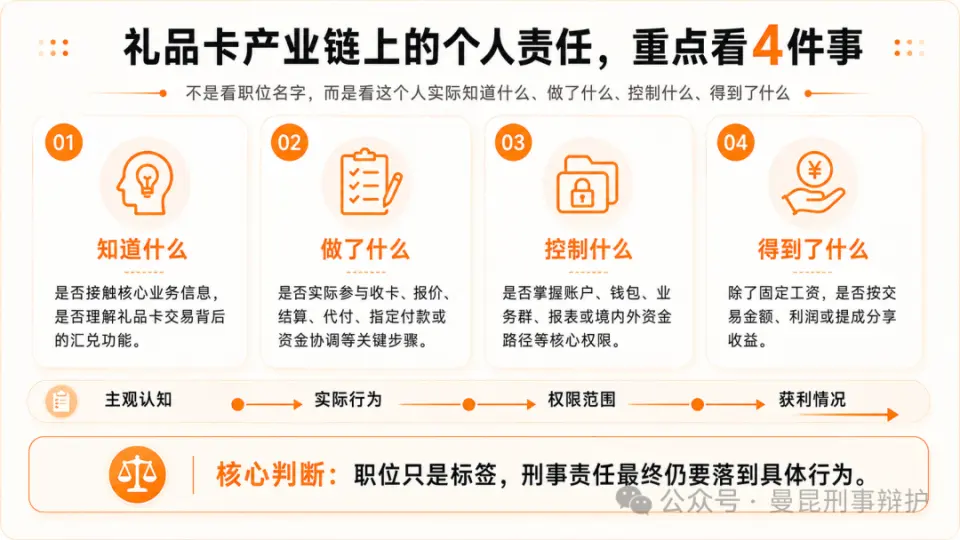
As for specific employees, further verification is needed of their date of joining, actual position, information to which they had access, account and fund authority, whether they participated in quoting and overseas settlement, whether they knew the company's profit model, and whether they received additional commissions based on transaction amounts beyond their salary.
A person directly responsible for overseas Naira payments and RMB fund arrangements, and an employee merely responsible for uploading product images and processing ordinary orders, may obviously have completely different degrees of awareness of the true nature of the entire business.
Therefore, "the company is involved in a case" is only the starting point of an individual liability investigation, not the end point of criminal liability for all employees.
Lawyer's Observations
A very common misjudgment in overseas gift card cases is to understand the "industrial chain" as a "chain of liability".
Upstream parties handle overseas card collection, midstream parties handle fund settlement, and downstream parties handle card sales. Commercially, the business can indeed continue to extend along the supply chain; however, criminal liability does not automatically pass from one entity to another merely because of such upstream-downstream relationships.
The genuinely reasonable order of assessment should be: first determine what the upstream party is actually doing, then determine how much the downstream party knows, and finally determine what the downstream party specifically did on the basis of that knowledge.
For an ordinary downstream card dealer, merely obtaining goods on a long-term basis from an upstream party later identified as an underground bank is insufficient to substitute for proof of joint criminal intent; however, if during the course of transactions there have persistently been obvious indicators such as third-party receipt of payments, abnormal pricing, overseas settlement, or cross-book transfers of funds, and the downstream party nevertheless actively participates, cooperates, or even assists in designing fund paths, then its liability assessment will not automatically end merely because "the parties had genuine gift card transactions."
Likewise, for a person who later takes over the studio or an ordinary employee of the company, individual liability cannot be determined solely by saying "the former boss committed a crime" or "the company committed a crime."
Ultimately, it is still necessary to return to the most basic questions in a criminal case: what exactly did this person know, at which step did he specifically participate, and what connection exists between those acts and the alleged illegal foreign exchange.Gift cards may circulate along the supply chain, but criminal liability cannot automatically pass along the supply chain.An upstream finding of illegal foreign exchange only means that the downstream party may need to accept further investigation; it cannot substitute for proof of the downstream party's joint intent and specific acts of participation.