

The cessation of operations by a cryptocurrency exchange may, on its face, appear to be merely an issue of “how users can withdraw their crypto assets,”but for a platform that has long provided spot trading,perpetual contracts, wealth management products, staking, and referral commission services,shutdowns typically give rise to two additional lines of risk:one pointing to employees who continue to work remotely from within the People’s Republic of China (PRC), and the other to key opinion leaders (KOLs) and agents who have long engaged in user acquisition, trade-copying services, and the promotion of contract trading for the platform.
Accordingly,BitMartthe issues arising from a cessation of operations cannot be understood solely from the perspective of “whether the crypto assets in accounts can still be withdrawn.”For users, it is necessary to manage open positions, redeem products, preserve records of fixed assets, and assess avenues for rights protection; for PRC-based employees, it is necessary to promptly clarify which business activities they participated in, what access permissions they held, and whether any anomalies have already been identified; for KOLs and agents, it is necessary to re-examine whether their promotional content, commission structures, and user-acquisition methods may have become deeply intertwined with the platform’s high-risk businesses.
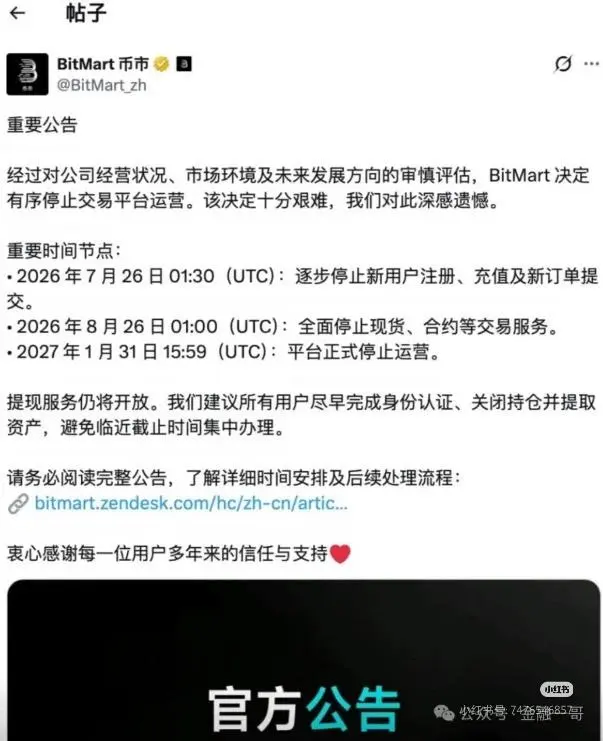
On July 26, 2026, BitMart issued an announcement stating that, after a comprehensive assessment of the company’s operational status, market conditions, and future development direction, it had decided to orderly cease operations of its trading platform. According to the announcement, starting from July 26, the platform would sequentially suspend new user registrations, deposits of digital assets and fiat currencies, and the acceptance of new spot orders and the opening of new contract positions; spot trading, contract trading, and other trading services were scheduled to cease on August 26, and the trading platform was scheduled to formally cease operations on January 31, 2027.
In the shutdown of the same exchange, the issues faced by the three categories of persons are not the same
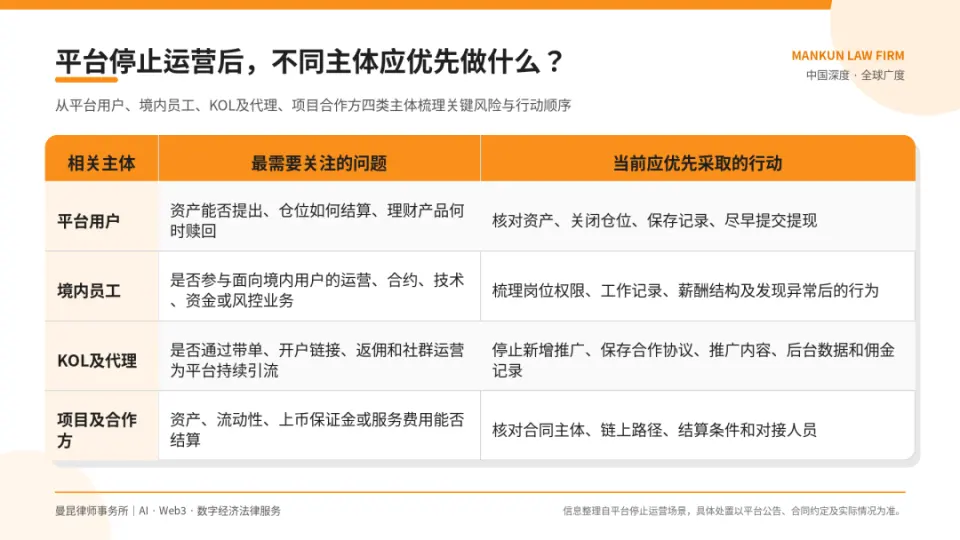
The legal positions of these three categories of subjects are not the same. Users are typically the party most directly bearing property losses following a platform shutdown; employees and KOLs may, due to their participation in platform operations, user acquisition, or the promotion of contract trading, be subject to further scrutiny as to whether they provided substantial assistance to the relevant businesses.
However, neither employees nor KOLs can be held liable solely based on an identity label.What truly requires examination remains their specific level of participation, subjective knowledge, method of deriving benefits, and ability to control the platform’s core business operations.
Users should not look only at “total assets”; different products must be exited separately.
According to BitMart’s announcement, the platform has ceased or plans to cease spot trading, futures trading, copy trading, grid trading, and other automated trading functions. Products such as Earn, staking, lending, and Launchpad will be discontinued in batches depending on the actual circumstances of each product, with redemption and settlement arrangements explained through special announcements or on-site notifications.
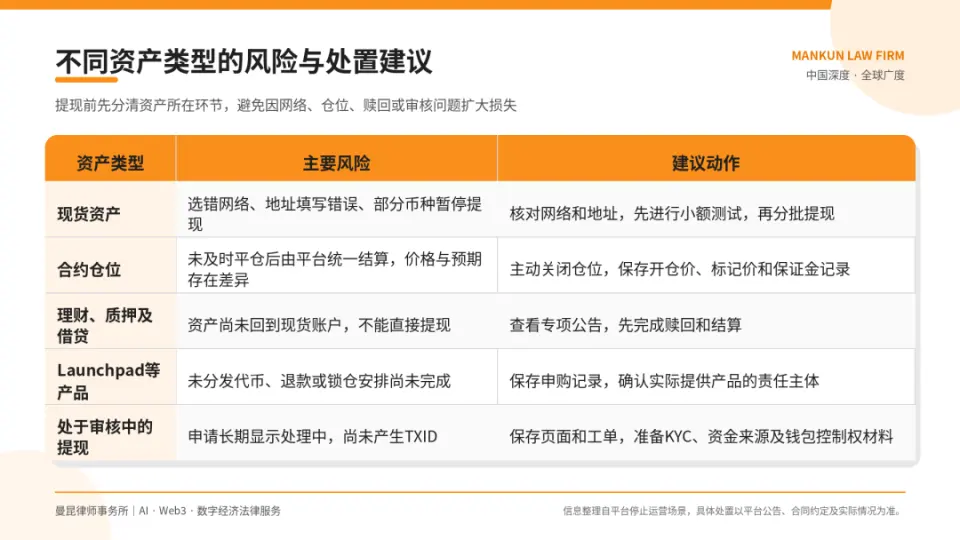
The platform has explicitly stated thatsubmitting a withdrawal request does not constitute completion of review, nor does it mean that the assets have been sent to the blockchain.Some requests may be subject to review of account identity, login device, IP address, withdrawal address, source of funds, transaction records, Travel Rule compliance, and sanctions lists; where necessary, additional proof of the source of funds or proof of wallet control may also be required.
Therefore, when users see that the withdrawal status has long displayed “Processing,” they should first confirm whether a TXID has been generated. The absence of a TXID usually means that the assets are still under internal review or processing by the platform; if a TXID has been generated, the on-chain status should be verified on the corresponding blockchain explorer.
If there is no progress in withdrawals, should one pursue cross-border rights protection or file a report with domestic authorities?
After an exchange ceases operations, the most common legal question for users is: customer service has not provided a clear response, so by what means can the assets in the account still be recovered?
There are typically three courses of action.
The first is to continue negotiations through the platform’s official channels.Where users are still able to log in to their accounts, submit support tickets, and the platform continues to process withdrawal requests, they should first compile in writing the account UID, token type, amount, network, withdrawal address, application reference number, and submission time, and formally request the platform to explain the reasons for its review and specify the required documentation.
Where there are trusted partners, designated platform contacts, or key opinion leaders (KOLs), having an intermediary assist in confirming the status of the review and any requirements for supplementary materials may be more efficient than immediately initiating costly cross-border procedures. However, all such communications must be fully documented, and no so-called "expediting fees" or "unfreezing fees" may be paid to personal wallets. BitMart has expressly stated that there are no paid channels for queue-jumping or priority withdrawals, and its staff will not solicit private keys or seed phrases.
The second approach is to consider initiating overseas litigation or arbitration based on the user agreement and the identity of the account-holding entity.This approach requires first confirming which company the user actually contracted with, the applicable law, the forum for dispute resolution, and whether any resulting judgment or award can be enforced in the jurisdiction where the assets are located. Merely knowing the platform’s name is insufficient to identify the correct defendant or arbitration respondent.
The third approach is to file a report with public security organs within the People’s Republic of China.However,the cessation of an exchange’s operations, delays in withdrawals, or price declines do not, by themselves, necessarily constitute fraud or other criminal offenses.Whether there is a basis for filing a criminal report depends on whether the platform engaged in abnormal conduct such as fabricating assets, maliciously transferring user funds, manipulating backend systems, continuing to absorb funds while knowing it could not honor redemptions, or situations involving loss of contact with personnel or destruction of evidence.
The 2026 Notice issued by eight governmental departments provides that civil acts by individuals investing in virtual currencies and related financial products may be deemed void if they violate public order and good morals, with resulting losses borne by the participants themselves. However, the principle that “investment risks are borne by the investor” does not mean that platforms may withhold assets already confirmed to belong to users without justification, nor does it preclude lawful investigation of indications of fraud, embezzlement, or misappropriation of property.
Accordingly, there is no absolute superiority among cross-border litigation, domestic reporting to authorities, and negotiated coordination; the appropriate course must be determined on a case-by-case basis, taking into account the location of the assets, the identity of the platform entity, the available evidence, and the causes of the user’s losses.
If the operating entity is located overseas, why do employees within the People’s Republic of China still face legal risk?
Many virtual currency exchanges establish their registration and operating entities overseas, but their technical, operational, business development, customer service, community management, or product staff may still perform work remotely from within the People’s Republic of China.
Current regulatory rules have made it clear that overseas entities and individuals are prohibited from illegally providing virtual asset-related services to domestic entities in any form. Domestic entities and individuals who, knowing or should have known that overseas entities were illegally providing such services to domestic parties, still provided assistance, may be held legally accountable in accordance with the law; if their conduct constitutes a crime, they shall be subject to criminal liability.
This does not mean that anyone who has ever worked at an exchange will necessarily bear criminal liability. Investigating authorities typically need to further examine the employee’s date of hire, job level, scope of authority associated with the position, actual job responsibilities, client base, compensation and bonus structure, and whether the employee participated in the platform’s derivatives contracts, user acquisition, fund handling, risk management, or settlement processes.
For example,Employees responsible only for routine administrative, human resources, or other non-client-facing basic tasks face markedly different risks compared to those directly involved in designing high-leverage derivatives contracts, formulating liquidation rules, operating domestic community groups, handling user funds, or managing affiliate rebates.
Based on the exchange-related cases we have handled,the ultimate allocation of liability is never determined by simply labeling someone as an “exchange employee,” but ratherrequires specific answers to the following questions:What exactly did the employee do, what did the employee know, what benefits did the employee receive, and what actions did the employee take upon discovering irregularities?
Conversely, if an employee joined the project for a relatively short period, received only a normal fixed salary, did not participate in making return promises, providing trading guidance, or handling funds, and genuinely lacked a comprehensive understanding of the project’s overall business model, and promptly ceased relevant work, raised objections, or voluntarily resigned upon discovering irregularities, these facts should be thoroughly examined in the determination of liability.
In one case we previously handled, we organized evidence focusing on the client’s date of hire, compensation structure, scope of authority associated with the position, actual scope of participation, and responses after discovering irregularities, and submitted a comprehensive defense opinion based thereon, ultimately achieving a favorable outcome of non-prosecution.
Can KOLs also become implicated if they merely share links and receive commissions?
Exchanges’ user acquisition efforts, particularly for perpetual contracts and copy-trading services, often rely heavily on KOLs, affiliates, and community managers. KOLs attract users through account-opening links, invitation codes, copy-trading communities, and trading courses, and the platform then pays them commissions based on user trading volume or fees.
During the platform’s normal operations, such revenues are typically structured as promotion fees, channel fees, or commissions.However, once the platform’s core business is determined by judicial authorities to be suspected of constituting a criminal offense, whether a key opinion leader (KOL) acted merely as an ordinary advertising partner or was deeply involved in soliciting users and organizing transactions may become a focal point of the case review.
In assessing KOL risk, it is insufficient to consider only whether the KOL held a platform account or received commissions. Instead, the review should focus on: whether the KOL prominently promoted high-leverage products and guaranteed profits; whether the KOL provided specific guidance on taking long or short positions and opening positions; whether the KOL established multi-tier agency structures and downstream commission rebates; whether the KOL assisted users with deposits, withdrawals, and account management; and whether the KOL’s income was primarily derived from user trading volumes, liquidations, or excessive transaction fees.
The 2026 regulatory notice explicitly provides that internet enterprises shall not provide commercial display, marketing and promotional, or paid traffic-referral services for virtual currency-related businesses. Domestic entities that knowingly or should have known that the relevant overseas services were unlawful yet still provided assistance may also be held legally accountable in accordance with the law.
Accordingly, following the shutdown of an exchange, KOLs should not rush to delete promotional content, close community groups, or align their statements with counterparties. Instead, they should preserve in full cooperation agreements, backend records of platform account openings, promotional materials, user acquisition sources, commission calculation methodologies, and actual receipt records. Whether the relevant commissions constitute illegal gains subject to disgorgement should be determined based on the individual’s subjective knowledge and actual level of participation, rather than being treated uniformly as all historical income.
Does offering perpetual contracts necessarily constitute the crime of operating a casino?
Based on case-handling practices in recent years, perpetual contracts have become a frequent entry point for investigations under the crime of operating a casino against exchange actual controllers, senior executives, technical staff, operational personnel, and KOLs.
In June 2026, a practical prosecution article republished on the official website of the Supreme People’s Procuratorate stated that the criminal characterization of virtual currency perpetual contract platforms should be subject to substantive review based on the platform’s operational and profit-making models, accurately distinguishing among financial investment, gambling, fraud, and illegal business operations. Key areas of review include whether leverage levels are extreme; whether the platform acts as the counterparty betting against users; whether the platform obtains user losses by controlling market conditions and employing forced liquidation mechanisms; whether a closed loop of betting and payout is formed; and whether the platform exercises substantive control over trading rules and fund settlement.
This means thatA platform that merely provides genuine market matching and charges reasonable transaction fees cannot be simply equated, for purposes of criminal assessment, with a platform that acts as the counterparty to user trades, manipulates price charts, and directly appropriates users’ principal through forced liquidations.
For ordinary employees and KOLs, this distinction is equally important. Whether an individual participated in the design of contract rules, integration of market data feeds, development of forced-liquidation algorithms, establishment of agency systems, or fund settlement will directly affect how closely their conduct aligns with the platform’s core criminal scheme.
What needs to be preserved most urgently now is not merely screenshots of account balances
Whether they are users, employees, or key opinion leaders (KOLs), the most critical common action after an exchange ceases operations is to preserve evidence.
Users should preserve records of account balances, orders, positions, deposits and withdrawals, subscription and redemption of wealth management products, platform announcements, customer service tickets, and on-chain transaction IDs (TXIDs); employees should preserve employment contracts, payroll records, job descriptions, work instructions, scope of authority, resignation records, and communications raising objections; KOLs should preserve cooperation agreements, promotional copy, referral links, backend data, commission details, and complete communications with the platform.
It is particularly important to note that preserving evidence does not equate to concealing assets, deleting records, or fabricating new explanatory documents. After an exchange ceases operations, if relevant personnel suddenly delete chats in bulk, transfer commissions, or forge contracts, conduct that could originally have been explained as normal may instead become new anomalous facts.
Legal Observations
BitMart’s cessation of operations is not merely a straightforward case of an exchange exiting the market; it simultaneously places users, mainland China-based employees, and KOLs in three distinct legal positions.
Users are concerned with whether they can recover their assets and whether they should safeguard their rights through communication, cross-border dispute resolution, or filing criminal reports; mainland China-based employees need to address which business activities they participated in, what authorities they held, and whether they were aware that the platform continued to provide services to mainland China users; KOLs must clarify whether they engaged only in ordinary brand collaborations or deeply participated in user trading through copy trading, commission rebates, and community management.
The shutdown of an exchange does not automatically determine anyone’s legal liability, but it brings into sharp focus previously overlooked business models, fund flows, and division of labor among personnel.
For users, completing asset inventory, position management, and evidence preservation at an earlier stage creates greater room for addressing abnormal withdrawals later on; for employees and KOLs, clarifying their job boundaries, sources of income, and actual level of participation at an earlier stage facilitates making accurate explanations when risks materialize.
/ END.
*This article is an original work of Mankun Law Firm. It reflects only the personal views of the author and does not constitute legal consultation or legal advice on specific matters. For reprint permissions and legal consultations, please add our customer service contact: mankunlawyer
Author of this Article