

Consider a scenario: an Asian merchant has set up a sales company in Dubai and wants the purchase price to be received in dirhams. The local buyer holds USDT, and an Asian payment institution plans to accept that token on the checkout page, convert it into dirhams, and then remit the purchase price to the merchant. If this institution holds only a transfer and settlement licence from the Dubai Virtual Assets Regulatory Authority (VARA), can it operate this business model in compliance?
Handling crypto payments in Dubai may be more complicated than it appears. The buyer clicks pay only once on the checkout page, but behind the scenes the platform must receive the token, convert it, and settle fiat currency to the merchant.If the platform intends to complete all these steps itself, a single VARA licence may not be sufficient.This article follows that purchase price to examine how far VARA licensing extends and in what circumstances a licence or registration from the Central Bank of the UAE is also required.
01 When is a VARA licence alone sufficient?
A platform transferring BTC on behalf of investment clients and a platform receiving USDT on a goods checkout page may both involve on-chain transfers. To determine whether a VARA licence is sufficient, it is first necessary to distinguish whether the platform is transferring investment assets or processing a purchase price.In Dubai and in free zones under VARA's jurisdiction, if an institution engages only in investment in non-payment tokens such as BTC and ETH, token-to-token trading, and related custody and transfer, without involving payment for goods, token-to-fiat conversion, money remittance, or other financial services regulated by the Central Bank, these activities do not in themselves require a separate payment licence or registration from the Central Bank.Trading, custody and transfer each fall within corresponding VARA licence scopes and must be provided by an entity authorised to conduct that activity.
The new Central Bank Law, effective 16 September 2025, also distinguishes between investment and payment. Article 61 lists the provision of payment services using virtual assets as a financial activity subject to Central Bank licensing. Article 187 excludes virtual assets used for investment, token-to-token exchange or trading swaps from the scope of that Central Bank Law, and the relevant activities remain subject to other applicable rules. Where virtual assets are used for payment or converted into currency, that article requires compliance with the regulations issued by the Central Bank for the relevant activities. If the platform is engaged in the exchange of payment tokens such as USDT, the Central Bank's Payment Token Services Regulation also applies.
As for the VARA transfer and settlement licence held by this institution, it covers services for transferring virtual assets between wallets, addresses or different entities. The VARA rules effective from 19 June 2025 require licensed institutions to also comply with applicable Central Bank payment and remittance regulations. Cross-border transfer and settlement must be lawfully conducted and completed in each jurisdiction involved in the transaction.
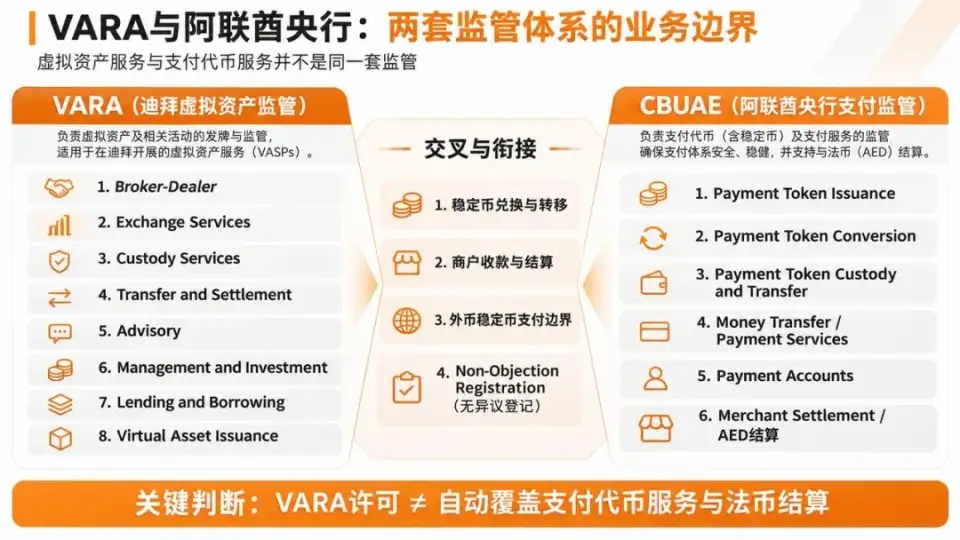
02 The buyer pays USDT and the merchant receives dirhams: can this order be processed?
If the buyer transfers USDT directly to a Dubai-based sales company to pay for ordinary goods, this route is not available. Under Article 2(7) of the Central Bank's Payment Token Services Regulation, where a local merchant wishes to receive payment for ordinary goods or services in tokens, it may accept dirham payment tokens issued by a Central Bank-licensed issuer. Foreign-currency payment tokens issued by a registered issuer may, under that provision, be used only to purchase virtual assets or their derivatives.
A store in Dubai has already tried accepting token payments in dirhams. In September 2026, Network International ran a pilot of DDSC at the Marks & Spencer store in Dubai Festival City. Buyers scanned the checkout QR code with a DDSC-enabled wallet, and merchants could choose to have the DDSC credited to their wallet or settled in dirhams. The pilot used dirham payment tokens issued by a central-bank-licensed issuer.
What if the buyer pays in USDT and a payment institution converts it into dirhams before paying the merchant? Where a platform, in providing services regulated under the Payment Token Services Regulation, knows that the buyer is using USDT to pay for ordinary goods, Article 2(4) does not permit a licensed or registered institution to process that transfer in the course of providing payment token services.The fact that the merchant ultimately receives dirhams does not change the purpose of the USDT transfer.If the buyer instead converts through a compliant channel and then pays for the goods in fiat currency at its own disposal, the conversion and the payment must each be handled under their respective rules. Whether the two activities are independent in practice depends on who controls the proceeds of the conversion and when the purchase price is settled.
There are also products on the market in which payment is confirmed on a crypto asset platform and the merchant settles in dirhams. In August 2026, Dubai Duty Free launched Crypto.com Pay at its physical stores and on its official website. Eligible UAE residents can authorize payment at checkout using a Crypto.com account, and Dubai Duty Free receives dirhams. Foris DAX Middle East FZE, which provides this service, holds a VARA virtual asset service licence and also holds a stored value facility (SVF) licence from the Central Bank of the UAE. Crypto.com expressly states on its UAE official website that Crypto.com Pay is provided under the SVF licence.
In both arrangements, the merchant can receive dirhams. The DDSC pilot disclosed the token used by buyers. The Dubai Duty Free launch announcement, by contrast, did not state which currency is actually debited in each transaction or at which step the conversion occurs, nor did it disclose the complete fund flow. Other payment institutions seeking to offer similar products must still determine who handles the tokens on the buyer's behalf, who completes the payment, and what services each party is authorized to provide.
If a merchant sells goods directly through an Asian company and the purchase price is ultimately remitted back to Asia, a payment institution must still consider where it is located and to whom it provides services. Article 2(1) of the Regulation covers both payment token services provided within the UAE and services provided to persons in the UAE. Even if the merchant is established outside the UAE, a platform operating such services in Dubai itself or in free zones under VARA's jurisdiction must still assess the matter under this set of rules. The UAE scope referred to in Article 2 of the Regulation does not include financial free zones such as the Dubai International Financial Centre (DIFC). VARA's jurisdiction also does not include the DIFC, where the provision of financial services is subject to the local regulatory regime administered by the DFSA.
03 If a platform collects or converts tokens itself, what must it apply for with the Central Bank?
A platform intending to collect or convert tokens itself must first confirm whether the tokens it handles constitute payment tokens as defined by the Central Bank. The Payment Token Services Regulation has been in effect since 31 August 2024. Such tokens mainly refer to virtual assets denominated in fiat currency that purport to maintain their value by reference to that fiat currency or to payment tokens in the same currency; US dollar stablecoins such as USDT and USDC fall within the scope of discussion. Even if the platform has not yet integrated merchant orders, as long as the services it provides fall within the scope of the Regulation and no applicable exclusion or exemption applies, it must still hold the corresponding Central Bank qualification.
First, consider how the platform collects tokens. If, in the course of business, a platform safekeeps payment tokens for clients, or safekeeps the private keys used to hold, store and transfer such tokens, or receives, holds and transfers payment tokens on clients' behalf, this involves payment token custody and transfer. A platform operating this business itself must, in principle, obtain the Central Bank'sPayment Token Custodian and Transferor licence(Payment Token Custodian and Transferor). An institution that has already obtained a virtual asset custody qualification granted by the Capital Market Authority (CMA, formerly the SCA) or the relevant local licensing authority may, under Article 8(3), apply for a no-objection registration for foreign currency payment token custody and transfer. A VARA transfer and settlement licence alone cannot be used as a custody qualification. Even if the registration conditions are met, Central Bank approval must still be obtained.
Next, consider who is converting the currency. Where a platform buys and sells payment token spot in the course of business for consideration, or enables both parties to a transaction to publish or accept offers for sale, this constitutes conversion under the Regulations. A party wishing to conduct this business itself must obtain the Central Bank'sPayment Token Conversion Licence(Payment Token Conversion), or obtain a no-objection registration through the applicable channel. The registration channel under Article 8(1) is available to virtual asset trading platform operators that meet the definition in the Regulations. The Central Bank will verify the operator's platform operating qualifications and its regulatory home, and only after approval may it conduct conversion within the scope of the registration. A VARA transfer and settlement licence alone does not permit an application for such registration on the strength of that licence.
The exclusions in the Payment Token Services Regulations are directed at specific activities. Where a business is already licensed under the retail payment or stored-value facility rules, or ought already to be licensed under those rules, the corresponding rules apply. Article 39 of the Regulations contains separate transitional provisions: after the transition period expires, a licence under the old rules no longer covers the relevant crypto asset business. Where a product simultaneously involves stored value, conversion and transfer, the applicable rules and the permitted scope must be checked item by item. To apply for the two Central Bank licences referred to above, the entity must be a company established in the UAE, excluding financial free zones (Article 6). If the same company is intended to carry on other business concurrently, the restrictions on business scope under Article 17 of the Regulations must also be checked.
04 How do the sale proceeds reach the merchant's account?
The sale proceeds are ultimately credited in dirhams, and it is also necessary to consider who handles fiat collection and settlement.If the payment institution itself provides fiat acquiring, payment aggregation, payment accounts or fund transfer services to the merchant, it must hold a Central Bank licence for that business or other statutory authorization; a VARA licence does not cover these services.If the sale proceeds are also to be paid to Asia, the corresponding cross-border fund transfer must likewise fall within the scope of what the actual service provider is licensed to do.
The merchant may contract directly with a duly qualified bank or payment institution, which will handle the funds and be responsible for settlement. If the Asian payment institution only carries on business for which it is licensed and does not actually provide or facilitate the relevant regulated service, it need not obtain the same qualification again for services provided directly by its counterparty. Currency conversion, custody and transfer may likewise be provided directly by institutions with the corresponding qualifications. If the currency conversion itself forms part of a VARA transfer and settlement service, an institution holding a VARA exchange services licence must also be used. Where an institution outside the Emirate of Dubai is selected, VARA approval must be obtained. The institution handling the transfer and settlement remains responsible to the client for completing that service.
If the merchant's collection contract is signed by the Asian payment institution, which collects and remits the sale proceeds and is also responsible for refunds, while the bank merely opens an account for it and executes transfers, the collection service is still being provided by the Asian payment institution itself, and it must hold the corresponding qualification. When discussing the division of responsibilities, the actual process can be reviewed point by point:Who does the merchant contract with, who can operate the wallet and accounts, who receives payment instructions, and who is contacted if the money does not arrive.
Another division of responsibilities is to provide only interfaces or wallet software, with the assets controlled by the client or a licensed institution. A technical team that meets the corresponding exclusion conditions may not need to obtain a separate licence for the payment services it supports. Even if the team does not handle funds, where it actually provides regulated services such as payment initiation, the position must be assessed under the corresponding rules. Article 62 of the new Central Bank Law likewise applies to those who, directly or indirectly through smart contracts, carry on, provide or facilitate regulated financial services.
What should the Dubai company do first?
If the Asian payment institution mentioned at the outset changes its checkout page so that buyers pay for goods directly in fiat currency, the first batch of merchants can sign with a partner that holds the requisite qualifications, with that partner collecting and settling payments directly, while the Dubai company initially handles product integration. Once the business stabilizes, the institution can then consider whether to conduct settlement itself.If the plan is for the Dubai company to collect the payments for goods and handle onward transfers and refunds, it must confirm and obtain the required qualifications before the switch, and at the same time adjust the merchant contracts and funds flow.
If you are preparing your first batch of UAE merchants, or are already in discussions with local banks or payment institutions about cooperation, you are welcome to bring an order you plan to launch and talk with Mankun. Starting from that order, we can examine which steps in the first phase can be implemented, which cooperation terms need to be agreed first, and when it may be worth considering converting part of the business to self-operated operations.