First, the conclusion: for projects that simply want to obtain a European crypto licence at low cost, Lithuania is no longer the "high-efficiency option" it once was;however, for projects that wish to connect digital asset services,stablecoin paymentsand the EU market at the same time, Lithuania is still worth assessing as a priority MiCA home Member State.
In 2026, Lithuania can hardly still be understood using the logic of a few years ago that treated it as a "European crypto company registration jurisdiction."
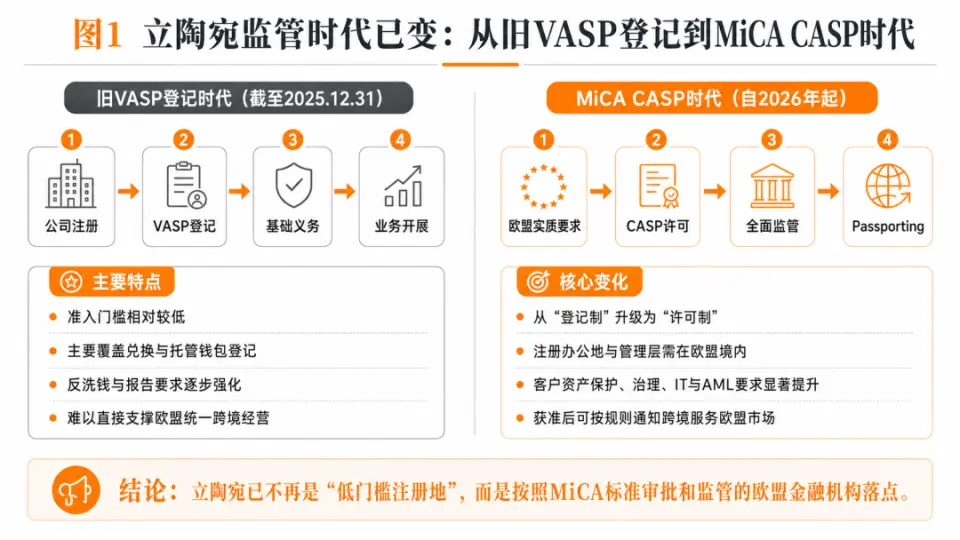
In the past, a project might first incorporate a Lithuanian company and then complete the relevant registration for virtual currency exchange or custodial wallet services, using a lighter structure to begin testing the European market; however, with the full implementation of MiCA, that path has exited the stage of history. Lithuania's transitional period ended on 31 December 2025, and from 2026 onward, continuing to provide regulated crypto asset services locally requires obtaining a CASP authorisation that complies with MiCA requirements, or entering the Lithuanian market lawfully through the CASP passporting mechanism of another EU Member State.
So asking today whether "obtaining a licence in Lithuania is fast" is in fact the wrong question.
What truly needs to be assessed is:whether Lithuania can become the connection point between a project's European digital asset business, stablecoin payments and traditional financial infrastructure in the coming years.
Lithuania CASPs in 2026: what are they now, and what can they do?
The MiCA regulatory rules for CASPs have applied formally since 30 December 2024 (while the ART/EMT rules relating to stablecoins took effect earlier, on 30 June of the same year), and Lithuania extended the transitional arrangements of its original VASP regime until 31 December 2025. In simple terms, this regulatory path can be summarised as follows:
MiCA published in June 2023 → CASP rules fully applicable on 30 December 2024 → Lithuania's transitional period ends on 31 December 2025 → 2026 marks the entry into the formal CASP licensing era.
After entering the new regime, Lithuanian CASPs are licensed and supervised by Lietuvos bankas, the Bank of Lithuania, while anti-money laundering and counter-terrorist financing are jointly supervised by the central bank and the financial crime investigation authority. The Bank of Lithuania has expressly stated that MiCA licensing is applied according to the same licensing standards it applies to other financial market participants; applicants must not only submit documents but also demonstrate management capability, source of funds, governance systems, AML/CFT mechanisms and genuine operational arrangements, and must avoid becoming a "shell company" that outsources most key functions.
A CASP may apply for different crypto-asset services according to its business model, such as custody and administration of client crypto assets, exchange of crypto assets for funds, exchange of crypto assets for other crypto assets, transfer of crypto assets, execution of orders, and other related services listed in MiCA. In March 2026, when the Bank of Lithuania granted a CASP authorisation to Micar assets UAB, the publicly disclosed services included custody of client crypto assets, exchange of crypto assets and order processing.
This means that a project can no longer first obtain a broad status and then gradually add business within it; instead, at the application stage it must clearly explain whether the platform controls client assets, who conducts exchanges, who executes asset transfers, and how client contracts and product features align with the scope of the licence.
MiCA is harmonised, so why still consider Lithuania?
MiCA harmonises the core regulatory framework for CASPs in the European Union, but it does not make all Member States identical licence markets. Companies still ultimately need to choose a home Member State in which to establish an entity and maintain ongoing communication with the local regulator; local talent, banks, the payment institution ecosystem, corporate operating costs and regulatory practice also directly affect actual operations after the licence is obtained.
The first point worth noting about Lithuania today is that the CASP application and ongoing supervision path is relatively clear. The Bank of Lithuania publicly provides application rules, supervisory forms, financial and prudential requirements, management qualification standards, supervisory reporting templates, and the passporting notification documents used when providing services to other EU Member States, so that before formally entering the application process a project can assess relatively systematically what the regulator requires.
The second point is Lithuania's long-accumulated payments and fintech ecosystem.
For projects engaged purely in crypto-asset trading or custody, the CASP itself may already resolve the main regulatory issues; but for stablecoin payments, PayFi, on-ramp/off-ramp and corporate cross-border settlement projects, digital assets are only one end of the transaction, while the other end often involves euro accounts, bank transfers, merchant settlement, payment execution and client fund protection.
The value of Lithuania lies in the fact that a project can assess the CASP together with PI, EMI or bank cooperation within the same structure from the outset, rather than obtaining a crypto licence and then discovering that the fiat currency and payment systems still need to be built entirely anew.
So-called "high efficiency" today should be understood as structural efficiency, not approval speed.
Stablecoin payments: beyond the CASP, payment service questions must also be answered
For stablecoin payment projects, this may be the layer most easily overlooked in this entire article.
MiCA addresses the regulatory status of crypto-asset services, but once stablecoins are actually used for payments, transfers and merchant settlement, they may intersect with payment services regulation under PSD2.
According to the current interpretation by the Bank of Lithuania and the EBA of how MiCA and PSD2 interface, if a CASP transfers electronic money tokens (EMTs) on behalf of clients, such transfer may simultaneously be regarded as a payment service under PSD2; if a platform custodies and manages EMTs on behalf of clients, and the relevant custody wallet allows clients to send or receive EMTs to or from third parties, the relevant wallet may also be regarded as a payment account. Conversely, merely exchanging between crypto assets and funds, or between different crypto assets, even where the transaction involves EMTs, will not on that basis alone be regarded as a PSD2 payment service.
From 2 March 2026, CASPs engaging in the specific EMT payment services described above will need to obtain an additional payment services authorisation, or entrust the corresponding services to an institution qualified to provide payment services.
For project teams, the following table can be used for a first-round assessment:
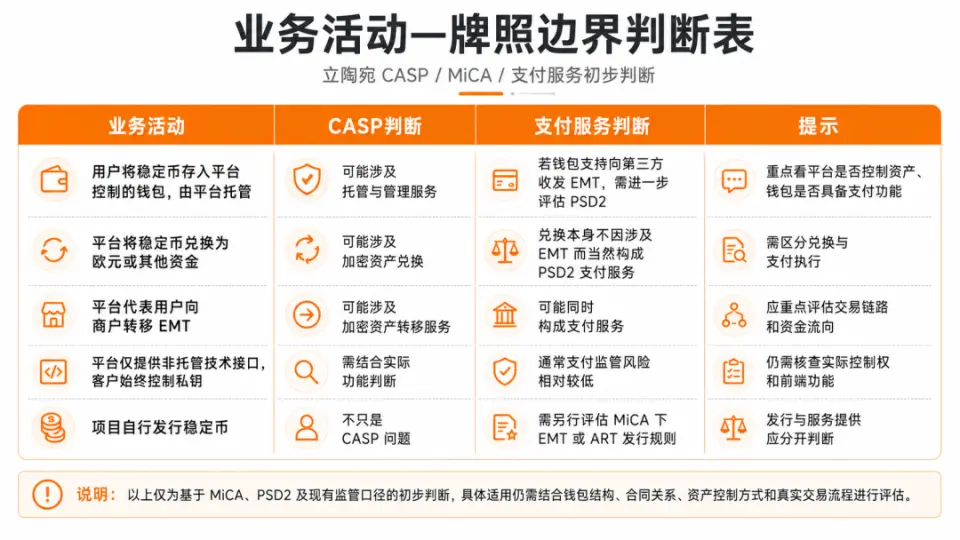
The above is only a preliminary assessment based on MiCA, PSD2 and existing regulatory guidance; the specific application still needs to be determined in light of the wallet structure, contractual relationships, the manner in which assets are controlled and the actual transaction flows.
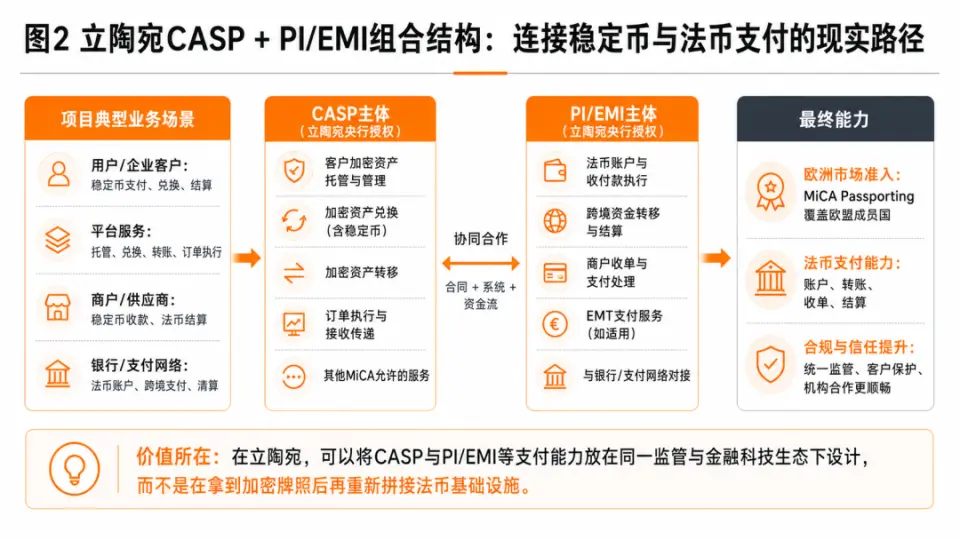
Therefore, a mature European stablecoin payment structure often does not have a single CASP assume all functions, but rather places digital asset services, fiat payments and bank accounts into respectively matching regulatory frameworks, and then connects them through group entities and partner institutions.
Which projects are more suitable for using Lithuania as their MiCA home Member State?
For projects that have clearly decided to enter the EU market and wish to use the MiCA passporting mechanism to serve clients in multiple Member States, Lithuania can be one of the home Member States worth assessing, especially where the team needs not only CASP status but also needs to consider payment institution status, bank accounts and cross-border settlement capabilities at the same time.
Stablecoin payment, PayFi, on-ramp/off-ramp and corporate settlement platforms are particularly worth paying attention to this structure, because these businesses inherently span both the digital asset and traditional payment systems; the earlier a project considers both within the same architecture diagram, the lower the cost of subsequently readjusting entities and fund flows due to mismatched licensing boundaries usually is.
However, if a project is still at the product validation stage, has no clear EU clients, and has not prepared to deploy genuine management, compliance and operational resources in Europe, then a Lithuanian CASP may not necessarily be the highest priority path at the current stage. MiCA does not require all projects to obtain a licence as early as possible; what it genuinely requires is that, once a project decides to enter the EU market for the long term, it must operate through entities and regulatory statuses that match the actual scale of its business.
The assessment can be quite simple:
Preparing to operate a digital asset business in the EU for the long term → assess CASP; involving fiat collection and payment, EMT payments or merchant settlement → concurrently assess PI/EMI; no substantive EU operating plan → it is not recommended to initiate an application merely for the sake of a "European licence".
“High efficiency” is no longer about obtaining a license quickly, but about avoiding one detour
From a project-cost perspective, what is truly expensive is often not the first license application, but discovering only after the business is already running that the original regulatory structure cannot cover the actual fund flows.
For example, a project has completed its CASP application only to find that stablecoin transfers also touch on PSD2; it has already onboarded merchants only to find that fiat settlement requires reintroducing a PI or EMI; it has already begun serving multiple countries only to find that the original group entity cannot support due diligence for banks and institutional clients. At that point, the company, contracts, accounts and fund flows need to be restructured, and the cost is usually far higher than designing the structure clearly from the outset.
Therefore, when Lithuania is described today as having “high efficiency,” the more reasonable understanding is not that regulation is more lenient, but that a project has the opportunity, at the CASP application stage, to consider payment capabilities, bank cooperation and cross-border EU operations at the same time, and to resolve in advance the problems it is highly likely to encounter later.
How we typically support such projects
For crypto payment and digital asset projects preparing to use Lithuania as their MiCA home Member State, the first step is usually not to enter the license application immediately, but first to break down product functions, client regions, stablecoin types, wallet control methods and fiat pathways, and to determine which services fall within the scope of CASP and which functions may further touch on PSD2, EMT or other financial regulation.
At this stage, it is usually necessary to produce an analysis of the business model and regulatory identity, a CASP service-scope matrix, and a determination of the boundary between digital asset and payment services. Then, based on the project's clients, team composition, banking needs and long-term business plan, Lithuania is compared with other EU Member States to determine the home Member State entity and group structure.
For stablecoin and PayFi projects, on-chain and off-chain funds also need to be placed in the same fund-flow map, clarifying which entity custodies and transfers stablecoins, which institution handles fiat payments, who settles for merchants, and how client assets are segregated from the company's own funds.
Once the project enters the formal application and implementation stage, regulatory materials are then prepared around the CASP business plan, corporate governance, management personnel, prudential resources, AML/KYC/KYT, client asset protection, and IT and outsourcing arrangements, with simultaneous consideration of passporting, bank account opening, cooperation with licensed payment institutions and due diligence for institutional clients. In addition, MiCA sets clear initial capital requirements for CASPs (divided into three tiers of EUR 50,000, EUR 125,000 and EUR 150,000 depending on the type of service), and applicants must demonstrate that they have sufficient prudential funds to support business operations.
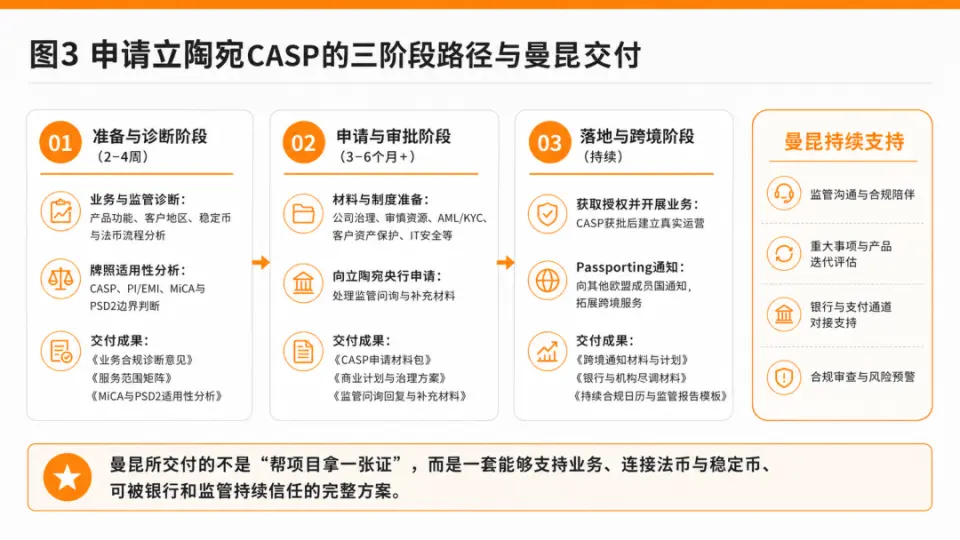
Mankun's delivery objective is to enable a project's CASP, payment services and bank cooperation in Lithuania to operate in long-term coordination, rather than merely completing a one-off license application.
Conclusion: Lithuania is still worth choosing, but the answer has changed
For projects that only want to obtain a license with a low threshold, Lithuania is no longer a high-efficiency option; but for projects that need to connect digital assets, stablecoin payments, PI/EMI and the EU market at the same time, Lithuania remains a structural choice worthy of priority assessment.
MiCA has brought an end to the era of relying on broad VASP registration to enter the European market; firms now need to build governance, capital, client assets and ongoing compliance systems to standards closer to those for financial institutions. Lithuania's real remaining advantage is no longer the ease of registration, but rather the relatively complete combination it can offer among its CASP regulatory pathway, its payment institution ecosystem and EU market access mechanisms.
For crypto payment projects genuinely preparing to operate in the European market over the long term, whether this structure can help them avoid one detour may matter more than whether a licence can be obtained within two months.
Preview of the next article"Global Crypto Payment Compliance Map · Advanced Series ⑤ Poland CASP: Does the New Low-Cost Path into the EU Market Still Hold?" Stay tuned.
/ END.
*This article is an original work of Mankun Law Firm and represents only the personal views of the author. It does not constitute legal advice or a legal opinion on any specific matter. For reprints and legal consultation, please add our customer service:mankunlawyer。
About the author