"Which licences do we need?" This is the first question payment companies ask when they bring stablecoin payment solutions to Hong Kong.The number of licences cannot be derived directly from the product name. The key is what role the company plays on-chain and off-chain respectively: is it collecting payments on behalf of customers, or buying and selling stablecoins itself? Is it settling funds to merchants' bank accounts, or allowing merchants to keep balances on the platform for continued use? Does the platform hold wallets and private keys on behalf of merchants?
A single payment may pass through three stages at the same time: stablecoins, bank accounts and platform balances,but this does not mean that a single "crypto payment licence" can cover them all.Fiat currency exchange and cross-border receipt and payment involve the MSO. Whether merchant balances can be retained and continue to be used for payment involves the SVF. Only where the company itself operates virtual asset trading, controls client assets or issues stablecoins does the analysis respectively enter into the VATP, VA Dealing, VA Custody or Stablecoin Issuer Licence. The licence assessment must ultimately come back to these specific business actions, rather than stopping at the product name of "crypto payment".
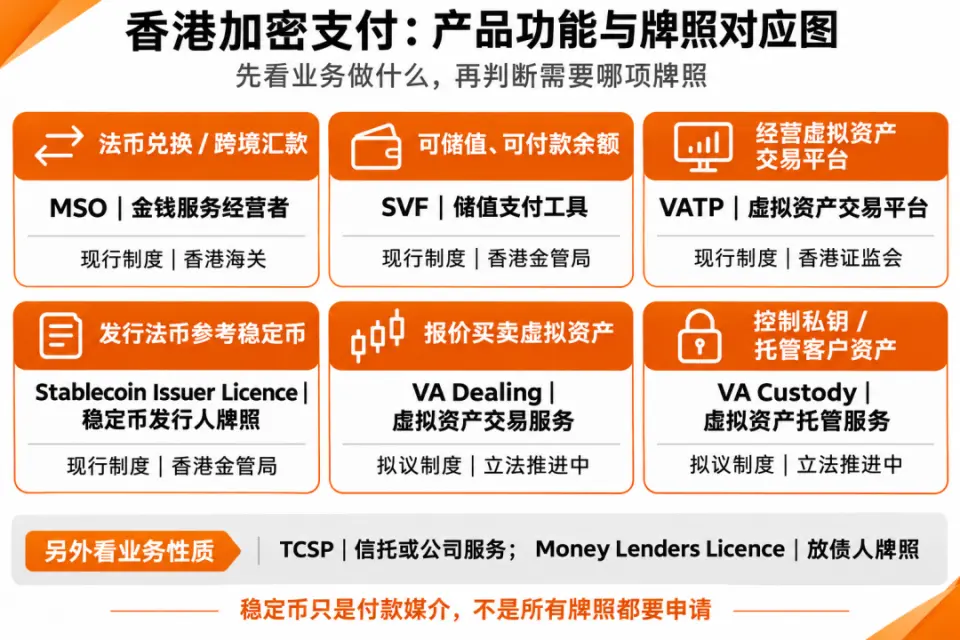
Hong Kong Crypto Payment Product Functions and Licence Correspondence Chart
01 MSO and SVF correspond respectively to two types of business arrangements
The MSO covers fiat currency exchange and cross-border remittance
When stablecoin receipts land in a merchant's account, there is usually still an "off-ramp" step: the buyer pays stablecoins overseas, the platform or its settlement arrangement converts the value into Hong Kong dollars, and what the merchant ultimately receives is Hong Kong dollars in a bank account. For a payment company, the focus of the assessment is not "which currency was used", but whether the company has accepted client instructions in Hong Kong to arrange this cross-border receipt and payment of Hong Kong dollars. The MSO licence covers fiat currency exchange and remittance services—sending or arranging the sending of money to places outside Hong Kong, receiving or arranging the receipt of money from places outside Hong Kong, and arranging the receipt of money outside Hong Kong. The bank handles the final transfer, and this does not automatically remove the payment company from the transaction chain.
There is a point here that is easily confused: converting stablecoins into Hong Kong dollars is not the same as "currency exchange" in the MSO sense. The MSO regulates exchange and remittance between fiat currencies, and holding an MSO licence does not automatically confer authorisation to buy and sell stablecoins or trade in virtual assets. In other words, a payment company may need to handle two separate lines: the buying or exchange on the coin side, and the receipt, remittance and settlement on the Hong Kong dollar side. Whether the latter line falls within the MSO depends on whether the company collects money on behalf of customers, arranges cross-border payments, or promises customers when Hong Kong dollars will arrive.
If the company itself undertakes Hong Kong dollar collection and cross-border remittance, it should prepare according to the MSO application requirements: it should submit information on its local business premises or management office and the place where books and records are kept, arranged according to the business premises, and be subject to the fit-and-proper person review; the anti-money laundering system and explanations of fund flows and delivery channels are also within the scope of review. Note, however, that the MSO addresses fiat money services and does not cover the buying and selling of stablecoins. When a company prepares to incorporate stablecoins into its cross-border settlement process, it should design and assess the two types of services separately, and must not treat an existing MSO licence as a pass for stablecoin business.
An SVF is not necessarily triggered simply because there "is a balance"
A payment platform's back office will usually have a "balance" page, but the legal nature of that balance cannot be determined merely by how the page looks. The platform simply records each transaction and, on the settlement date, transfers the funds to the merchant's bank account; this is closer to a settlement ledger. If a merchant can leave funds on the platform indefinitely and then use them to pay suppliers or transfer them to other users, the platform is no longer merely keeping records; it is allowing a single pool of value to circulate repeatedly within the system. This is precisely the point that SVFs need to address.
An SVF is licensed by the Hong Kong Monetary Authority (HKMA) and regulates the issuance, or assistance in the issuance, of stored value payment instruments that meet the definition. Non-bank applicants are generally also required to meet requirements such as paid-up capital of at least HK$25 million or equivalent financial resources, and to establish floating deposit safeguards, risk management and anti-money laundering systems. The HKMA permits SVF licensees to provide remittance or currency exchange services on an ancillary basis, but this is a regulatory arrangement of "stored value payment as the principal service, with other services as ancillary"; it must not be understood in reverse to mean that a payment platform is already an SVF merely because it has a balance page. An SVF licensee that meets the ancillary service arrangement described by the HKMA does not need to apply for a separate MSO licence in respect of such remittance or currency exchange services.
The assessment can turn on a single question: is the money waiting for settlement, or can it continue to be used for payments? The former is usually merely a record of receivables and payables; the latter may already possess stored value and payment functions. Whether a merchant can leave the balance on the platform, whether it can be transferred to a third party, and whether the platform bears redemption liability for the balance are often more critical than whether the "product page displays a balance".
02 Other licences depend on whether the product has entered the corresponding business
VATP applies to operating a virtual asset trading platform
Stablecoin payment products are often connected to trading platforms, but connecting to a trading platform and operating a trading platform are two different things. A VATP licence corresponds to the regulated business of operating a virtual asset trading platform. A payment company that only provides collection and settlement services to merchants generally has no need to operate an electronic facility through which parties to transactions regularly conclude purchases and sales of virtual assets. If a product in fact regularly makes or accepts offers to buy or sell virtual assets that can form binding transactions, or regularly introduces counterparties to conclude such transactions, and the company directly or indirectly holds client funds or virtual assets, it is necessary to assess under Schedule 3B to the Anti-Money Laundering Ordinance whether the platform business scope has been entered.
Virtual asset transactions that a Type 1 intermediary can conduct are subject to specific conditions
Type 1 regulated activity deals with securities trading. Intermediaries that meet the applicable licensing conditions may provide virtual asset trading services in accordance with the requirements of the Securities and Futures Commission (SFC) and the HKMA, for example by executing transactions for qualified clients through omnibus accounts on licensed platforms. The SFC has separate applicable requirements for relevant stablecoins authorised for issuance by Hong Kong-licensed stablecoin issuers. A payment company that merely completes stablecoin exchange for merchants does not automatically require a Type 1 licence merely because the counterparty asset is a digital asset.
A stablecoin issuer licence corresponds to issuance and redemption
Only a company that intends to issue its own fiat-referenced stablecoin has reason to assess an issuer licence and the accompanying reserve, redemption and ongoing supervisory obligations. The HKMA issued the first batch of licences to Dingdian Fintech and HSBC in April 2026. For an ordinary payment company using third-party stablecoins, the key point is to confirm whether it is actually undertaking trading, custody or payment services.
If a company, in the course of carrying on business in Hong Kong, offers specified stablecoins to clients, it must also confirm which institution is making the offer and whether that institution is an "authorised provider" within the meaning of section 9 of the Stablecoins Ordinance. For specified stablecoins whose issuance is not authorised by a Hong Kong licence and which do not fall within the scope of the issuance prohibition under section 8, authorised providers may in principle offer them only to professional investors; statutory exemptions are separate. If a product adds an entry point for "buying coins from the platform", this issue needs to be addressed separately.
TCSP is for trust or company services
The TCSP licence applies to trust or company services. A payment company falls within the scope of this licence only if it incorporates Hong Kong companies for clients, provides registered address or company secretary services, or acts as trustee of an express trust in the course of business. A payment company that merely provides collection, exchange and settlement services typically does not carry on TCSP business.
The reason TCSPs frequently appear in virtual asset regulatory materials is that the current VATP framework requires platforms to hold platform client assets on trust through a qualifying wholly-owned associated entity, and that associated entity is required to hold a TCSP licence. Here, the TCSP is a trust or company services qualification and does not equate to a standalone virtual asset custody licence. A payment company holding a TCSP will not thereby obtain authorisation for currency exchange, payment or general virtual asset custody.
The money lender licence is used for carrying on merchant lending
The money lender licence addresses a different product: a payment company provides financing to merchants using its own funds, and the merchants repay the principal as agreed. A company carrying on money lending in Hong Kong in the course of business should assess the money lender licence unless a statutory exemption under the Money Lenders Ordinance applies. That licence is determined by the Licensing Court, the Registry handles applications and licence renewals, and the Police handle vetting and enforcement. Collection, currency exchange or money service operator licences do not cover merchant lending.
"Advance disbursement" in payment products needs to be assessed in light of the contract. If the platform merely pays transaction funds that already belong to the merchant ahead of schedule, this is typically a settlement arrangement. If the platform separately advances its own funds and requires the merchant to repay the principal even where future sales are insufficient, this is closer to a loan. If the contract provides for the purchase of the merchant's future receivables, it is also necessary to examine whether the receivables are genuinely assigned and whether the merchant remains subject to an independent primary repayment obligation. In Global Merchant Funding, the Hong Kong Court of Final Appeal characterised a particular future credit card receivables arrangement as a sale based on the legal effect of the contract. Where stablecoins are delivered or used to repay financing, the asset transaction and custody arrangements also require separate analysis.
03 Currency exchange and custody are where payment products most easily cross the boundary
Payment companies most easily cross the boundaries of their existing products in two areas. First, the company begins to quote prices to clients and buy and sell stablecoins in its own name. Second, the company no longer merely transmits payment instructions but exercises long-term control over the wallets and private keys holding merchant assets. The former corresponds to the proposed virtual asset dealing regime, and the latter corresponds to the proposed standalone virtual asset custody regime.
The consultation conclusions on the dealing regime have made clear that a payment purpose does not in itself exclude virtual asset exchange from the regime. If a payment service provider provides virtual asset exchange in the course of business, it may fall within the proposed VA Dealing regime by entering into, or offering to enter into, agreements for the acquisition or disposal of virtual assets. The proposed regime remains at the legislative stage, and the final scope and exemptions will be subject to the bill and implementing rules.
The proposed VA Custody regime focuses on who safeguards the private keys or similar tools required to transfer client assets. Taking a wallet using multi-party computation (MPC) as an example, it is necessary to examine whether the platform can unilaterally transfer assets, and whether clients can independently restore access to and manage their assets without the platform's involvement. Where a payment company uses wallets under its own control to pool merchants' stablecoins, these permissions need to be clarified. The current regulatory rules already impose requirements on licensed trading platforms and on authorized institutions meeting HKMA requirements regarding the custody of client assets, and the proposed regime will establish a separate licence for VA Custody services.
Accordingly, what an ordinary payment company most needs to clarify at present is the boundary between dealing and custody. Providing investment advice or managing portfolios on behalf of clients enters the analysis only where the product genuinely extends to these functions. For a payment product about to be launched, identifying the actual functions under the current rules first and then monitoring the year-end legislative amendments and subsequent implementing rules is typically closer to business reality than incorporating every licence into the plan at once.
04 Map your own product against each item
Listing together the functions the company intends to provide is often more useful than simply counting licences. The table below sets out common business activities alongside the corresponding licensing scope, making it easier to compare against your own product: which activities are part of the payment process itself, and which have already extended to virtual asset dealing, asset custody, stablecoin issuance or merchant financing.
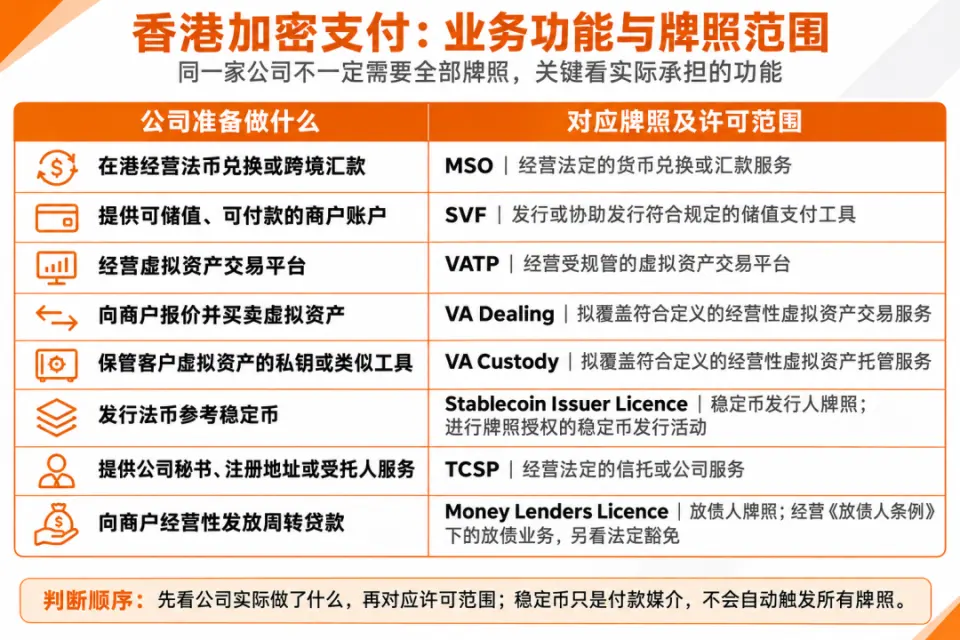
Functional Scope and Licensing Perimeter of Crypto Payment Businesses in Hong Kong
Conclusion
For companies preparing to operate a crypto payment business in Hong Kong, the licensing assessment need not begin with the question of how many licences Hong Kong has issued. What needs to be clarified is a set of specific arrangements: who is responsible for fiat currency exchange and cross-border collection and payment, whether the platform creates a balance that can continue to be spent, whether the company itself buys and sells virtual assets, who controls the wallets and private keys, and whether the company lends money to merchants.
Once broken down in this way, the relationship among the licences becomes less complicated: the MSO and SVF regimes are usually the first to be assessed for payment products; the VATP and the Stablecoin Issuer Licence enter the core analysis only where the company itself operates a trading platform or issues stablecoins; VA Dealing and VA Custody currently depend on the progress of legislation; and the TCSP and the Money Lenders Licence depend on whether the company actually provides trust or company services, or provides financing to merchants.
Therefore, before implementation, what is most worthwhile is not to list every licence, but to map out the fund flows, asset control and customer relationships clearly, and then compare each item against the scope of the relevant licence. Only in this way can it be determined whether the existing design can be launched directly, which functions need to be narrowed, and which issues should be dealt with after the new regimes and detailed rules are clarified.
Next Article | Global Crypto Payment Compliance Map · Advanced Series ⑯ (Final Installment)
With multiple licences in hand, why does the business still fail to operate?
In the next article, we will no longer discuss a single country or a single licence in isolation, but will place the entire preceding series within the same business chain and discuss how licences, bank accounts, fund pathways, customer onboarding, group entities and licensed partnerships can truly work together.
Sources:
Hong Kong Customs and Excise Department, Guide to Licensing of Money Service Operators (MSO)
Hong Kong Monetary Authority, Guide to Licensing of Stored Value Payment Facilities (SVF)
Securities and Futures Commission of Hong Kong, Licensing Handbook for Virtual Asset Trading Platforms (VATP)
Hong Kong Securities and Futures Commission and Hong Kong Monetary Authority, Joint Circular on Virtual Asset-Related Activities of Intermediaries, December 22, 2023
Hong Kong Securities and Futures Commission Circular on Intermediaries' Handling of Relevant Stablecoins, May 27, 2026
Hong Kong Stablecoins Ordinance (Ordinance No. 17 of 2025)
Hong Kong Monetary Authority: Announcement of the First Batch of Stablecoin Issuer Licences, April 10, 2026
Hong Kong Financial Services and the Treasury Bureau and Securities and Futures Commission, Consultation Conclusions on Virtual Asset Dealing Services (VA Dealing)
Hong Kong Financial Services and the Treasury Bureau and Securities and Futures Commission, Consultation Conclusions on Virtual Asset Custody Services (VA Custody)
Hong Kong Companies Registry: Regulatory Authority for Money Lenders Licences
Hong Kong Special Administrative Region Government Legislative Council Question and Answer: Legislative Progress on the Virtual Asset Trading and Custody Regime, November 4, 2026
This article provides a general analysis based on Hong Kong legal and regulatory materials publicly available as of November 16, 2026. The scope of application of the proposed regime is subject to the final legislation and implementing rules.