

When a crypto payment project reaches a certain stage, licensing is usually not the first problem to surface. A company may already have obtained CASP authorization, completed FinCEN MSB registration, and connected with licensed overseas payment institutions, yet its business can still stall at specific points such as customer funds, wallet control, fiat currency accounts and merchant settlement.
Once the business actually starts operating, several problems quickly come to light: an institution capable of handling digital assets may not be able to handle euro payments; a bank may be willing to open an operating account but not accept that account holding third-party customer funds on a long-term basis; and the entities responsible for customer acquisition, contract signing, wallet control and transaction execution may be different companies within the same group.
As a result, each company in the group has its own regulatory status, yet the transaction as a whole still cannot be completed smoothly. The number of licenses does not solve this problem; the key is whether customers, assets, fiat currency and liability all fall within the same executable business chain.
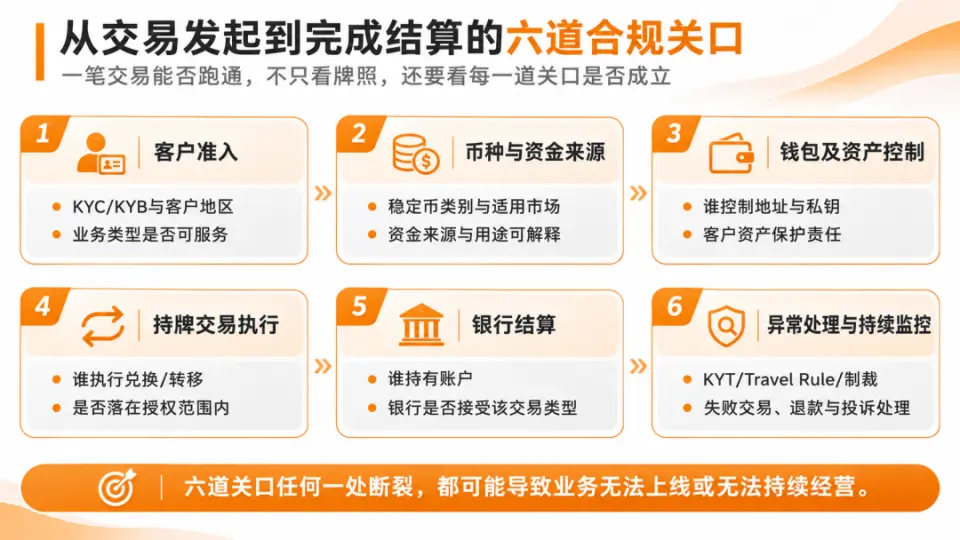
A license can only answer whether a given entity may engage in a given regulated activity. Who onboards the customer, who controls the stablecoin, who pays out the euros, why the bank accepts the funds, and who handles refunds or freezes when they occur — all of these must be tied to specific entities, contracts, accounts and system permissions.
Previous articles discussed the US MSB, the Canadian MSB, the Australian DCE, the EU MiCA CASP, Dubai's VARA, Hong Kong stablecoins and licensed partnerships. Returning to the actual operation of crypto payments, the question is in fact quite simple: when every link has a compliance arrangement, why can the transaction still not be completed?
The assessment should focus on which entities, accounts and systems the transaction actually passes through, not merely on the list of licenses.
A project needs to break down customer wallets, asset custody, stablecoin exchange, on-chain transfers, fiat payments and merchant settlement item by item, and set out clearly which entity performs each function, under which authorization, and who bears responsibility if something goes wrong.
A project needs a table mapping business functions to regulatory status: customer wallets, asset custody, stablecoin exchange, on-chain transfers, fiat payments and merchant settlement — which entity performs each, under which authorization, and who bears responsibility if something goes wrong.
01 The license list does not map onto the actual business
The most common mistake a project makes is to put all the regulatory qualifications obtained by the group on a single promotional page and then assume that these licenses already cover the entire business.
For example, the group holds MSB registration in the United States, CASP authorization in Europe, and has established partnerships with licensed payment institutions in other regions. These regulatory statuses are of course valuable, but they cannot simply be added together.
FinCEN MSB registration in the United States is not a unified operating license covering money transmission throughout the entire country; specific activities still need to be assessed in light of state-level law.
An EU CASP may, through MiCA's passporting mechanism, enter other Member States after completing the required cross-border notification, but what it can provide on a cross-border basis remains limited to the crypto-asset services within the scope of its original authorization. Completing passporting does not automatically confer on it the full business permissions of a payment institution or an electronic money institution.
For stablecoin payment projects, the issues may be even more complex. On 2 March 2026, the transition period previously set by the EBA for the interface between MiCA and PSD2 ended, and certain transfer and custodial wallet services involving electronic money tokens (EMTs) may simultaneously need to resolve payment services authorization issues.
This means a project cannot simply ask how many licenses the group holds; it must also confirm item by item: under which entity and which authorization do the client wallet, asset custody, stablecoin exchange, on-chain transfer, fiat payment and merchant settlement respectively fall.
What the project needs is a mapping table of business functions to regulatory status, not a list of the group's licenses.
02 Client relationships, asset control and fund flows do not match up
Assume an enterprise client intends to pay for goods to a European merchant.
The client registers on the project's official website, uploads its corporate information and completes KYC/KYB, and then transfers stablecoins to a wallet designated by the platform. The platform completes the exchange and then, through a payment partner, remits euros to the merchant's bank account.
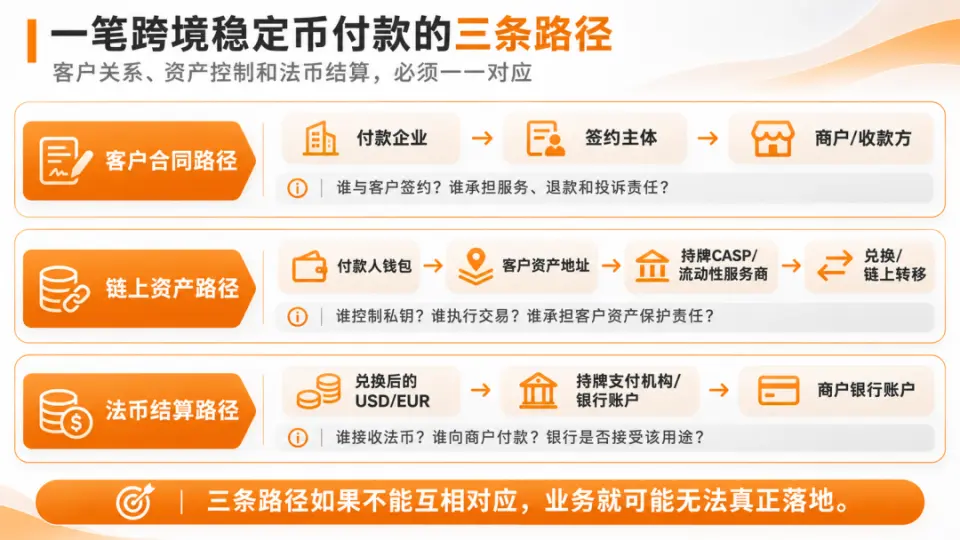
What the user sees may be merely a single payment, but regulatory and bank due diligence need to reconstruct at least three distinct pathways.
The first is theclient relationship pathwayWith which company in the group does the client actually sign the service agreement? Is the client purchasing a digital asset exchange service, a money transmission service, or a complete cross-border payment service? In the event of refunds and complaints, which entity should be responsible?
The second is theCrypto asset control pathwayWhich address do the client's stablecoins enter? Who controls the private keys? When are the assets transferred to the CASP or liquidity provider? Who has the authority to decide on transaction execution, and who bears responsibility for protecting client assets?
The third is thefiat currency fund pathwayInto whose account do the US dollars or euros from stablecoin conversion enter? Is that account permitted to receive the relevant funds? Who ultimately executes payment to the merchant, and can the bank identify the actual payer and payee?
If the client signs with a European CASP, but the assets and fiat currency are controlled on a long-term basis by other entities without the corresponding business authority, the project needs to re-examine the entities actually providing the services and the legal responsibilities.
If the contract states it is a technical service, but in reality a technology company receives client funds and decides on transactions, it cannot be determined solely on the basis of the contract name that it is entirely outside financial regulation.
03 Having a license does not mean banks are willing to take on the transaction
This is where the preceding issues are most likely to converge and become apparent.
An enterprise may have obtained regulatory permission and found a partner institution able to provide fiat currency services, yet still be unable to establish a stable payment collection and disbursement account.
The reason is not necessarily that the bank does not accept the crypto asset industry, but may be that the account use proposed by the project cannot obtain the bank's approval.
For example, the fact that a bank permits an enterprise to open an account for payroll, rent and normal operating expenses does not mean that the account can be directly used to receive payment funds from multiple third-party clients.
The fact that a licensed institution is able to handle a particular type of financial transaction does not mean that its banking partner has approved all customer jurisdictions, transaction amounts, sources of funds and merchant categories.
The European Banking Authority (EBA) emphasizes that financial institutions should assess customers based on their actual risk and should not subject an entire category of customers to excessive de-risking without sufficient basis. However, banks still need to comply with anti-money laundering requirements and decide whether to establish or continue a business relationship when the relevant risks cannot be effectively managed.
Therefore, even if a project is licensed, it still needs to explain to the bank: what the account is specifically used for, how customer funds are generated, whether transactions correspond to genuine commercial activity, which stages on-chain assets pass through, and how the enterprise identifies and handles anomalous transactions.
If this explanation cannot hold up, obtaining additional licenses may not necessarily resolve the account-opening problem.
A license can demonstrate that a certain business has a lawful operating basis, but the bank still needs to determine whether it can bear the risk of that business once it enters the account system.
Therefore, truly mature license planning should not wait until the license is approved before looking for a bank.
The account type, payment and collection pathways, settlement methods and the business admission scope of banking partners should be considered in parallel when designing the license and group entities.
04 There are many licensed partners, yet no one is responsible for the complete transaction
The crypto payment industry has already developed a large number of mature infrastructure cooperation models.
Wallets can connect to third parties, identity verification can rely on KYC service providers, exchange can be delegated to liquidity institutions, and fiat payment can be undertaken by PIs, EMIs or banks.
This division of labor itself is not problematic. For enterprises that do not intend to obtain licenses themselves in all markets, reasonable use of licensed institutions may even be a more efficient business choice.
However, the more partners there are, the easier it is for responsibility to become dispersed.
For example, a customer payment is suspended because an on-chain address triggers a risk alert. The wallet service provider considers itself responsible only for technology, the CASP considers KYC to be handled by the front-end platform, the payment institution considers the source of assets to fall outside the scope of its review, and the project party considers the entire process to have been handed over to a licensed partner.
If, when a transaction anomaly occurs, the parties only then begin discussing who has the authority to freeze, who is responsible for providing explanations, and who contacts the customer, this shows that the cooperation arrangement has not yet formed a genuinely enforceable allocation of responsibilities.
Article 73 of MiCA sets out clear requirements for CASP outsourcing: an entity may outsource operational functions, but it cannot thereby transfer its own regulatory responsibility, nor may outsourcing alter the relationship between the CASP and its customers or its authorization conditions.
Licensed cooperation must address interface integration and commercial revenue sharing, and must also clearly define the boundaries of responsibility.
The cooperation agreement must also specify customer onboarding, transaction instructions, asset control, compliance monitoring, exception handling, data sharing, complaints and refunds, regulatory inspections, and how customers will be migrated after termination of the cooperation.
For regulated services that an entity has itself actually provided, it likewise cannot simply substitute a partner's license for the necessary authorization.
Whether a service can be delegated to others for performance and whether regulatory responsibility can be transferred to others are two different questions.
05 The business runs, yet sustained risk management cannot be established
Some projects can complete test transactions and can provide transfer and exchange services to a small number of customers, but once they enter the scaling stage, they may still encounter significant obstacles.
The reason is that completing a single transaction and operating a financial business over the long term impose different requirements.
An early-stage project may serve only a small number of enterprise customers, with the source of transactions and the use of funds relatively clear. But when the platform begins to cover more countries, increase the number of merchants, support self-hosted wallets, or connect to multiple liquidity providers, the risk management requirements will change accordingly.
In July 2026, the FATF published its seventh update on the implementation of supervision of virtual assets and service providers, with particular attention to the abuse of stablecoins, transactions involving self-hosted wallets, offshore VASPs, DeFi arrangements, and the practical difficulties in implementing the Travel Rule.
For crypto payment projects, this means compliance cannot stop at completing a one-time KYC check at account opening or purchasing a chain analytics tool.
Projects need to be able to continuously identify customers and counterparties, monitor anomalous transactions, fulfill applicable Travel Rule information requirements, and address sanctions, fraud and suspicious-fund risks.
A more practical question is: once customer funds have entered the platform, how should the platform handle the situation if a transaction cannot be executed or a bank refuses to settle? If a partner institution suddenly stops providing services, can the platform promptly identify the affected customer assets and arrange refunds or other lawful handling?
A genuinely mature risk management system should cover the periods before a transaction begins, during execution and after a transaction fails.
06 Before launch, use a single transaction to conduct a complete stress test
Rather than reviewing all licenses and policy documents together, it is better to select one typical business scenario that the project plans to launch and run a simulation from beginning to end.
For example, an Asian company uses a stablecoin that meets applicable regulatory requirements to pay a European supplier for goods, and the supplier ultimately receives euros.
The project needs to answer the following questions one by one in accordance with the actual business process.
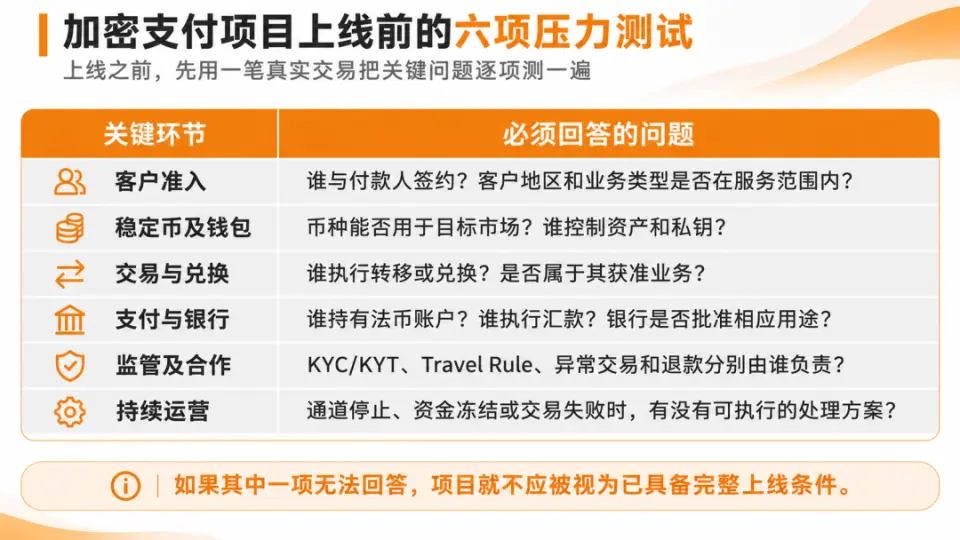
If any question cannot be answered, the project cannot conclude that it already meets the full conditions for launch, nor can it use the fact that it is already licensed in other areas to conceal this gap.
Some problems cannot be solved simply by adding another license. A bank's refusal to accept certain types of customer funds may require adjusting the account and transaction structure; unclear responsibilities within a group may require re-determining the contracting and asset-control entities; and a partner's lack of access to transaction data may require modifying system permissions and contractual arrangements.
For enterprises, this inspection method is closer to real operations than merely comparing the number of licenses.
07 Multi-license coordination: three maps are indispensable
An enterprise preparing to conduct global crypto payment business over the long term does not necessarily need to establish a fully independent business system in every market.
However, it must confirm that different regulatory authorities can work together under clear rules.
A more reasonable planning approach can be divided into three stages.
Stage One: Design the business first, then choose the regulatory pathway.
The project needs to clarify which countries its main customers are located in, where funds come from, where final settlement occurs, and whether the product involves issuance, custody, exchange, money transmission, or traditional payment services.
Only on this basis can it be determined which qualifications the group needs to hold itself and which businesses can be carried out through licensed cooperation.
Stage Two: Design licenses, accounts, and fund pathways in parallel.
At the entity structuring stage, the enterprise should determine the customer contracting entity, the method of asset control, the purpose of bank accounts, payment partners, and intra-group and external service agreements, rather than adding a separate company each time a license is obtained.
For projects preparing to expand into multiple markets in the future, it is also necessary to consider in advance local customer access, cross-border service restrictions, and the scope of business licenses.
Stage Three: Validate the entire structure through real transactions.
Before formal large-scale launch, representative customers and transaction types should be selected to verify, in accordance with approved testing arrangements, whether the flow of funds, flow of information, and flow of responsibility are consistent, and to check the ability to handle situations such as abnormal transactions, interruption of cooperation, refunds, and customer complaints.
The focus is not on completing a single successful payment, but on confirming whether the entire business can be continuously executed in real operations.
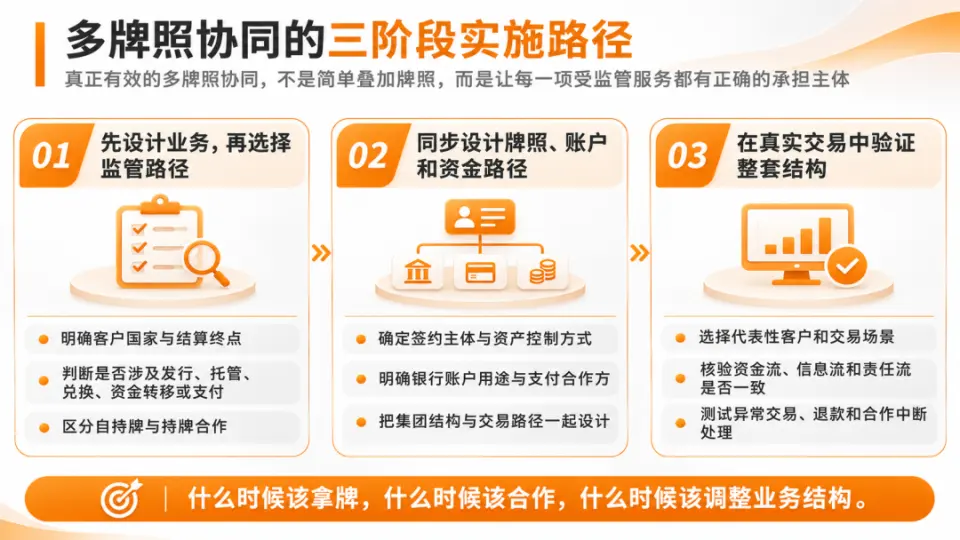
when a licence is required, when cooperation is appropriate, and when the business structure should be adjusted.
Conclusion: a licence must ultimately become an executable payment pathway
From the US MSB, the Canadian MSB and the Australian DCE, to El Salvador's DASP and the Cayman Islands VASP, and further to the EU MiCA, Dubai VARA, Hong Kong stablecoins and multi-licence coordination, in the Global Crypto Payment Compliance Map we discussed the regulatory pathways of different countries and regions.
These regimes each have their own characteristics and correspond to different markets and business needs.
However, if the series is viewed as a whole, one issue runs through it from beginning to end:
What a crypto payment project must resolve is not only what a given country permits it to do, but also how to connect different countries, different financial institutions and different business functions.
An MSB registration cannot replace a state-level licence, a CASP licence cannot automatically cover all fiat payment services, a VARA licence cannot directly resolve all payment token issues, and having multiple licensed partners does not mean that a bank will necessarily accept the relevant funds.
What a project should pursue is not the number of licences, but the completeness of its operating structure.
Who is the service provider to the customer, who lawfully holds and transfers assets, who executes exchange and payment, why a bank is able to accept the funds, and who bears responsibility when an anomaly occurs.
Only when these questions all have clear answers have licences truly been converted into business capability.
The ultimate goal of global crypto payment compliance is not for every company to obtain the greatest number of licences, but for every payment of funds to be completed through a lawful, clear and sustainable pathway.
This is also the core question that the entire Global Crypto Payment Compliance Map series seeks to answer.
This marks the interim conclusion of the main series of the Global Crypto Payment Compliance Map.
Going forward, we will continue to monitor global stablecoin regulation, digital asset payment infrastructure, AI Agent payments, cross-border settlement and related regulatory developments, and will follow up on new legal and commercial issues through dedicated research.