AI summaryThis is utterly outrageous!This article is an original work by Mankun Law Firm. It represents only the personal views of the author and does not constitute legal consultation or legal advice on specific matters. For permission to reprint this article, please contact Mankun Law Firm staff at: MankunLawFirm Internet Celebrity KOLs Issue Tokens to Leverage Fan Economy: Legal Risks Behind the Popularity of Friend.…
This is utterly outrageous!
Special Disclaimer:
This article is an original work by Mankun Law Firm. It represents only the personal views of the author and does not constitute legal consultation or legal advice on specific matters. For permission to reprint this article, please contact Mankun Law Firm staff at: MankunLawFirm
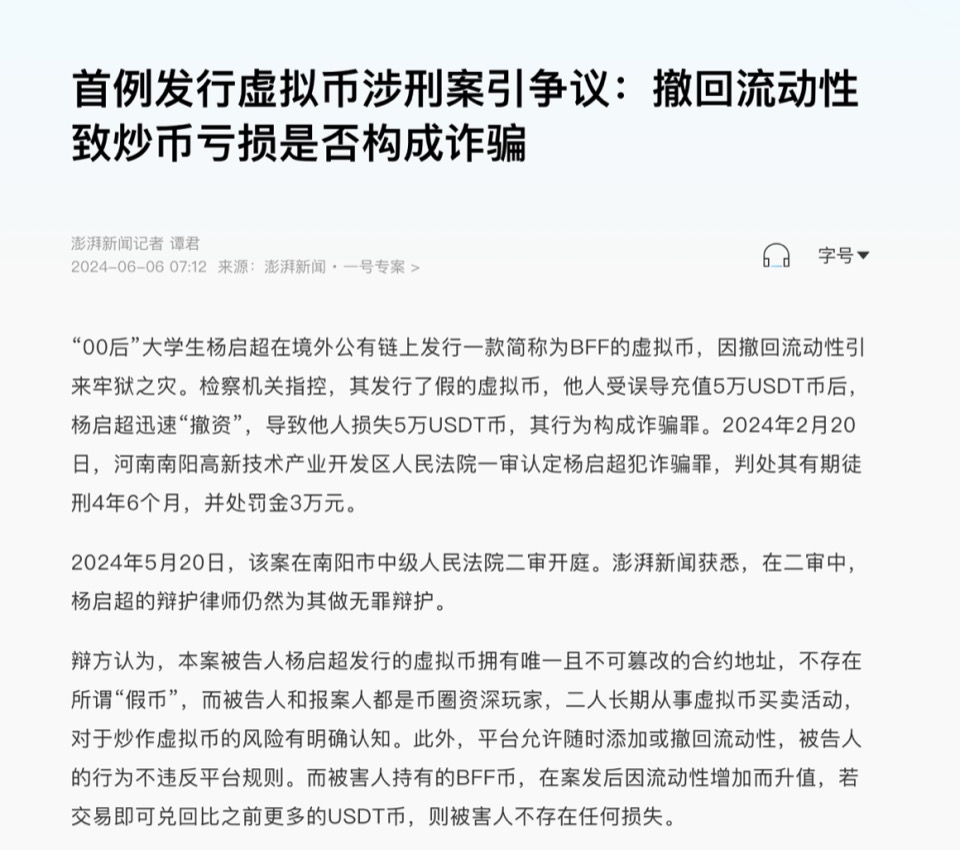
On June 6,a fraud case involving virtual currencies published by The Papergarnered widespread attention in China. The protagonist was Yang Qichao, a university student born after 2000, who issued a virtual currency named BFF on an overseas public blockchain and rapidly withdrew liquidity, causing investor Luo to lose 50,000 USDT. In the first-instance judgment, Yang Qichao was found guilty of fraud and sentenced to four years and six months of fixed-term imprisonment, along with a fine of RMB 30,000. However, during the second instance, Yang’s defense counsel pleaded not guilty, arguing that Yang’s actions complied with platform rules and that Luo should have had full awareness of the risks associated with virtual currency investments.
*Image source: Screenshot from The Paper
As the first criminal case involving the issuance of virtual currencies, this case has sparked intense debate not only at the legal level but also widespread discussion in society upon its disclosure. The high-risk nature of the virtual currency market and regulatory uncertainty have once again become focal points of public concern.
Although no final conclusion has been reached, the arguments presented by various parties in this case represent the current societal, legal, and regulatory perspectives and attitudes toward participation in virtual currency projects.
Arguments of the Prosecution and Defense
Based on news reports, Lawyer Hong Lin has summarized the core content of this case and the main viewpoints of all parties.
Prosecution’s Viewpoint: A Carefully Orchestrated Scam
The prosecution firmly asserts that Yang Qichao induced Luo to deposit 50,000 USDT by creating a fake BFF token with the same name as the “Qudong Weilai” virtual currency, and then rapidly withdrew funds, thereby effectively defrauding Luo of his capital. Although virtual currencies are not regarded as legal tender in China, their trading on international platforms and the economic benefits derived therefrom exhibit property attributes. The prosecution argues that these can be converted into Renminbi for sentencing purposes.
Defense’s Viewpoint: Legitimate Arbitrage Activity
The defense counsel stated that the virtual currency issued by Yang Qichao had a unique and immutable contract address, complying with the technical specifications of virtual currency transactions, and thus did not constitute counterfeit currency. Meanwhile, Yang’s withdrawal of liquidity after issuing the virtual currency was a legitimate arbitrage activity that did not violate platform rules. The defense further pointed out that Luo, as an experienced participant, should have had clear awareness of the risks involved in virtual currency trading. His participation constituted high-risk speculative behavior, and he should bear responsibility for his own investment decisions. Furthermore, the defense emphasized that, under current laws and regulations, virtual currency investment activities are not protected by law; both parties’ transactions were illegal financial activities, and the losses should not be afforded legal protection.
Victim’s Viewpoint: An Innocent Investor
Luo firmly maintained that he was defrauded. He purchased BFF tokens in the same second that Yang Qichao added liquidity, but due to Yang’s rapid withdrawal of funds, the virtual currencies he held depreciated significantly. He reported to the police that he lost 50,000 USDT (equivalent to more than RMB 300,000), alleging that Yang Qichao defrauded him of his funds through false publicity and rapid withdrawal of funds. In court, he stated that he rushed to buy BFF tokens via a mobile trading platform in the parking lot of a supermarket in Nanyang High-Tech Zone, expecting to gain profits through early-stage investment. He denied using scripts to automatically purchase BFF tokens, claiming instead that he made manual purchases, and emphasized that he was a victim.
Speculation and Arbitrage in Virtual Currencies
The virtual currency market has always been rife with opportunities for speculation and arbitrage. From the early days of Bitcoin to the present, various forms of virtual currencies have emerged endlessly, attracting a large number of investors and speculators. The high volatility of virtual currencies and the relative lack of regulation have resulted in a market filled with various arbitrage activities and potential scams.
The controversy triggered by the Yang Qichao case actually reflects a phenomenon prevalent in the virtual currency market—rapid arbitrage behavior. Although his defense counsel attempted to characterize his actions as legitimate arbitrage operations, for most ordinary investors, such rapid withdrawal of funds resembles a “pump-and-dump” scam.
In the virtual currency trading market, arbitrage activities vary widely; some are legitimate market operations, while others tread the gray areas of law and morality. Below are some common methods of virtual currency arbitrage:
-
Spatial Arbitrage: Utilizing price differences between different exchanges to buy low and sell high. For example, purchasing Bitcoin on Exchange A and then selling it on Exchange B, where the price is higher, to profit from the price spread.
-
Triangular Arbitrage: Conducting arbitrage within the same exchange by leveraging price discrepancies among different trading pairs. For instance, exploiting price differences among BTC/ETH, ETH/USDT, and BTC/USDT to achieve risk-free returns through rapid trading.
-
Liquidity Mining: Providing funds to liquidity pools of decentralized exchanges (such as Uniswap and SushiSwap) to earn transaction fees and platform rewards. This method typically involves high returns accompanied by high risks.
-
Lending Arbitrage: Borrowing virtual currencies at low interest rates on one platform and depositing or staking them at high interest rates on another platform to profit from the interest rate differential.
-
Cash-and-Carry Arbitrage: Engaging in arbitrage by exploiting price differences between the spot market and the futures market. For example, buying spot Bitcoin while simultaneously shorting an equivalent amount of Bitcoin in the futures market to lock in risk-free returns.
-
Arbitrage Bots: Using automated programs to execute high-frequency trades at the millisecond level to capture tiny market price spreads. This approach requires significant technical expertise and capital thresholds.
-
Liquidity Withdrawal Arbitrage: Adding liquidity to a decentralized exchange and then rapidly withdrawing it, profiting from changes in the token ratios within the liquidity pool. Such behavior is sometimes referred to as a “rug pull” and remains controversial both morally and legally.
In such a market environment, how can investors protect themselves from harm caused by similar behaviors? Furthermore, how should the boundary between legitimate arbitrage and illegal fraud be defined? These questions not only pertain to the final judgment in the Yang Qichao case but also relate to the future development of the virtual currency market.
Mankun Lawyers’ Perspective
Currently, the legal status of virtual currencies remains unclear in many countries and regions, with varying regulatory policies across jurisdictions. Some countries have established relatively clear legal frameworks, while others are still exploring appropriate approaches. For instance, the United States and the European Union impose stricter regulations on virtual currencies, requiring virtual currency exchanges and related enterprises to comply with anti-money laundering and counter-terrorism financing laws and regulations. In 2019, the U.S. Securities and Exchange Commission (SEC) filed a lawsuit against Telegram’s project, ultimately ruling its Initial Coin Offering (ICO) illegal and ordering the return of funds to investors. In China, virtual currency trading and ICOs (Initial Coin Offerings) are comprehensively prohibited. The Chinese government has repeatedly issued notices and announcements clarifying that virtual currencies do not hold the status of legal tender, and that investment and trading activities are not protected by law.
Moreover, new practices and innovations continue to emerge in the virtual currency market, from Decentralized Finance (DeFi) to Non-Fungible Tokens (NFTs), attracting substantial capital and investor attention. However, these emerging fields are likewise accompanied by significant risks and uncertainties. For example, frequent hacker attacks and exploits of smart contract vulnerabilities in DeFi projects, as well as price bubbles and hype phenomena in the NFT market, demonstrate the high complexity and volatility of the virtual currency market.
The high-risk nature of the virtual currency market is reflected not only in market fluctuations and technical vulnerabilities but also in the prevalence of fraud and illegal fundraising activities. Despite repeated warnings from governments and regulatory authorities, the allure of high returns in the virtual currency market continues to attract numerous unsuspecting investors.
In mainland China, criminal cases involving virtual currencies are gradually increasing, highlighting the legal and investment risks in the virtual currency market. For example, in 2018, Shenzhen public security organs solved a fraud case involving virtual currency “cloud mining,” with the amount involved reaching hundreds of millions of Renminbi. The criminals used the pretext of high returns from virtual currencies to attract investors to purchase so-called “mining machines,” which was in fact a Ponzi scheme. In the same year, Hangzhou police also cracked a case of illegal fundraising using virtual currencies, with the amount involved exceeding RMB 1 billion, affecting thousands of investors.
However,courts often lack clear and uniform adjudication rules when handling such cases, causing considerable confusion regarding judicial certainty for grassroots judicial personnel and parties involved in the cases. For instance, the Supreme People’s Court explicitly stated in guiding cases that it does not support redemption transactions between virtual currencies and legal tender. Yet, in the Yang Qichao case, the court of first instance recognized the property attributes of virtual currencies, indicating inconsistencies in judicial practice.
As legal practitioners in the Web3 industry, personally speaking,the most absurd aspect of this case is this: If investors make profits in the virtual currency market, it is attributed to their own capabilities and insight; but if they incur losses, they resort to state public power by reporting to the police in an attempt to recover their losses. This approach is somewhat outrageous.
The high-risk nature and volatility of the virtual currency market dictate that investors must possess sufficient knowledge and judgment, rather than attributing their investment decision errors to others or seeking state protection. Therefore, enhancing investor education and risk awareness is the fundamental way to avoid similar disputes and losses.
As a new type of financial instrument, virtual currencies hold immense potential but must operate within a legal framework to truly realize their value. We call on relevant authorities to promptly issue clearer regulatory policies for virtual currency trading and more definite court adjudication rules, thereby protecting investors’ interests while promoting the healthy development of the industry.
Recommended Reading
Internet Celebrity KOLs Issue Tokens to Leverage Fan Economy: Legal Risks Behind the Popularity of Friend.tech and TimeStore
Blockchain Projects Issue Tokens Without Liquidation: What Should Investors Do?
Can Registering a Singapore Foundation Legally Issue Virtual Currencies?

{loadmoduleid 245}
To submit articles or request permission for reprinting, please add WeChat ID: MankunLawFirm