
A Tribute to Comrade Chuan Jianguo
Special Disclaimer:
This article is an original work by Mankun Law Firm. It represents only the personal views of the author and does not constitute legal consultation or legal advice on specific matters. For permission to reprint this article, please contact Mankun Law Firm staff at: MankunLawFirm
In 2024, the world has become increasingly surreal.
Upon waking up this morning, I learned that Donald Trump, a leading candidate in the US presidential election, had been convicted.
According to CCTV News, a jury in a New York court handling the "hush money" case involving former US President Donald Trump delivered its verdict yesterday, finding Trump guilty on all 34 felony counts of falsifying business records.Trump has become the first former US president to be convicted of a crime.。

Image source: Foresight News
New York State prosecutors stated that during his 2016 presidential campaign, Trump commissioned Michael Cohen to pay adult film actress Stephanie Clifford $130,000 in "hush money" to prevent her from publicizing a 2006 affair with Trump, which could have adversely affected the election outcome. Trump subsequently falsified business records by reimbursing Cohen's advance payments in installments under the guise of "legal fees," thereby concealing his violations of New York State and federal election laws.
Each of Trump's 34 felony convictions carries a maximum sentence of four years' imprisonment. The judge is scheduled to pronounce sentence on July 11.
An article written by Mankun lawyers this morning,"The Legal Dilemmas Facing OTC Merchants in Virtual Currencies"was featured by Foresight News, coinciding with the concept coins associated with the US presidential election. This juxtaposition carries a certain comedic tone.
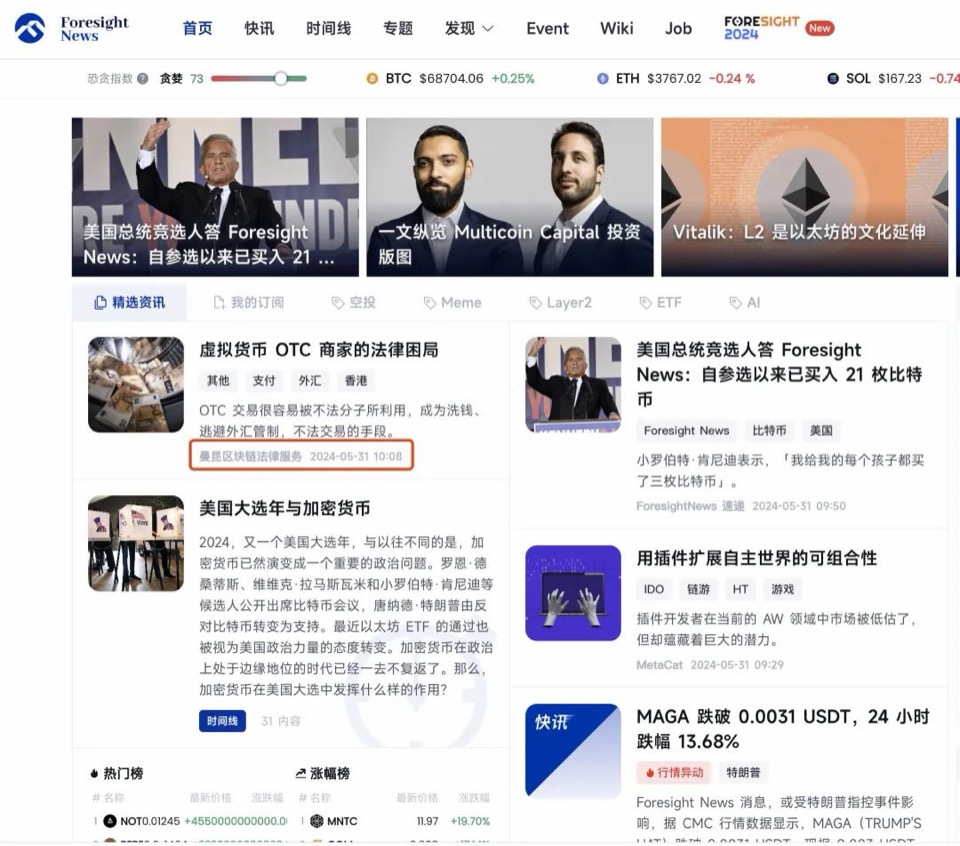
Image source:Foresight News
Due to the US election, candidates have largely adopted "clear-cut" stances in support of virtual currencies.Why are candidates in the US election, including Trump, using cryptocurrencies as a banner?The reason is none other than to secure voters' ballots.
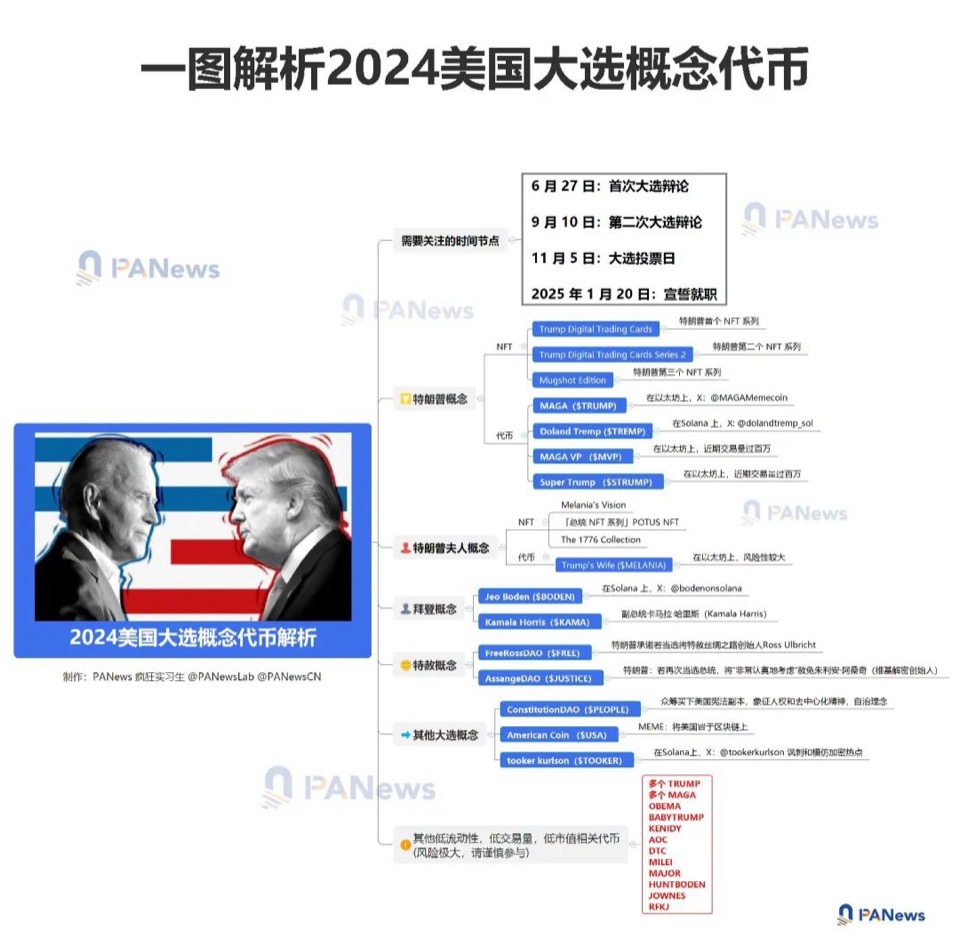
Image source:PANews
In March 2024, a poll showed that 69% of Americans were dissatisfied with the current financial system, and 19% of registered US voters had purchased cryptocurrencies.
According to a research report released by CouponBirds in March, 45.2% of American parents who own cryptocurrencies have already purchased some for their children, and 40.6% of parents plan to specifically purchase cryptocurrencies for their children in the future.
Data disclosed by the listed exchange Coinbase on the X platform in May indicated that in 2023, 52 million Americans owned cryptocurrencies, accounting for 20% of the US adult population.
Therefore, the influence of the cryptocurrency community on the US election is growing day by day. Given Comrade Chuan Jianguo's consistent opportunistic style, we can reasonably believe that his promotion of virtual currencies is purely for votes.
Although Trump is unreliable, his statement that "Bitcoin production must be ensured in the United States" holds significant reference value. After all, whoever controls the supply controls the pricing. Perhaps Chinese regulatory authorities need to re-examine mainland China's regulatory policies regarding virtual currencies, especially Bitcoin mining.
If Trump is sentenced, can he still serve as president?
The Republican National Convention will formally nominate the presidential candidate on July 15, and the second presidential debate is scheduled for September 10. This raises the question: If Trump is indeed sentenced, can he still serve as US President?
It is worth noting that in China, anyone with a criminal record, along with their immediate family members, is generally disqualified from becoming civil servants, as they would fail the most basic political background check.
Interestingly, there is no explicit federal law in US history prohibiting convicted individuals from running for president. The US Constitution clearly stipulates the qualifications for running for and serving as president. According to Article II, Section 1, Clause 5 of the Constitution, a presidential candidate must meet three conditions: be at least 35 years old, be a natural-born US citizen, and have resided in the United States for at least 14 years.
In other words, the Constitution does not mention the impact of criminal convictions on eligibility to run for office.
Trump's verdict may lead to reduced support for him as a candidate within the Republican Party, and may even prompt other potential candidates within the party to seek to replace him. However, even if sentenced, Trump could theoretically still run for and be elected president. This is largely because the US legal system features a complex separation of powers between federal and state authorities, and presidential elections, as a federal matter, are prioritized and protected by the Constitution.
Trump is not the only individual with a criminal sentence who has run for US President. During the 1920 US presidential election, a prisoner serving time participated in the presidential race. His name was Eugene V. Debs.
Debs was sentenced to 10 years in prison in 1918 for anti-war activities and was subsequently incarcerated at the federal prison in Atlanta, Georgia. By the 1920 election year, Debs ran for US President while imprisoned, becoming the first prisoner in US history to participate in a presidential election.
Unlike typical US presidential candidates, Debs was unable to campaign across various states. Instead, he relied on writing in-depth columns criticizing the prison system for media outlets from within the prison to boost his popularity. Ultimately, Debs received 3.4% of the total votes. Although he did not enter the White House, the new President, Warren G. Harding, ordered Debs' release, granting him freedom.
Therefore, as a country characterized by its uniqueness and enduring sense of entertainment, from a legal perspective, Trump can still run for US President even if convicted.
Addressing a somewhat tangential topic
There is another detail in Trump's case worthy of criticism. Trump used the payment of legal fees as a means for his lawyer to manage relationships and resolve issues. This practice is not unique to the US; it is also common domestically.
Especially in criminal cases, certain individuals who have left the public sector transition into becoming "lawyers" (quotation marks are used here deliberately, as this behavior is deemed detrimental to the dignity of legitimate lawyers) but find legitimate legal work tedious and unprofitable. Consequently, they resort to unethical practices, eagerly engaging in the business of judicial brokerage.
A common tactic involves such a "lawyer" assuring clients during consultations that officials at specific procuratorates, public security bureaus, or courts are their close friends, buddies, or former classmates, and that entrusting the matter to them will ensure a favorable outcome. The former aura of their public service instantly dazzles the client, creating an illusion of seeing the "light of righteousness."
More strikingly, after making these bold assurances, they demand exorbitant "public relations" fees, ranging from hundreds of thousands to millions. Any client would feel somewhat bewildered by this situation. After all, the claims are ambiguous; while it is true that they may have such connections, it is unclear whether they can actually deliver the promised results, as such guarantees are not included in the contract.
After much hesitation, influenced by successful anecdotes from acquaintances who resolved matters through connections, clients often think, "Since I need a lawyer anyway, why not choose one with 'connections'?" Thus, they fall into the trap. Only later do they realize that these "connection fees" are akin to a bottomless pit. A common scenario involves paying hundreds of thousands, only to be told that the efforts are insufficient and that additional individuals require further "facilitation." In such situations, family members face a dilemma: continuing to pay risks falling into a bottomless pit, while stopping means the previous payments may have been wasted.
Judicial brokers exploit this mindset effectively. More importantly, for these money-making "lawyers," the business is risk-free. If the matter is resolved through payments, the family expresses gratitude, viewing the lawyer as highly capable. If the matter is not resolved, the lawyer's standard response is, "Look at how many connections we have leveraged; unfortunately, your payment was insufficient." With such flexibility, the lawyer remains immune to criticism... In these circumstances, the client or their family becomes prey.
As ordinary citizens, we may have become accustomed to being misled by lawyers. However, Trump, as a former US President, being misled by his lawyer, is likely a unprecedented occurrence. Truly characteristic of Trump, educating the public through his own legal experiences.

{loadmoduleid 245}

To submit articles or request permission for reprinting, please add WeChat ID: MankunLawFirm