AI summaryOn September 10, 2024, the AI + Web3 Industry Forum, co-hosted by Draper Dragon, Uweb, and HKBA, kicked off. The forum brought together entrepreneurs and elites from the Web3 and AI industries to jointly explore directions for industry innovation and pathways to implementation. Mankun Law Firm was also invited to participate.…
On September 10, 2024, the AI + Web3 Industry Forum, co-hosted by Draper Dragon, Uweb, and HKBA, kicked off. The forum brought together entrepreneurs and elites from the Web3 and AI industries to jointly explore directions for industry innovation and pathways to implementation. Mankun Law Firm was also invited to participate. Liu Honglin, Founder and Managing Partner of the firm, served as a keynote speaker and shared insights on “Web3 Startup Compliance: Don’t Be ‘Too Web3’,” offering reference guidance for Web3 entrepreneurs from a legal perspective.
 The entire presentation revolved around compliance issues in the Web3 industry, combining recent high-profile events to analyze common pitfalls and challenges in compliant operations for Web3 projects. Starting from industry practices and considering China’s current regulatory landscape, Attorney Liu Honglin emphasized the importance of compliance in business operations, clearly identified the current policy red lines in China regarding virtual currencies and blockchain, and proposed how Web3 practitioners can promote lawful and compliant innovation and development within this context.
We have compiled these insights into this article to share with more Web3 entrepreneurs.
The entire presentation revolved around compliance issues in the Web3 industry, combining recent high-profile events to analyze common pitfalls and challenges in compliant operations for Web3 projects. Starting from industry practices and considering China’s current regulatory landscape, Attorney Liu Honglin emphasized the importance of compliance in business operations, clearly identified the current policy red lines in China regarding virtual currencies and blockchain, and proposed how Web3 practitioners can promote lawful and compliant innovation and development within this context.
We have compiled these insights into this article to share with more Web3 entrepreneurs.
Project Teams Suspected of Illegality Are Not Necessarily Due to Token Issuance
Hello everyone, I am Liu Honglin, Founder of Mankun Law Firm. I am delighted to be here today to share some of my views on the theme “Web3 Project Compliance: Don’t Be ‘Too Web3’.”
First, allow me to introduce ourselves. Mankun Law Firm is the first law firm in China dedicated exclusively to the Web3.0 blockchain industry, currently operating offices in Shanghai and Hong Kong. We are currently preparing to open offices in Hangzhou and Shenzhen, and colleagues from our Hangzhou team are present today. Mankun Law Firm specializes in providing one-stop legal services to enterprises and individual users in the Web3.0 industry, including security in crypto asset transactions, crypto asset investment and financing, establishment of crypto funds, and compliant overseas issuance for projects going global.
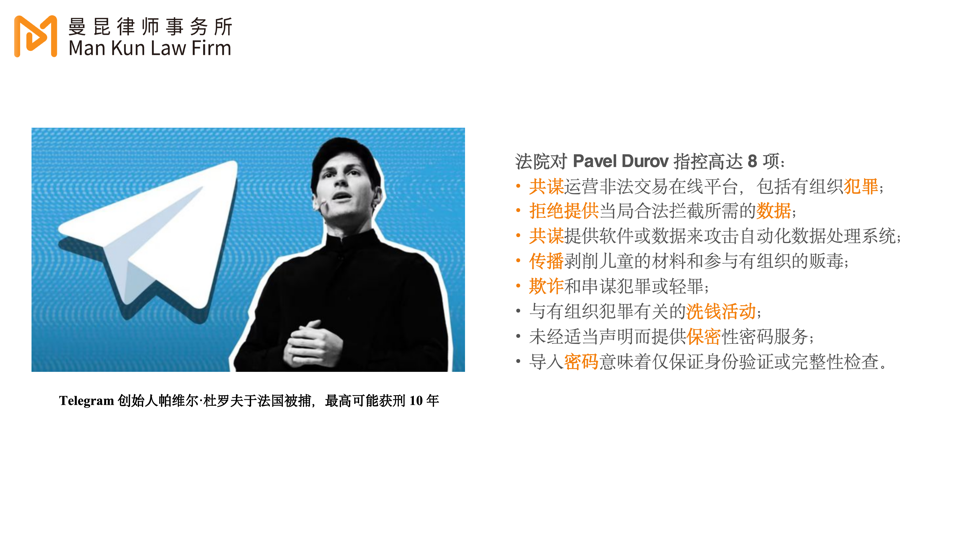
In today’s sharing, I would like to discuss compliance issues for Web3 projects through a recent high-profile industry event. On August 25, Pavel Durov, the founder of Telegram, was detained in Paris, facing eight charges, including conspiracy to commit crimes, refusal to provide data, and dissemination of illegal information.
This event had a significant impact on the TON project, which collaborates closely with Telegram. TON’s market capitalization rapidly dropped by more than ten percentage points from its highs, falling below USD 5. After the incident, many people voiced support for Durov online, and even Russian authorities stepped in to coordinate. Ultimately, Durov was released after posting millions in bail but was required not to leave France.
After his release, Durov posted an audio message online. Although lengthy, its core content comprised two points:
-
First, he stated that his work was not undertaken for profit but to defend people’s fundamental rights, which is his clear political stance.
-
Second, he pointed out that the core of the incident lies in the contradiction between privacy protection and the enforcement requirements of regulatory authorities.
This event reveals a very important truth about compliance in the Web3 industry—The vast majority of projects investigated or encountering legal issues do so not because they issued tokens, but because compliance loopholes emerged during their business operations.
Regarding compliance, many project teams mistakenly believe that establishing a company overseas, obtaining a license, and setting up a foundation for token issuance constitutes compliance. In reality, compliance is a systematic endeavor that permeates every operational aspect of an enterprise. The reason is straightforward:Legal risks arise from business activities; therefore, legal compliance must naturally penetrate every aspect of the business.
Legal Risks Stem from Business; Compliance Must Penetrate Business Operations
Over the past few years, Mankun Law Firm has engaged with numerous project teams facing regulatory investigations or prosecutions by law enforcement agencies. The issues did not stem from operating qualifications or failures to establish proper overseas corporate structures. Rather, the problems often arose during business operations.
For example, some projects resold user data, infringing on privacy; others engaged in activities suspected of pyramid schemes during user acquisition and promotion; and certain platforms, although engaged in virtual asset trading, failed to implement anti-money laundering (AML) compliance measures, thereby becoming hotbeds for funds from gray and black markets. Although these projects operated under the banner of Web3, their issues actually fell within the realm of traditional financial or economic crimes.
Therefore, I wish to remind everyone that when ensuring compliance for Web3 projects, you must not be “too Web3.” Instead, return to the essence of the business andfocus on preventing traditional criminal and financial risks. Compliance is not merely about establishing overseas entities or obtaining licenses; it is a systematic undertaking involving every link in the business chain. For instance, security audits of code, management of user personal information, and compliance requirements for user markets in specific countries and regions are areas requiring our close attention. Meanwhile, risk prevention concerning external commercial partners is also crucial. Many inexperienced Web3 teams are easily misled by industry “veterans,” ultimately becoming victims of reverse exploitation, with these startup teams left to clean up the mess. Therefore, in the compliance process, we must not only focus on internal risk control but also conduct strict due diligence on external partners.
Current Regulatory Landscape for the Web3 Industry in China
Based on Mankun lawyers’ years of continuous monitoring of industry regulatory policies and accumulated practical experience, there are currently three activities explicitly prohibited for Web3 projects operating in China.
First, public fundraising is prohibited.Such activities easily trigger criminal offenses such as illegal fundraising. Whether raising funds in RMB or virtual currencies, China explicitly banned this model of public fundraising following the “September 4 Announcement” issued during the 2017 ICO boom, as such fundraising readily becomes a scheme for illegal fundraising. In fact, this prohibition is not targeted solely at the Web3 industry; public fundraising is illegal in any legitimate industry. However, because virtual assets possess certain economic value, fundraising through virtual assets has also been brought within the scope of regulation.
Second, the operation of virtual currency exchanges is explicitly prohibited in China.Due to foreign exchange controls and the widespread use of virtual currencies in gray and black markets, virtual currency exchanges are not permitted, whether established within mainland China or targeting Chinese users. Many investors may have experienced the freezing of their bank cards during virtual currency transactions. This occurs because the flow of funds involves illicit sources or money laundering activities, not because the trading of virtual currencies itself is illegal. Although individual investors may trade virtual currencies according to their preferences, involvement with funds from gray and black markets may expose them to serious criminal risks.
Third, high-energy-consuming mining activities, such as Bitcoin mining, are prohibited in China.The state is advancing its dual-carbon strategy and restricting high-energy-consuming industries, hence the ban on mining. However, we observe that virtual currency mining is legal in countries such as the United States and Russia, with a growing trend toward green-energy-powered mining. Whether virtual currency mining will be reopened in the future as mining technology becomes more environmentally friendly remains to be seen. From the perspectives of national security and cybersecurity, we do not wish for all Bitcoin to be produced in the United States, as this would be detrimental to China’s national security in the era of asset digitization.
Policy Support and Industry Development Prospects
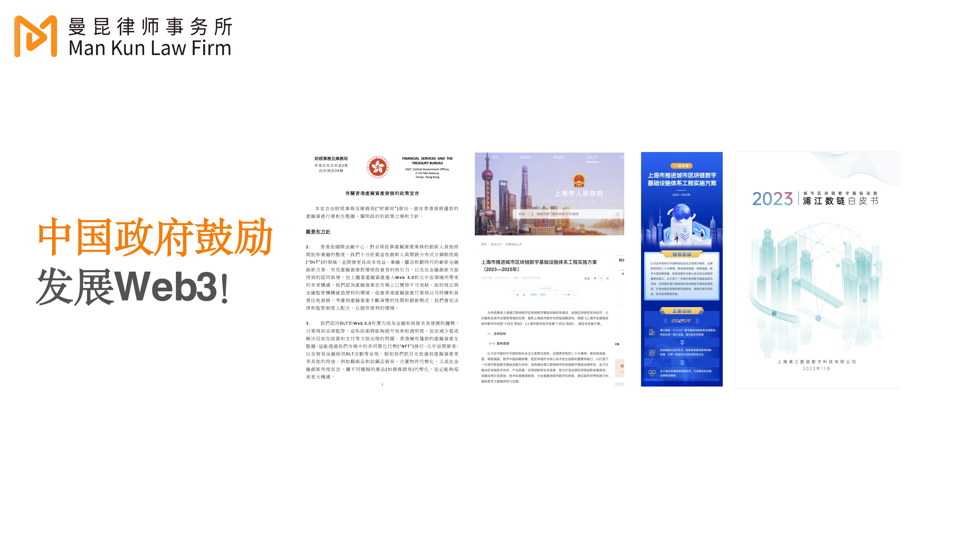
If you pay attention to local investment attraction policies, especially in cities with developed internet economies such as Hangzhou, Shenzhen, and Shanghai, you will see numerous documents encouraging the development of Web3 and blockchain technologies.
Taking Shanghai as an example, at the end of last year, the Shanghai Municipal Government released the “Pujiang Shulian White Paper,” proposing to leverage blockchain technology to establish an international positioning as a global blockchain data exchange center. Meanwhile, Shanghai’s Xuhui and Jing’an districts have introduced a series of specific policies to support the establishment and development of blockchain enterprises.
These policies indicate that the state encourages blockchain technology. The prohibitions on token issuance and operating exchanges do not mean that the state does not support blockchain. Blockchain technology itself has many application scenarios; token issuance and exchanges are merely two of them.
Mankun Law Firm’s Industry Contributions and Persistence
Mankun Law Firm has always been committed to playing a positive and constructive role in the Web3 industry. We often say, “Mankun lawyers do not scare people”; we aim to be good friends to Chinese Web3 entrepreneurs.
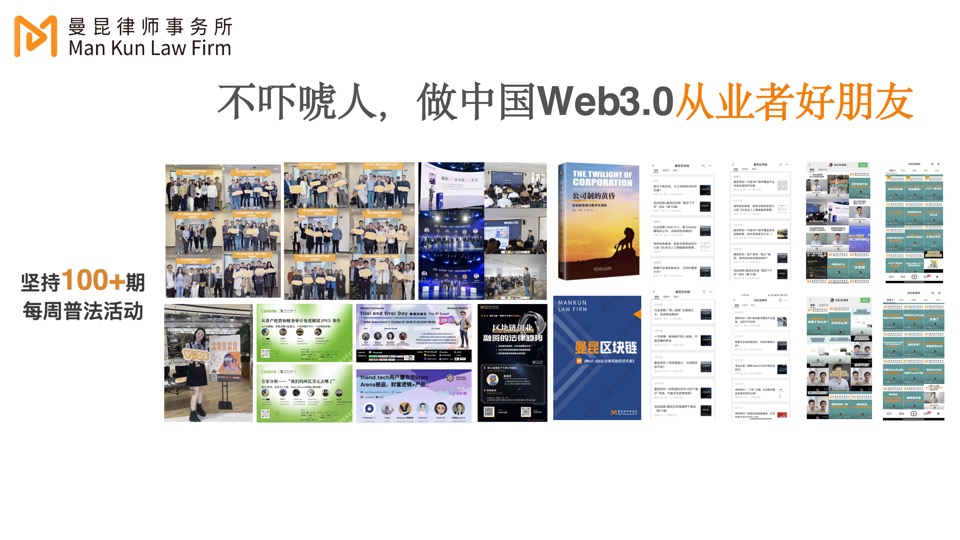
Therefore, we persist in writing daily articles on legal education, pointing out legal issues and potential risks in the industry. We also convey positive messages to more industry partners through short videos. Furthermore, we insist on holding our “Blockchain Afternoon Tea” event every Friday, having hosted over 80 sessions to date. We also actively collaborate with Web3 communities, sharing compliance experience with more entrepreneurs and practitioners through sharing events.
 Finally, thank you to all friends who participated in today’s event. Mankun Law Firm has prepared a benefit for everyone. Over the past few years, we have collected a large number of legal questions concerned by entrepreneurs and industry practitioners, compiling them into a Q&A booklet updated every six months. If you are interested, you may scan the QR code to add our staff member on WeChat to receive this material free of charge. Thank you again for your support and attention. We hope to jointly promote the positive development of the Web3 industry. Thank you all!