

In late August, the Supreme People's Court released the"Announcement on Bidding for Major Judicial Research Projects in 2024". At first glance, this may seem unrelated to the crypto community, but upon closer inspection, you will notice that one of the key funded projects is explicitly titled "Research on Issues Concerning the Disposal of Virtual Currencies Involved in Cases." You might still think, "Well, isn't this just an academic research project? Who knows when it will actually be implemented in practice!"
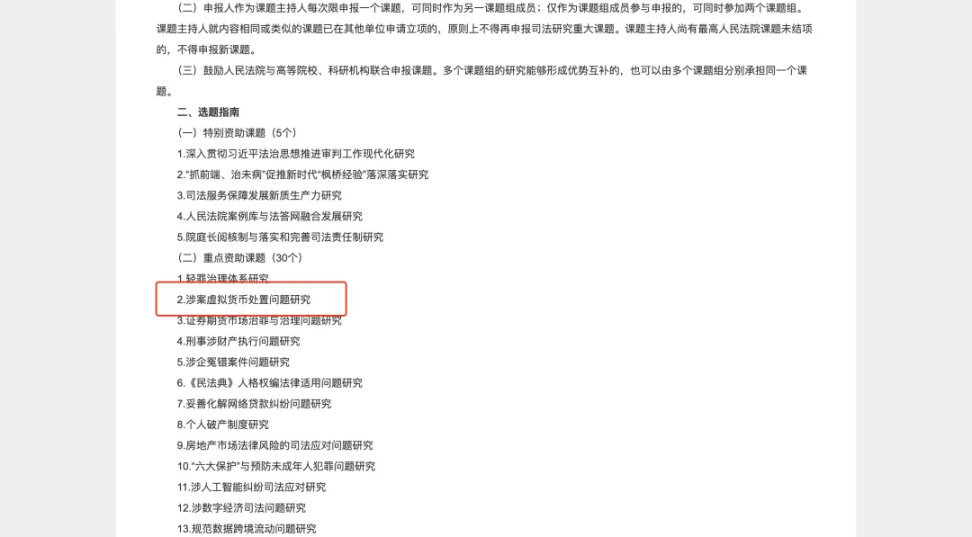
* Image source: Screenshot from the official website of the Supreme People's Court of China
Then, on September 3, the latest update arrived: People's Court Daily published anarticle titled "Judicial Disposal of Virtual Currencies Must Be Standardized", which stated: "In current judicial practice, the disposal of virtual currencies has become a focal issue of widespread concern." "Legal regulation of the judicial disposal of virtual currencies is currently urgent." The terms "widespread concern," "focal issue," and "urgent" collectively illustrate the attention paid by China's judicial sector to the judicial disposal of virtual currencies, reflecting a strong determination to implement solutions.
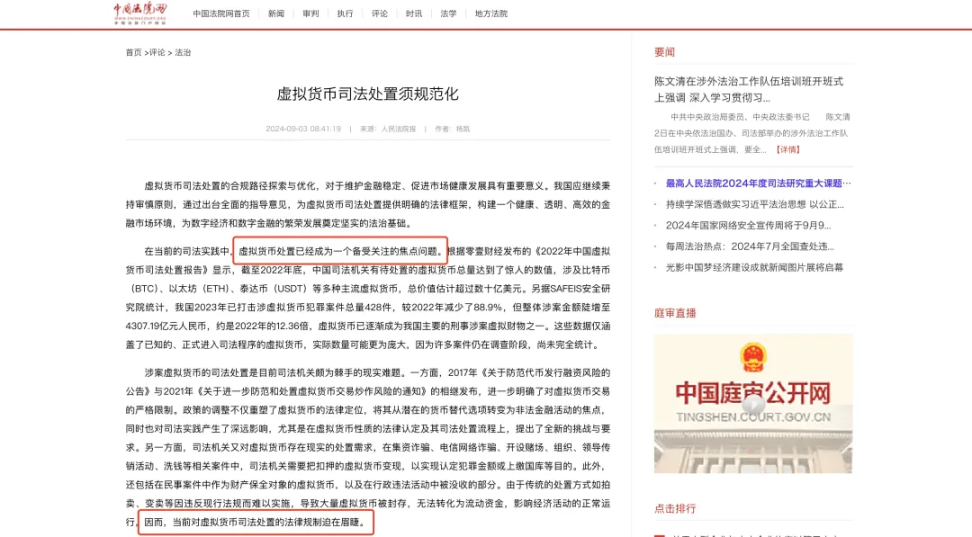
* Image source: Screenshot from China Court Net
Meanwhile, the article also identified legal issues commonly encountered in the judicial disposal of virtual currencies in China, including determination of ownership, valuation of virtual currencies, and lawful liquidation of virtual currencies. This aligns with the views expressed in the article published by Mankun Law Firm as early as November 2023,"Three Major Challenges in the Disposal of Virtual Currencies in Criminal Cases". Furthermore, in Mankun Law Firm's article, Attorney Liu Honglin conducted an in-depth analysis of these three major challenges, which we hereby share.
How Is Ownership of Virtual Currencies Determined?
The determination of ownership of virtual currencies is the prerequisite and foundation for their judicial disposal. Due to the anonymity and decentralization of virtual currencies, their ownership does not rely on real-name accounts or registration with third-party institutions, but is instead achieved through cryptographic principles. Simply put, whoever controls the private key (a complex string of numbers or characters) corresponding to the virtual currency possesses the power to dispose of that virtual currency.
Therefore, in judicial practice,determining whether virtual currencies that have been sealed, seized, or confiscated belong to the criminal suspect or defendant, and whether there are other parties with legitimate rights and interests, is a highly challenging issue.
Currently, judicial authorities primarily obtain virtual currencies involved in cases through the following methods:
(1) Searching, seizing, or confiscating electronic devices (such as mobile phones, computers, hardware wallets, etc.) controlled by the criminal suspect or defendant, and extracting the private keys or passwords stored therein through technical means;
(2) Searching, seizing, or confiscating paper documents (such as paper wallets, notebooks, etc.) recording private keys or passwords from the criminal suspect or defendant;
(3) Searching, seizing, or confiscating recharge cards, bank cards, payment accounts, etc., used by the criminal suspect or defendant, tracing the flow of funds to locate their accounts on virtual currency exchanges or other platforms, and obtaining the virtual currencies therein through judicial assistance or technical means;
(4) Directly obtaining the private keys or passwords controlled by the criminal suspect or defendant based on their confessions or other evidence.
Regardless of the method adopted, judicial authorities must address the following issues:
(1) How to prove that the criminal suspect or defendant has actual control over the obtained private keys or passwords, rather than them being borrowed, stolen, or forged?
(2) How to prove that the virtual currencies corresponding to the obtained private keys or passwords are proceeds of crime or gains derived from criminal activities, rather than legally acquired assets?
(3) How to exclude or handle claims from third parties who assert legitimate rights and interests in the obtained virtual currencies?
(4) How to prevent the leakage, theft, or misuse of private keys or passwords obtained during judicial proceedings?
In response to the above issues, from a compliance perspective, Mankun lawyers believe the following measures should be taken:
(1) When obtaining private keys or passwords, efforts should be made to collect and secure as much evidence as possible to prove their source, nature, and ownership, such as search records, seizure lists, electronic data extraction reports, bank statements, transaction records, network logs, witness testimonies, etc., while avoiding sole reliance on the confessions of the criminal suspect or defendant;
(2) When determining whether the virtual currencies corresponding to the private keys or passwords constitute proceeds of crime or gains derived from criminal activities, case facts and evidence should be combined, comprehensively applying methods such as direct presumption, indirect presumption, and statutory presumption. This includes tracing the source, flow, and use of the virtual currencies, analyzing the causal relationship between the virtual currencies and the criminal acts, and comparing the quantity, type, and value of the virtual currencies with the legal income and property status of the criminal suspect or defendant;
(3) When handling claims by other third parties regarding rights and interests in virtual currencies, their legitimate rights and interests should be fully respected and protected. They should be informed of their remedies, such as applying for hearings, filing appeals, or initiating litigation, in accordance with the law. Their provided evidence should be reviewed, and judgments should be rendered in accordance with the principle of no-fault liability and the principle of remedial requests;
(4) When storing and using private keys or passwords, confidentiality systems and standardized procedures must be strictly observed. A dedicated account management mechanism should be established to prevent the leakage, theft, or misuse of private keys or passwords. If any abnormalities are discovered, immediate remedial measures should be taken, and the relevant responsible persons should be held accountable.
How Is the Value of Virtual Currencies Assessed?
The valuation of virtual currencies is a crucial step in judicial disposal. Due to the lack of unified regulation and pricing mechanisms in the virtual currency market, prices are influenced by various factors, exhibit extreme volatility, and show significant price differences across different trading platforms. Therefore, in judicial practice, determining the value of virtual currencies that have been sealed, seized, or confiscated, in order to facilitate liquidation, restitution, or turnover to the state treasury, is a highly challenging issue.
Currently, judicial authorities primarily employ the following two methods for valuing virtual currencies:
(1) Referring to real-time or historical market data from virtual currency exchanges or other authoritative institutions, converting virtual currencies into fiat currency according to certain exchange rates or conversion formulas;
(2) Commissioning qualified and reputable professional institutions or personnel to issue valuation reports and determine specific value amounts in accordance with scientific valuation principles and methods.
Regardless of the method adopted, judicial authorities must address the following issues:
(1) How to select an appropriate valuation timing,considering the volatility and timeliness of virtual currency prices: Should the price at the time of sealing, seizure, or confiscation prevail, or the price at the time of liquidation, restitution, or turnover to the state treasury? Or should another reasonable compromise solution be adopted?
(2) How to select an appropriate valuation standard,considering the wide variety of virtual currencies and price differences across different trading platforms: Should the price on a specific platform prevail, or the average price across multiple platforms? Or should another reasonable compromise solution be adopted?
(3) How to ensure the objectivity and fairness of valuation results,considering that the virtual currency market involves improper practices such as manipulation, fraud, and insider trading, which may affect the authenticity and validity of valuation data: How can conflicts of interest and corruption during the valuation process be prevented?
(4) How to handle objections and disputes regarding valuation results,considering that valuation results may involve multiple stakeholders, including criminal suspects or defendants, victims, and third parties: How can their rights to information, participation, defense, and remedy be fully safeguarded?
In response to the above issues, from a compliance perspective, Mankun lawyers believe the following measures should be taken:
(1) When determining the valuation timing, factors such as fairness, reasonableness, and operability should be comprehensively considered based on the specific circumstances of the case and judicial objectives. The timing that best reflects the true value and market conditions of the virtual currencies should be selected, such as the time of the incident, sealing, judgment, or execution, with dynamic adjustments made when necessary;
(2) When determining the valuation standard, standards that best reflect the liquidity and fairness of virtual currencies should be selected based on the characteristics of virtual currencies and market laws. Well-known, regulated, and secure trading platforms domestically and internationally should serve as references, with weighted averages or range values applied when necessary;
(3) To ensure the objectivity and fairness of valuations, legal provisions and professional ethics must be strictly observed. Review, supervision, and accountability regarding the sources, processes, and results of valuation data should be strengthened, and relevant information should be disclosed to all stakeholders in a timely, open, and transparent manner;
(4) When handling objections and disputes regarding valuations, the legitimate rights and interests of all stakeholders should be fully respected and protected. They should be informed of their remedies, such as raising objections, requesting reviews, seeking administrative reconsideration, or initiating litigation, in accordance with the law. The evidence and reasons they present should be examined, and rulings should be made in accordance with statutory procedures and standards.
How Can Virtual Currencies Be Lawfully Liquidated?
The method of liquidating virtual currencies is the ultimate purpose and result of judicial disposal. Since virtual currencies do not have legal status equivalent to legal tender in mainland China and cannot be directly used for payment, settlement, or turnover to the state treasury, their value must be realized by converting them into fiat currency. Therefore, in judicial practice, selecting an appropriate liquidation method to timely and effectively dispose of virtual currencies that have been sealed, seized, or confiscated is an urgent issue to be resolved.
Currently, judicial authorities primarily employ the following methods for liquidating virtual currencies:
(1) Entrusting third parties to sell virtual currencies on virtual currency exchanges in exchange for fiat currency;
(2) Transferring virtual currencies to willing and capable buyers through judicial auctions in exchange for fiat currency;
(3) Returning virtual currencies to the original rights holders or transferring them to new rights holders through judicial mediation or other negotiation methods, in exchange for corresponding compensation or damages;
Regardless of the method adopted, judicial authorities must address the following issues:
(1) How to select an appropriate timing for liquidation,considering the volatility and uncertainty of virtual currency prices: Should liquidation occur as soon as possible to lock in value and avoid risks, or at an opportune time to maximize returns and optimize outcomes? Or should another reasonable compromise solution be adopted?
(2) How to select an appropriate channel for liquidation,considering the complexity and diversity of the virtual currency trading market: Should formal, legal, and secure trading platforms or institutions be chosen, or should flexible, convenient, and efficient trading methods or means be selected? Or should another reasonable compromise solution be adopted?
(3) How to ensure compliance and security during the liquidation process,considering that virtual currency transactions may involve legal regulations and risk prevention related to taxation, foreign exchange, and anti-money laundering: How can relevant legal provisions and policy requirements be complied with, and how can situations such as loss, theft, or freezing of funds during the liquidation process be prevented?
(4) How to handle the distribution and attribution of liquidation proceeds,considering that liquidation proceeds may involve multiple stakeholders, including criminal suspects or defendants, victims, and third parties: How can their respective shares be reasonably determined in accordance with legal provisions and judicial rulings, and how can payments, refunds, or turnovers to the state treasury be made to them in a timely manner?
In response to the above issues, from a compliance perspective, Mankun lawyers believe the following measures should be taken:
(1) When determining the timing for liquidation, factors such as fairness, reasonableness, and operability should be comprehensively considered based on the specific circumstances of the case and judicial objectives. The timing that best realizes the value of virtual currencies and protects the rights and interests of stakeholders should be selected, such as when the judgment becomes effective, at the commencement of execution, or at the conclusion of execution, with dynamic adjustments made when necessary;
(2) When determining the channel for liquidation, channels that best ensure the security of virtual currencies and realize their fair value should be selected based on the characteristics of virtual currencies and market laws. Well-known, regulated, and secure trading platforms or judicial auction platforms domestically and internationally should be the primary choice, with comparative selection or comprehensive application employed when necessary;
(3) To ensure openness and transparency in the liquidation process, legal provisions and professional ethics must be strictly observed. Review, supervision, and accountability regarding the liquidation process and results should be strengthened, and relevant information should be disclosed to all stakeholders in a timely, open, and transparent manner;
(4) In handling the distribution of liquidation proceeds, the legitimate rights and interests of all stakeholders should be fully respected and protected. They should be informed of their remedies, such as raising objections, requesting reviews, seeking administrative reconsideration, or initiating litigation, in accordance with the law. The evidence and reasons they present should be examined, and rulings should be made in accordance with statutory procedures and standards.
Summary by Mankun Lawyers
"The harm caused by one wrongful trial far outweighs that of countless crimes, for the latter merely pollute the stream, while the former pollutes the source." This famous quote, often used to elucidate the importance of judicial fairness, is equally applicable in the context of the judicial disposal of virtual currencies.
China has consistently maintained a clear policy stance against the negative social effects of virtual currencies, namely explicit opposition and resolute crackdowns. However, the formulation of rules must generally align with societal development and needs. This is one of the key reasons why the Supreme People's Court of China has included "judicial disposal of virtual currencies" as a key research project. Committed to providing legal services for Web3, Mankun Law Firm hopes to leverage its years of service experience, whether through participation in research projects or the provision of daily legal services, to continuously advance research in the field of virtual currency judicial disposal in China, ultimately ensuring that Web3.0 develops lawfully in China!
This article is an original work of Shanghai Mankun Law Firm. It represents only the personal views of the author and does not constitute legal consultation or legal advice on specific matters.
Recommended Reading
Summary of Global Crypto Industry Regulatory Policies (August 26–September 1, 2024)
Summary of Global Crypto Industry Regulatory Policies (August 12–18, 2024)
OKX Announces Entry into Malta: How Should Virtual Currency Exchanges Respond to MiCA?

{loadmoduleid 245}