
Web3.0 Year-End Lecture
Special Disclaimer:
This article is an original work by Mankun Law Firm. It reflects only the personal views of the author and does not constitute legal consultation or legal advice on any specific matter. For permission to reprint this article, please contact Mankun Law Firm staff at: MankunLawFirm
Good afternoon, friends. I am Attorney Liu Honglin, founder of Mankun Law Firm. Today, I would like to discuss how Chinese Web3.0 startups should approach compliance.

Rather than identifying solely as a lawyer, I prefer to regard myself as an entrepreneur in the Web3.0 industry, whose service happens to be legal in nature. Over the past decade, my entrepreneurial focus has been "Law and Technology." Every entrepreneur has their own mission; the mission of the team at Mankun Law Firm is to ensure that Web3.0 develops legally in China.
At every offline event, I present this slide.
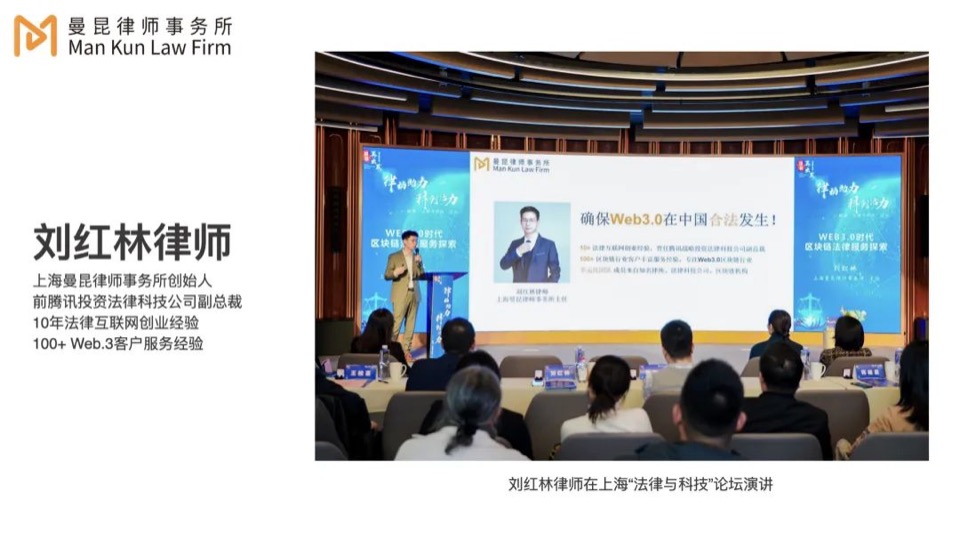
To fulfill this entrepreneurial mission, we established what is likely China's first law firm dedicated to Web3.0. Based in Shanghai and serving clients globally, our team currently comprises more than 30 members. These include elite lawyers from traditional prestigious law firms, as well as professionals from the Web3.0 industry, such as those from asset exchanges, crypto funds, prominent mining farms, and industry think tanks.
Our practice areas essentially cover all legal services required by industry entrepreneurs, including contract disputes involving cryptocurrencies, criminal defense related to virtual currencies, and overseas expansion for blockchain projects. We have established partnerships with many well-known project teams and institutions within the industry.

Today, I wish to share insights on three topics.
These are questions frequently raised, to varying degrees, by many Chinese Web3.0 practitioners I have encountered throughout 2023:
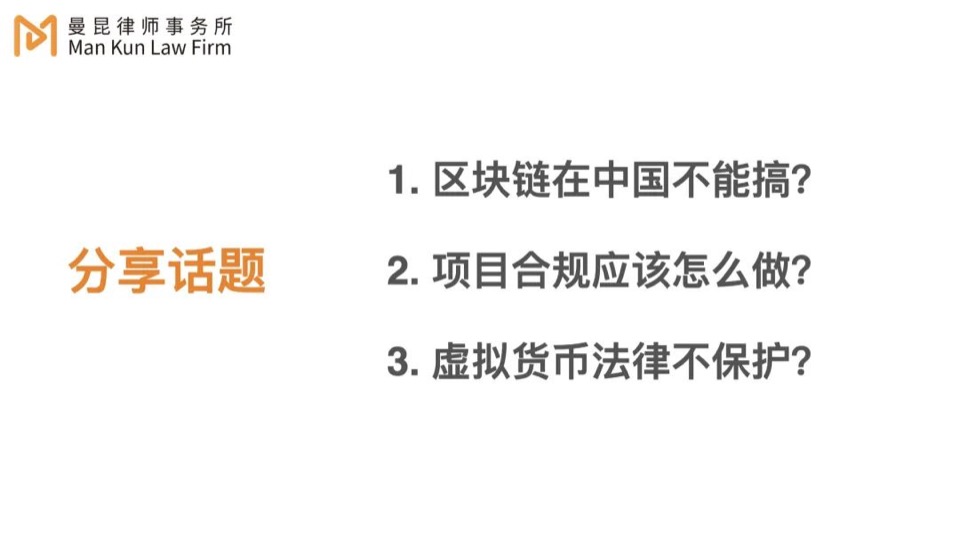
Is Blockchain Development Prohibited in China?
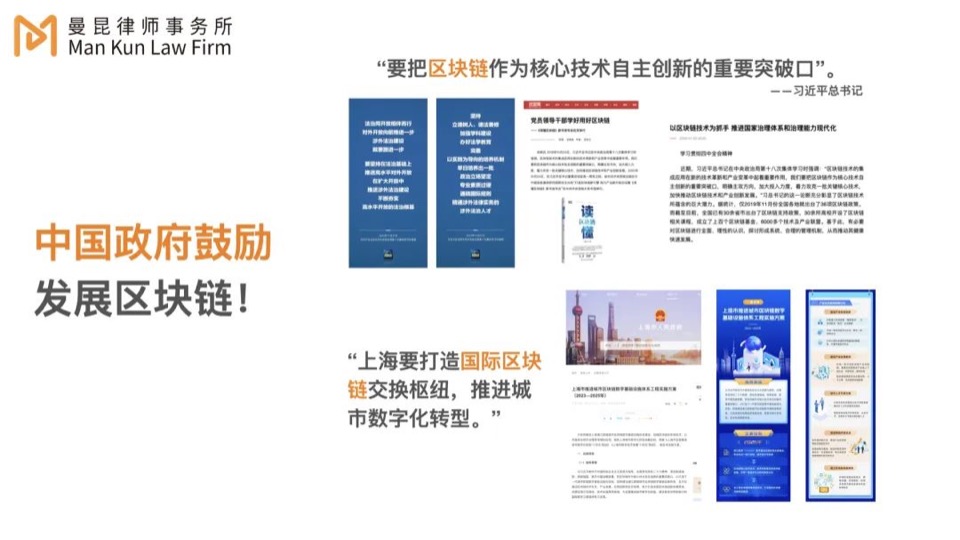
Let us begin with the first topic. Based on our review of China's historical regulatory policies on blockchain, we have found that China adopts a negative list approach to blockchain regulation. Apart from three matters explicitly prohibited by regulators, blockchain development is encouraged by authorities at both central and local levels.

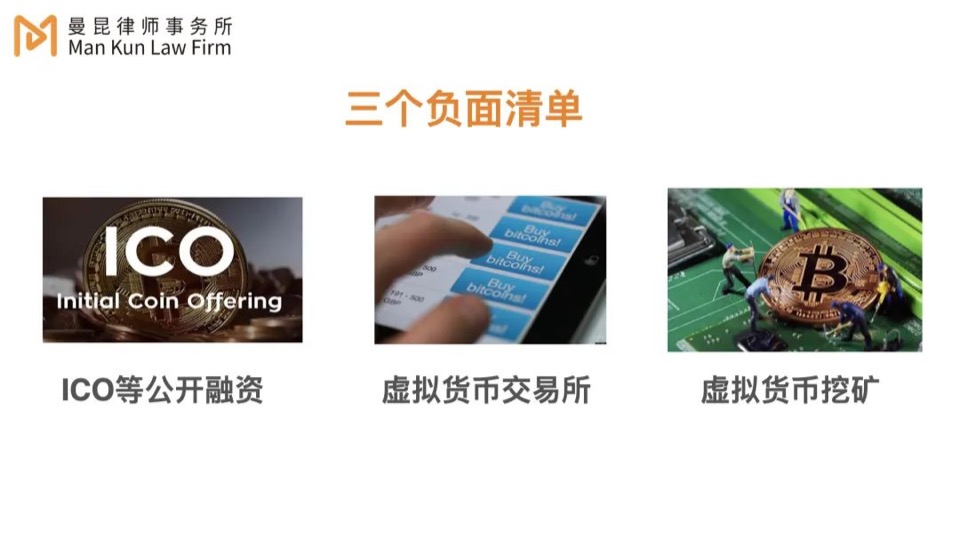
What are the three matters that Chinese blockchain entrepreneurs must avoid?
First, public fundraising from unspecified members of the society, such as Initial Coin Offerings (ICOs) and Initial Exchange Offerings (IEOs).In fact, this prohibition is not specifically targeted at the blockchain industry, as illegal fundraising is prohibited in any industry.
Second, operating virtual currency exchange businesses in China is prohibited.This prohibition includes not only conducting operations within mainland China but also providing services to Chinese citizens.
Third, virtual currency mining activities similar to Bitcoin mining are prohibited within mainland China,due to excessive electricity consumption, which contradicts China's environmental policies regarding carbon peaking and carbon neutrality.
Under the principle that "what is not prohibited by law is permitted," provided your project does not involve the aforementioned three activities, other entrepreneurial ventures are permissible domestically. For instance, Non-Fungible Tokens (NFTs) have gained significant popularity in China since 2022. Although there have been occasional negative reports concerning NFTs in recent years, from a legal perspective, we must objectively state that no entrepreneur has faced legal troubles solely due to the nature of NFT entrepreneurship itself.
Therefore, friends aspiring to succeed in Web3.0 entrepreneurship can proceed with confidence and boldness. This is particularly true for entrepreneurs in Shanghai. Recently, the Shanghai municipal government issued a document stating its intention to establish Shanghai as an international hub for blockchain technology, utilizing blockchain as infrastructure for the city's digital transformation.
How Should Project Compliance Be Implemented?
The second topic I wish to share concerns how blockchain projects should achieve compliance. Many individuals associate compliance with establishing offshore companies and applying for various licenses. Upon learning that the cost of obtaining licenses in Hong Kong can amount to tens of millions, they often abandon the effort.
This represents a common misunderstanding of compliance. Entrepreneurs familiar with Attorney Honglin know that I frequently share the following viewpoint:Compliance efforts can be scaled according to one's resources.
Compliance is not a completed state but an ongoing process. If you aim for full compliance, you will face endless tasks and costs. As your company and business continuously develop, legal risks emerge from business operations. As long as your company operates, compliance efforts must continue indefinitely.
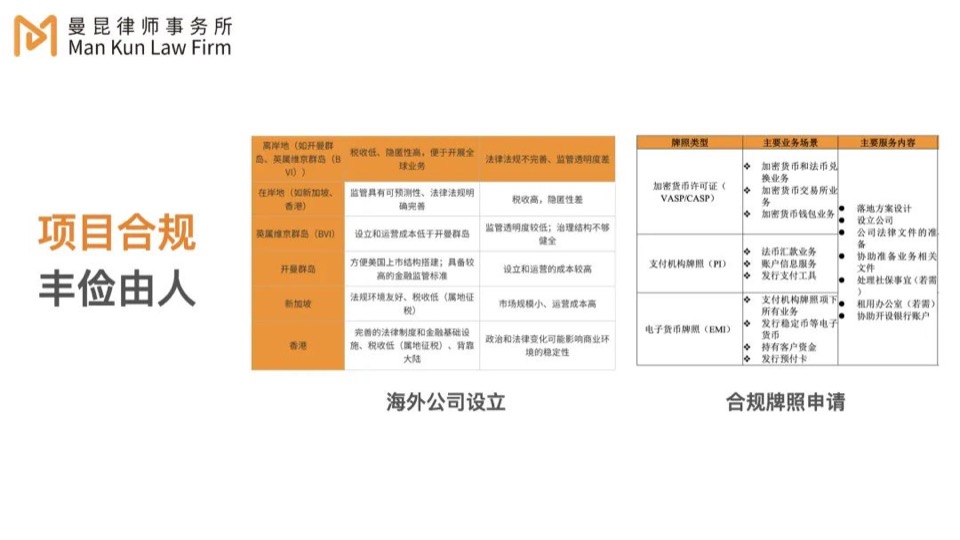
Does this mean compliance becomes a bottomless pit? Certainly not.
All matters involve a consideration of return on investment. As the saying goes, "Use good steel on the blade edge." During the early stages of entrepreneurship, limited compliance budgets should be allocated to the most critical issues.
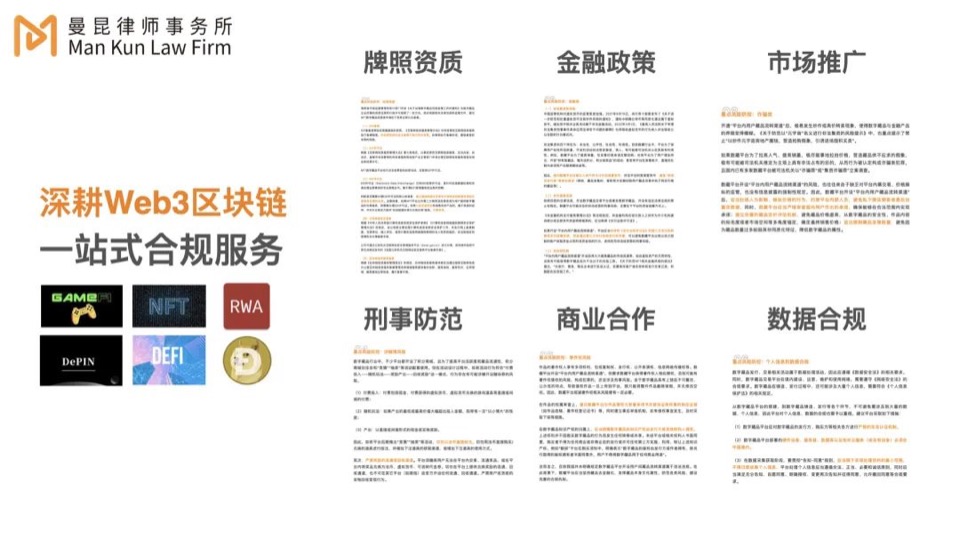
Based on our experience serving numerous blockchain entrepreneurs, we have identified the compliance challenges faced by Chinese Web3.0 founders, ranging from legal risks related to operational qualifications to financial risks and data compliance. Our recommendation is to prioritize addressing criminal risks first, followed sequentially by operational qualifications and marketing/promotional activities.
Why this order of priority? Because entrepreneurial success itself is a low-probability event. While profits may not be guaranteed, personal liberty must be preserved. As long as one remains safe, future opportunities exist.
Why are marketing and promotional activities prone to issues? Because the primary risk points in cryptocurrency-related cases in China concentrate on interactions with users. Arguably, without user complaints or police reports, successful startup teams rarely attract regulatory attention.
Guided by this service philosophy, the Mankun team provides customized compliance services tailored to clients' different stages and business models. For recently popular sectors such as real-world assets (RWA) and DePin, we strive to help entrepreneurs achieve significant outcomes with modest compliance expenditures.
Are Virtual Currencies Unprotected by Law?
The third topic concerns the current status of legal protection for virtual currencies in China. Friends often report that their virtual currencies were stolen, yet local police stations refuse to handle the case, citing the illegality of virtual currencies. Similarly, courts sometimes refuse to accept lawsuits involving virtual currency disputes.
This reflects the current industry reality, which I describe as "metaphysical" within the crypto community, because cases involving virtual currencies with identical facts may receive vastly different treatments in different courts. For example, many courts in Shanghai recognize the validity of contracts involving virtual currencies and may support claims for the return of virtual currencies. In contrast, relevant contracts are deemed invalid in Beijing. Furthermore, while investment funds may not be recoverable under invalid contracts in Beijing, they might still be recoverable in Shenzhen cases.

Such inconsistency is understandably confusing. Fortunately, the relevant rules are expected to become clearer in the future.
In early 2023, a draft opinion was released at the National Courts' Financial Trial Conference, providing guidance on adjudicating cryptocurrency-related cases. I will share several typical scenarios outlined therein.
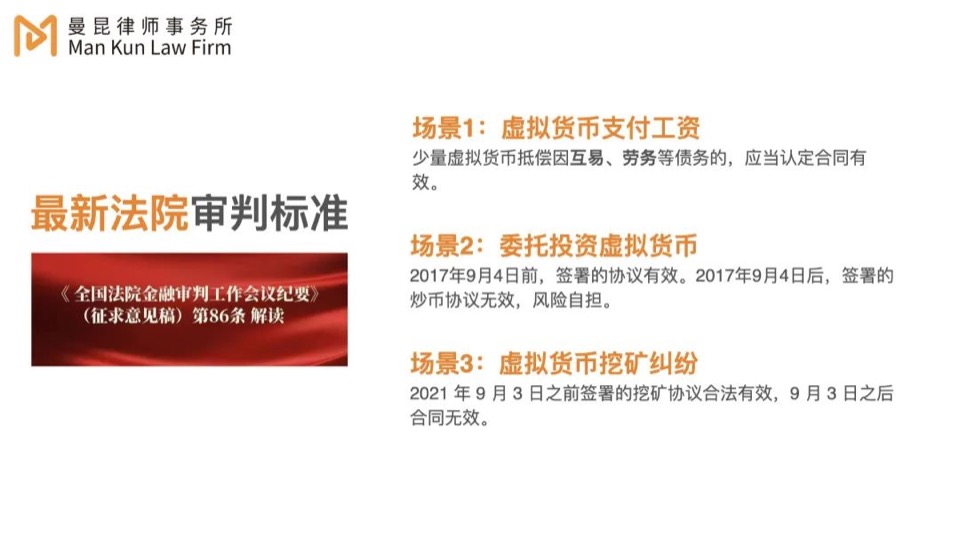
Scenario 1: A company uses virtual currencies to pay wages or service fees. If a dispute arises and proceeds to court, the court should recognize the contract as valid and may order the company to pay virtual currencies. If the counterparty lacks virtual currencies, the court may calculate compensation based on the value obtained by the benefiting party at the time of contract signing. For example, if a project team and an employee agreed on a monthly salary equivalent to 100,000 RMB in USDT, and the company later refuses to pay USDT, the company should pay the employee 100,000 RMB.
Scenario 2: Investing in virtual currency projects through friends—is the contract valid? Validity depends on the signing date. Investment agreements signed before September 4, 2017, are valid. Agreements signed after September 4, 2017, are invalid because the agency matter is illegal. Losses suffered by the principal may be shared between the parties based on the causes related to the entrusted matter.
Scenario 3: The legal validity of contracts involving virtual currency mining cannot be uniformly determined; it depends on the "contract signing date" and the "date litigation was initiated." Mining agreements and related matters signed before September 3, 2021, are legal and valid, as the state had not explicitly prohibited them. Mining agreements and related matters signed after September 3, 2021, are invalid. This applies to both pure mining agreements and varied arrangements combining mining machine sales with custody services.
Being a Good Friend to Chinese Web3.0 Entrepreneurs
The topics shared today represent the legal issues we research and handle daily over the past two years. We share insights with industry practitioners through daily legal education articles, short videos, and industry exchange events. Our core philosophy is singular: to befriend Chinese Web3.0 entrepreneurs, help them resolve various unusual legal problems encountered during entrepreneurship, safeguard ambitious young professionals, jointly promote the compliant development and progress of the industry, and ensure that Web3.0 develops legally in China.
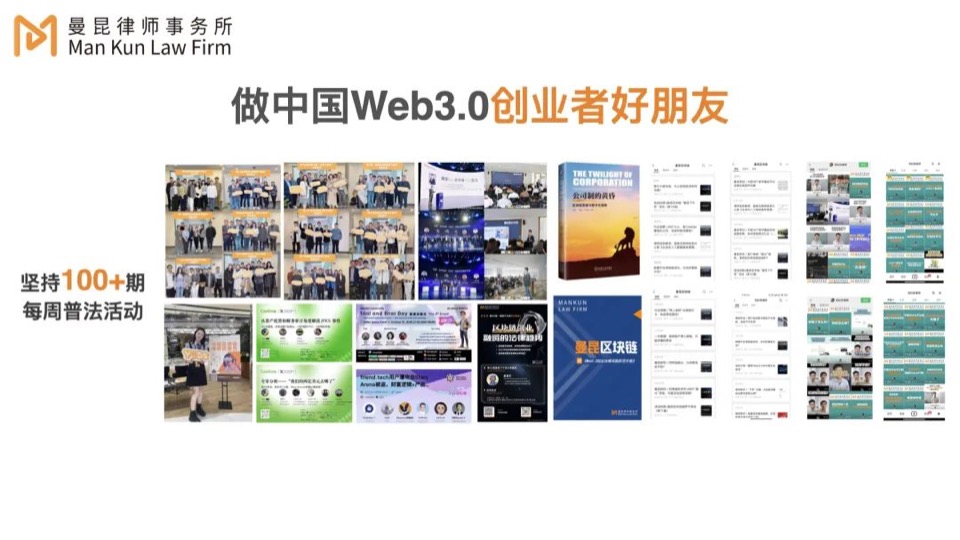
As a bonus for today's event, we have compiled frequently encountered legal questions for Chinese Web3.0 entrepreneurs into a Q&A booklet, which we are airdropping to everyone. Welcome to scan the QR code to add Mankun staff on WeChat to receive your copy.

Once again, thank you to the organizers for the invitation and to all new and old friends for your support. Wishing you great success and continued achievements in the new year.
Recommended Reading
Starting a Crypto News Media Venture: How to Prevent Legal Risks?
zkSync Shanghai Tour: How to Legally and Compliantly Host Web3 Offline Events?

{loadmoduleid 245}

To submit articles or request reprint permissions, please add WeChat ID: MankunLawFirm