Mankun Law Firm's official website Version 1.0 quietly went live.
From the first version record left on July 9, 2026, to tonight, July 22, this code repository already contains 361 commits. The homepage, services page, lawyer profiles, article system, Q&A system, back end, content migration and deployment were 100% built by me, Lawyer Honglin, alone — and I do not know how to write code.
But this article is not a feel-good piece about "generating an official website with AI in ten minutes." Using Mankun Law Firm's official website 1.0, I want to seriously break down how a lawyer who cannot write code used AI to step into the product process; and to lay out the design thinking connecting the website's front end, back end and legal services, leaving a stage-by-stage record for people who are using AI to build products.
The website must have Mankun's taste
The earliest idea was actually very simple: Mankun Law Firm needed an official website that felt more like itself.
Traditional law firm websites follow a very mature template. A dark blue or dark red background, a city skyline, a gavel, scales of justice, Roman columns, paired with a row of "professional, efficient, trustworthy, excellent." Such websites are of course safe, but Mankun Law Firm has long served Web3, artificial intelligence, crypto payments, real-world assets (RWA) and cross-border business, and our clients are building new products and entering new markets every day. If our website still looked like it was stuck ten years ago, that would be somewhat hard to justify.
I did not start by choosing a template. Instead, I first asked: when a potential client opens Mankun Law Firm's official website, what do they most want to confirm?
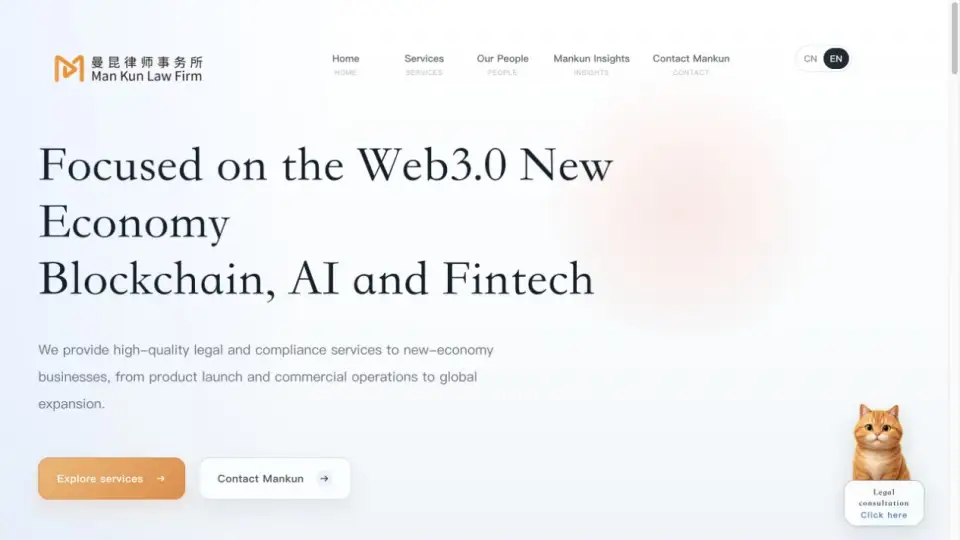
The first screen of the homepage answers only one thing — whether you truly understand the industry I am in. So the page does not first pile up the firm's history and honors; instead, it states directly: focused on the Web3.0 new economy, with deep expertise in blockchain, AI and technology finance. Only further down does the reader see, in order, service scenarios, professional lawyers, research content and the consultation entry point.
Visually, I also did not interpret "a sense of technology" as a black background, fluorescent blue and a constantly rotating globe. The primary color comes from Mankun Law Firm's orange logo, and the background uses warm white, light gray and restrained gradients. The page retains a good deal of white space, because legal services are inherently a high-information-density business.
The noisier the interface, the more tired the reader becomes.
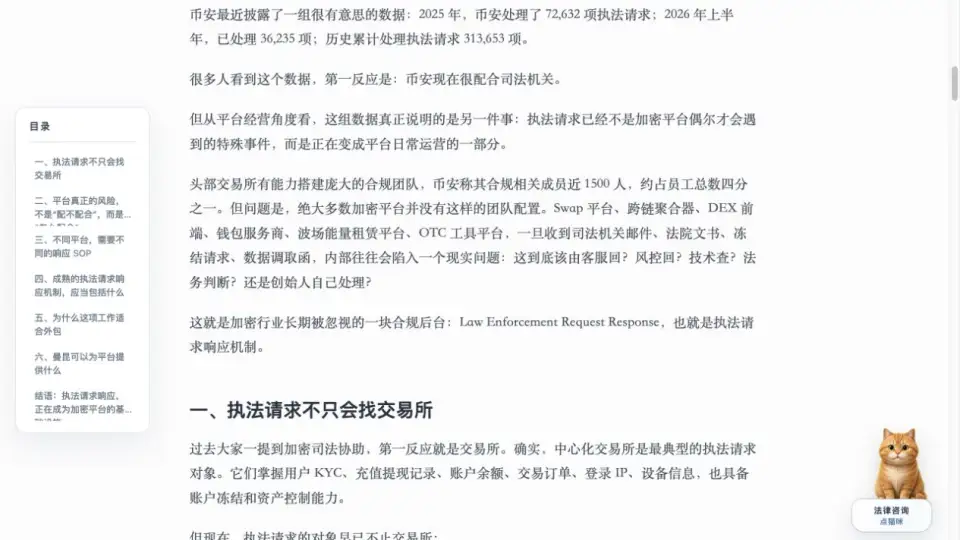
The cat in the lower right corner is the least law-firm-website-like thing on the entire site. It was originally just a small easter egg, and later I turned it into a site-wide consultation entry point. Readers can find it on the homepage, lawyer profiles, research articles or Q&A details; when entering a consultation from a specific content page, the system also carries the topic currently being read. Cuteness is only on the surface; lowering the psychological pressure on clients to speak up and saving people one more search for contact details are its real product functions.

Every page of the front end must accomplish one thing
When building pages, I set a simple rule for myself: each page must first define one primary task. If users enter and do not know why they should keep reading or where to go next, the page has most likely failed.
Service pages: clients should not have to learn legal categories first
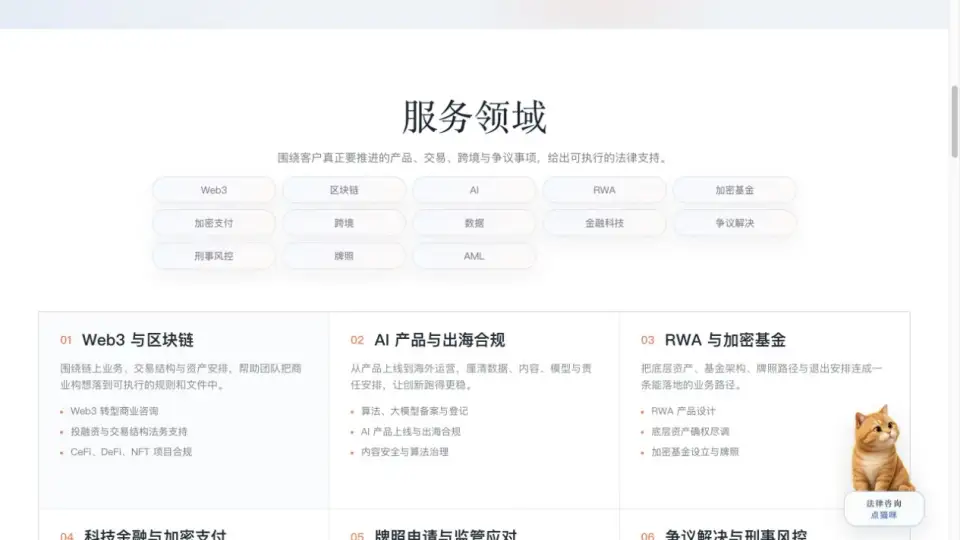
Clients usually do not say, "I need a corporate law service." They are more likely to ask: my AI product is going overseas—where do I start with data compliance; I plan to launch crypto payments—how do I choose the first license; a project is involved in a coin-related dispute and the account has been frozen—what should I do.
Therefore, the website does not divide business by traditional legal departments. Instead, it breaks services into six groups of real-world scenarios: Web3 and blockchain, AI products and overseas compliance, real-world assets (RWA) and crypto funds, technology finance and crypto payments, license applications and regulatory response, and dispute resolution and criminal risk management. Each group is further broken down into products, funds, data, licenses, evidence and handling actions.
Clients do not need to first understand how the firm divides work internally before they can judge whether Mankun Law Firm can help them.
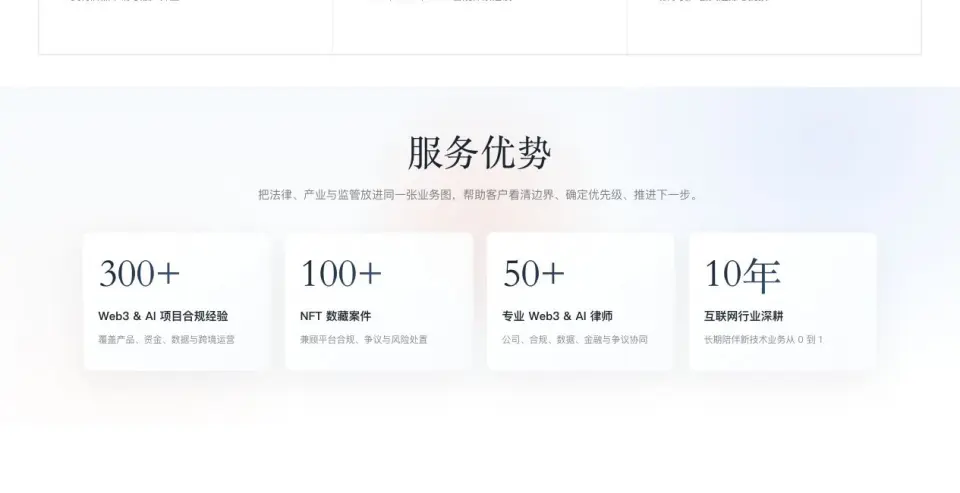
The data behind the service pages is not meant to be a row of good-looking numbers. Project experience, case numbers, professional team and years in the industry at least give readers several factual anchors they can quickly understand. They cannot replace professional capability, but they offer more value for judgment than "international, professional and boutique."
Lawyer profiles: a professional card that can keep growing
The team page answers another question: who ultimately provides the professional legal services.
The team homepage does not compress lawyers into a dense wall of ID photos. Instead, it first presents people, positions and core business tags. Clients can first find people by the direction they care about, and then enter a specific lawyer's profile.
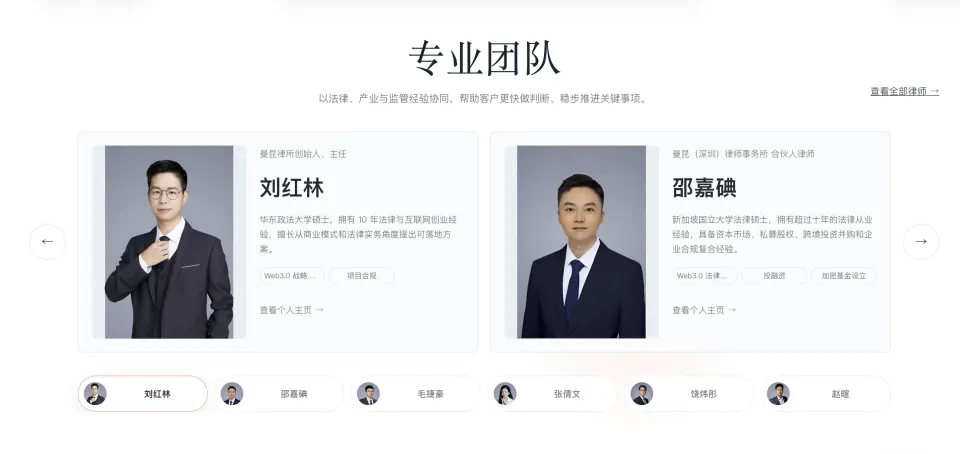
My expectation for lawyer profiles is not just an online resume. It is more like a lawyer's own professional blog and long-term identity page: professional introduction, education and practice experience, representative projects and service directions are placed here, and articles the lawyer has published in the past are automatically aggregated on the same page.
Readers may first see an article and then follow the author into the profile; they may also first get to know a lawyer and then continue reading his past judgments on an industry issue.

This is also a page that can be shared.
When lawyers share an article on WeChat, WeChat Moments or other social platforms, what they share is not just a name but a complete and continuously updated body of professional information; after reading it, clients can directly initiate a consultation. The firm brand establishes the first layer of trust, articles and project experience demonstrate professional judgment, and the consultation entry point carries the next step forward. Only when the three are connected on the same page is a lawyer more than a static photograph on a website.

Content pages: reducing the cost of understanding for readers first
Many law firm websites pack all content into a "news center": firm awards, leadership visits, reposted regulations and professional articles are all mixed together. After readers click in, they still have to work out for themselves which article actually solves their problem.
Mankun divides its content into three lines.
Mankun Research carries in-depth articles and professional judgment; Mankun Q&A addresses the questions clients directly search for; Mankun Updates records events, cooperation and team developments. This is not merely a categorization of sections but three different reading purposes: I want to study a problem systematically, I have a question right now, or I want to understand what this law firm is doing.

On the article detail page, I took this one step further.
Long articles begin with an AI-generated summary so that readers can first judge whether the content is relevant to them; the page also automatically identifies the structure of the body text and generates a clickable table of contents. Service tags connect professional content to specific practice areas, while author information and the consultation entry point bring the content back to people and services.

These features may look like just a few small modules, but behind them is a content product approach: readers do not have to read from the first line to the last before knowing whether an article has value; and clients do not have to finish a complex regulatory analysis and then return to the homepage to search again for the corresponding lawyer.
So that professional content serves not only current readers, articles are also configured with canonical URLs, social sharing cards, structured data for frequently asked questions, a sitemap, and a site description file for AI retrieval. The purpose is not to chase new buzzwords, but to ensure that when clients later ask questions on WeChat, search engines, ChatGPT, DeepSeek or Doubao, the answers Mankun has already written can be found accurately and can lead back to a clear and complete original text.
Q&A pages are shorter and closer to the way clients actually speak. For example: "If an AI agent is used to process payments automatically and financial losses or compliance issues arise, who bears responsibility?" This is not an essay title, but something a product lead might genuinely ask a lawyer before launch.

After entering the detail page, the page first gives an outline of the conclusion through an intelligent summary, then reconstructs the user scenario in sequence, explains why, gives recommended actions, and clearly sets out the legal boundaries. This gives readers a useful preliminary judgment while avoiding any misunderstanding of a public Q&A as formal legal advice issued on the basis of complete facts.

The English site follows the same content logic. Chinese content remains the source of truth, and only English articles that have completed translation and quality review are made public. Content that is not ready is better left unpublished for the time being than allowing pages that are half Chinese and half English, or that misplace facts, to be seen by the public.
The backend is not a toolbox, but a content production line
The public-facing website addresses "what clients see," while the backend must address "how Mankun continuously produces, reviews and publishes content." If every article publication required lawyers to copy Feishu content into an unfamiliar backend, re-upload images, adjust heading levels, and fill in author and tags, the site would soon grind to a halt because it is too difficult to maintain.
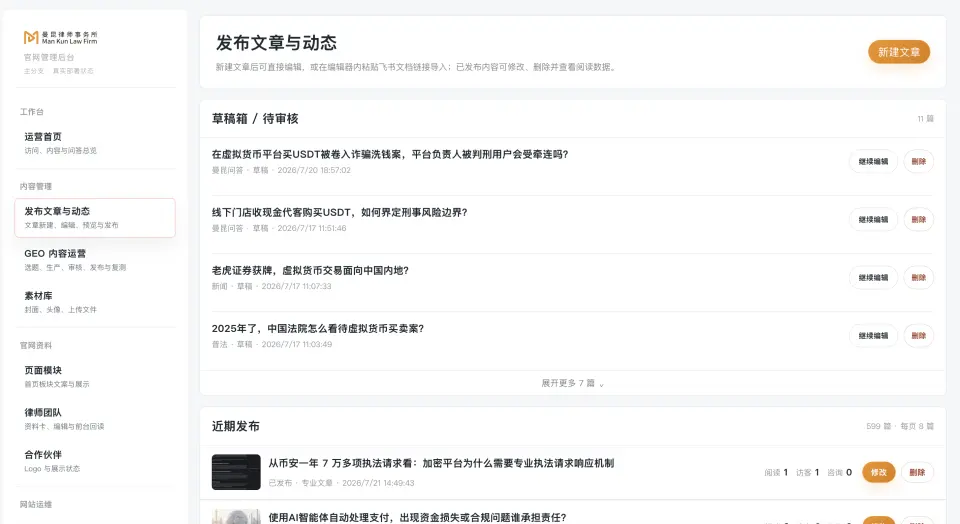
Mankun is a law firm that has grown up on Feishu, so I made Feishu import a basic backend capability.
Lawyers continue drafting in the familiar Feishu environment and, once finished, hand the document over to the website: headings, hierarchy, bold text, images and author information enter the editor as faithfully as possible, then go through preview, publication and read-back from the live site. It is not simple copy-and-paste, but a bridge built across Feishu permissions, user and bot identities, ordinary documents versus knowledge-base links, image downloads and rich-text conversion.
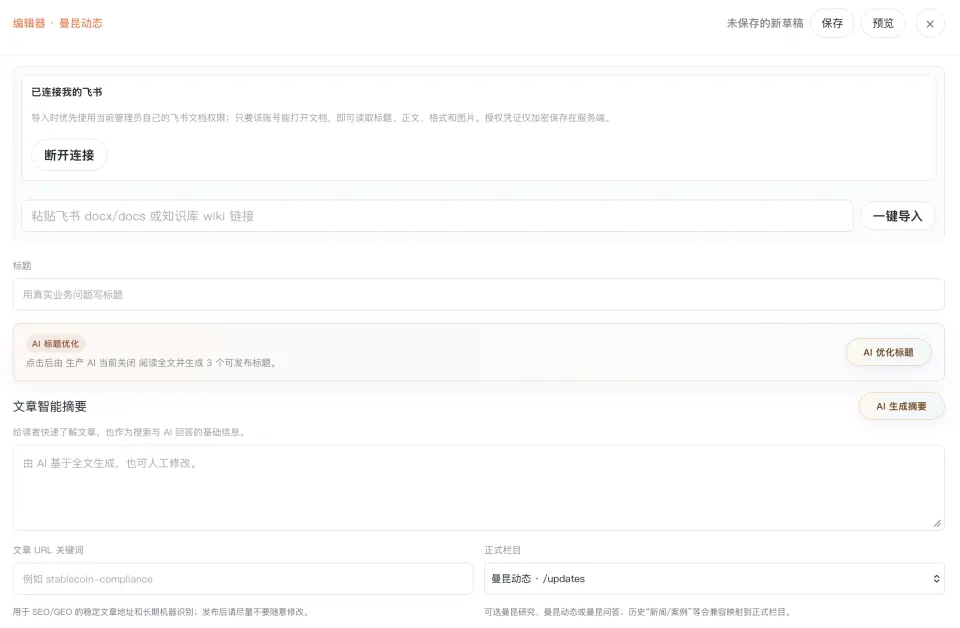
Once an article enters the backend, AI performs another round of structural analysis: generating smart summaries, refining search titles and descriptions, and identifying frequently asked questions, service tags and cover suggestions. None of these results are decisions made on the lawyer's behalf; they first become checkable, editable candidates. Lawyers are responsible for facts and professional judgment, while AI takes repetitive organizational work as far forward as possible.
The backend is also attempting to connect trend discovery, topic selection and content production. The system can obtain news leads, determine which events are genuinely relevant to clients, Web3, AI or cross-border business, and then convert topics worth writing about into client questions, service associations and article tasks. Lawyer review is still required in the end, but "scanning the news—finding an angle—drafting—filling in structure—publishing—reviewing feedback" no longer has to be scattered across a dozen windows.
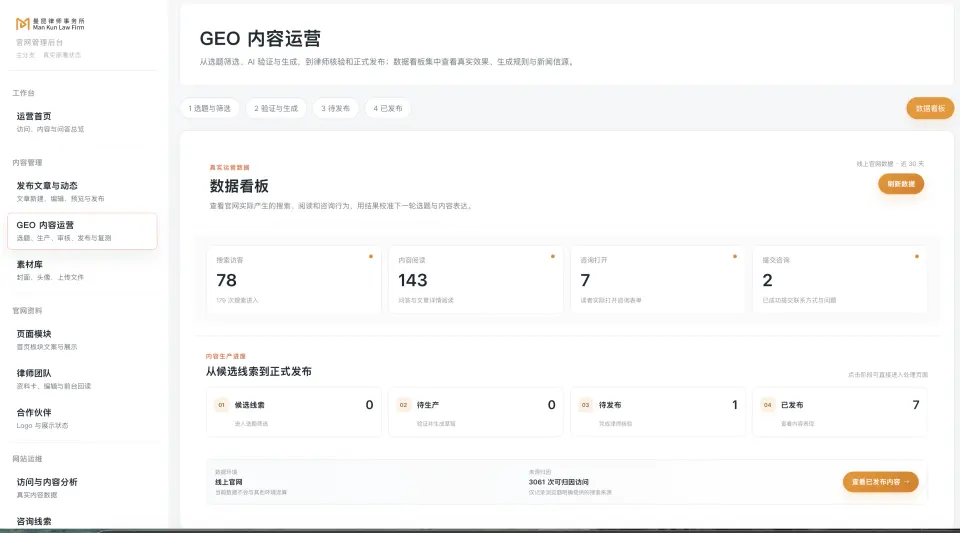
The final section is the launch workbench. Preview addresses, versions, publication conditions, online status and rollback points must sit within a single workflow. The backend showing "published" does not mean clients have seen it; a successful build and normal API responses do not mean the real page works. Launching must return to the official domain and walk through the homepage, list, detail, images, mobile view and consultation path in a real browser.
One person building a website with AI is not as smooth as imagined
The biggest takeaway from this development was not that "AI can already write code for people," but that it brought someone who cannot write code into the actual product scene for the first time. However, being able to start building and being able to deliver something stably to users are separated by a long road.
The most direct lesson came from deployment. The website initially used Netlify, and after encountering quota and stability issues, I migrated the public site to Alibaba Cloud's Object Storage Service and content delivery network, with function services handling dynamic content and APIs. Migration is not just changing a platform name: adding an extra directory layer breaks article paths; failing to refresh the cache leaves users seeing old pages; and if routing between the static site and dynamic articles is not properly connected, content that shows "published successfully" in the backend disappears from the frontend. I used to avoid these technical terms; now I at least know the problem may lie in the domain, cache, origin fetch, cross-origin access or APIs.
The second lesson came from large-model costs. When I first integrated Tongyi Qianwen, I burned through the entire prepared call quota in less than half a day. An AI API that runs does not mean it can run without regard to cost. Only later did I start seriously setting limits on input, output, calls per minute, daily tokens and expenses, and recording where each call's cost actually goes. If a feature has no cost ledger and no circuit-breaker conditions, the more popular it becomes after launch, the faster it may take itself down.
The third lesson came from Codex itself. It is indeed fast at writing pages, filling in APIs and finding errors, but it is far from the point where I can say "build the official website" and it delivers everything fully automatically. It misunderstands the business, and it can fix one problem locally while affecting another page; sometimes several development windows all say "done," but when merged together nothing runs. To this day, I still have to manually verify pages, check text, click real buttons, look at the mobile view, and when critical issues arise, point out what is wrong myself before letting AI continue revising.
In other words, AI amplifies execution speed; it does not automatically supply product judgment, business trade-offs, or acceptance responsibility. But precisely because of this, this development effort has been very valuable to me. In the past, when lawyers participated in internet products, they mostly appeared at the stage of agreement drafting and risk review. But only by actually building a product from start to finish can one perhaps increasingly understand that many so-called compliance issues are inherently product issues, and that behind many user experiences also lie the allocation of responsibility, the boundaries of authorization, and the preservation of evidence.
After Website 1.0, AI Reshapes Mankun Law Firm
Today's website can only be considered version 1.0, and of course there are still endless bugs waiting for me to discover and fix.
But writing it down tonight serves, on the one hand, as a stage-by-stage record of this AI Web Coding experience, sharing with everyone the pitfalls an outsider has encountered in development, deployment, model invocation, and product trade-offs; and on the other hand, it uses the website to present in a concentrated way Mankun's current business structure, product thinking, and design philosophy.
For the next step, I do not intend to leave the website as merely a "showcase site." What comes next is to connect Feishu with the AI-enabled daily client services and legal products of Mankun lawyers: Feishu will handle lawyers' daily work and internal collaboration, the website (cli) will handle the products and interactions that clients can see and use, and AI automation will connect the two in between.
This means that in the future, what is placed on the website may not be limited to articles. It could be a tool that automatically organizes a materials checklist after a client fills in basic information, a legal product that breaks down complex compliance requirements into task nodes, or a workflow and AI Skill repeatedly used within a lawyer team. How clients submit requests, how lawyers collaborate, how research results are accumulated, and how the service process provides feedback may all be redesigned.
I also hope to present Mankun's long-term learning about the Web3 and AI industries in a more digital way. It could be a thematic database, an interactive industry map, a tools page, or even a Web3 learning game akin to leveling up and fighting monsters: users advance along projects, roles, assets, and regulatory events, understanding how this industry developed and where the risks lie while playing.
Some of these ideas have already begun to be implemented, while others are still just sketches. But Website 1.0 at least proves one thing: when a person within the industry sufficiently understands the business and is also willing to keep learning AI and digital tools, many ideas that previously could only be written in mind maps and proposals can already be personally built into things that others can see, click, and use.
For me, this is also an important task going forward as an operator of Mankun: to reshape Mankun with AI and help specialist lawyers in each business area turn their experience into the legal service products that this era calls for. The ultimate goal is not to appear more "technological," but to enable clients to obtain clearer, more timely, and higher-quality service experiences, and to let lawyers spend more time on the places that truly require professional judgment.
I hope Mankun can become a boutique law firm with genuine product capabilities in the Web3 and AI industries, and I am willing to continuously share the attempts, failures, and methods along this path.
This website is not the answer; it is only a small beginning.
The page screenshots are taken from the current code version and development acceptance records of the Mankun Law Firm website as of July 22, 2026; the website is still being continuously iterated, and the actual pages are subject to www.mankunlaw.com shall prevail.