Over the past two years, what we have discussed most is whether large models can write, whether they can draw, and whether they can answer questions. Now, more and more entrepreneurs are beginning to confront another, more concrete set of questions:
Can AI truly understand a continuously changing environment? Can it accompany a user over the long term? Can it perform tasks on a person's behalf? And can it enter real-world scenarios such as education, robotics, autonomous driving, and industrial simulation?
Educational agents, world models, embodied intelligence, and spatial intelligence are therefore appearing with increasing frequency in discussions among entrepreneurs, researchers, and investors. But more worthy of attention than the concepts themselves is how far these technologies have actually developed, which capabilities are already ready to enter products, which remain at the exploratory stage, and where new entrepreneurial opportunities will emerge as AI moves beyond "generating content" toward "understanding, judging, and acting."
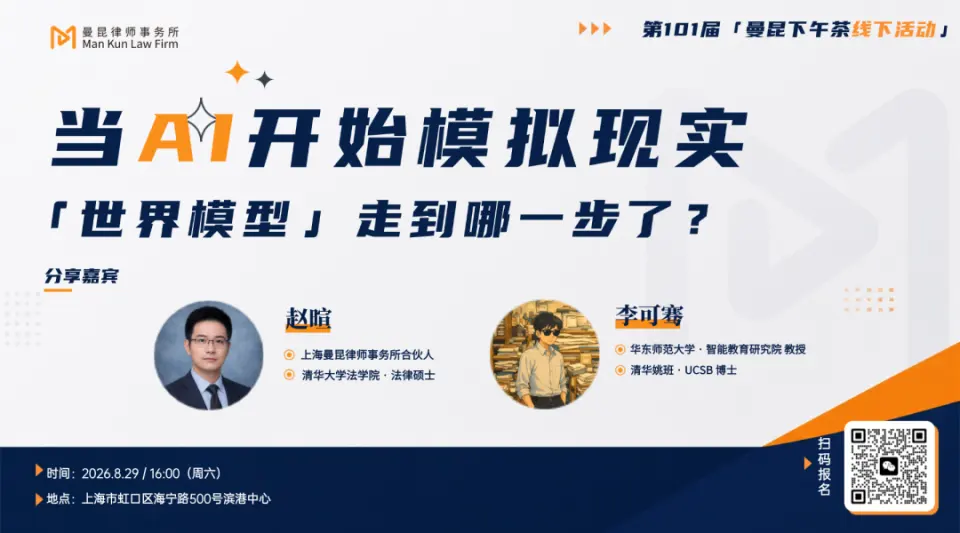
On August 29, the Mankun Afternoon Tea AI Special Session will be held in Shanghai, and we will talk about this together~
Speakers:
Professor Li Keqian:Professor, Institute of Intelligent Education, East China Normal University|Tsinghua Yao Class · PhD, UCSB
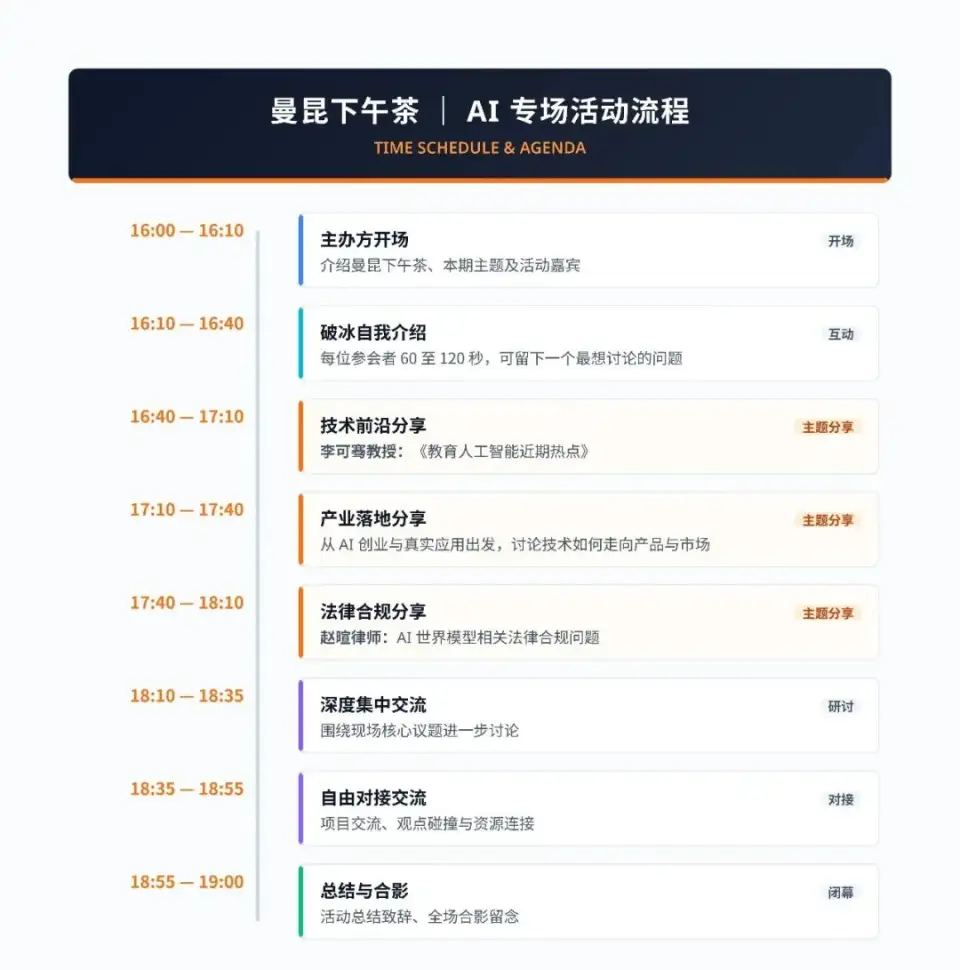
Topic: "Recent Hot Topics in Artificial Intelligence in Education"
Educational large models, agents, personalized learning, intelligent tutoring, automated assessment, multimodal teaching—over the past year, almost every one of these directions has been evolving rapidly. Professor Li Keqian will draw on practical cases to take stock of the latest progress in AI in education, and will focus on a change that is now taking place: AI is moving from being an auxiliary tool for teaching toward deep participation in the entire process of teaching, learning, and assessment.
Lawyer Zhao Xuan:Partner, Mankun Law Firm|Tsinghua University School of Law · Master of Laws
Topic: "New Legal Propositions of AI World Models"
As AI evolves from “generating content” to “understanding and simulating the real world,” the legal issues escalate accordingly: How should the source and ownership of training data be defined? If losses are caused by decisions simulated by a model, who bears liability? And where are the boundaries when AI is deeply involved in high-risk scenarios such as teaching and evaluation?
This event isby small-scale targeted invitation only, and we sincerely invite entrepreneurs, researchers, industry leaders and investors in relevant fields to participate and exchange views.
If you are working on AI products, focusing on educational agents, world models, embodied intelligence and related frontier directions, and are also thinking about how technology can truly translate into products and business opportunities, you are welcome to come and join the discussion on site.
Scan the QR code to register👇

/ END.
*This article is an original article ofMankun Law Firm, represents only the personal views of the author, and does not constitute legal consultation or legal advice on any specific matter. For reprinting and legal consultation, please add our customer service:mankunlawyer。