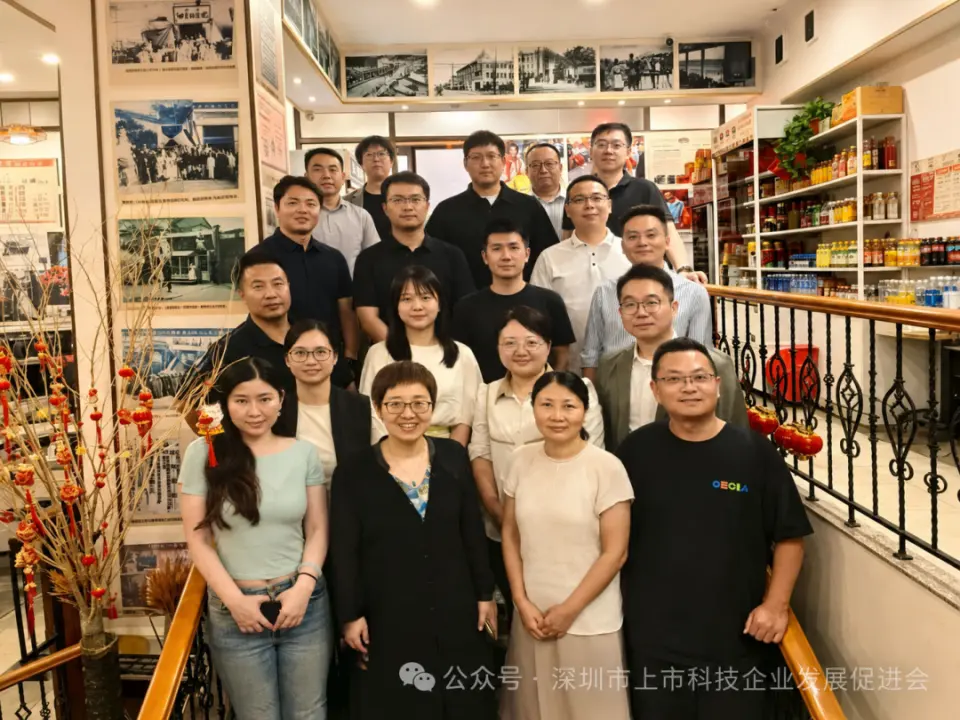
Recently, the second session of the listed company executive salon, hosted by the Shenzhen Listed Technology Enterprise Development Association, was held in Shenzhen.Senior executives from listed and technology companies such as Tencent, Xunlei, UBTECH, Sangfor, Sinexcel,Bingchuan Network, as well as relevant heads of professional service institutions includingMankun Law Firm, Guangdong Kesi Law Firm, and Shenwan Hongyuan Securities, gathered together to exchange views on topics including cross-border funds, international taxation, overseas compliance, and localized operations in the context of corporate globalization.
Ms. Zhao Hongyan, Secretary-General of the Shenzhen Listed Technology Enterprise Development Association,welcomed the attending guests. The participants, drawing on their respective practical experience in overseas business expansion and global operations, discussed the real-world issues encountered by companies as they enter different markets.
Going global is shifting from "selling abroad" to "putting down roots"
For a growing number of technology companies, talking about "going global" today no longer means merely selling products overseas and finding channels and customers; it also requires simultaneously considering a whole set of issues, including product certification, data and privacy protection, intellectual property, cross-border funds, supply chains, and local regulation.
This is especially true for frontier technology companies in fields such as AI, robotics, smart hardware, and Web3, where technology iterates quickly, business models are new, and regulatory differences among countries and regions are more pronounced. A single change in rules may directly affect whether a product can enter the local market and may further affect a company's business model, supply chain arrangements, and pace of globalization.
This also means that compliance is gradually moving forward from a supplementary step after business implementation to the stages of product design and globalization strategy.
Regulatory changes are directly affecting companies' market entry pathways
At the event, participants also exchanged views in light of recent regulatory changes by the U.S. Federal Communications Commission (FCC) concerning areas such as advanced robotic devices.
For robotics, AI and smart hardware companies, changes in overseas regulatory policy are often not merely an isolated "legal issue," but may further affect product certification, market access, supply chain arrangements and even local business layout. Companies have in the past been more accustomed to addressing compliance issues once a product is complete and ready to enter the market, but in the new globalization environment, an increasing number of regulatory requirements need to be considered in advance at the stages of product R&D, architecture design and market selection.
From this perspective, the overseas expansion logic of Chinese technology companies is also changing: from "products going global" toward "compliance front-loading and deep local cultivation."
Global competition increasingly tests companies' systemic capabilities
Once companies truly enter overseas markets, what they face is often not a single isolated issue.
How the corporate entity is structured, how funds flow across borders, where data is stored, how intellectual property is protected, whether products meet local market access requirements, and how teams operate locally—these issues are often interrelated and require companies to make judgments from an overall perspective.
For technology companies, global competitiveness comes not only from technology and products, but increasingly from companies' understanding of the rules of different markets and their ability to translate regulatory requirements into executable business solutions.
This executive salon also provided a more open setting for exchange among companies, industry institutions and professional service providers. Through the sharing of real overseas expansion experience by different companies, participating guests exchanged views on the practical difficulties and solutions in global layout, and further explored the possibilities of industry collaboration and professional cooperation.
Mankun continues to monitor the legal and compliance needs of technology companies in globalization
In recent years, as AI, Web3 and other frontier technology companies continue to expand into overseas markets, the legal issues they face have increasingly taken on characteristics that are cross-regional, cross-sector and cross-regulatory-system.
In the future, Mankun Law Firm will continue to monitor the legal and compliance needs of AI, Web3 and frontier technology companies in the process of globalization,We maintain in-depth exchanges with technology companies, industry institutions and professional service partners on real business scenarios such as overseas market entry, cross-border structuring, data governance, intellectual property and operational compliance, so as to provide legal support more closely aligned with business realities for the globalization of Chinese technology companies.