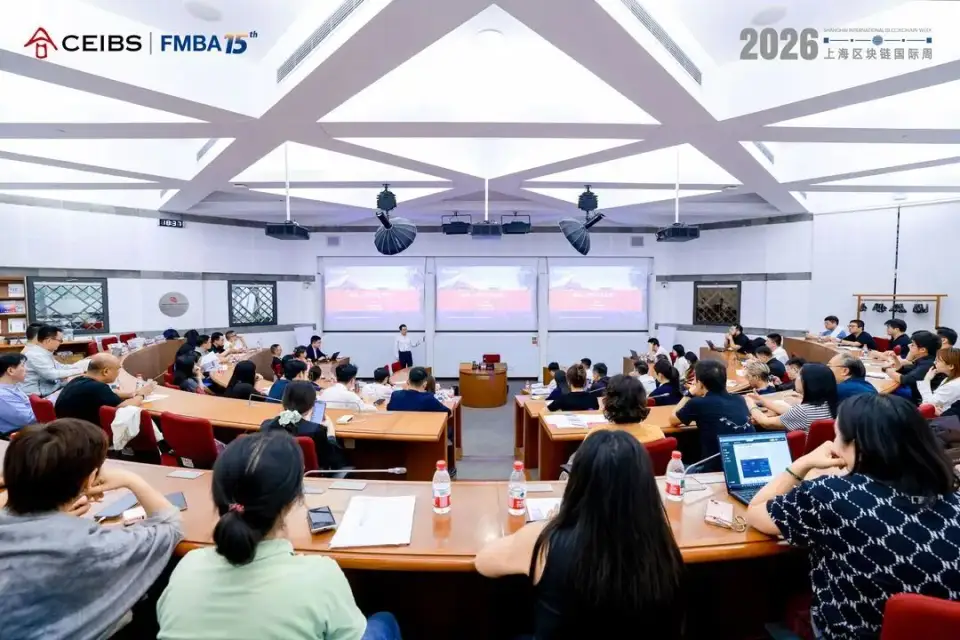
Event site
On the evening of September 22, 2026, the CEIBS Finance MBA 15th Anniversary F-Dialogue series event “From Trusted Collaboration to an Intelligent Ecosystem: New Frontiers of On-Chain Applications” was successfully held at the Shanghai campus of China Europe International Business School (CEIBS). This event was also one of the2026 Shanghai Blockchain International Weekseries of events. Four speakers—Zhu Haikun, Assistant Professor of Finance at CEIBS; Yang Guang, CTO of Shanghai Tree-Graph Blockchain Research Institute; Liu Honglin, founder of Mankun Law Firm; and Wang Puyu, Senior Researcher at HashKey Group—joined nearly one hundred attendees on site to discuss frontier trends in blockchain technology, industrial applications, and the boundaries of compliance.
Keynote Speech I: Digital RMB and Ecosystem Promotion
Assistant Professor of Finance, China Europe International Business School (CEIBS)Zhu Haikundelivered the keynote speech “Digital RMB and Ecosystem Promotion.” He first introduced the underlying changes that distributed ledgers bring to payment models, and systematically compared the essential differences between central bank digital currencies (CBDCs) and privately issued token-type assets in terms of issuing entities, value-stability mechanisms, and sources of risk. Citing industry research data, he noted that although the transfer volume of such on-chain tokens reached USD 85 trillion in the first eight months of 2026, only about 5% of that was related to real economic activity; at the same time, such assets still find it difficult to effectively satisfy basic requirements such as customer identity identification and anti-money laundering, and there are risks of their being used for money laundering and illicit cross-border transfers of funds, accompanied by hidden dangers of selling pressure and runs in the secondary market.
He further noted that the rapid expansion of such U.S. dollar-denominated tokens may erode the monetary sovereignty and monetary policy efficiency of non-U.S. economies, which is also an important reason why central banks around the world are accelerating their exploration of central bank digital currencies. In the part on the digital renminbi, he focused on interpreting the institutional arrangements of "digital renminbi 2.0": starting in 2026, the digital renminbi will move from the cash-type 1.0 version tothe deposit-money-type 2.0 version, under which balances in real-name wallets will bear interest paid by banks and be included in the framework of deposit reserves and deposit insurance. Drawing on the case of Luzhou Laojiao distributors obtaining bank credit based on on-chain transaction data and Oasis Jinke's practice in the field of carbon credits, he noted that the digital renminbi is driving domestic blockchain applications to extend from "credit reporting on-chain" to a broader"value circulation"Extension.
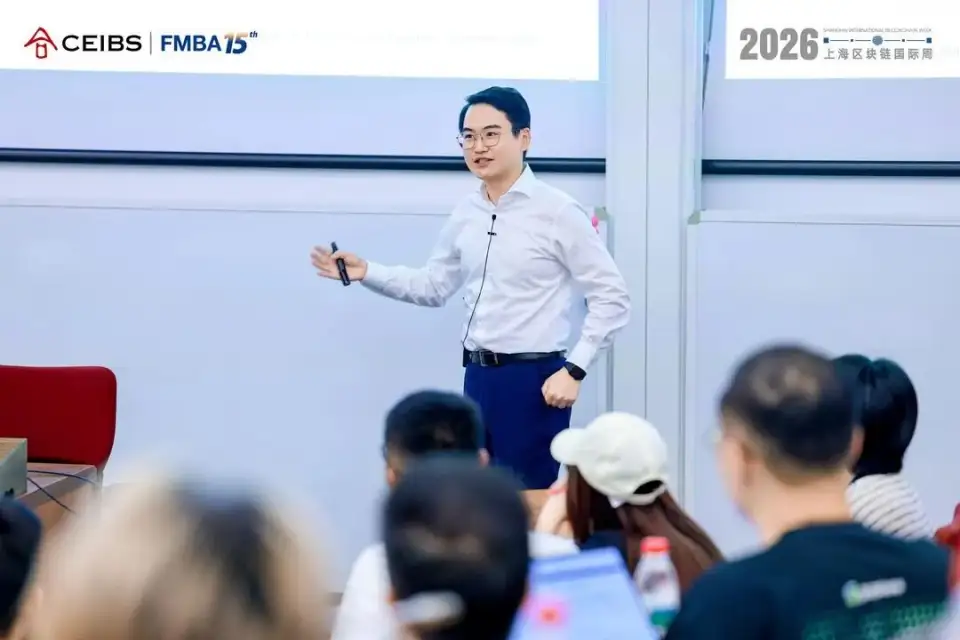
Zhu Haikun, Assistant Professor of Finance, China Europe International Business School
Keynote Speech II: When AI Becomes an Economic Participant
Yang Guang, CTO of Shanghai Conflux Blockchain Research InstituteYang Guangdelivered a keynote speech titled "When AI Becomes an Economic Participant—The User Blockchain Has Waited Fifteen Years For May Not Be Humandelivered a keynote speech on the topic of “.”
He began by asking "why fifteen years of exploration in blockchain have failed to bring it into everyday transactions," and pointed out that the root cause lies in the following: for humans, the incremental value brought by migrating to blockchain is often insufficient to cover the migration costs of changing usage habits, system integration, and security management.
When blockchain users shift from humans to AI Agents, however, this cost-benefit structure may be completely rewritten. Large models provide thinking capability, while Agents, by connecting to external tools and execution environments, become "acting entities" with independent capacity for action, leaping from tools to participants in economic activity. On the one hand, high-frequency, large-scale, cross-entity collaboration among machines naturally aligns with blockchain's core advantages of "shared state, executable commitments, and open composability"; on the other hand,the high learning costs that make blockchain unfriendly to human users are precisely the most natural technical path for machines。
He introduced machine coordination mechanisms under construction in the industry, such as x402, and pointed out that the key bottleneck to AI adoption lies in"how much authority Agents can be trusted with"—high-capability domains such as autonomous driving and medical diagnosis struggle to gain traction due to the absence of liability mechanisms, while scenarios such as quantitative finance where "a mistake requires no rollback" have already achieved scale first.
Yang Guang further introduced the explorations Conflux Tree-Graph Blockchain has undertaken for the AI intelligent ecosystem in areas such as accounts and authorization, cross-system collaboration, and performance and security. He also pointed out that becoming"authorization with boundaries, commitments that are executable, and liability that is traceable"machine collaboration infrastructure may bethe biggest opportunity for blockchain in the next decade。
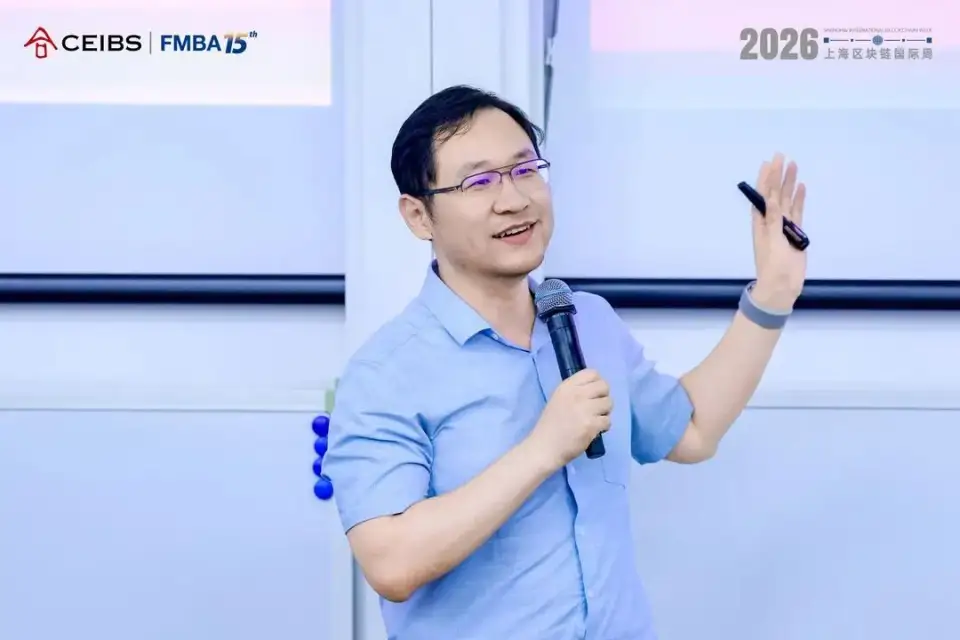
Yang Guang, CTO of Shanghai Tree-Graph Blockchain Research Institute
Keynote Speech III: Payments in the AI Era: Business Opportunities and Compliance Challenges
Founder of Mankun Law FirmLiu HonglinUnder the title “Payments in the AI Era: Business Opportunities and Compliance Challenges,” he shared his perspective from a legal angle. He opened with his personal experience of purchasing vitamins through the “Ant Afu” AI, which linked with Taobao Flash Sale to complete the order and payment, confirming that“AI payments are quietly seeping into daily life.”He then extended the discussion to the business models of platforms such as Doubao and Qwen, which combine “intent recognition + service fee commissions,” and to Meta’s launch of “AI employee” agency sales services for merchants, and cited the case of an international payment company acquiring an API routing platform (reported to involve a transaction amount exceeding USD 7 billion) to argue that“whoever can influence the determination of a transaction can influence the transaction”has become the new reality of the AI era.
On the compliance level, he referred to a lawsuit heard by a court in Hangzhou arising from erroneous content generated by generative AI (in which the court dismissed the plaintiff’s claims), and to the situation in Tongzhou, Beijing, where a lawyer was recorded in a judgment for using AI to generate fictitious cases, among other circumstances, and pointed out that AI remains unreliable at the information and decision-making levels, and that the essence of the problem is still trust—blockchain is precisely“a machine for creating trust.”,The users who truly enable on-chain payments to scale may not be humans, but AI.Only in this way can it meet the requirements of cross-border, small-value, high-frequency, and programmable payment scenarios in the AI era.
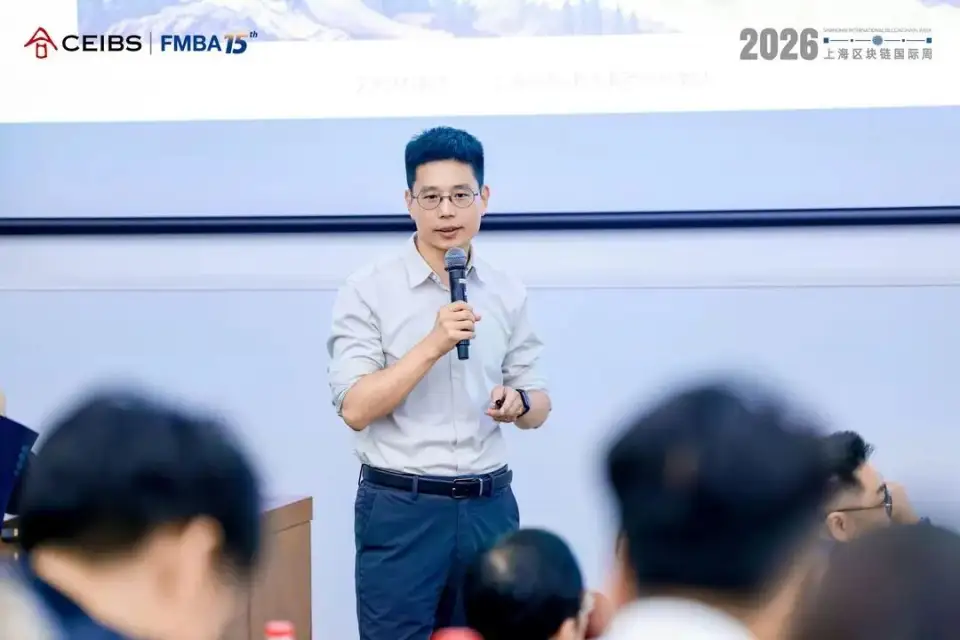
Liu Honglin, Founder of Mankun Law Firm
Keynote Speech IV: Progress and Observations on DTCC's Tokenization of U.S. Equities on Blockchain
Senior Researcher at HashKey GroupWang PuyuUnder the title “Progress and Observations on DTCC's Tokenization of U.S. Equities on Blockchain,” he introduced the progress and observations regarding the U.S. securities depository and settlement infrastructure's pilot for tokenizing securities on blockchain. According to the introduction, the pilot is intended to improve the efficiency of securities settlement and collateral circulation; within the DTC system, securities entitlements recorded in traditional ledgers are converted into on-chain form, and near-real-time ledger monitoring mechanisms are used to ensure the accuracy of on-chain records. Participants are mainly DTC participants and their clients, and the relevant wallets and participating institutions must meet strict qualification access, technical, and compliance requirements.
He outlined the pace of the pilot's advancement: in the early stage, small-scale exploration was carried out through distributed ledger technology; thereafter, in 2025, a time-limitedNo-Action Letterwas obtained from the U.S. SEC, and it has now entered acontrolled production environment, with plans to further formally launch the relevant services. He also noted that the pilot still has obvious limitations in areas such as the scope of supported chains, wallet access, and cross-chain transfers, and in the short term it will still mainly apply to controlled institutional market scenarios.
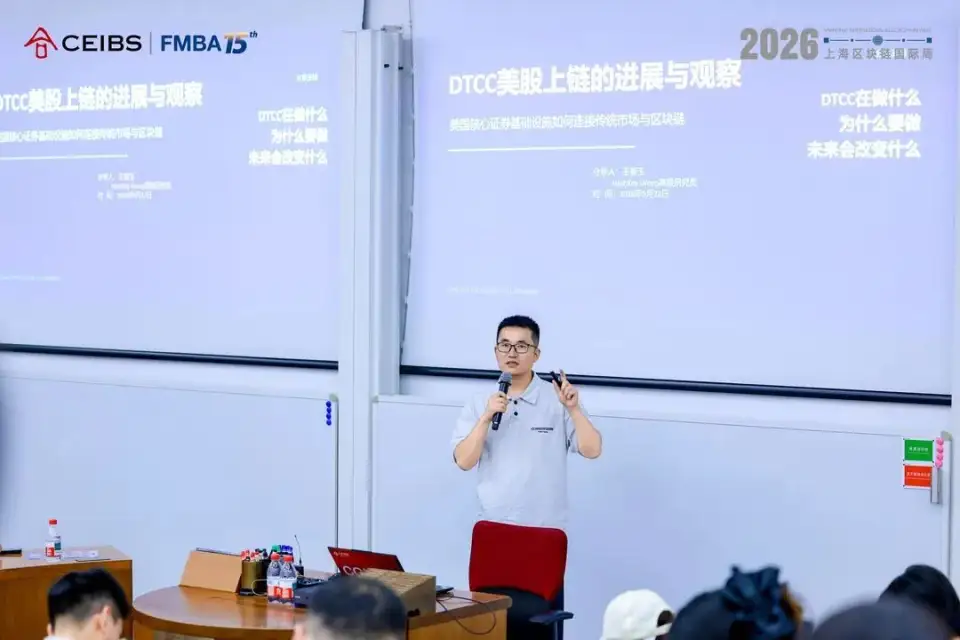
Wang Puyu, Senior Researcher, HashKey Group
During the interactive Q&A session, audience members asked questions enthusiastically: after shell money, metal currency, paper money and electronic payments, where will currency go next; and ultimately in what currency will AI Agents complete payments, among other questions. The four guests answered the above questions one by one.
As one of the key events in the CEIBS Finance MBA 15th Anniversary Series, this F-Dialogue, from theresearch, industry, technology and legalfour dimensions, presented the trend of blockchain technology moving from the underlying infrastructure of digital assets toward trusted collaboration and an intelligent ecosystem. The participating guests also reminded thatsuch token assets do not have the same legal status as fiat currency, and the public should enhance risk awareness and stay away from related speculationIn the future, the CEIBS Finance MBA will continue to rely on the F4 series event matrix to build a high-end platform for in-depth dialogue among industry and academia, industry and technology, and industry and finance, empowering the growth of students, alumni and applicants.