

We look forward to our next gathering!
The legal industry is undergoing change: from an abundance of case sources to intense competition, and from being driven by professionalism to being driven by trust.
The scope of lawyers’ capabilities is also quietly expanding—beyond legal reasoning, they must understand client psychology and master“the art of closing deals”。
Professional expertise is no longer the only advantage; client trust, communication efficiency, and deal-closing ability are becoming new growth engines for lawyers.
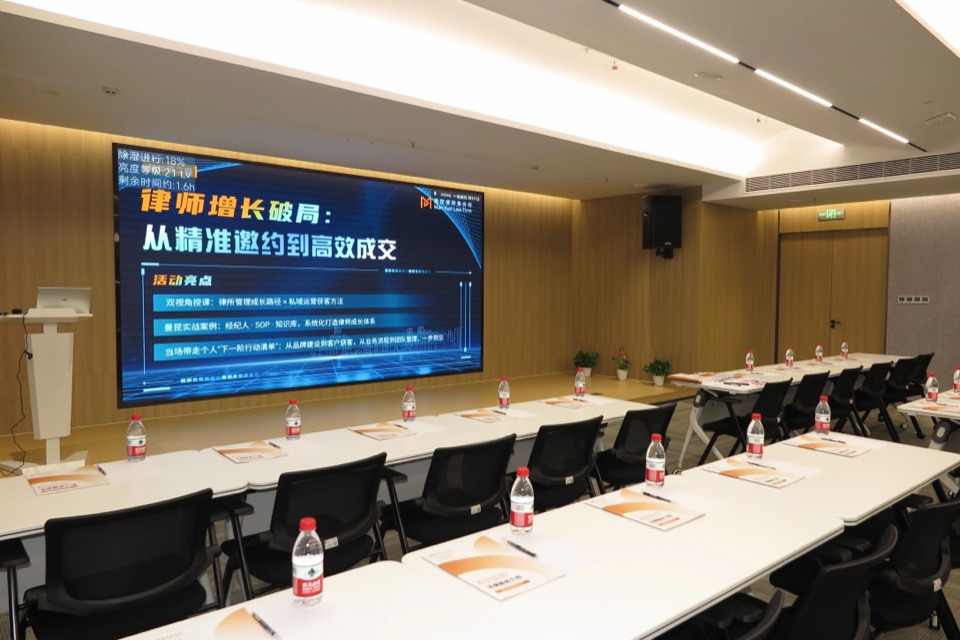
On October 19, the second session of Mankun Law Firm’s “Lawyer Mini-Class” was successfully held in Binjiang District, Hangzhou.This session focused on “growth in lawyers’ practices,” addressing core challenges lawyers face in consultation conversion, communication and appointment-setting, and efficient deal closure. Participating lawyers engaged in roundtable discussions, focusing not on statutory provisions and case precedents, but on a more practical and challenging question—As clients become increasingly rational, how can lawyers enhance their “deal-closing capability”?
The course, titled “Breaking Through Lawyers’ Growth Bottlenecks: From Precise Appointment-Setting to Efficient Deal Closure,” through“case-source development – building communicative trust – efficient conversion”a comprehensive mapping of this end-to-end process, combined numerous practical cases and methodologies to guide lawyers in systematically considering how to achieve steady business growth while maintaining professional excellence in an era of intensifying competition.
With the successful conclusion of the course, each participant departed with clearer growth strategies and actionable methods—What you take away is not only knowledge, but also fresh insights into "lawyer growth potential."
Course Recap

-
Five Levels from Precise Invitation to Efficient Conversion—Zhang Na, Co-Founder and Marketing Director of Mankun Law Firm
At the beginning of the sharing session, Ms. Zhang Na started with"Consultation Mindset Management"as the starting point, inviting lawyers present to share common psychological reactions when failing to secure engagement after client consultations, and summarizing the profound impact brought by two distinctly different mindset patterns.
-
If non-conversion is simply attributed to"poor market conditions", lawyers may easily fall into passivity and emotional exhaustion, which will affect their professional performance and client relationships in the long run;
-
whereas if it is viewed as"a necessary cost investment", one can shift to an entrepreneurial mindset, treating each consultation as a strategic step for building trust, screening clients, and accumulating reputation, thereby systematically optimizing service processes and enhancing long-term conversion rates.
Against the backdrop of this mindset shift, Ms. Zhang Na systematically expounds on“the Way, the Method, the Technique, the Tool, and the Momentum”across five levels, deconstructing the entire process from client engagement to case conversion in a progressive manner, from conceptual framework to practical execution.
Level One: The Way—Managing Consultation Mindset
“The Way” constitutes the foundation of successful case conversion.When handling consultations that do not result in immediate engagement, lawyers should shift froma victim mentality of “being exploited for free advice” to a rational, cost-oriented business mindset.
Ms. Zhang Na points out that this shift entails moving from emotional reactions to rational decision-making, and from focusing on short-term gains or losses to emphasizing long-term accumulation. Lawyers should view consultations as part of market investment, client screening, and relationship building, thereby achieving a positive cycle in their professional practice.
Level Two: The Method—Standardized Conversion Process
“The Method” refers to the rules and methodology grounded in “the Way,” forming the framework of the conversion system.
Ms. Zhang Na breaks down the conversion process into eight steps:lead generation, lead qualification, needs assessment, proposal development, fee quotation, objection handling, contract signing and payment, and case initiation and service delivery.Each step corresponds to clear objectives and operational guidelines, forming a closed-loop process that lawyers can practically implement, ranging from private-domain lead management to the presentation of solution value.
The Third Level: Shu (Technique) – Communication Skills and Client Insights
“Shu” (Technique) refers to strategic actions and skills, representing the most dynamic aspect of closing deals.
She emphasizes that the key to communication is not“answering questions”, but rather“gaining insights into behaviors and motivations”Through the“Behavior–Awareness–Purchasing Power”three-step interview method, lawyers can identify clients’ true needs and decision-making logic, thereby achieving the transition from“defensiveness to trust”, making communication a genuine process of value delivery.
Level Four: Instruments—Systematizing Tools to Reduce Costs and Enhance Efficiency
“Instruments” serve as a lever that amplifies “techniques.”
Addressing efficiency bottlenecks in process execution, Ms. Zhang Na drew on practical cases to demonstrate how knowledge base systems,customer relationship management (CRM) systems,and standardized product libraries can achieve significant efficiency gains. She pointed out thattool-based approaches not only enable new hires to ramp up quickly and allow senior lawyers to focus on high-value tasks, but also facilitate the formation of reusable growth frameworks through data accumulation.
Level Five: Momentum—Leveraging Trends for Growth and Achieving Sustainable Development
“Momentum” represents the wisdom of integrating the preceding four elements and acting in accordance with prevailing trends. Ms. Zhang Na explained how to “leverage momentum” from three perspectives:
-
Leveraging Platform Momentum: From “Artisan Craftsmen” to “System Members.”
Individual effort has inherent limits, whereas robust platforms provide mature systems and resources, enabling lawyers to move beyond inefficient trial-and-error, integrate into more efficient, systematized growth pathways, and pursue their professional careers with greater stability and longevity.
-
Leveraging Industry Momentum: From “Going It Alone” to “Acting in Accordance with Trends.”
Legal services are undergoing a transformation from a "jack-of-all-trades" model to one characterized by specialization, team-based collaboration, and productization. Only by cultivating deep expertise in vertical sectors and establishing clear professional identities can lawyers distinguish themselves amid industry restructuring and seize the opportunities of the era.
-
Leveraging Momentum: From "Professional Competence" to "Market Value".
Professionalism is the fulcrum, while"Law" (processes), "Technique" (communication), and "Tools" (instruments)are the levers. Mastering the synergy of these three elements amplifies individual value, enabling a leap from "case-handling capability" to "scalability."
In her concluding remarks, Ms. Zhang Na stated:
"Legal professional services and commercial deal closure are not opposing forces but two sides of the same coin. A healthy deal-closure framework begins with the operator's cost-conscious mindset and succeeds through standardized execution processes.Take it step by step; there is still ample time to succeed!"

-
Private-Domain Practical Strategies: Digital Tools Empowering Efficient Conversion—Kai Kai, Expert in Private-Domain Operations and Client Acquisition
In the second part of the course, Instructor Kai Kai used"Scenario-Based Expression to Empower Lawyers' Value"as the entry point to discussprivate-domain operationsandpersonal brand buildingare closely integrated, sharing how to achieve full-funnel conversion from visibility to trust through empathetic content.
She pointed out that the core value of private-domain operations lies in"one expression, multi-dimensional reach"It is not only a key channel for lawyers to reduce communication costs and cultivate trusted relationships, but also an amplifier of individual professional value. In the process of building relationships between lawyers and potential clients,WeChat Moments should no longer serve merely as a "case-handling log," but rather as a "storyteller" and a "trust catalyst."
Addressing common content pitfalls among many lawyers—such asexcessive use of legal jargon, lack of contextual imagery, and stiff, AI-like copywriting—Teacher Kai Kai provided specific optimization principles:Adopt the framework of A (content) + B (contextualized format) + C (personal perspective/vision), using vivid language, authentic client stories, and service details to transform each content display into an opportunity to convey professionalism and evoke resonance.
She further emphasized, through on-site case comparisons, that content strategy must serve the lawyer’s professional posture:
-
Forindependent lawyers who need to build trust, they should effectively leverage"Client Says," "Family Says"and similar approaches to elegantly demonstrate professional value;
-
forgrowth-oriented lawyers seeking market breakthroughs, they should focus on developing"scenario-based stories", integrating professional services into vivid narratives to achieve dignified communication;
-
forSeasoned lawyers seeking brand elevationmust constructa "value vision", elevating case-by-case services into shared objectives that guide client relationships.
Teacher Kai Kai’s insights enabled attending lawyers to deeply recognize that, as the basic unit of private-domain operations, their WeChat Momentsderive value not only from "client acquisition," but also from making lawyers’ professional profiles perceptible, respected, and capable of commanding a premium, ultimately achieving the brand effect of "earning fees with dignity."
Practical Implementation Session
During the hands-on guidance session, Teacher Kai Kai provided in-depth"content diagnostics": drafting WeChat Moments copy on site.Based on each lawyer’spractice area, client base, and personal attributes, she provided one-on-onecoaching to develop customized content strategies, transforming unique professional value into highly distinctive personal brand narratives, thereby achieving a transition from"copywriting"to"brand building"cognitive elevation.


Among them, Ms. He Mengyao, Head of New Media at Shentong Law Firm, who attended the event, shared her personal experiences to illustrate howsincerity, humility, and proactive learning have brought her key opportunities.She pointed out that confidence is a prerequisite for bold expression. Her respect for senior practitioners is reflected not only in reverence and appreciation but also in continuous learning and sincere communication. She firmly believes thatsincerity is more powerful than technique.The significance of interpersonal relationships lies not in meticulous design, but in every thoughtful preparation and sincere expression. While they may not bring about immediate change, they will, at some point, unexpectedly provide opportunities for growth and meaningful responses.

Conclusion

This course, "Breaking Through Lawyer Growth: From Precise Invitation to Efficient Conversion," represents a systematic review by Mankun Law Firm of the intersection between business growth and professional practice. Centering on the core challenges faced by lawyers in an era of stock competition, the course constructs a replicable and actionable growth path, covering customer screening, trust building, conversion, and reputation management.
For the participating lawyers,This is not merely a skills training session, but also an opportunity to reflect on how to ensure that professional expertise is understood and that value is trusted.
In the future, Mankun Law Firm will continue to offer a series of courses aimed at supporting the professional development of lawyers,grounded in accumulated experience and bridged by practical insights, to explore new solutions for growth together with more lawyer partners, and to advance steadily on the path of long-termism.