

Radio Program Transcript
In recent years, as new concepts such as “financial innovation,” “digital assets,” and “real-world assets (RWA)” have increasingly entered public awareness, fraudsters have quietly updated their deceptive scripts. Exploiting the general public’s limited understanding of RWA, they operate under the guise of financial innovation, blockchain technology, and promises of high yields with stable returns, inducing elderly individuals to invest their life savings through offline seminars, WeChat groups, live video streams, and other channels.
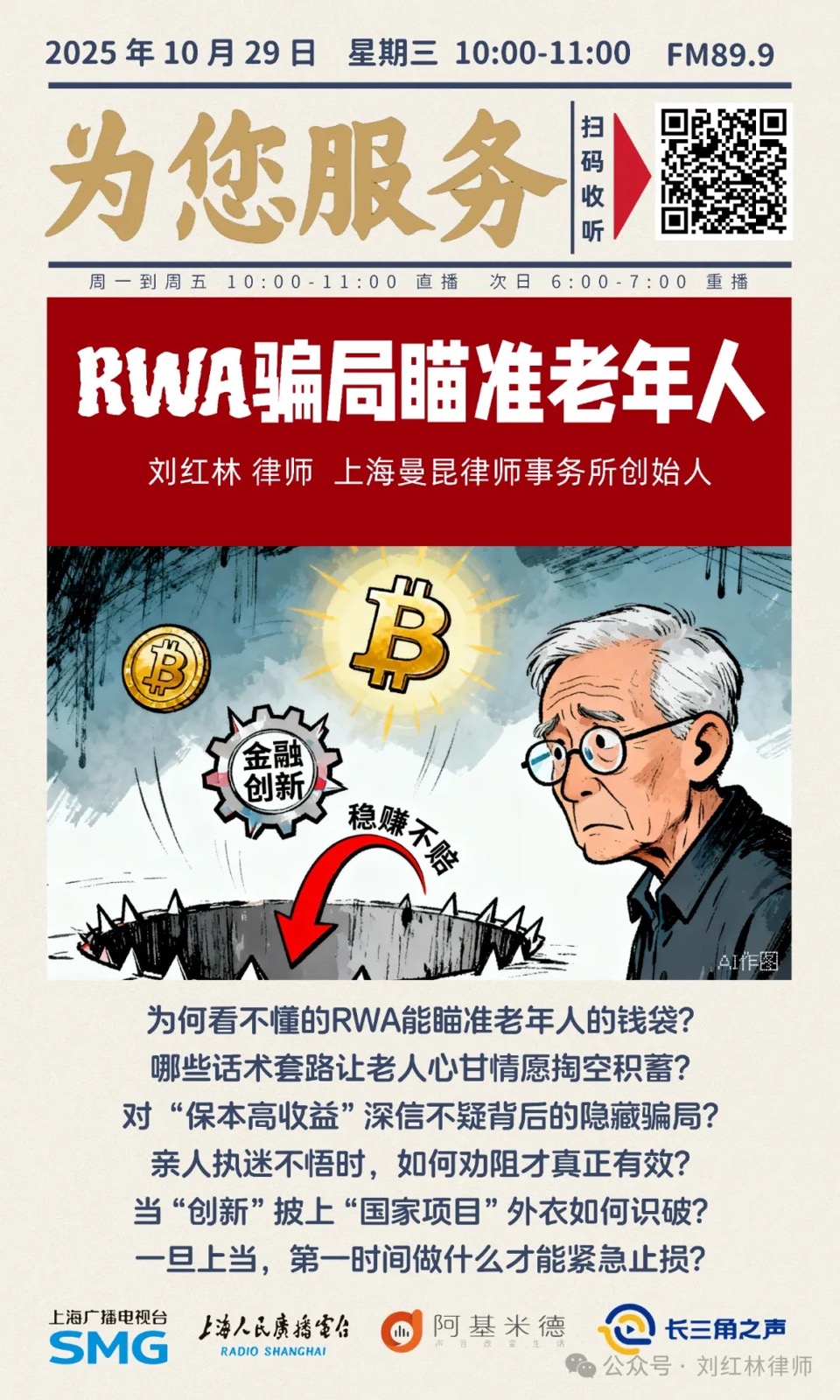
Why can completely incomprehensible concepts become effective tools for fraudulent fundraising? What traps lie behind promises of principal protection and high returns? How can we identify and expose them?Shanghai People’s Radio Station’s program At Your Service invited Attorney Liu Honglin, founder of Mankun Law Firm, to systematically unveil the deceptive facade of RWA scams and help safeguard property security.
(The audio transcription has been processed by AI and may contain omissions or errors.)
Scan the QR code below to listen to the full broadcast 👇
Host:Hello everyone, and welcome to At Your Service. I am your host, Cheng Gong.
Recently, we have observed a new type of scam spreading.Many individuals are using seemingly professional terms such as “RWA” and “blockchain” to promote so-called “principal-protected, high-yield” or “passive income” investment schemes to elderly persons.After attending several lectures and joining WeChat groups, many elderly individuals have invested funds under the guidance of self-styled “instructors.”Given that these concepts are clearly difficult to understand, why do they still deceive so many elderly people? How have the retirement savings painstakingly accumulated over a lifetime come to face such serious threats? What traps lie behind promises of “guaranteed profits with no losses”? And how can we identify and guard against them?
Today’s program specially featuresLiu Honglin, founder of Mankun Law FirmAttorney Liu has long focused on the legal aspects of fintech. He previously served as Vice President of a strategic investment legal-tech company at Tencent and as head of legal at a private equity fund with a listed-company background, accumulating extensive experience in this field. Over the next hour, we will join Attorney Liu in peeling back the layers of real-world assets (RWA) fraud schemes and offering practical advice to better safeguard the property security of elderly individuals.
Attorney Liu, welcome!
New Fraud Schemes Emerge: Beware of “RWA Investment” Traps
Host:
Attorney Liu, could you please explain in plain languagewhat exactly RWA is and what role it plays in the regulated financial sector?
Liu Honglin:
Certainly. RWA stands for “tokenization of real-world assets.” There are numerous RWA models worldwide, and as this is a relatively emerging field, the industry has not yet reached a fully unified definition. Put simply,Real-world assets (RWA) refer to the conversion of assets in the real world, such as real estate and stocks, into digital credentials through blockchain technology.Holding such a credential represents your ownership of a portion of the rights and interests in the corresponding underlying physical assets.
From the current landscape, RWA primarily adopts three models:
The first model,involves placing traditional financial assets such as stocks on the blockchain for trading;
the second model,is being explored by certain internet and technology companies in China in recent years, namely the tokenization of private equity fund interests or certain token-based equity interests. However, this model imposes investor eligibility requirements, mandating that participants be qualified investors (as in the case of private equity funds), and thus has limited relevance to the general public;
the third model,which from our perspective as lawyers is the most heterogeneous and mixed in quality, pertains to the RWA projects recently reported by numerous investors, which in substance constitute traditional illegal fundraising or fundraising fraud, merely repackaged under a new guise.
We are pleased to discuss this topic with you today, helping you identify and avoid these pitfalls.
“Old Wine in New Bottles”: Unveiling the Modus Operandi of “RWA” Scams
Moderator:
Just as learning requires first grasping basic concepts, our understanding of real-world assets (RWA) must begin with clarifying what they are. Only by laying this foundation can we have a basis for judgment when analyzing specific cases later on. Recently, I understand that Attorney Liu has received numerous inquiries from friends and clients, all related to RWA. It appears that such scams have indeed been rampant recently, with many elderly individuals losing their savings. While everyone may be relatively familiar with past telecommunication fraud tactics, many people do not even understand professional concepts like RWA. Why, then, are elderly individuals still falling victim? This is something I find quite puzzling.
Based on the cases you have encountered recently, and from the perspective of the victims’ experiences,how do you think the scammers package the concept of RWA? What methods do they use to lower the guard of elderly individuals and ultimately defraud them?
Liu Honglin:
I believe a significant factor is related to the market development of crypto assets over the past two years. For instance, seeing Bitcoin rise to such high levels, many people regret not having invested earlier, thinking they missed an opportunity for sudden wealth.
Scammers precisely exploit this psychology. They argue that blockchain itself is a neutral technology, pointing out that not only institutions but also many overseas governments are paying attention to and investing in Bitcoin. They use these examples to endorse their claims, stating that since prices have increased hundreds or thousands of times in the past, one should seize the next wave of opportunities in the coming decade. Alternatively, they may claim to have a project with early-access slots available and ask if you want to get on board.
Scammers leverage the attention garnered by emerging technologies, combined with price increase data accessible online,to confuse elderly individuals about the differences between Bitcoin and the RWA projects they are promoting. By exploiting this psychological gap, they cause many people to fall victim inadvertently.
Host:
In fact, I believe there is another possibility: people often wonder why others can make money—because they possess information inaccessible to ordinary individuals. Scammers are adept at exploiting this mindset. They may ask rhetorically: If this project is so profitable, why haven’t you heard of others getting rich from it? They then answer their own question: Because this is an internal opportunity, not everyone is qualified to know about it. They also emphasize that the fewer people who know, the greater the profit potential, thereby requiring investors to maintain confidentiality, claiming that “if everyone knew, no one would make money; we only allow a select few destined individuals to become wealthy.” Once investors lower their guard and are blinded by the promise of high returns, they may even help the scammers keep the secret strictly. In some cases we have encountered, the victims remained unwilling to disclose details until the very end.
Among the cases you have handled,could you share some specific fraudulent techniques, provided that personal information is anonymized?We are keen to understand the specific operational modus operandi of such scams through real-world cases.
Liu Honglin:
Based on the information we have gathered,currently, scams conducted under the guise of real-world assets (RWA) primarily target two groups: entrepreneurs and individual retail investors.The fraudulent strategies and tactics employed in these two types of scams differ significantly.
In scams targeting entrepreneurs, the core pitch is the claim that RWA can help companies raise capital and achieve a de facto listing.Fraudsters typically cite media-reported cases, such as “a certain enterprise raised tens of millions through an RWA issuance in Hong Kong,” and selectively present these “success stories” to persuade business owners, arguing: “See, they succeeded; you too can quickly resolve your funding issues through RWA, while also leveraging the blockchain hype to enhance your market presence.”
Many business owners are tempted by this pitch and may invest millions to engage these fraudsters as consultants or for product development. When the project is “launched,” tokens are issued on the surface and their prices appear favorable, butin reality, much of the data is fabricated to create a false impression.In the end, not only do the business owners lose their money, but they may also face legal liability for the project.
Host:
This is indeed a scam specifically targeting entrepreneurs. As you have analyzed, these pitches can easily make business owners perceive the fraudsters as highly professional, akin to Doraemon pulling out his magic pocket, seemingly capable of instantly resolving any financing or listing challenges.
As the presentation continues, the content sounds highly abstruse. Business owners, realizing they do not understand it, are more inclined to entrust the matter to “professionals.” From the fraudsters’ perspective, however, this is merely a superficial change with no substantive difference—essentially no different from past online telecom fraud: forging websites, fabricating data, and fictitiously representing profits, using exactly the same modus operandi. The only difference is that now they havedraped the old scheme in the new guise of real-world assets (RWA), thereby launching a new round of fundraising fraud against different target groups.
Liu Honglin:
You are absolutely right. Based on our observations, such scams are essentially“old wine in new bottles.”In 2025, we are seeing scams carried out under the banner of real-world assets (RWA), whereas five or six years ago, the prevalent scams were those centered on “blockchain transformation.” In fact, their underlying logic is the same, and their operational methods are largely similar.
Host:
Indeed, before making significant investments, it is highly necessary for enterprises to consult professionals and conduct thorough due diligence. This is particularly important when hundreds of millions or even tens of millions of yuan are at stake, where stringent safeguards against capital risks are imperative. So,from the perspective of individual investors, what are the specific operational tactics and operating models commonly employed in such scams?
Liu Honglin:
Currently, RWA scams targeting individual investors mainly follow two common models:
The first involves fabricating overseas projects, akin to the pure speculation logic surrounding virtual currencies.Fraudsters promote so-called overseas real-world assets (RWA) projects, claiming that they are in the early fundraising stage and have not yet been listed on public exchanges. They urge investors to subscribe using virtual currencies such as Bitcoin, promising that once the project is listed on mainstream exchanges, the price will surge tenfold or even a hundredfold. To enhance credibility, they also showcase past "success stories" of market manipulation. Many investors, motivated by the desire to "get in early" or believing they possess exclusive information, use their virtual currencies to subscribe. In reality, these projects ultimately list only on obscure, small overseas exchanges, with token prices entirely manipulated behind the scenes by the fraudsters. What investors seeas price increases are merely fictitious figures, often impossible to cash out in practice, leaving investors trapped at high valuation levels.
The second type is a more common RWA fraud model in mainland China. Such schemes typically operate under the guise of "membership benefits" or "pre-sale of goods," usually using commodities with opaque pricing, such as tea, as the underlying vehicle.Investors spend thousands or even tens of thousands of yuan to purchase digital certificates or digital collectibles purportedly corresponding to physical goods, thereby obtaining the right to take delivery. Tea is the most typical example, as its price lacks a fair and objective benchmark; it can be quoted at 200 yuan per jin or 30,000 yuan per jin. However, this alone is insufficient to attract more participants. Therefore, fraudsters further promise that investors may not only take delivery but also receive future profit distributions from the project, endowing these digital products with wealth-management characteristics. As a result, investors perceive low risk, believing they have both physical collateral and dividend income.
Even more enticingly, fraudsters claim that these digital rights can be resold within their platform and showcase so-called "success stories"—for instance, a product rising in value from 1,000 yuan to 10,000 yuan.The combination of physical collateral, dividend promises, and resale premiums creates a triple lure that easily induces individuals to fall victim.
Host:
In this way, investors commit their funds.The key lies in the fact that fraudsters must rapidly establish trust from the outset—especially among elderly individuals—by convincing them that the scheme is genuine, reliable, and a secure investment.
Regarding the two fraud models you analyzed earlier,the first is indeed intricately linked at every step.They do not directly ask you to invest cash into a project; instead, they first guide you to convert cash into virtual currency. This step appears reasonable because the virtual currencies themselves are real and verifiable. Subsequently, they instruct you to use these virtual currencies for the so-called "investment." Although this involves only an additional conversion step, this maneuver often lulls individuals into lowering their guard, causing them to unwittingly fall into the trap.
The core of the second type of scam is to create the illusion of "seeing is believing."When elderly individuals see tangible tea plantations, projects, and fixed assets, they develop a sense of security based on the notion that "the monk may run, but the temple remains," which naturally enhances their trust and favorability. Once such trust is established, it plays directly into the scammers' hands. These seemingly prestigious projects are, in fact, far removed from the daily lives of elderly individuals. Many seniors initially feel perplexed: "Why would such high-end projects approach me? Am I qualified to participate in such investments?" The scammers' first step is precisely to dispel these doubts, convincing the elderly that this is a rare opportunity, thereby lowering their guard.
Liu Honglin:
I believe that modern scammers are indeed adept at exploiting human psychology. Their basic modus operandi is"casting a long line to catch a big fish"—first offering small incentives to let you experience returns, then gradually inducing you to invest more. This is essentially the logic underlying fraud across the industry.
Many current real-world assets (RWA) scams have shifted to offline operations.They reserve venues at luxury hotels to hold promotional events, inviting potential middle-aged and elderly investors interested in RWA and investment. The events not only provide attentive hospitality but also arrange for "project operators" or "chairmen" to speak, sharing insights on global economic trends, showcasing appreciation cases of virtual currencies such as Bitcoin, and presenting proof of the company's strength. Thenthey introduce so-called "preferential opportunities", encouraging participants to make small initial investments. Initially, investors are usually allowed to obtain some returns; once trust is established, the scammers induce larger investments under the pretext of "wanting to earn more."
Due to the extensive anti-fraud publicity campaigns currently underway, such scams are rarely conducted via telephone or online channels anymore. Instead, they have increasingly shifted to offline activities,building trust through on-site company visits and face-to-face interactions, ultimately completing the fraud.
Host:
It is evident that fraudsters have conducted in-depth research into the psychological profiles of different demographic groups. This leads me to wonder: with your professional articulation and analytical capabilities, Attorney Liu, if exploited by fraudsters, you would essentially become their "powerful ally." In your experience, have any institutions invited you to participate in similar offline lectures? Or, even without your knowledge, have individuals used your name to conduct instructional promotions under the guise of "legal education" or "product introductions"? Given your highly senior and professional credentials, have you encountered instances where your identity was misappropriated in this manner?
We would like to inviteAttorney Liu to share his personal experiences. Through these real-world cases, we aim to help the public identify the true nature of various activities and enhance their awareness of prevention.
Liu Honglin:
I have indeed encountered such situations, and they have been particularly prevalent in the past month. On several occasions, friends sent me promotional posters for events, asking if I would be participating. Upon review, I realized I had never heard of these events.
Currently, there are indeednumerous fraudulent companies or obscure institutions that, without our consent, unauthorizedly place the law firm’s logo, my personal photograph, and biography on their promotional materials.Just recently, I have encountered this situation twice. Typically, such projects carry fraud risks, which is a certainty.
Host:
Indeed, these promotional posters often feature not only lawyers but also so-called"investment experts" and "market analysts" to lend credibility, making the entire event appear highly professional and premium.When elderly individuals see so many "masters" lecturing, they perceive it as a rare opportunity worth attending.
Fraudsters first use these impressive titles to attract people, and then rely on specific scripts to persuade elderly individuals. I have observed that theyone of the most commonly used tactics is operating under the guise of "government cooperation."For instance, they claim that a project is conducted in cooperation with a certain government department; I have even seen departments issue specific statements clarifying that they have never cooperated with any such entities. They also create a sense of urgency that the opportunity must not be missed, saying things like "if you miss it, it will be gone." These pitches are particularly effective in persuading elderly individuals, leading many to part with their retirement savings.
We would like to ask you to provide a specific analysis ofwhich sales pitches are most effective in triggering the investment desires of elderly individuals?
Liu Honglin:
In my view,for elderly individuals, the most persuasive factors are promises of "principal protection with interest payments," or the provision of tangible assets as security.Because elderly individuals are most concerned about the loss of principal, scams targeting them invariably emphasize these two points. By contrast, scams targeting younger individuals place greater emphasis on aggressive investment concepts such as "tenfold or hundredfold returns" and "getting rich overnight." The focal points of the sales pitches for these two demographic groups are entirely different.
There are three common tactics employed in scams targeting elderly individuals:
The first remains the traditional sales model, such as one tied to elderly care and health needs.For example, fraudsters may say: "You were going to buy protein powder anyway; if you invest in our project now, we will not only provide free protein powder every month, but you will also receive dividends at the end of the year." This leads elderly individuals to believe that they can meet their daily needs while also earning money, achieving two goals with one action, which makes them easily inclined to proceed.
The second tactic exploits the psychology of seeking petty gains.After participating in the project, participants receive monthly "airdrop" bonus points, which can be used for shopping in the project’s online store, or the fraudsters may claim that these points will be listed on exchanges and appreciate in value. Such "free benefits" are used to lure elderly individuals into continued participation.
The third tactic is a pyramid scheme based on person-to-person recruitment.Citing the project’s early-stage promotion as justification, they encourage elderly individuals to invite friends to participate and promise referral rewards. This approach closely resembles traditional pyramid schemes and is quite common among the elderly population.
Host:
Our listener, "Lucky Unicorn," noted that such scams target different segments of the elderly population compared to health supplement scams—real-world assets (RWA) scams often target elderly individuals with some education, basic financial literacy, and a refusal to accept aging. Indeed, different types of elderly individuals encounter different scam tactics, andit is distressing that many elderly individuals are reluctant to heed their children’s advice, yet place unwavering trust in fraudsters.
In daily life, we often observe blatantly flawed scams that nevertheless continue to attract elderly individuals to invest their retirement savings, ultimately resulting in total loss. This situation is both worrying and heartbreaking. Precisely for this reason, we need professionals like Attorney Liu to dissect the underlying mechanics of these scams layer by layer.
The several tactics analyzed by Attorney Liu sound familiar, do they not? Listeners who have attended similar seminars should recognize them. In fact, it is not easy for elderly individuals to trust a project; they also employ their own methods of evaluation, such as requesting the counterparty to produce relevant documents, qualification certificates, and other proof materials.
Attorney Liu,in the victim cases you have handled, did the elderly individuals verify these materials? Moreover, fraudsters today often prepare a seemingly complete set of materials; how exactly do they construct this "full-package scam"?
Liu Honglin:
Certainly,Impersonating government authorities or reputable institutions to obtain endorsements is a common tactic employed in such scams.For instance, we recently discovered cases where individuals forged licensing credentials of Hong Kong financial institutions, established fraudulent websites, fabricated documentation, and conducted public offline promotional campaigns. In fact, Hong Kong financial regulatory authorities regularly issue public notices identifying entities that are conducting business in violation of regulations without proper authorization. This demonstrates that such issues are not confined to the mainland; Hong Kong faces similar challenges. For fraudsters, securing endorsements from large institutions serves to garner trust.
Furthermore,fraudsters often invite so-called "guest speakers" to offline events and exploit group photographs to create a false impression of collaboration,subsequently using these images on official websites or in offline promotions to mislead the public. For this reason, I now strive to avoid taking group photographs with strangers at events, out of concern that they might use such photos to claim that "Mankun Law Firm is involved in their project" or "provides legal services," thereby improperly leveraging our firm for endorsement. Fraudsters are indeed deliberate in this regard, constantly seeking opportunities to exploit.
How to See Through the Elaborate Facade of "Real-World Assets (RWA)" Scams?
Moderator:
Indeed. Recent news reports indicate that even certain academicians have personally come forward to debunk frauds, precisely because fraudsters exploit group photographs and video footage from events to package them as "proof" of corporate strength and project compliance, causing significant distress to many public figures.
These scams often disguise themselves through meticulously prepared documentation; however, reviewing such materials does require professional discernment. Therefore,what key points should we focus on when verifying these supporting documents?We hope Attorney Liu can share some practical recommendations with our audience.
Liu Honglin:
Regarding the due diligence on qualifications for real-world assets (RWA) projects, I believe the focus should primarily be on two aspects:
First isissuance qualifications.It is necessary to verify whether the project sponsor holds relevant financial licenses issued by the Hong Kong government or operational qualifications for asset exchanges. These are key qualifications that must be verified from a financial regulatory perspective.
Second isverification of promotional claims.If a project claims to collaborate with government departments or has official endorsements, we recommend directly contacting the relevant institutions for verification. This can be done by calling the department’s public hotline or consulting through government service windows, which is the most direct method of verification.
Both verifications can be completed through official channels. We advise everyone to conduct these basic checks before making any investments.
Host:
If you encounter a project that purports to operate under the auspices of a government department, the most direct approach is to call that department to verify, or consult via the 12345 citizen hotline to confirm whether the project genuinely exists. A response is usually received quickly, as such scams often involve multiple victims and the related issues may have already come to light, even if they are not yet widely known.
When such projects present relevant materials, how long does it typically take you, Attorney Liu, to determine their authenticity?
Liu Honglin:
Forprojects with sloppy packaging, we can usually see through them at a glance.For example, last month an aunt from my hometown consulted me about a real-world assets (RWA) project recommended to her. Upon reviewing the materials, I found that the project was merely using the RWA label, while its substance remained the traditional "on-chain mining" scheme. This is akin to scammers learning new concepts and cloaking old frauds in new attire.
For projects with more careful packaging, we carefully study their whitepapers and business plans,focusing on whether the business model is feasible and whether there is exaggerated publicity. We also verify whether core data, such as user volume, trading volume, and scale of development, are authentic and credible. Through this examination, we can form a preliminary judgment.
Host:
Legitimate institutions usually engage professional lawyers to review compliance content when preparing such plans. For us lawyers, reviewing these documents is part of our daily work; we know clearly from which angles to assess authenticity. If we cannot determine it at first glance, we will take a closer look. Therefore,if you have any investment projects under consideration and feel uneasy, you are welcome to send us a private message at any time.Attorney Liu and I can help you conduct a preliminary analysis. If it is a sound investment opportunity, we will keep it confidential and would be happy to join you in generating returns; however, if issues are identified, we may help you avoid losses amounting to tens or even hundreds of thousands of yuan.
We just saw a comment from a listener named "Unicorn," who mentioned that he is in his fifties and has elderly parents in their eighties. He noted that while he used to patiently persuade them in previous years, he now feels deeply powerless. We fully understand this sense of helplessness. Later, we will invite Attorney Liu to help everyone break down how to conduct such analyses and how to provide guidance and clarification.
In the course of these scams, you also mentioned that fraudsters often give investors some "sweeteners" at the outset. I would like to ask Attorney Liu,how exactly do these early-stage rebates cause investors to let down their guard and even proactively recommend the scheme to friends and relatives?
Liu Honglin:
In fact, we have found that many victims vaguely sense that something is amiss when they participate in such projects, butmany victims harbor the wishful thinking of a "pass-the-parcel" scheme, always believing that they will not be the last ones left holding the bag.
There was a typical case previously: an investor was willing to recruit friends to join because the project had a"token unlock" mechanism, which could accelerate the unlocking process to recoup the principal. For example, if he invested RMB 10,000, it would originally take 12 months to gradually recover the principal. However, for each person he invited, the unlock speed would double, allowing him to break even within six months while continuing to earn returns. Although he realized this might involve pyramid selling, he wanted to recover his principal as quickly as possible, so he recruited friends to participate and hinted that they should "quit while ahead." As a result, three or four months later, the project was investigated and shut down by the police, and all participants' funds were trapped.
This situation is very common—it is not that people fail to see the problems, but rather that they always believe they will not be the last ones left holding the bag. However, the reality is often thatby the time you enter, you may already be close to the end of this scam.
Host:
Therefore, I want to remind everyone that even if an investment project is recommended by good friends or old classmates, you must remain vigilant.When it comes to investment and wealth management, we must not rely solely on personal relationships; instead, we must adhere to the law and assess risks.
A comment from a listener just now was quite interesting. He asked why no one had approached him for investment opportunities. I believe this precisely demonstrates his solid knowledge base and analytical ability, enabling him to see through such scams. As he correctly identified, these are typical "Ponzi schemes."
In essence, these scams follow the same underlying pattern despite being cloaked in new concepts such as "blockchain" and "real-world assets (RWA)." Many victims later express regret, asking, "How could I have failed to recognize such an obvious scam?" This reflects the common phenomenon that those directly involved are often less clear-sighted than outside observers. What warrants even greater vigilance is thatinvestment scams marketed under novel concepts tend to result in greater losses compared with traditional investment fraud,leaving investors with total losses and making asset recovery extremely difficult, thereby causing more severe harm than conventional scams.
Liu Honglin:
With respect to investments involving virtual currencies or blockchain projects, if one encounters fraud or risks,under the current regulatory framework in mainland China, recovering funds is indeed more difficult than in traditional investment contexts.Because, under mainland China’s regulatory policies, investments in virtual currencies are not protected by law. Contracts involving virtual currencies, such as lending or partnership agreements, are likely to be deemed invalid, which typically leads to two common scenarios:
The first scenario is thatwhen you report to the public security authorities that you were defrauded in an investment in virtual currencies or an RWA project, they may decline to initiate a case or inform you that virtual currencies are unlawful in China and that participation entails assuming the resulting losses.
The second scenario is thatYou may bring a formally executed contract to court to file a lawsuit, but the court may deem contracts involving virtual assets void, and may even refuse to accept the case for docketing. The situation may be somewhat more favorable in Shanghai, but in many third- and fourth-tier cities, courts generally will not accept such cases, and you may be unable to gain access to the court at all.
Here, we wish to highlight one particular detail:If the project sponsor or an intermediary requires you first to convert your funds into stablecoins such as USDT and then to invest using those stablecoins, your risk is further compounded, because purchasing USDT with renminbi is itself prohibited. When you subsequently use USDT to invest, if problems actually arise, public security organs and courts will, in most cases, decline to intervene.
This is precisely why we have consistently reminded everyone thatinvestments involving virtual assets require greater caution than traditional investments.
How can one more effectively dissuade others from falling victim to scams?
Host:
Indeed, scammers areexploiting legal loopholes to set traps;they deliberately package activities that are already non-compliant in mainland China as polished, trendy concepts, leading investors to mistakenly believe they are keeping pace with financial innovation. As one listener aptly remarked, these issues ultimately stem from human greed. Therefore, if we cannot overcome this vulnerability, we may evade a scam in one context only to fall victim in another.
Nowadays, various scams cloaked in obscure labels such as “blockchain” and “real-world assets (RWA)” are targeting elderly individuals. Many elderly persons, after receiving invitations to lectures or joining specific WeChat groups, gradually become ensnared in traps carefully orchestrated by scammers. In such circumstances, although children may promptly offer reminders and attempts at dissuasion, these efforts often yield limited results. As the aforementioned listener lamented, at times one may even feel powerless to persuade.
Nevertheless, precisely for this reason, we must not give up. If children’s persuasions prove of limited efficacy, it may be helpful to have someone else speak to the matter. Accordingly, I would like to ask Attorney Liu: if you were toWhat communication approaches should be used with elderly individuals to ensure they accept reminders, avoid resistance, and genuinely recognize the existence of these risks?
Liu Honglin:
You are absolutely right. As the saying goes, "only magic can defeat magic." Therefore,"only another expert can outmatch a pseudo-expert."At times, children and parents each hold their own views and positions, and insisting on their respective opinions can easily lead to confrontation. In such situations, introducing a third party or an expert often yields better results.
We have encountered situations where children, upon discovering that their parents intended to invest in suspicious projects, proactively suggested arranging a consultation with a professional lawyer for their parents. They then brought their parents to our firm for consultation. We analyzed and explained the matter using real cases based on the specific materials provided. Through such professional communication, the elderly individuals generally formed their own assessments.
Therefore, I believe thatwhen such family disagreements arise, engaging a third party is an effective resolution method. Meanwhile, legal education programs like ours are worth recommending to family members for listening, as information conveyed from a third-party perspective is often more readily accepted.
What steps should be taken if funds have already been invested?
Host:
Indeed. This is particularly true when elderly listeners hear case analyses in the program that closely mirror the sales pitches they encountered in lectures, prompting immediate alertness. In fact, fraudsters’ tactics are often similar; by learning about others’ experiences of being defrauded and listening to expert analyses, individuals can naturally see through these schemes.
One listener put it well: If one refuses to accept the limitations of age and wishes to continue investing and managing finances, participation should occur through formal channels. In public markets, gains and losses are transparent. Moreover, in factBeing defrauded not only results in financial loss but also inflicts severe psychological harm on elderly individuals.Indeed, many individuals have suffered significant adverse impacts on their physical and mental well-being as well as family harmony due to such losses.
Regarding investment amounts, some elderly individuals now commit hundreds of thousands or even tens of millions of yuan in a single transaction. This underscores the importance of professional legal consultation. For substantial investments, particularly when there are concerns about risks, it is essential to consult a lawyer. Our program has emphasized this principle for many years, yet it bears repeated reminder.
When funds have already been invested but the counterparty becomes unreachable, or when the counterparty begins to delay using various excuses, we begin to recognize the dangers involved.Attorney Liu, in such circumstances, should one report to the police first or consult a lawyer first? Regarding evidence, what materials are most critical to preserve?
Liu Honglin:
In cases of investment fraud or sudden loss of contact with the project promoter, both consulting a lawyer and reporting to the police are viable options.
However, generally speaking, ifthe investment amount is not substantial, or if you possess relatively complete contractual documentation, the police are likely to characterize the matter as a civil dispute and advise resolution through the courts. In such instances,consulting a lawyer first would be the more appropriate course of action.
There are two points that warrant particular attention.First, for any investment involving a substantial amount, it is essential to execute a formal written contract.Participating in an investment based solely on oral agreements is extremely risky, because the absence of documentary evidence will place you at a disadvantage whether you report the matter to the police or initiate litigation;Second, when transferring large sums of funds, it is advisable to conduct the transaction at a bank counter.Banks’ risk-control systems are currently quite stringent; staff will carefully inquire about the purpose of the transfer and whether you know the payee, among other matters. This process can, in effect, filter out many risks associated with telecom fraud.
Of course, if you unfortunately fall victim to a scam,please do not engage in excessive self-blame; it is better to address the issue promptly. At this stage, seeking assistance from professionals is the more appropriate course of action.
Host:
Next, we will respond to a query from a listener. He posted in the listeners’ group that some time ago he invested in an industrial company, unaware at the time that the company was engaged in the illegal absorption of public deposits. The investment term was one year,and after it matured this April, he not only failed to receive any dividends but also could not recover his principal. Despite multiple negotiations, the company continually evaded its obligations by claiming a lack of funds, and his report to the police was not accepted.
I also looked into the matter and it appears that the court’s economic crime investigation division has recently opened a case and taken measures to seal the company’s assets. I would like to ask Attorney Liu,under these circumstances, what information asymmetries may exist? And for this listener’s predicament, how should we formulate a subsequent response strategy and proceed step by step to minimize losses to the greatest extent possible?
Liu Honglin:
In our day-to-day advisory practice, such scenarios are indeed common. Many companies now attract investment through referrals from acquaintances, ostensibly for project investment or working capital purposes. These arrangements typically take two forms:
The first involves companies that engage in genuine business operations but, due to cash flow shortages or obstacles in obtaining bank credit, turn to private lending for financing.Such investments often take the form of loan agreements stipulating interest rates of 10% or higher. However, if the company becomes insolvent due to poor management, reporting the matter to the police is unlikely to resolve the issue, as this constitutes a civil loan dispute. Investors can only participate in asset distribution as ordinary creditors. If the company’s assets are insufficient, creditors who are lower in priority may be unable to recover their funds.
The second type is a shell-company scam.These companies are professionally packaged and enter into contracts with you under the guise of project investment. They may even structure your investment as equity contributions by establishing limited partnerships and completing corporate registrations. Once the funds are received, they will attempt to transfer the assets. When disputes arise, the situation may superficially appear to be an internal conflict among shareholders, but in reality it is a carefully orchestrated fraud.
Nevertheless, the underlying principle remains the same. Whether the funds are provided as loans or as equity-like subscription payments,Regardless of the form, if the counterparty does not genuinely use the funds for business operations but instead diverts them for other purposes or squanders them personally, without bona fide investment in production, it will constitute fundraising fraud. In such circumstances, immediately reporting the case to the authorities is the most appropriate course of action.
Conclusion
Host:
Thus, risks are ubiquitous. Once you have engaged in these activities and signed documents, you may be held accountable for the consequences. Therefore,exercise caution before signing any documents or making payments, and consult qualified lawyers and other professionals.We recommend that, prior to making significant investments, you execute written contracts and have them reviewed by a lawyer.
We often say that to defeat magic, one must rely on magic itself. What is this "magic"? It essentially means understanding the logic behind fraudulent schemes. Moreover, from a legal perspective, we have developed our own mature methodologies and response templates to combat such crimes.
At the end of the program, we would like to invite Attorney Liu to share his outlook:What new variations of such scams do you anticipate emerging in the future? In the current environment, which emerging concepts might be exploited by fraudsters? How might they repackage old tricks with new facades to reappear before the public?
Liu Honglin:
Certainly. We often say that"History does not repeat itself, but it often rhymes."From a more pessimistic standpoint, whenever a new buzzword emerges, scams of this nature are likely to recur in succession.Yet precisely for this reason, we must strive to cut through the fog and discern the underlying essence.
At times, parties involved may find it difficult to see clearly due to their direct involvement. In such cases, it is advisable to consult lawyers or authoritative industry experts and rely on professional analysis to distinguish truth from falsehood, thereby ensuring greater security. Additionally, the public should not place excessive faith in various large-scale offline events or so-called expert training programs. Be wary of stages that ultimately guide you to swipe your card for payment or commit substantial funds, as these often constitute the final step in a scammer's scheme to extract money.Maintaining a mindset of continuous learning is commendable, but when real money is at stake, utmost caution is imperative.
Host:
As we conclude today's program, we wish to remind everyone once again:When confronted with various investment opportunities, please be sure to seek extensive consultation and verification.As your trusted "At Your Service" program, we are honored to collaborate with Attorney Liu Honglin to provide professional support. In addition to his demanding professional practice, Attorney Liu has long been committed to public-interest legal education and has authoreda substantial number of anti-fraud articles and advisory content, consistently providing the general public withlegal literacy outreachWe also encourage everyone to seek assistance from qualified attorneys whenever encountering suspicious investment projects, as they can help identify risks and avoid pitfalls.
Finally, we speciallyrecommend Attorney Liu Honglin’s law firm WeChat official account, which compiles many valuable anti-fraud insights and case analyses that we believe are well worth studying.
Liu Honglin:
Our firm,Mankun Law Firm, is a specialized law firm focusing on the Web3 blockchain sector, publishing two industry updates and legal education articles daily to introduce the latest domestic and international development trends, analyze representative cases handled by our firm, and expose common scams and risks in the industry.
Mypersonal account name is "Attorney Liu Honglin", and you can directly search for it on platforms such as Douyin, Xiaohongshu, WeChat Channels, and WeChat Official Accounts. Moreover, many lawyers in our firm, including myself, publish articles and short videos onthe "Mankun Blockchain Legal Services" WeChat Official Account, so if you prefer not to read lengthy articles of several thousand words, you may also watch our short videos.
Host:
Thank you, Attorney Liu Honglin, and thank you all for listening and participating. Remember:For any investment, if you do not understand it, do not invest; any promise of "high returns with zero risk" is a scam; leave professional matters to professionals for assessment.See you next time!