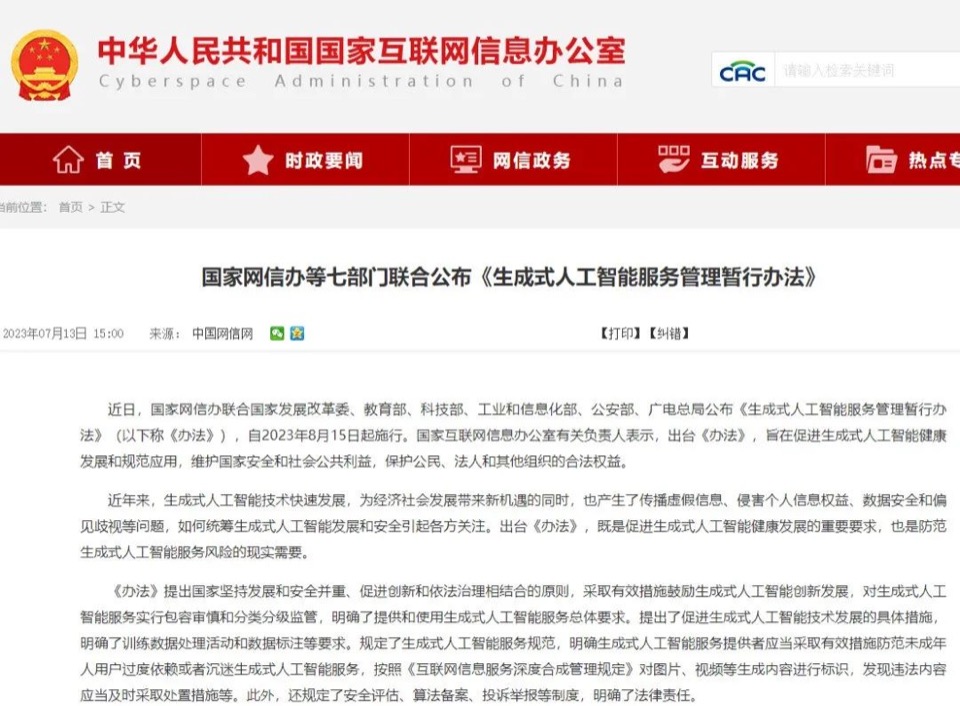
Yesterday afternoon, the Cyberspace Administration of China and six other departments jointly issued the Interim Measures for the Administration of Generative Artificial Intelligence Services. It has been only three
Yesterday afternoon, the Cyberspace Administration of China and six other departments jointly issuedthe Interim Measures for the Administration of Generative Artificial Intelligence Services months since the release of the draft for comments on April 11. This pace is remarkably swift. Even more notably, the Interim Measures will take effect one month from now, on August 15, 2023.
The timeline is tight and the tasks are substantial. As entrepreneurs in China’s highly prominent AIGC sector, what should you pay attention to before the Measures take effect? What activities are permitted and which are prohibited? In this article, we will provide a clause-by-clause interpretation from the perspective of entrepreneurs.
Chapter I General Provisions
Article 1 These Measures are formulated in accordance with the Cybersecurity Law of the People’s Republic of China, the Data Security Law of the People’s Republic of China, the Personal Information Protection Law of the People’s Republic of China, the Law of the People’s Republic of China on Progress in Science and Technology, and other laws and administrative regulations, in order to promote the healthy development and standardized application of generative artificial intelligence, safeguard national security and the public interest, and protect the lawful rights and interests of citizens, legal persons, and other organizations.
Legal Commentary:
(1) The laws cited as the basis for the Interim Measures constitute the foundational legal framework for cybersecurity, information protection, and data compliance in China’s internet sector.
(2) Overall, China’s regulatory response speed regarding AIGC ranks among the leading tier globally. Why so fast? Because the competent authorities face significant pressure. Only China’s internet features a vast, unified domestic market at scale, and Chinese entrepreneurs are among the most diligent and core participants in the global internet industry.Thus, the Cyberspace Administration of China has effectively been compelled to act promptly, providing rapid answers to the fundamental questions on the minds of industry practitioners: Can this business be pursued? And if so, how?Therefore,the entrepreneurial opportunities in AIGC lie not overseas, but in China.
Article 2 These Measures apply to services that use generative artificial intelligence technology to provide the public within the People’s Republic of China with generated content such as text, images, audio, and video (hereinafter referred to as “generative AI services”).
Where the State has separate provisions governing the use of generative AI services for activities such as news publishing, film and television production, and literary and artistic creation, such provisions shall prevail.
These Measures do not apply to industry associations, enterprises, educational and research institutions, public cultural institutions, relevant professional institutions, and other entities that develop and apply generative AI technology but do not provide generative AI services to the public within China.
Lawyer’s Interpretation:
(1) As long as your application supports use by users within China, you must comply with these regulatory requirements. This applies even if your corporate entity, servers, and R&D team are all located overseas.
(2) If AIGC is used solely for internal office purposes within a corporate group, or merely to assist your company’s customer service (such as chatbot customer support), these Interim Measures do not apply.
(3) News publishing, film and television production, and literary and artistic creation are singled out because they play a prominent role in shaping public opinion and exerting cultural influence, thus warranting special attention. Entrepreneurs in these three AIGC sectors will receive [preferential treatment].
Article 3 The State adheres to the principles of balancing development and security, and combining the promotion of innovation with law-based governance. It adopts effective measures to encourage innovative development in generative AI, and implements inclusive and prudent, category- and tier-based regulation of generative AI services.
Attorney Commentary:
The State encourages development in fields related to artificial intelligence generated content (AIGC); central authorities have signaled support, and local governments are following suit. It is anticipated that local governments across various regions will introduce supportive policies for AIGC-related companies. Entrepreneurs are advised to closely monitor notices issued by local science and technology commissions, commissions of economy and information technology, and other relevant departments.
Article 4 The provision and use of generative artificial intelligence services shall comply with laws and administrative regulations, respect social public morality and ethical standards, and adhere to the following provisions:
(1) Uphold core socialist values; do not generate content prohibited by laws and administrative regulations, including content that incites the subversion of state power or the overthrow of the socialist system, endangers national security and interests, damages the national image, incites secession or undermines national unity and social stability, promotes terrorism or extremism, advocates ethnic hatred or discrimination, contains violence or obscene and pornographic material, or disseminates false and harmful information;
(2) Take effective measures during algorithm design, training data selection, model generation and optimization, and service provision to prevent discrimination based on ethnicity, religious belief, nationality, region, gender, age, occupation, health status, or other factors;
(3) Respect intellectual property rights and business ethics, maintain the confidentiality of trade secrets, and refrain from leveraging advantages in algorithms, data, or platforms to engage in monopolistic practices or unfair competition;
(4) Respect the lawful rights and interests of others; do not endanger the physical or mental health of others, and do not infringe upon others' rights to portrait, reputation, honor, privacy, or personal information;
(5) Based on the characteristics of the service type, take effective measures to enhance the transparency of generative artificial intelligence services and improve the accuracy and reliability of generated content.
Attorney Commentary:
(1) AI systems developed by law-abiding citizens must also operate in compliance with the law and align with correct political orientations. Entrepreneurs should implement keyword filtering at the user input stage to block sensitive terms, and conduct screening and desensitization of AIGC outputs for sensitive words or imagery to avoid unnecessary legal risks.
(2) Compliance with intellectual property obligations requires attention: one must not directly scrape third-party databases to train proprietary AI models, nor use copyrighted content owned by others as direct materials for synthetic content generation.
(3) AIGC entrepreneurs providing celebrity face-swapping services should cease such activities, as they are unlawful and infringe upon celebrities' rights of publicity and other related rights.
Chapter II Technological Development and Governance
Article 5 Encourage the innovative application of generative artificial intelligence technologies across various industries and fields, generate high-quality content that is positive, healthy, and conducive to social good, explore and optimize application scenarios, and build an application ecosystem.
Support collaboration among industry organizations, enterprises, educational and scientific research institutions, public cultural institutions, and relevant professional institutions in areas such as technological innovation in generative artificial intelligence, data resource development, transformation and application, and risk prevention.
Legal Commentary:
(1) The State encourages large models, and even more so industry-specific small models. The broader direction of China's internet development is shifting from virtual to real, promoting the development of the real economy. The same applies to AIGC; therefore, consumer-facing (to-C) AIGC ventures may not necessarily be the optimal path. Serving industry clients, providing commercial services within application scenarios, and enhancing work efficiency in specific industries constitute a promising business opportunity. After all, initiatives encouraged by the State make it easier for listed companies to craft compelling narratives and for state-owned enterprises to secure budget approvals.
(2) For startups, collaborating with universities and other scientific research institutions on R&D is an effective way to reduce costs and increase efficiency during the product development phase, which also enhances their public image. Additionally, this may provide opportunities to apply for national research funding.
Article 6 Encourage independent innovation in foundational technologies for generative artificial intelligence, including algorithms, frameworks, chips, and supporting software platforms; conduct international exchanges and cooperation on the basis of equality and mutual benefit; and participate in the formulation of international rules related to generative artificial intelligence.
Promote the construction of infrastructure for generative artificial intelligence and public training data resource platforms. Facilitate the coordinated sharing of computing power resources to improve their utilization efficiency. Promote the orderly, classified, and graded opening of public data to expand high-quality public training data resources. Encourage the adoption of secure and trustworthy chips, software, tools, computing power, and data resources.
Legal Commentary:
(1) In addition to the application layer, the underlying technologies of artificial intelligence-generated content (AIGC) also warrant encouragement. While data may not necessarily be permitted for cross-border data transfer, the underlying technologies may be.
(2) The State encourages the development of shared-computing-power models in the AIGC computing-power sector.
Article 7 Providers of generative artificial intelligence services (hereinafter referred to as "providers") shall lawfully conduct training data processing activities, including pre-training and optimization training, and comply with the following requirements:
(1) Use data and foundation models that have lawful sources;
(2) Where intellectual property rights are involved, refrain from infringing upon the intellectual property rights enjoyed by others in accordance with the law;
(3) Where personal information is involved, obtain the individual's consent or meet other circumstances prescribed by laws and administrative regulations;
(4) Adopt effective measures to improve the quality of training data and enhance its authenticity, accuracy, objectivity, and diversity;
(5) Comply with other relevant provisions of laws and administrative regulations, such as the Cybersecurity Law of the People's Republic of China, the Data Security Law of the People's Republic of China, and the Personal Information Protection Law of the People's Republic of China, as well as relevant regulatory requirements issued by the competent authorities.
Legal Commentary:
(1) It is reiterated that while commercial operations are permissible, infringement is prohibited.
(2) With respect to infringement matters involving internet companies, the State focuses primarily on two areas: intellectual property rights and users' personal privacy data.
Article 8 Where data labeling is conducted in the course of research and development of generative artificial intelligence technologies, providers shall formulate clear, specific, and operable labeling rules that comply with the requirements of these Measures; carry out assessments of data labeling quality and conduct sample-based verification of the accuracy of labeled content; provide necessary training to labeling personnel to enhance their awareness of respecting and abiding by the law, and supervise and guide labeling personnel to carry out labeling work in a standardized manner.
Lawyer’s Interpretation:
A human-in-the-loop approach is required; obligations are not imposed solely on automated systems but also on natural persons. Companies must provide relevant training to labeling personnel and maintain proper training records to mitigate risks associated with random inspections or ex post facto reviews. As the saying goes, early compliance reduces subsequent troubles.
Chapter III Service Standards
Article 9 Providers shall, in accordance with the law, bear the responsibilities of online information content producers and fulfill obligations for network information security. Where personal information is involved, they shall, in accordance with the law, bear the responsibilities of personal information processors and fulfill obligations for the protection of personal information.
Providers shall enter into service agreements with users who register for their generative artificial intelligence services (hereinafter referred to as “Users”), clearly specifying the rights and obligations of both parties.
Lawyer’s Interpretation:
This provision reiterates the protection of users’ private information and clarifies that such protections should be explicitly stipulated in the User Agreement of the website or application.
Article 10 Providers shall clearly specify and publicly disclose the target audience, applicable scenarios, and intended purposes of their services; guide Users to understand and use generative artificial intelligence technologies in a scientific, rational, and lawful manner; and take effective measures to prevent minor Users from becoming overly dependent on or addicted to generative artificial intelligence services.
Legal Commentary:
While AI bots are beneficial, they should not be overused. For instance, primary and secondary school students should not rely on AI bots to complete their homework. Entrepreneurs may draw lessons from the gaming industry by implementing robust anti-addiction mechanisms for minors.
Article 11 Providers shall, in accordance with the law, fulfill their obligations to protect users’ input information and usage records. They shall not collect personal information that is unnecessary, shall not illegally retain input information and usage records capable of identifying users, and shall not illegally provide such input information and usage records to any third party.
Providers shall, in accordance with the law, promptly accept and handle individuals’ requests to access, copy, correct, supplement, or delete their personal information.
Legal Commentary:
(1) Implement product-level restrictions on content input by users.
(2) Ensure proper safeguarding of collected user data. Providers must not sell user data in their possession to third parties for supplemental income, whether openly or covertly. Such conduct is not only unlawful but also constitutes a criminal offense.
(3) The application must support functionality for users to delete their accounts.
Article 12 Providers shall label generated content, such as images and videos, in accordance with the Provisions on the Administration of Deep Synthesis of Internet Information Services.
Legal Commentary:
Images and video content generated by AI bots must beclearly labeledas AI-generated. For example, if you are developing virtual digital humans, you must provide explicit labeling in your videos, similar to the approach used on Mr. Liu Run’s WeChat Channels account.
Article 13 Providers shall provide safe, stable, and continuous services during the course of their service provision, so as to ensure users’ normal use.
Lawyer’s Interpretation:
Providers may not sell membership services and then abscond, nor may their services be plagued by persistent bugs. This poses significant challenges for entrepreneurs who integrate overseas API interfaces to package mini-programs, given that API outages do not constitute a valid excuse for service failures. If users bring claims against you, you will bear liability.
Article 14 Where a provider discovers unlawful content, it shall promptly take disposal measures such as halting generation, halting transmission, and deletion; implement rectification measures including model optimization and training; and report to the relevant competent authorities.
Where a provider discovers that a user is engaging in unlawful activities by using generative artificial intelligence services, it shall, in accordance with law and contract, take disposal measures such as issuing warnings, restricting functionality, and suspending or terminating the provision of services to such user; preserve relevant records; and report to the relevant competent authorities.
Lawyer’sInterpretation:
This reflects the application of the "Red Flag" doctrine and the "Safe Harbor" doctrine in internet infringement cases to the field of AIGC. The "Red Flag" doctrine means that if illegal content on your website is obvious to everyone and you fail to remove it, you will be held liable. The "Safe Harbor" doctrine means that if users file complaints or reports regarding problematic content on your website, you must remove such content to avoid legal liability.
Article 15 Providers shall establish and improve mechanisms for handling complaints and reports, provide convenient channels for submitting complaints and reports, publish the handling procedures and timeframes for feedback, and promptly accept and process public complaints and reports while providing feedback on the outcomes.
LawyerCommentary:
(1) A customer service channel must be available, even if it is operated by a chatbot in the backend.
(2) The user agreement must clearly specify the customer service channels, procedures, and methods of response on the website to ensure that users have accessible avenues for filing complaints.
Chapter IV: Supervision, Inspection, and Legal Liability
Article 16 Departments including the cyberspace administration, development and reform, education, science and technology, industry and information technology, public security, radio and television, and press and publication shall, in accordance with their respective duties, strengthen the administration of generative artificial intelligence services as required by law.
The relevant national competent authorities shall improve scientific regulatory approaches adapted to innovative development, and formulate corresponding classified and graded regulatory rules or guidelines, taking into account the technical characteristics of generative artificial intelligence and its service applications in relevant industries and fields.
Lawyer's Commentary:
(1) This provision clarifies the regulatory approach to AIGC, emphasizing multi-agency responsibility. Given the longstanding multi-agency model of internet regulation in China, entrepreneurs should be mindful of the numerous government authorities whose interests must be considered.
(2) It is anticipated that various WeChat groups for drafting industry standards will be reactivated, and business opportunities related to national standard white papers will emerge. For entrepreneurs, paying tens of thousands of RMB may secure a spot in these initiatives, but such participation offers limited practical value. Beware of fraud.
Article 17 Providers of generative artificial intelligence services with public opinion attributes or social mobilization capabilities shallconduct security assessments in accordance with relevant state regulations, and fulfill the procedures for algorithm filing, as well as filing for changes or cancellation, pursuant to the Provisions on the Administration of Algorithmic Recommendations for Internet Information Services.
Legal Commentary:
With greater capability comes greater responsibility. AIGC entrepreneurs operating in sectors such as industry media, social networking products, and cultural communication should prioritize conducting security assessments and completing algorithm filings.
Article 18 Where users discover that generative artificial intelligence services fail to comply with laws, administrative regulations, or these Measures, they have the right to file complaints or reports with the relevant competent authorities.
Legal Commentary:
The AIGC sector relies on public oversight akin to the "Chaoyang Masses" model.Entrepreneurs subject to reports and subsequent regulatory inquiries should respond proactively.Avoid administrative penalties.
Article 19 The relevant competent authorities shall, in accordance with their respective duties, conduct supervision and inspections of generative artificial intelligence services. Providers shall cooperate in accordance with the law and, as required, provide explanations regarding the sources, scale, types, annotation rules, algorithmic mechanisms and principles of training data, and provide necessary technical, data and other support and assistance.
Relevant institutions and personnel participating in the security assessment and supervision and inspection of generative artificial intelligence services shall keep confidential, in accordance with the law, state secrets, trade secrets, personal privacy and personal information obtained in the course of performing their duties, and shall not disclose or illegally provide such information to others.
Lawyer’s Interpretation:
(1) This provision outlines the general approach for regulatory authorities when investigating entrepreneurs. When facing inquiries and investigations by regulatory authorities, entrepreneurs may provide written responses addressing these aspects.
(2) Law enforcement personnel are obligated to maintain confidentiality.
Article 20 Where generative artificial intelligence services provided from outside the People's Republic of China into its territory fail to comply with laws, administrative regulations, and the provisions of these Measures, the national cyberspace administration shall notify relevant institutions to take technical measures and other necessary measures to address the non-compliance.
Lawyer’s Interpretation:
Regulatory authorities are well aware of practices such as reverse proxying and VPN setup. The State will take measures. Therefore, domestic large language models warrant serious consideration. Entrepreneurs, please take note.
Article 21 Where a provider violates the provisions of these Measures, the relevant competent authorities shall impose penalties in accordance with the Cybersecurity Law of the People's Republic of China, the Data Security Law of the People's Republic of China, the Personal Information Protection Law of the People's Republic of China, the Law of the People's Republic of China on Progress in Science and Technology, and other laws and administrative regulations. Where no provisions are stipulated in laws or administrative regulations, the relevant competent authorities shall, within the scope of their respective duties, issue warnings, circulate notices of criticism, and order rectification within a specified time limit; where the provider refuses to make corrections or the circumstances are serious, an order shall be issued to suspend the provision of related services.
Where the conduct constitutes a violation of public security administration, public security administration penalties shall be imposed in accordance with the law; where the conduct constitutes a crime, criminal liability shall be pursued in accordance with the law.
Lawyer’s Interpretation:
The regulatory authorities have clearly warned entrepreneurs that engaging in AIGC ventures may not only constitute illegality but may even amount to criminal offenses. Therefore, do not assume that having connections within government departments will shield you from consequences. In cases involving network data and cybersecurity, entities are likely to be selected as typical enforcement cases. Entrepreneurs should exercise caution.
Chapter V Supplementary Provisions
Article 22 The terms used in these Measures are defined as follows:
(1) Generative artificial intelligence technology refers to models and related technologies capable of generating content such as text, images, audio, and video.
(2) Providers of generative artificial intelligence services refer to organizations or individuals that utilize generative artificial intelligence technology to provide generative artificial intelligence services (including providing such services through programmable interfaces or other means).
(3) Users of generative artificial intelligence services refer to organizations or individuals that use generative artificial intelligence services to generate content.
Lawyer’s Interpretation:
Official definitions are the most reliable.
Article 23 Where laws or administrative regulations require that the provision of generative artificial intelligence services be subject to relevant administrative licensing, providers shall obtain such licenses in accordance with the law.
Foreign investment in generative artificial intelligence services shall comply with the provisions of laws and administrative regulations governing foreign investment.
Attorney’s Interpretation:
(1) AIGC startups are required to obtain operational permits, complete filings, and secure other necessary qualifications. Attorney Hong Lin will discuss this topic separately on our official account in a future post; please stay tuned.
(2) Cybersecurity is a matter of significant national concern. Startups in the AIGC sector with foreign shareholders may encounter certain complications.
Article 24 These Measures shall come into effect on August 15, 2023.
Attorney’s Interpretation:
The “China speed” is characterized by its rapid, precise, and decisive implementation.
Appendix
Q&A with the Person in Charge of the Cyberspace Administration of China Regarding the Interim Measures for the Management of Generative Artificial Intelligence Services:
Q: Please briefly introduce the background for the issuance of the Measures.
A:The formulation of the Measures is primarily based on the following considerations:First, it is an important measure to thoroughly implement the important instructions of General Secretary Xi Jinping and the decision-making arrangements of the CPC Central Committee.General Secretary Xi Jinping pointed out at a meeting of the Political Bureau of the CPC Central Committee: "Attention should be paid to the development of general-purpose artificial intelligence, an innovation ecosystem should be fostered, and risk prevention should be prioritized."Second, there is an urgent need to promote the healthy development of generative artificial intelligence.With the rapid development of generative artificial intelligence technology, while bringing new opportunities for economic and social development, it has also given rise to issues such as the dissemination of false information, infringement of personal information rights and interests, data security risks, and bias and discrimination. The Measures adhere to both goal-oriented and problem-oriented approaches, specifying concrete measures to promote the development of generative artificial intelligence technology and establishing basic norms for generative artificial intelligence services.Third, it is an inherent requirement for advancing the implementation of legal provisions.The formulation of the Measures is an important requirement for implementing the relevant provisions of the Cybersecurity Law, the Data Security Law, the Personal Information Protection Law, and the Law on Progress of Science and Technology, so as to further regulate activities such as data processing, safeguard national security and public interests, and protect the legitimate rights and interests of citizens, legal persons, and other organizations.
Q: What is the scope of application of the Measures?
A: The Measures stipulate that these Measures shall apply to services that use generative artificial intelligence technology to provide generated content, such as text, images, audio, and video, to the public within the territory of the People's Republic of China.Where the State has separate provisions on the use of generative artificial intelligence services for activities such as news publishing, film and television production, and literary and artistic creation, such provisions shall prevail. Where industry organizations, enterprises, educational and research institutions, public cultural institutions, and relevant professional institutions develop and apply generative artificial intelligence technology without providing generative artificial intelligence services to the public within the territory of China, the provisions of these Measures shall not apply.
Q: What are the main principles upheld by the Measures?
A: The Measures provide that the State adheres to the principles of placing equal emphasis on development and security, and combining the promotion of innovation with law-based governance. It adopts effective measures to encourage the innovative development of generative artificial intelligence, and implements inclusive and prudent regulation as well as classified and graded supervision over generative AI services.
Q: What do the terms “generative artificial intelligence technology” and “providers of generative artificial intelligence services” refer to in the Measures?
A: As used in the Measures, “generative artificial intelligence technology” refers to models and related technologies capable of generating content such as text, images, audio, and video. “Providers of generative artificial intelligence services” refer to organizations and individuals that use generative artificial intelligence technology to provide generative AI services (including providing such services through programmable interfaces and other means).
Q: What considerations does the Measures include for promoting the healthy development of generative artificial intelligence?
A:In terms of regulatory scope, the Measures target generative artificial intelligence services.With respect to regulatory approach, the Measures propose implementing inclusive and prudent regulation as well as classified and graded supervision over generative artificial intelligence services, requiring relevant national competent authorities to improve scientific regulatory approaches adapted to innovative development, and to formulate corresponding rules or guidelines for classified and graded supervision, taking into account the characteristics of generative AI technology and its service applications in relevant industries and fields.Regarding specific measures to promote development, first, the Measures explicitly encourage the innovative application of generative artificial intelligence technology across various industries and fields, fostering the creation of high-quality content that is positive, healthy, and uplifting, exploring and optimizing application scenarios, and building an application ecosystem.Second, support is provided for collaboration among industry organizations, enterprises, educational and research institutions, public cultural institutions, and relevant professional bodies in areas such as technological innovation in generative AI, data resource development, transformation and application, and risk prevention. Third, independent innovation in foundational technologies such as generative AI algorithms, frameworks, chips, and supporting software platforms is encouraged., engage in international exchanges and cooperation on the basis of equality and mutual benefit, and participate in the formulation of international rules related to generative artificial intelligence.Fourth, it proposes promoting the development of infrastructure for generative artificial intelligence and publictraining dataresource platforms.It promotes the coordinated sharing of computing power resources and enhances the efficiency of their utilization. It advances the orderly, classified, and graded opening of public data, thereby expanding high-quality public training data resources. It encourages the adoption of secure and trustworthy chips, software, tools, computing power, and data resources.
Q: What regulations does the Measures specify must be complied with in the provision and use of generative artificial intelligence services?
A: The Measures specify that the provision and use of generative artificial intelligence services shall adhere to core socialist values, and shall not generate content prohibited by laws and administrative regulations, such as content that incites the subversion of state power or the overthrow of the socialist system; endangers national security and interests or damages the national image; incites the splitting of the country or undermines national unity and social stability; promotes terrorism or extremism; advocates ethnic hatred or ethnic discrimination; contains violence, obscenity, or pornography; or consists of false and harmful information. Effective measures shall be taken throughout the processes of algorithm design, training data selection, model generation and optimization, and service provision to prevent discrimination based on ethnicity, belief, nationality, region, gender, age, occupation, health status, or other grounds. Intellectual property rights and business ethics shall be respected, trade secrets shall be kept confidential, and advantages in algorithms, data, or platforms shall not be exploited to engage in monopolistic or unfair competition practices. The legitimate rights and interests of others shall be respected; no harm shall be caused to the physical or mental health of others, and no infringement shall be made upon others' rights of portrait, reputation, honor, privacy, or personal information interests. Based on the characteristics of the service type, effective measures shall be taken to enhance the transparency of generative artificial intelligence services and to improve the accuracy and reliability of generated content.
Q: What are the primary governance systems stipulated in the Measures?
A:The Measures specify that providers of generative artificial intelligence services shall lawfully conduct training data processing activities, such as pre-training and optimization training, and shall use data and foundation models from lawful sources. Where intellectual property rights are involved, the legally protected intellectual property rights of others shall not be infringed. Where personal information is involved, individual consent shall be obtained, or other circumstances prescribed by laws and administrative regulations shall be met. Effective measures shall be taken to improve the quality of training data and to enhance its authenticity, accuracy, objectivity, and diversity. In addition, relevant requirements for data labeling are specified.
Q: What specifications for generative artificial intelligence services are primarily clarified in the Measures?
Answer: The Measures require the adoption of effective measures to prevent minor users from developing excessive reliance on or addiction to generative artificial intelligence services.Providers are required to label generated content, such as images and videos, in accordance with the Provisions on the Administration of Deep Synthesis of Internet Information Services. Where providers discover illegal content, they shall promptly take disposal measures, including ceasing generation, ceasing transmission, and deletion, and implement rectification measures such as model optimization and training. It is clarified that where providers discover users employing generative artificial intelligence services to engage in illegal activities, they shall take relevant disposal measures in accordance with the law and contractual agreements, preserve relevant records, and report to the competent authorities.
Question: What provisions do the Measures make regarding complaints and reports?
Answer: The Measures provide that providers shall establish and improve mechanisms for handling complaints and reports, set up accessible channels for submitting complaints and reports, publish the handling procedures and timeframes for feedback, and promptly accept and process public complaints and reports and provide feedback on the handling results.It is clarified that where users discover that generative artificial intelligence services fail to comply with laws, administrative regulations, and the provisions of these Measures, they have the right to file complaints and reports with the competent authorities.