

The more standardized, the more compliant.
A recent news item has caused significant stir within the industry, with many insiders sharing the report. The Shanghai High People's Court disclosed that the Baoshan District People's Court successfully carried out a value realization and disposal of over 90,000 FIL tokens for the first time in a criminal case involving property execution.This marked the first successful value realization and disposal of over 90,000 FIL tokens.
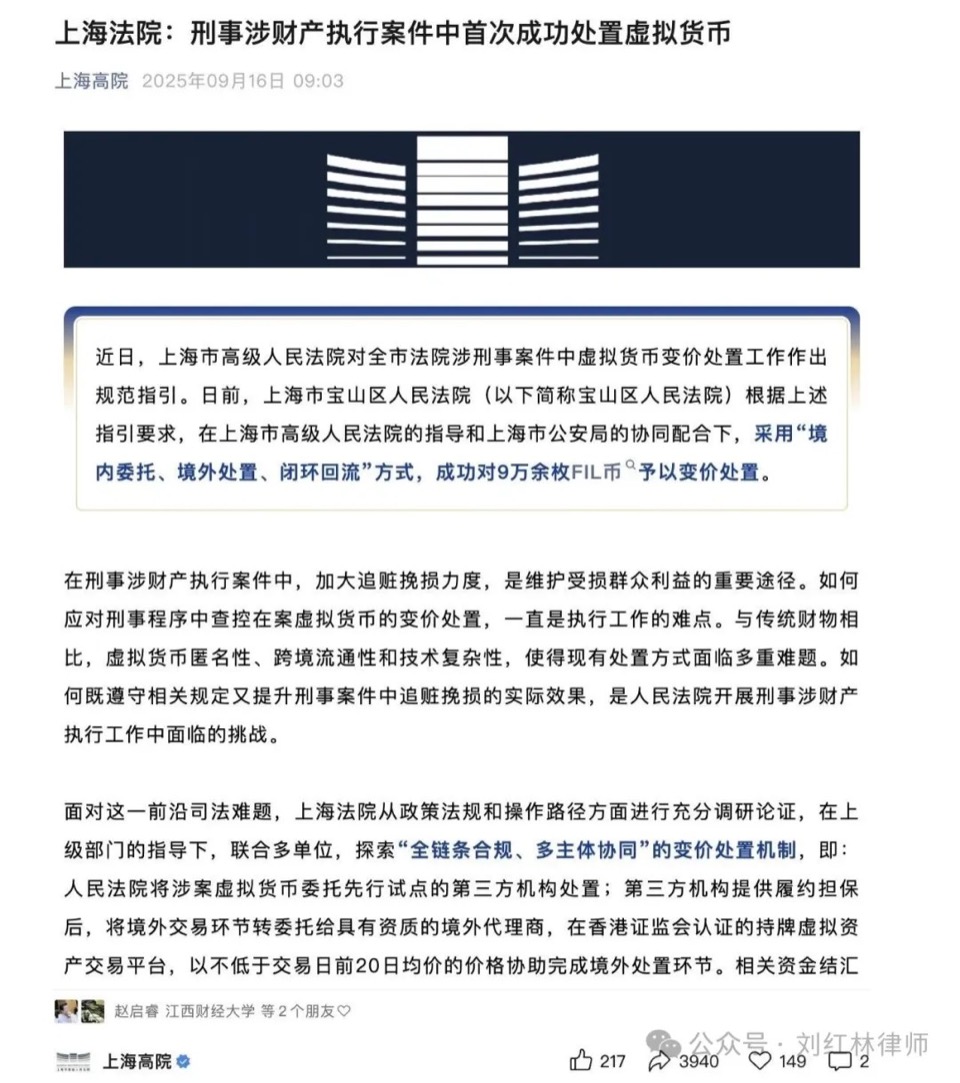
The specific operational method was 'domestic entrustment, overseas disposal, and closed-loop repatriation.'Specifically, the court entrusted the virtual currencies involved in the case to a third-party institution. After this institution provided performance guarantees, it transferred the overseas transaction procedures to qualified overseas agents. The disposal was ultimately completed on a licensed virtual asset exchange certified by the Hong Kong Securities and Futures Commission, with the price not lower than the average price of the 20 trading days preceding the transaction date. Upon completion of the disposal, the funds were required to undergo approval by the national foreign exchange administration authorities and were finally converted into RMB and repatriated to the court's special account for case funds, to be used for lawful confiscation or restitution to victims.
While this pathway may not seem extraordinary at first glance, when understood in the context of reality,it addresses a long-standing judicial dilemma.
The 'Execution Challenge' of Virtual Currencies
In recent years, as virtual currencies have increasingly become involved in criminal cases, the judicial system has faced unprecedented challenges. Public security organs and courts can freeze bank accounts, seal real estate, and auction vehicles. However, they face an awkward situation when dealing with BTC, ETH, or, in this instance, FIL held in on-chain addresses: seizure is difficult, and disposal is even more challenging.
Virtual currency prices are highly volatile. If left undisposed in accounts, their value could shrink significantly within a single day. Rash selling lacks legal channels and may raise questions about low-price dumping harming victims' interests, or potentially cross the red line of cross-border fund management. Consequently, virtual currencies seized by judicial authorities have largely remained in a 'frozen' state for a long time, making it difficult to truly convert them into judicial compensation.
The exploration by the Shanghai High People's Court provides a practical 'solution' against this backdrop.
The news report used the term 'closed-loop,' the importance of which cannot be underestimated.
The anonymity and cross-border liquidity of virtual currencies mean that any slight looseness in any link could become a new gray channel. A closed loop means that domestic courts do not operate directly; instead, compliant third parties provide guarantees, transactions must be completed on licensed platforms in Hong Kong, and funds must undergo foreign exchange approval before repatriation. This process not only ensures compliance but also ensures that funds safely enter the state treasury or are returned to victims.
There are two key points here.
The first key point is the role of licensed exchanges in Hong Kong.Regarding the disposal process in this case, according to Lawyer Hong Lin's understanding, the partner in Hong Kong wasHashkey Exchange, currently one of the first batch of virtual asset exchanges in Hong Kong licensed by the Securities and Futures Commission and open to retail investors. Behind Hashkey is the established Asian blockchain investment firm HashKey Group, which has applied for licenses in Hong Kong for many years and possesses a relatively mature compliance framework and risk control system. Being selected as a judicial partner is not merely a business opportunity; it signifies that it is becoming a 'trusted compliant market' in the eyes of the mainland judicial system. In other words, compliant exchanges in Hong Kong not only serve ordinary investors and institutions but may also become important clients for mainland judicial and regulatory authorities. It is not only the Shanghai courts cooperating with Hashkey; a court in a certain region in Northwest China previously conducted crypto asset disposals with Hashkey as well, though this was not publicly announced in the news, possibly due to public opinion considerations.
The second key point is foreign exchange approval.Fund repatriation must pass through the State Administration of Foreign Exchange. This 'main gate' ensures that the closed loop does not evolve into a legal channel for ordinary individuals to cash out. This also indicates that this mechanism addresses the challenge of judicial disposal rather than signaling a relaxation of crypto asset controls. Ordinary crypto asset investors should not fantasize about 'borrowing the judicial closed loop'; this channel does not belong to the market.
Industry Significance of the Shanghai Model
Taking a broader perspective, there are several layers of interpretable value behind this case.
On one hand, it indicates that in the eyes of mainland government departments, virtual currencies are not untouchable monsters.The judicial system has found a solution for the disposal of virtual currencies, moving beyond the situation where 'seizure is easy, but liquidation is difficult.' Moreover, even assets like FIL, which are not considered mainstream, can complete transactions through compliant channels. Extending the scenario further, how should government departments balance practical needs and compliance regulation regarding the increasingly frequent use of crypto assets for payments and receipts by mainland enterprises in global foreign trade?
On the other hand, it reveals the special role of Hong Kong in this process.Hong Kong's virtual asset licensing regime was originally designed for market investors, but this case effectively opens another function: serving as a compliant outlet for the mainland judicial system. Lawyer Hong Lin has previously written and shared multiple times that the local market in Hong Kong is too small; for licensed compliant exchanges in Hong Kong, the greatest market demand comes from the mainland, including mainland-backed financial institutions and mainland government departments. Judicial disposal is just one aspect; in the future, administrative regulation, confiscated assets, and even foreign exchange management scenarios may also rely on Hong Kong platforms as 'legal intermediaries.' This effectively binds Hong Kong's compliance system with mainland judicial needs in a practical sense.
Looking at horizontal comparisons, a few years ago, when public security organs in Hangzhou and Shenzhen dealt with seized BTC and ETH, they mostly could only adopt measures of 'seizure and freezing,' lacking compliant liquidation channels. The awkwardness at that time was: having the assets, but being unable to convert them into fiat currency to return to victims.Shanghai's attempt this time marks a leap from 'freezing and custody' to 'closed-loop disposal.'This means that in the future, courts in other parts of the country, when encountering similar issues, are likely to refer to the Shanghai model and gradually institutionalize this mechanism.
Mankun Lawyers' Summary
The judicial disposal of virtual currencies is moving from a 'technical blind spot' to an 'institutional norm.'
China's overall regulatory attitude towards virtual currencies has not changed, but the judiciary must find practical solutions. Shanghai's exploration tells us that so-called 'virtual' assets, once implemented in judicial practice, will ultimately be incorporated into the cage of real-world institutions. Similar cases will continue to emerge in the future, and the four words 'closed-loop disposal' may become the standard procedure for mainland judicial handling of virtual currency cases in the coming years. For the market, this is a process of gradually completing the institutional framework. Looking deeper, this is also silently reshaping the role positioning of compliant exchanges in Hong Kong. Institutions like Hashkey are no longer just financial service providers facing investors but are gradually becoming partners for mainland judicial, regulatory, and even foreign exchange management authorities.
