Virtual Currency Mining Is Not a Scourge
Is It Unwise to Prohibit Virtual Currency Mining?
Professor Wang Yang of the Hong Kong University of Science and Technology (HKUST) shared his profound insights on Bitcoin and the blockchain industry at the HashKey New Horizons event. Professor Wang is an internationally renowned mathematician, currently serving as Vice President (University Advancement) and Chair Professor of the Department of Mathematics at HKUST. He has made outstanding contributions in the fields of big data and bio-intelligence and possesses a deep understanding of the blockchain industry and policy formulation.
Professor Wang reviewed his early misconceptions about Bitcoin. When he first encountered Bitcoin in 2012, he regarded it as a scam and missed the opportunity for early participation. With the passage of time and the development of the industry, he gradually recognized the importance of Bitcoin and blockchain technology. He pointed out that Hong Kong’s pace of development in these areas has been too slow and requires higher goals and determination to lead regional development.
Of course, what attracted Lawyer Honglin’s attention most was Professor Wang’s particular emphasis on the social and economic value of virtual currency mining during his sharing. Professor Wang believes that a complete ban on mining is unwise, as it would drive the mining industry to other countries, resulting in the loss of valuable tax revenue and economic opportunities. He suggests that through policy guidance and regulation, the legitimate and compliant development of the mining industry should be promoted to achieve the integration of the digital economy and the real economy.
After Professor Wang’s remarks were published, Lawyer Honglin forwarded them to several friends in the industry for discussion. Based on these exchanges, this article was written to discuss Lawyer Honglin’s views and thoughts on virtual currency mining.
Virtual Currency Mining: A Mixed Bag of Reactions
There was a time when mainland China was the dominant force in the virtual currency mining market. According to data from the Cambridge Centre for Alternative Finance in 2021, Chinese miners accounted for more than 65% of the Bitcoin network’s hashrate, with Xinjiang, Sichuan, and Inner Mongolia accounting for 35.76%, 9.66%, and 8.06% of the total network hashrate, respectively. Since 2021, the Chinese government’s negative regulatory stance on virtual currency mining has gradually intensified. Naturally, the share of hashrate dominated by Bitcoin has plummeted, and virtual currency mining has gradually become a topic disappearing from mainstream media.
According to Lawyer Honglin’s understanding, the main reasons for China’s prohibition of virtual currency mining include the following: First, virtual currency mining consumes enormous amounts of electricity, leading to power supply shortages in some regions and adversely affecting environmental protection. Second, virtual currency transactions carry high financial risks, easily triggering market volatility and speculative behavior, thereby posing a threat to financial stability. Finally, there are risks of illegal activities such as money laundering in virtual currency transactions and mining activities, making regulation difficult.
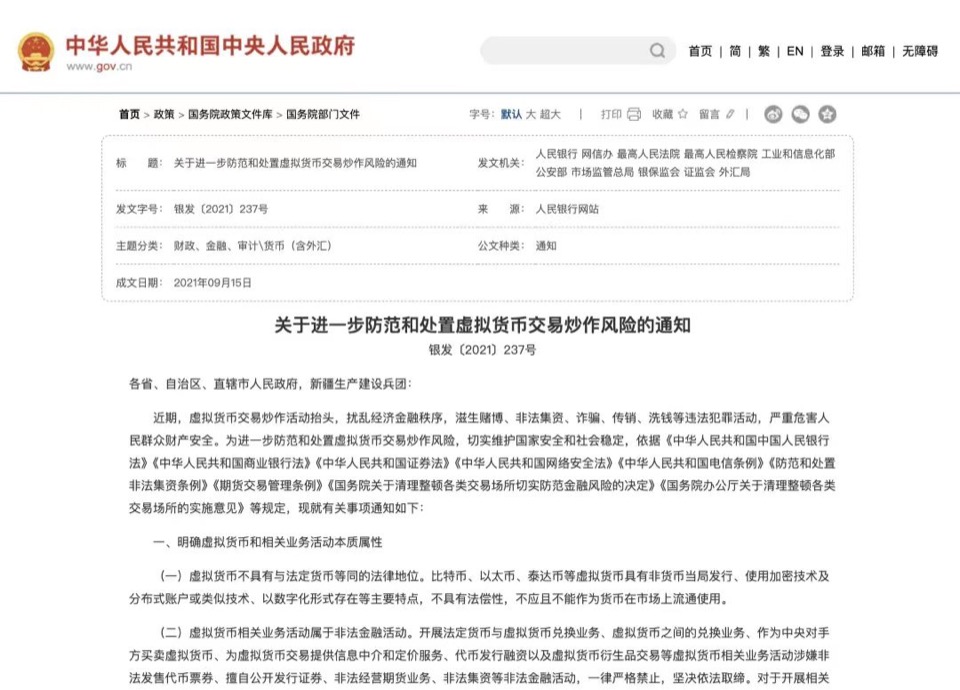
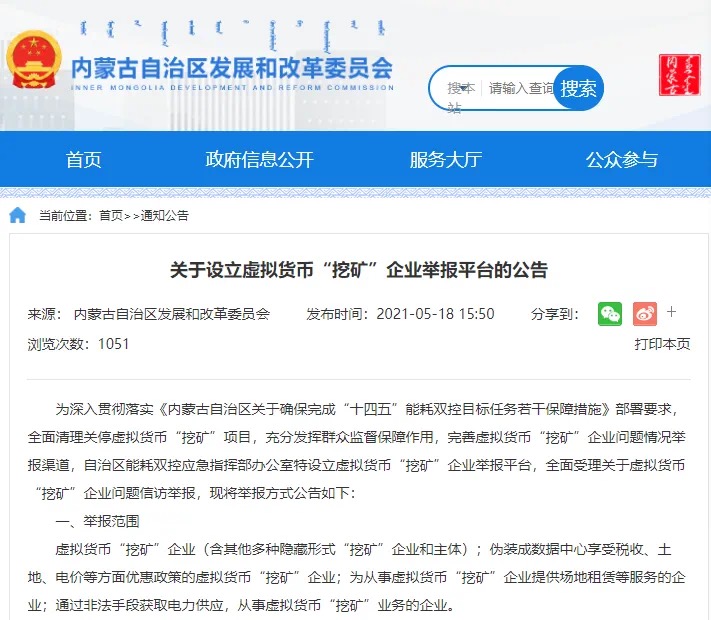
Based on these reasons, the Chinese government has taken a series of measures to gradually strengthen the regulation of virtual currency mining. In September 2017, the People’s Bank of China and six other ministries jointly issued the “Announcement on Preventing Risks Associated with Token Issuance and Financing,” completely halting Initial Coin Offerings (ICOs) and requiring all token issuance and financing activities to cease immediately. In April 2019, the National Development and Reform Commission included virtual currency “mining” in the “Guidance Catalog for Industrial Structure Adjustment” as an industry slated for elimination, indicating the government’s increasingly strict attitude toward virtual currency mining. In May 2021, the Financial Stability and Development Committee of the State Council proposed cracking down on Bitcoin mining and trading activities, marking the first time that China explicitly stated at a national-level meeting its intention to combat virtual currency mining and trading. In September 2021, the People’s Bank of China and nine other departments issued the “Notice on Further Preventing and Disposing of Risks Associated with Virtual Currency Trading and Speculation,” clearly stating a comprehensive ban on virtual currency trading activities and requiring financial institutions and payment institutions not to provide services related to virtual currencies. Local governments successively introduced policies to clear out mining operations; for example, governments in Inner Mongolia, Xinjiang, and Sichuan required the shutdown of virtual currency mining enterprises and the clearance of related projects. These policies demonstrate the government’s determination to curb virtual currency mining activities.
Unlike China’s restrictions and prohibitions on virtual currency mining, other countries overseas have different attitudes and policies toward virtual currency mining.
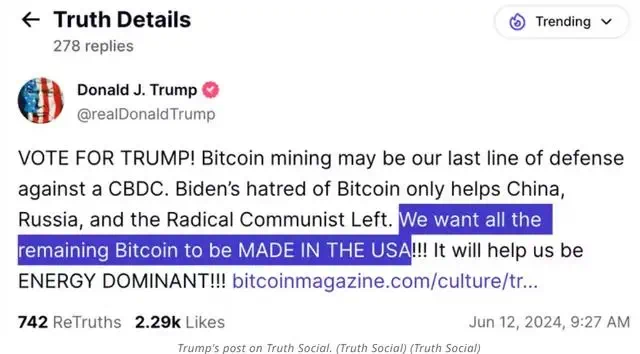
United States:The United States maintains a relatively open attitude toward virtual currency mining, although policies vary by state. For instance, states like Texas and Wyoming are friendly toward cryptocurrencies and encourage investment by mining companies, while New York implements a stricter licensing system. The U.S. has attracted a large number of mining companies, especially after China cracked down on mining, prompting many miners to relocate their equipment to the United States. According to data from the Cambridge Centre for Alternative Finance, by 2022, the United States accounted for 37.84% of the global Bitcoin hashrate. These mining activities have not only driven local economic development but also optimized energy consumption. For example, some mining companies in Texas cooperate with power companies to use renewable energy and reduce electricity consumption during peak demand periods to support grid stability. On June 12, 2024, former U.S. President Trump met with executives from CleanSpark Inc. and Riot Platforms, both Bitcoin mining companies listed on NASDAQ, promising Washington’s support for the Bitcoin mining industry. He also posted on social media that he hopes all remaining Bitcoin will be mined within the United States, reiterating that this will help the U.S. become an energy powerhouse.
 Canada: Canada adopts a supportive attitude toward virtual currency mining, particularly in Quebec, where abundant and low-cost electricity resources have made it a gathering place for mining companies. The Canadian government encourages mining companies to use clean energy and implements strict energy efficiency standards for high-energy-consuming enterprises. In 2022, Canada accounted for 9.55% of the global Bitcoin hashrate. The mining industry has promoted local economic development in Canada, increased employment opportunities, and simultaneously driven the utilization of renewable energy.
Russia: The Russian government maintains a relatively open attitude toward virtual currency mining. Although there are certain restrictions on virtual currency transactions, mining activities are relatively active locally. Russian mining companies are mainly concentrated in the Siberian region, utilizing the area’s abundant hydropower resources for mining. In 2022, Russia accounted for 11.23% of the global Bitcoin hashrate. Mining activities have driven economic development in parts of Russia, while also posing challenges regarding energy consumption and power load.
Kazakhstan: In recent years, Kazakhstan has become one of the world’s major Bitcoin mining centers. The government supports mining activities but is gradually strengthening regulation. Mining companies in Kazakhstan mainly utilize the country’s coal-fired power resources. In 2022, Kazakhstan accounted for 13.22% of the global Bitcoin hashrate. The mining industry has promoted Kazakhstan’s economic development but has also brought issues such as power shortages. The government is seeking balanced development and promoting the transition of mining companies to renewable energy.
European Union: The European Union maintains a cautious attitude toward virtual currency mining, with policies varying among member states. Countries such as Germany and Sweden are open to mining activities and support the use of renewable energy for mining. Other countries, such as the Netherlands, implement strict regulations on mining activities to limit their energy consumption. Overall, the EU focuses on the environmental impact of mining activities and has implemented a series of policies to promote the use of green energy and improve energy efficiency. In 2022, the EU accounted for 5.83% of the global Bitcoin hashrate.
Canada: Canada adopts a supportive attitude toward virtual currency mining, particularly in Quebec, where abundant and low-cost electricity resources have made it a gathering place for mining companies. The Canadian government encourages mining companies to use clean energy and implements strict energy efficiency standards for high-energy-consuming enterprises. In 2022, Canada accounted for 9.55% of the global Bitcoin hashrate. The mining industry has promoted local economic development in Canada, increased employment opportunities, and simultaneously driven the utilization of renewable energy.
Russia: The Russian government maintains a relatively open attitude toward virtual currency mining. Although there are certain restrictions on virtual currency transactions, mining activities are relatively active locally. Russian mining companies are mainly concentrated in the Siberian region, utilizing the area’s abundant hydropower resources for mining. In 2022, Russia accounted for 11.23% of the global Bitcoin hashrate. Mining activities have driven economic development in parts of Russia, while also posing challenges regarding energy consumption and power load.
Kazakhstan: In recent years, Kazakhstan has become one of the world’s major Bitcoin mining centers. The government supports mining activities but is gradually strengthening regulation. Mining companies in Kazakhstan mainly utilize the country’s coal-fired power resources. In 2022, Kazakhstan accounted for 13.22% of the global Bitcoin hashrate. The mining industry has promoted Kazakhstan’s economic development but has also brought issues such as power shortages. The government is seeking balanced development and promoting the transition of mining companies to renewable energy.
European Union: The European Union maintains a cautious attitude toward virtual currency mining, with policies varying among member states. Countries such as Germany and Sweden are open to mining activities and support the use of renewable energy for mining. Other countries, such as the Netherlands, implement strict regulations on mining activities to limit their energy consumption. Overall, the EU focuses on the environmental impact of mining activities and has implemented a series of policies to promote the use of green energy and improve energy efficiency. In 2022, the EU accounted for 5.83% of the global Bitcoin hashrate.
Virtual Currency Mining Is Not a Scourge
As a commercial lawyer deeply engaged in the Web3 industry, based on Lawyer Honglin’s understanding of the sector, prohibiting virtual currency mining may do more harm than good to the development of China’s Web3.0 digital economy.
First, shutting down the mining industry will weaken China’s influence in the global blockchain technology and digital currency markets, leading to a significant brain drain of talent with rich experience and skills in high-performance computing, algorithm optimization, and hardware development. China was once the world’s largest Bitcoin mining market. According to Bloomberg data, China’s Bitcoin hashrate accounted for 65% of the global total in 2021, but by 2023, this proportion had dropped to less than 10%. This change has not only caused China to lose its dominant position in the global digital currency market but also led to the migration of a large number of talented individuals and enterprises to other countries, such as the United States. This weakens China’s technological innovation capabilities and competitiveness in this field, placing China at a disadvantage in future digital economy competitions.
Second, prohibiting mining not only affects technology and the economy but also represents a significant loss of commercial profits. According to media statistics, there were previously 13 A-share listed companies, 7 Hong Kong-listed companies, and 9 China-concept stocks involved in virtual currency mining businesses in China, such as Xinyuan Technology (300472.SZ), Liaison Interactive (002280.SZ), and Futong Information (000836.SZ). The mining industry once provided substantial employment opportunities and tax revenue for local economies. Regions such as Inner Mongolia, Yunnan, and Sichuan, due to their energy advantages, attracted a large number of mining companies, playing a positive role in local economic development.
For example, Sichuan Province ranks first nationwide in both installed hydropower capacity and electricity generation. Promoting the absorption of surplus hydropower has been a problem the local government has been exploring and resolving. In August 2019, the Sichuan Provincial Government officially published the “Implementation Plan for the Construction of Hydropower Absorption Industry Demonstration Zones in Sichuan Province,” launching demonstration zones in Ganzi Prefecture, Panzhihua City, Ya’an City, Leshan City, Liangshan Prefecture, and Aba Prefecture. Successively, cities and prefectures such as Ganzi, Ya’an, and Liangshan released policies to attract Bitcoin mining projects. For virtual currency mining farms, the hydropower prices in the absorption demonstration zones during the wet season are very attractive. The market transaction price for abandoned hydropower during the wet season is approximately RMB 0.075 per kWh. Adding transmission and distribution prices of RMB 0.04 per kWh and government funds of approximately RMB 0.02–0.047 per kWh, the final consumer price ranges from RMB 0.135 to 0.162 per kWh. Using hydropower for virtual currency mining can create a win-win situation where mining farms operate stably, power generation companies absorb abandoned hydropower, power supply companies increase revenue from grid transmission fees, and local governments increase fund and tax revenues. The losses brought to these regions by a one-size-fits-all mining ban are quite evident. According to a report by the South China Morning Post, the Inner Mongolia region lost thousands of jobs due to the departure of mining companies, and local fiscal tax sources were weakened.
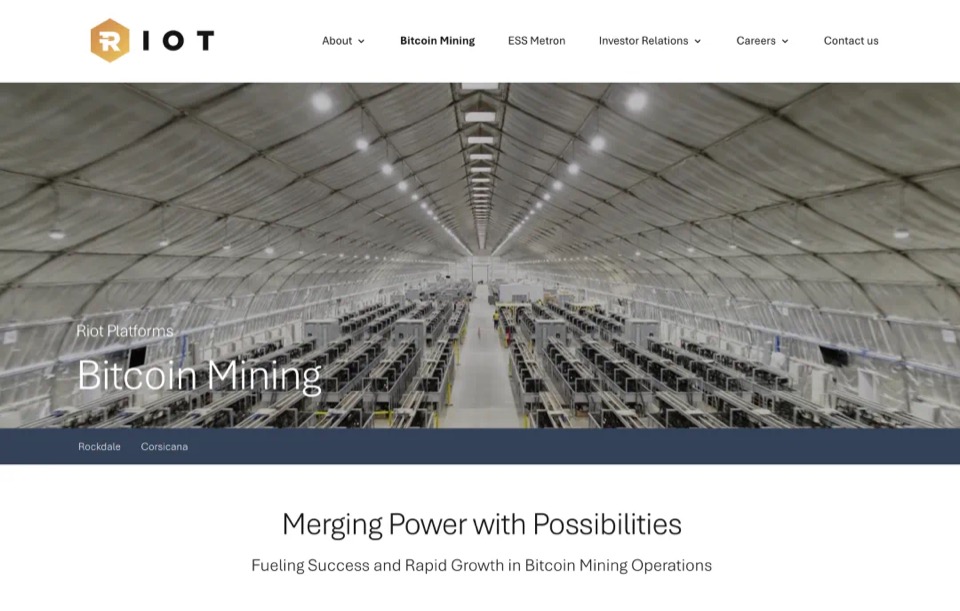
 In contrast, well-known virtual currency mining companies in the United States, such as Riot Blockchain and Marathon Digital Holdings, are listed on the NASDAQ. These companies have obtained substantial profits through mining activities. Riot Blockchain, a company focused on Bitcoin mining and blockchain technology headquartered in Castle Rock, Colorado, reported total revenue of USD 213 million in 2022, a year-on-year increase of 65%, which continued to grow to USD 275 million in 2023. Marathon Digital Holdings, headquartered in Las Vegas, Nevada, achieved total revenue of USD 250 million in 2022, a year-on-year increase of 75%, growing to USD 310 million in 2023. According to CoinDesk data, the stock prices of Riot Blockchain and Marathon Digital Holdings increased by 45% and 60%, respectively, in 2023, demonstrating investor confidence in these companies and recognition of their market prospects.
 If China could guide the legitimate and compliant development of the mining industry, these profits and economic growth could also be realized within China. According to a research report by PwC, China’s potential annual income from the virtual currency mining industry could reach billions of U.S. dollars. If combined with clean energy development and technological innovation, the actual economic benefits could be even higher.
Furthermore, according to a report by the International Energy Agency (IEA), global energy consumption for Bitcoin mining is gradually transitioning toward clean energy. Mining companies in countries such as the United States and Canada are actively adopting renewable energy sources like hydropower and wind power to reduce their carbon footprint and improve energy efficiency. For example, some mining companies in Texas cooperate with power companies to use renewable energy sources such as wind and solar power for mining activities. Additionally, the Electric Reliability Council of Texas (ERCOT) allows these companies to reduce electricity consumption during peak demand periods to support grid stability. In Quebec, Canada, strict energy efficiency standards are implemented for high-energy-consuming mining companies, encouraging them to use clean energy for mining. Hydro-Québec cooperates with mining companies to reduce carbon emissions by providing renewable energy power. This trend indicates that through reasonable policy guidance and regulation, a win-win situation for both virtual currency mining and environmental protection can be achieved.
By referencing the successful experiences of other countries, China can explore reasonable policies and regulatory frameworks to promote the healthy development of the virtual currency mining industry, achieving comprehensive benefits in technological progress, economic growth, and environmental protection.
If China could guide the legitimate and compliant development of the mining industry, these profits and economic growth could also be realized within China. According to a research report by PwC, China’s potential annual income from the virtual currency mining industry could reach billions of U.S. dollars. If combined with clean energy development and technological innovation, the actual economic benefits could be even higher.
Furthermore, according to a report by the International Energy Agency (IEA), global energy consumption for Bitcoin mining is gradually transitioning toward clean energy. Mining companies in countries such as the United States and Canada are actively adopting renewable energy sources like hydropower and wind power to reduce their carbon footprint and improve energy efficiency. For example, some mining companies in Texas cooperate with power companies to use renewable energy sources such as wind and solar power for mining activities. Additionally, the Electric Reliability Council of Texas (ERCOT) allows these companies to reduce electricity consumption during peak demand periods to support grid stability. In Quebec, Canada, strict energy efficiency standards are implemented for high-energy-consuming mining companies, encouraging them to use clean energy for mining. Hydro-Québec cooperates with mining companies to reduce carbon emissions by providing renewable energy power. This trend indicates that through reasonable policy guidance and regulation, a win-win situation for both virtual currency mining and environmental protection can be achieved.
By referencing the successful experiences of other countries, China can explore reasonable policies and regulatory frameworks to promote the healthy development of the virtual currency mining industry, achieving comprehensive benefits in technological progress, economic growth, and environmental protection.
Recommendation for Timely Adjustment of Virtual Currency Mining Policies
To promote China’s leading position in the next-generation internet centered on blockchain technology, it may be time for Chinese regulatory authorities to re-examine and adjust the current one-size-fits-all prohibitory regulatory policy on virtual currency mining.
First, the government should formulate clear policies to guide the mining industry toward green and energy-saving development, while simultaneously strengthening the regulation of mining activities to prevent illegal acts. Through a reasonable regulatory framework, industry behavior can be standardized while avoiding the negative impacts of a complete ban. For example, since virtual currency mining typically consumes enormous amounts of electricity, the government could mandate that mining companies use a certain proportion of renewable energy, thereby promoting the development of green energy and improving overall energy efficiency. Strict penalties should be imposed on companies that violate these regulations.
Second, encourage enterprises to innovate in mining equipment, algorithm optimization, and energy-saving technologies to improve energy efficiency and reduce environmental impact. The development of the mining industry is closely linked to advancements in computer hardware, particularly innovations in high-performance computing chips, cooling technologies, and large-scale computing systems. These technologies are not only widely applied in virtual currency mining but also have a positive driving effect on other high-tech industries. The government can provide special funds and policy support to promote the research, development, and application of related technologies. For instance, establishing special science and technology funds to subsidize enterprises and research institutions in developing high-efficiency, low-energy-consumption mining equipment and technologies.
Additionally, explore models where state-owned enterprises hold controlling or participating stakes in mining companies to ensure that mining activities are conducted under government supervision. The mining industry has previously provided substantial employment opportunities and tax revenue for local economies, especially in economically underdeveloped regions, where mining activities have become an important driver of local economic development. Through the participation of local state-owned enterprises, risks can be effectively controlled, ensuring steady growth in tax revenue and economic benefits. The involvement of state-owned enterprises can help mining companies secure stable power supplies and policy support, while also increasing the government’s regulatory oversight of mining activities.
Furthermore, actively participate in the formulation of global digital currency regulatory frameworks and cooperate with other countries and regions to jointly address the challenges posed by the virtual currency market. Through international cooperation, China can maintain its competitiveness and voice in the global digital currency market. The government can proactively participate in relevant discussions and decision-making within international organizations, share experiences and technologies with other countries, and jointly formulate global regulatory standards and policies.
Finally, strengthen public awareness of virtual currencies and blockchain technology. Through transparent information disclosure, enhance public trust in the industry. The government can conduct educational and promotional activities to help the public understand the value and risks of virtual currencies. For example, releasing information related to virtual currencies and blockchain technology through various media channels, organizing popular science lectures and training courses, and improving public awareness levels.
Virtual currency mining plays an important role in promoting technological innovation, optimizing energy utilization, fostering economic development, and enhancing international influence. Although the Chinese government’s comprehensive ban on virtual currency mining was motivated by considerations of controlling financial risks and environmental protection, it has also brought negative consequences such as the loss of technical talent, damage to local economies, and a decline in global market influence. We recommend that by formulating reasonable policies and regulatory frameworks, guiding the mining industry toward green and energy-saving development, and strengthening supervision of illegal activities, the positive effects of virtual currency mining can be harnessed while ensuring financial and environmental safety.
We call upon more industry professionals and research institutions to conduct in-depth research and discussion on the regulatory policies for virtual currency mining, proposing scientific and reasonable policy recommendations to promote the healthy development of China’s digital economy and blockchain technology.