
In determining whether a Web3 exchange job carries criminal risk, one cannot look only at the job title; more important is to whom the platform provides what services, and which part of the business the employee actually participated in.
A virtual currency exchange registered in Singapore issues offers to domestic job seekers through headhunters: remote work, no need to be physically present overseas, daily collaboration through Telegram, Slack and Google Meet, a monthly salary of RMB 40,000 to 80,000, payable in RMB or directly in USDT; the company has an overseas entity, team members are distributed across multiple countries, and positions range from Chinese-language operations, business development (BD) and customer service to Java development, wallet engineer and payment product manager.
For many practitioners in the traditional internet, fintech and payment industries, the appeal of such an opportunity is not hard to understand. The working style is freer, the salary may be double the previous position or even more, and judging from the job descriptions, much of the work is not essentially different from the past: programmers still write code, operations staff still run campaigns, and customer service still handles user issues.
What really gives people pause is another question: the company is overseas, I am in China, and I am merely working for it—if the project is investigated in the future, will I be counted in?
I. After 2026, the key question is no longer whether there is a "domestic office"
The 2021 Notice on Further Preventing and Handling the Risks of Virtual Currency Trading and Speculation expressly provided that overseas virtual currency exchanges providing services to domestic residents through the internet constitute illegal financial activities, and specifically mentioned that domestic staff of the relevant overseas exchanges, as well as entities and individuals that, while knowing or ought to know that others are engaged in virtual currency business, still provide marketing and publicity, payment and settlement, technical support and other services, shall be held liable in accordance with the law.
In February 2026, the People's Bank of China and seven other departments issued a new Notice on Further Preventing and Handling Risks Related to Virtual Currency and Other Risks, and the 2021 notice was repealed at the same time. The new rules continue to adhere to the regulatory policy of prohibiting virtual currency-related business activities within China, and provide that overseas entities and individuals may not, in any form, illegally provide virtual currency-related services to domestic entities; in the part on legal liability, they further clarify that domestic entities and individuals that, while knowing or ought to know that an overseas entity is illegally providing virtual currency-related services to domestic parties, still provide assistance to it, shall be held liable in accordance with the law, and where a crime is constituted, criminal liability shall be pursued in accordance with the law.
This change means that, in determining today whether a job at an overseas exchange carries risk, one can no longer simply rely on a few formal labels, such as whether the company has an overseas office, which overseas company the labor contract is signed with, whether the salary is paid from a Hong Kong account, or even whether the employee is full-time, part-time or outsourced.
What truly needs to be clarified first is: whether this overseas platform actually provides prohibited virtual currency-related services to domestic entities, and whether the work of the domestic employee helps this part of the business operate.
An overseas exchange that mainly serves overseas markets, whose products, marketing, users and fund flows have no substantive connection with business within China, and another project that, although its entity is registered overseas, has long maintained Chinese-language communities, developed domestic agents, guided domestic users to open accounts and make deposits, and set up customer service, operations, technical and payment teams within China, cannot be judged the same simply because both have business licenses in Singapore.
Therefore, the real first step in a Web3 job search is not to ask "is this an overseas company", but first to look at where its real customers and real business are.
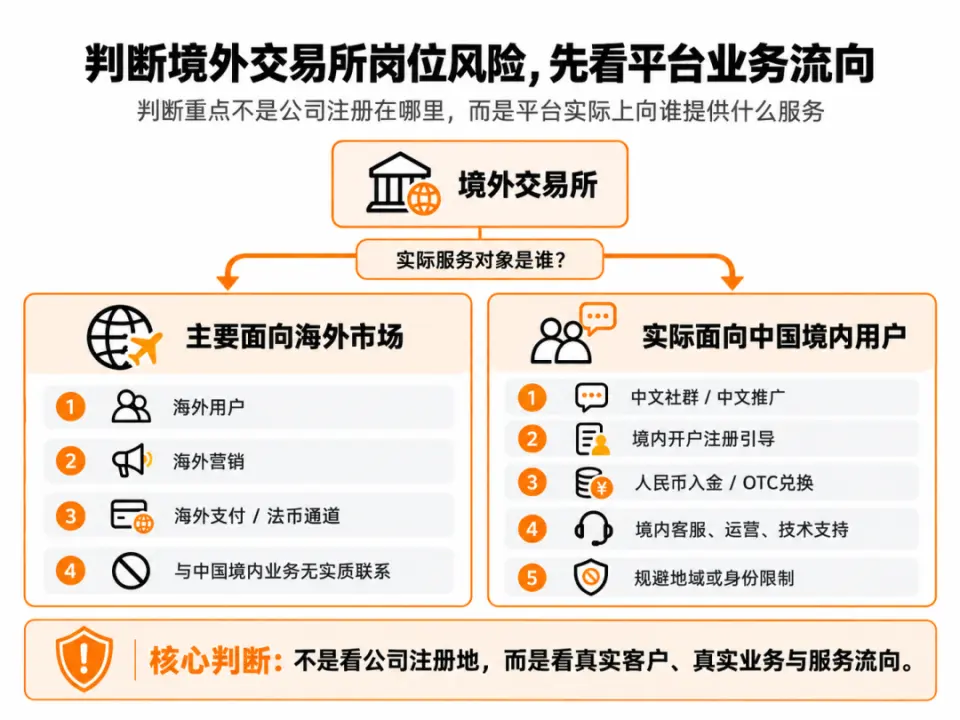
To assess the risk of an overseas exchange position, first look at where the platform's business flows
II. Operations and marketing roles: the risk lies not in “how many tweets were posted,” but in whether the role directly participates in domestic customer acquisition
Operations roles are easily understood as a lower-risk type of work at an exchange, because employees typically do not touch wallets, do not control funds, and do not have authority to modify the matching engine or back-end balances. However, if the platform itself is conducting prohibited virtual currency trading business targeting domestic users, what operations personnel are responsible for may be precisely the front-end entry point that brings users onto the platform.
For example, daily work that merely involves maintaining overseas English-language social media is not the same kind of “operations,” in factual terms, as long-term operation of Chinese-language communities, production of RMB deposit tutorials, organization of trading activities targeting domestic users, provision of platform account-opening guidance, and receipt of performance commissions based on deposits or trading volume.
Similar issues also exist with KOLs, community managers and Affiliates. Compared with ordinary industry content cooperation, continuously publishing trading guidance, account-opening links and invitation codes and receiving rebates based on new registrations, deposit amounts or trading fees clearly differs in the connection between the conduct and the platform’s trading business.
Therefore, for operations, marketing and community roles, what truly needs to be examined is not whether the labor contract contains the word “Marketing,” but whether the work content involves channeling domestic users? On what results is work performance ultimately calculated? If the assessment indicators directly point to domestic user registration, deposits, trading volume and fee income, then this fact has practical significance for determining whether the employee understood the platform’s business and the degree of participation.
III. BD, payment and OTC-related roles: risk is usually concentrated in “making the fund chain work”
Compared with ordinary brand operations, roles responsible for payment, fiat currency channels, OTC, merchant cooperation or liquidity channels need to pay greater attention to what exactly they are connecting.
Suppose one BD is responsible for contacting overseas licensed payment institutions to connect overseas users to compliant bank transfer channels, while another BD seeks coin dealers, bank card channels and payment accounts within the mainland to solve the problem of “how RMB enters the platform and how USDT exits the platform.” Although both positions are called Business Development, the actual business content is completely different.
The virtual currency illegal foreign exchange cases recently announced by the Shanghai police have already shown that some criminal models specifically set up different links such as customer liaison, coin dealer contact, account aggregation and fund transfers. Therefore, in fund-related cases, judicial authorities usually further distinguish who solicits customers, who contacts coin dealers, who controls accounts and who issues fund instructions, rather than evaluating individual responsibility solely based on an employee’s position.
The same applies to exchange employees. If the work begins to involve finding domestic collection and payment accounts, arranging third-party collection, helping customers convert RMB into USDT, handling abnormal funds or coordinating circumvention of bank and platform risk controls, then what the person participates in is no longer commercial cooperation in the ordinary sense, but a core link in the platform’s fund business.
The biggest characteristic of such roles is that employees can often directly see why transactions occur, and are more likely to grasp the true relationship among customers, funds and business.
IV. The risk of programmers cannot simply be ranked ahead of operations, nor ranked last merely because they “only write code”
There was a time when, because technical support was indispensable to the operation of exchanges, the risk associated with technical positions could to some extent be higher than that of ordinary marketing personnel. That reminder had practical significance at the time, but if today one continues to simply rank risks on the basis that 'technical is more dangerous than operations,' it becomes easy instead to overlook what criminal liability truly requires to be proven.
Among programmers, some are responsible for logging systems, UI components, or internal office tools unrelated to specific business, some are responsible for core matching and wallet infrastructure, and some are specifically tasked, in accordance with business requirements, with developing modules to bypass regional restrictions, evade KYC, manage accounts in bulk, or handle anomalous funds. The legal significance of these categories of work is plainly different.
In 2025, the new Opinions of the 'Two Highs and One Ministry' on handling criminal cases such as the crime of aiding information network criminal activities clearly require that, in determining the crime of aiding information network criminal activities, a comprehensive review be conducted of whether the actor knew that others were using information networks to commit crimes, whether the actor actually provided assistance, and whether the circumstances are 'serious'; as for the determination of 'knowledge,' it is necessary to make a comprehensive judgment based on facts such as the time, manner, number of times, and tools of the assistance provided, whether the conduct violated prohibitive provisions of law, whether there was evasion of regulation or investigation, illegal profit-making, and the actor's professional identity, past experience, and relationship with the person being assisted. The new Opinions also list the cross-border illegal provision of technical support, and the provision of technology, software, or equipment specifically or primarily used for information network crimes, as circumstances to be severely punished in accordance with law.
In other words, a programmer's occupation itself is not a risk level; what truly matters is what was developed, why it was developed, what was known during the development process, and whether, after anomalies arose in the project, development continued to iterate on those anomalous requirements.
In the next article, we will specifically elaborate on this issue.
V. Customer service positions appear far from funds, but may hold the most direct user information
Customer service is often regarded as merely answering questions, but in fact, for some trading platforms, customer service may be one of the positions with the most direct exposure to users' genuine trading needs.
Ordinary customer service may only handle password resets, page malfunctions, or general product inquiries, but if the work over the long term involves guiding domestic users to complete real-name verification, helping to handle issues with buying coins using RMB, explaining OTC payments, resolving frozen funds, coordinating anomalous deposits and withdrawals, or even teaching users how to bypass regional access or identity restrictions, then the business information to which they have access will increase markedly.
Therefore, the key to a customer service position is not whether it has 'fund authority,' but what problems its daily work actually solves, and the specific tasks the customer service representative undertakes when facing these facts.
This is also why one cannot simply create a job risk ranking table of 'technical highest, operations second, customer service lowest.' What is truly meaningful in a criminal case is a person's behavioral contribution, subjective intent, the harmful consequences caused, and so on.
VI. Administrative, HR, and design positions are usually farther from the core business, but 'working at the company' is itself neither evidence of guilt nor evidence of exemption from liability
If an exchange as a whole is under investigation, employees are most prone to two extreme understandings: one is that 'the company is in trouble, so all of us will be arrested,' and the other is that 'I am HR or design, so it has nothing to do with me no matter what.'
Both judgments are overly simplistic.
Criminal liability must ultimately still be traced back to individual conduct. Administrative, human resources, visual design and ordinary internal support positions are generally further removed from transactions, funds and clients. If an employee did not participate in the core unlawful business and also lacked corresponding awareness of the platform's specific operating model, criminal liability cannot be inferred directly merely from the fact that the person received a salary from the company. However, if the so-called "administrative" role in fact involved recruiting persons within China in bulk to build an unlawful business team, if the so-called "design" role involved producing over the long term transaction solicitation materials targeting users within China, or if the individual had already participated in organizational and funding arrangements beyond the core business, the job title will likewise not become the boundary for determining liability.
Therefore, the truly meaningful question is never "which department am I in," but rather what matter the company accomplished through me.
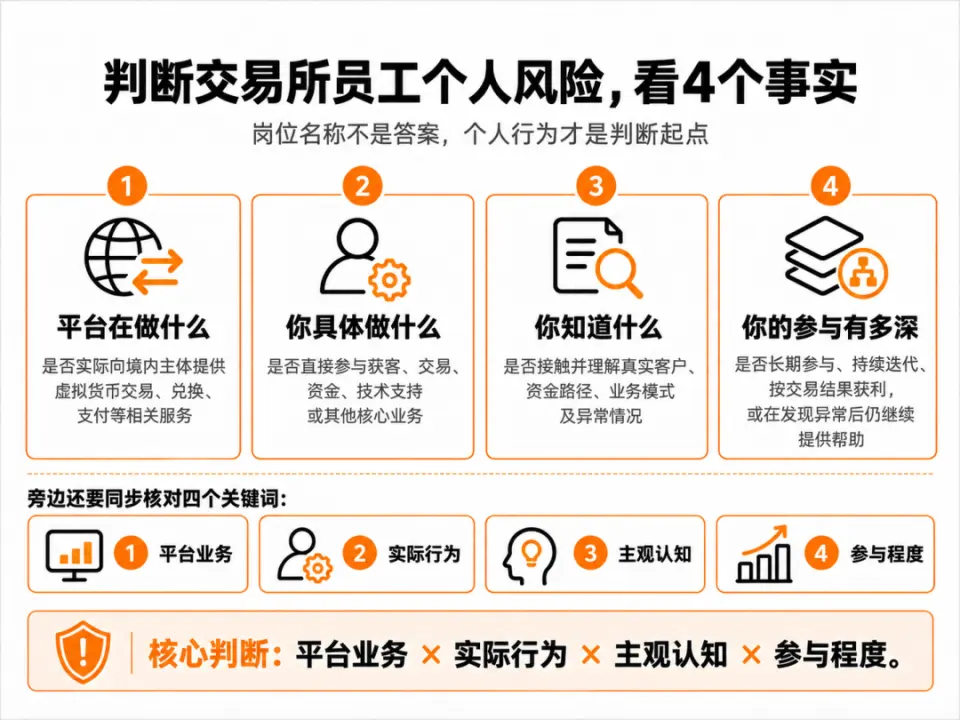
Four facts to consider in assessing the individual risk of exchange employees
Lawyer's Observations
When receiving an offer today from an offshore virtual currency exchange, simply searching for "where this exchange ranks globally" or "whether it is a top-tier platform" is no longer sufficient to complete an assessment of occupational risk, because whether a platform operates lawfully overseas and whether the business actually undertaken by employees within China complies with Chinese law are themselves questions at two different levels.
A more practical approach is to clarify, item by item before joining, the platform's business directed at mainland China, the scope of authority of one's own position, the sources of clients, the fund pathways and the performance assessment methods. If the work content gradually shifts from general overseas business toward domestic client acquisition, RMB-to-virtual-currency exchange, account settlement, circumvention of geographic or KYC restrictions and similar links, one should reassess the actual function one is undertaking, rather than waiting until the project is under investigation and then using "the company is overseas," "what I signed is an employment contract" or "the salary is only a fixed monthly amount" to explain away all the issues.
The risk of a Web3 job is not determined by the job title, but by the platform's business and the individual's conduct together.

