
Some people hold a batch of USDT and sell it when the price is right; some quote prices in multiple chat groups every day, buying low and selling high, earning a few cents of spread on each transaction; and others do more than simply buy and sell USDT — they collect RMB, buy USDT, and transfer it to designated wallets at the client's request, and even help complete conversions between domestic and cross-border funds.
In transaction records, these activities may all appear as the same thing: RMB comes in, USDT goes out.
But from a legal perspective, they are not the same issue.
On February 6, 2026, the People's Bank of China and seven other departments issued the Notice on Further Preventing and Handling Risks Related to Virtual Currencies and Other Matters, which once again clarified that virtual currencies such as Bitcoin, Ether and Tether do not have the same legal status as legal tender; conducting business activities within China such as exchanging legal tender for virtual currencies, exchanging virtual currencies for one another, and providing information intermediation and pricing services for virtual currency transactions constitutes illegal financial activity, which is strictly prohibited and resolutely banned in accordance with the law. The relevant 2021 notice was simultaneously repealed.
This means that by 2026, any discussion of whether there is risk in "buying and selling USDT to earn the spread" must first separate regulatory issues from criminal issues.
A transaction falling within the scope of a regulatory prohibition does not mean the participants necessarily commit a crime; but equally, one cannot ignore the criminal risks that may already have arisen behind a transaction model simply because one is only "normally buying and selling USDT."
What truly determines where the risk develops is why the transaction occurs, whose funds they are, where the USDT ultimately goes, and what role the actor actually plays in the entire fund chain.
First, distinguish: occasional buying and selling is not the same thing as treating exchange as a business
There is a clear difference in behavioral characteristics between a person occasionally disposing of virtual assets they hold for reasons such as investment or asset adjustment, and a person who publicly quotes prices over the long term, continuously receives and sells USDT, and derives stable income from the buying and selling spread.
The 2026 Notice uses expressions such as "conducting legal tender and virtual currency exchange business." For entities that have long engaged in exchange as a business, if they have already formed fixed quotations, a stable client base, continuous transactions and large-scale fund turnover, their conduct is clearly closer to the "virtual currency-related business activities" prohibited by the regulatory rules.
However, it must be particularly emphasized that "constituting illegal financial activity" and "constituting the crime of illegal business operations under criminal law" still cannot be directly equated.
Criminal liability must be grounded in a specific charge and its constitutive elements. One cannot, simply because a person has long bought and sold USDT, skip over the actual transaction model, the function of the funds and subjective knowledge, and directly conclude that "USDT dealers = illegal business operations crime."
In practice, what genuinely requires further examination is often the point at which a transaction is no longer merely a straightforward purchase and sale of virtual assets, but begins to perform other fund-related functions.
For example, whether one collects or pays funds on behalf of others, whether USDT is used to complete cross-border currency exchange, whether one knowingly receives proceeds of crime and still assists in converting the form of the assets, or whether one has become a fixed link in the fund chain of fraud, gambling or other illicit and grey-market activities.
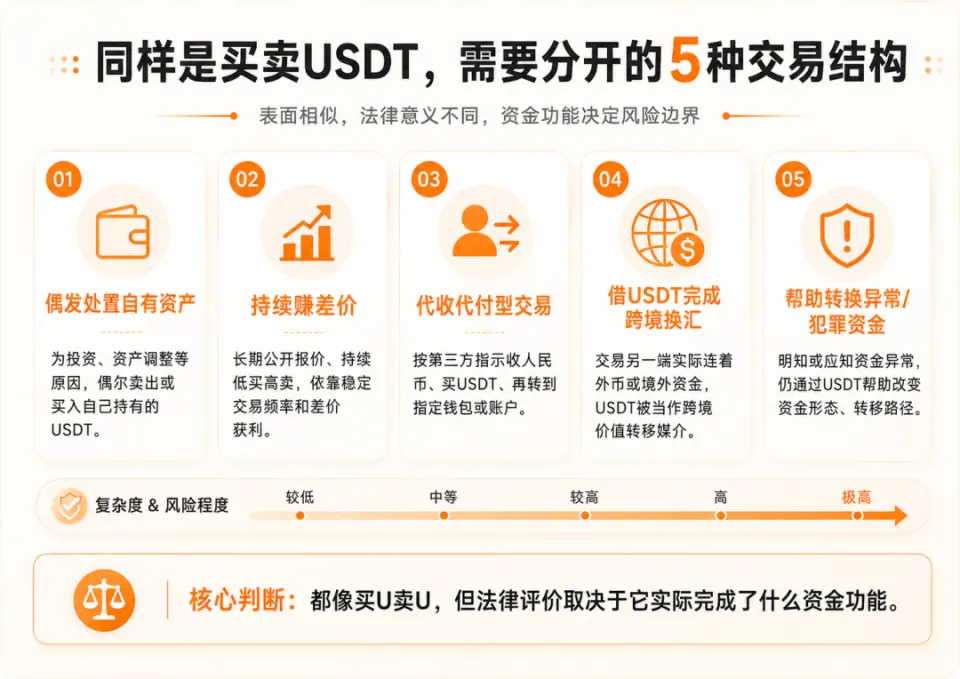
The first signal of a clear change in risk is when you begin to "complete fund tasks" on behalf of others.
In many crypto-related cases, the person involved will stress: "I do buy and sell USDT, but every transaction involves real coins, and I am not running an illegal payment-settlement scheme."
The genuine existence of USDT transactions is of course an important fact, but it cannot resolve all issues.
If the transaction model has already become: a stranger transfers RMB into your account, you purchase USDT according to the other party's instructions, and then transfer the USDT to another designated address; or the upstream party directly gives you USDT, and you are responsible for finding RMB buyers and remitting the funds to a designated bank card, then what needs to be assessed at this point is no longer merely "whether there is a genuine purchase and sale of virtual currency."
More importantly, it is whether you are completing a transfer of funds for a third party.
In a typical case published by the Supreme People's Court in 2026, the defendant, Huo, knowing that the funds he was assisting in collecting included illicit proceeds from drug transactions, still provided a payment QR code to collect the funds, and then converted the relevant funds into USDT and transferred them to others. The court ultimately found that he constituted the crime of money laundering.
This case shows that USDT transactions themselves can be genuine, but if the actual function the transaction performs is to change the form of property constituting proceeds of crime, transfer funds and conceal their source and nature, then the focus of legal attention is no longer how much coin-price spread the actor earned, but whether he participated in the money-laundering process.
Of course, this cannot conversely be understood as "buying USDT for others automatically constitutes money laundering." The crime of money laundering requires a specific predicate offence and the corresponding subjective knowledge; the crime of concealing or disguising proceeds of crime and the crime of assisting information network criminal activities also each have their own distinct constitutive conditions. The 2025 judicial interpretations and typical cases of the "Two Supremes" concerning the crime of concealing or disguising proceeds of crime once again emphasized that the facts of the predicate offence, the actor's subjective knowledge and the specific manner in which he provided assistance should be strictly examined, and that a mechanical conviction cannot be based merely on account anomalies or participation in the flow of funds.
Therefore, the real risk signal is not "helping someone buy USDT once," but whether a person's transactions gradually become a fixed service of continuously completing fund transfers for unfamiliar third parties.
The second matter requiring particular vigilance is the use of USDT to complete cross-border currency exchange.
Many people understand USDT trading as buying USDT with RMB and selling USDT for RMB.
However, if US dollars, dirhams, Hong Kong dollars or other foreign currencies appear at the other end of the transaction chain, the issue changes markedly.
In a typical case previously jointly released by the Supreme People's Procuratorate and the State Administration of Foreign Exchange, Zhao and others collected cash in dirhams in Dubai, used the dirhams to purchase USDT, and then an onshore group sold the USDT for RMB, thereby forming a "foreign currency—USDT—RMB" circulation of funds. The judicial authorities ultimately determined that this model substantively used virtual assets as a medium to effect a conversion of monetary value between RMB and foreign exchange, constituting disguised foreign exchange trading, and pursued criminal liability against the persons involved for the crime of illegal business operations.
The key point of this case is not that "USDT constitutes foreign exchange."
USDT itself cannot be directly equated with the US dollar, nor is it statutory foreign exchange under China's foreign exchange administration system.
The real issue is whether the overall transaction structure uses USDT to bypass normal foreign exchange channels and ultimately effect an exchange between RMB and foreign currency.
In other words, to determine whether a USDT trader has entered into the risk of illegal foreign exchange trading, one cannot look merely at whether the words "US dollar" or "currency exchange" appear in chat records; rather, the complete chain must be reconstructed.
What assets the client delivered overseas, why someone onshore received RMB, what function USDT performed in the middle, how the parties determined the exchange rate, and whether the actor continuously profited through the exchange rate spread or service fees therein—only by placing these facts together is it possible to show that a seemingly ordinary "buying and selling USDT" arrangement actually performed a cross-border currency exchange function.
The third risk signal is that the transaction terms increasingly resemble normal market transactions less and less.
In criminal cases, a finding of "knowledge" is usually not determined solely on the basis of a party's statement "I knew" or "I did not know."
Judicial authorities often conduct a comprehensive review by considering the transaction price, frequency, identity of the payer, abnormal account circumstances, content of communications and profit model. The 2025 new judicial interpretation on the crime of concealing or disguising criminal proceeds and the relevant typical cases also expressly emphasize that the subjective knowledge of the actor should be strictly determined in accordance with the principle of consistency between subjective and objective elements.
Therefore, for those who have long engaged in USDT trading, what truly warrants vigilance is the continuous emergence of certain abnormal signals.
For example, the person buying the coins and the person making the payment are persistently not the same person over time, and the counterparty frequently asks to split payments across multiple unfamiliar bank cards; the market price is basically stable, yet the counterparty is willing to continuously offer a clearly higher price; after one bank card is frozen, the counterparty immediately asks to switch to another card to continue the transaction; the transaction shows no concern at all for the coin price, only requiring that the funds "arrive quickly" and be "immediately transferred to a designated address"; or the client never truly controls the USDT and merely has an intermediary continuously receive and transfer coins along a designated path.
None of these circumstances, taken individually, can automatically prove that the funds are proceeds of crime, nor can they be used on that basis alone to directly find that the trader has committed a crime.
However, when anomalous factors continuously accumulate while the actor still repeatedly engages in transactions over a long period and obtains returns above the normal level therefrom, the explanation that "I was merely earning a normal price spread" will increasingly require support from other evidence.
In the earlier edition of the Web3 Practitioner's Legal Risk Avoidance Guide, we treated "abnormal transaction prices, transaction records, chat records, and prior card-freezing experiences" as important facts for assessing a USDT merchant's subjective knowledge. In current judicial practice, this line of reasoning still holds, but it needs to be expressed more precisely: these are all evidentiary factors for determining knowledge, and no single factor, standing alone, can establish that a crime has been committed.
The fourth issue is that a "genuine sale and purchase of USDT" does not sever liability upstream and downstream
Many parties readily form the understanding that as long as I actually delivered USDT, there is no problem of aiding a crime, because the two parties engaged in a genuine transaction.
However, a criminal case does not determine whether the transaction formally had consideration, but rather what role the transaction played in the overall criminal chain.
Suppose a fraud group obtains RMB 1 million in illicit funds and needs to convert the RMB in its bank cards into virtual assets that are difficult to freeze directly, so it engages a regular coin merchant. After the coin merchant receives the RMB, it delivers USDT as usual; from the perspective of the civil and commercial transaction structure, an exchange between RMB and USDT did indeed occur.
However, if it can be proven that the coin merchant knew the source of the funds was abnormal and still long-term performed this conversion function, then the "genuine delivery of USDT" does not automatically exclude criminal risk.
Conversely, if a trader can explain the counterparty's identity, the source of the order, and the correspondence between the funds and the coins, and there is no obvious abnormality in the transaction price, and no other facts are sufficient to prove that the trader knew of the upstream crime, then it cannot be inferred in reverse that the trader necessarily participated in the crime merely because the funds at issue once passed through the trader's account.
This is also the two extremes that must especially be avoided in coin-related criminal cases: one cannot assume safety merely because there was a "genuine transaction," nor can one assume that the trader necessarily had knowledge merely because "illicit funds were received."
The authenticity of the transaction and subjective knowledge are two issues that must be proven separately.
In assessing a USDT transaction, what truly matters is the entire chain of transactions
If the risks discussed above are considered together, it becomes clear that what judicial authorities truly focus on is not the phrase "buying and selling USDT for a price spread" itself, but how the business actually operates.
In a criminal case, at least several sets of relationships must be reconstructed: who paid the RMB, and whether the payer and the actual transacting party are the same person; from which wallet the USDT was transferred out and into which wallet it ultimately entered; whether the trader independently determined the trading price and counterparty, or completed transfers according to instructions from a fixed upstream party; whether income came from normal trading spreads or from commissions calculated as a proportion of fund flows; whether the funds had a cross-border exchange background; and whether bank card freezes, payments from unfamiliar third parties, abnormally high prices, transfers through designated paths, and similar circumstances repeatedly occurred during the transactions.
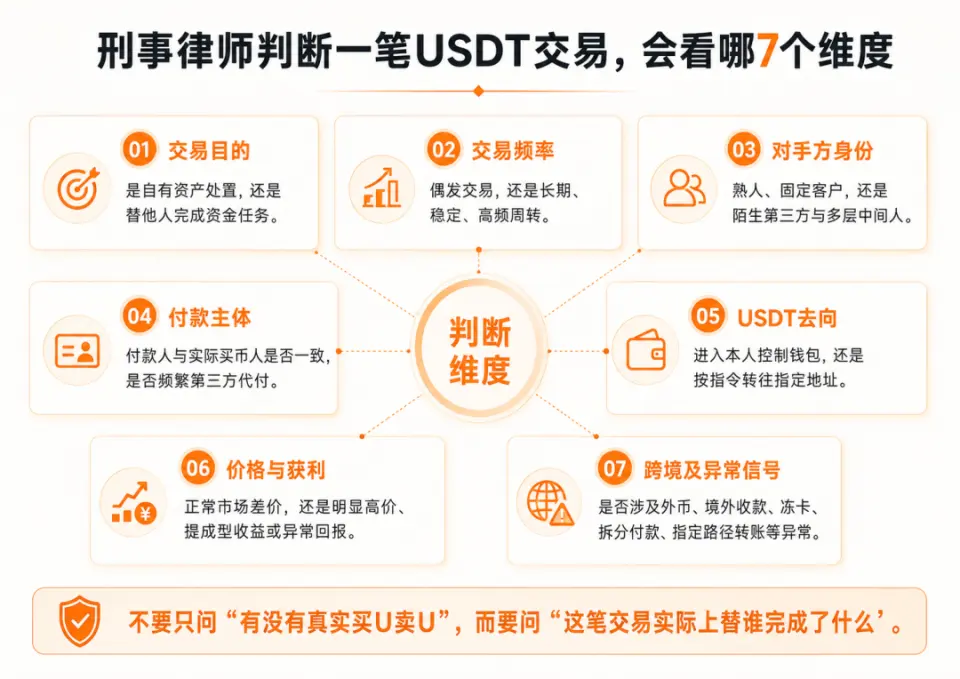
This is also why two people who both appear to be "buying low and selling high USDT" may ultimately face completely different legal assessments.
Lawyer's Observations
The regulatory environment in 2026 has undergone a change that must be squarely acknowledged.
The latest Notice issued by the People's Bank of China and seven other departments continues to maintain the prohibitive policy on virtual currency-related business activities within China, and expressly includes fiat currency-virtual currency exchange and other related business activities within the scope of illegal financial activity governance; at the same time, cases in recent years from the Supreme People's Court, the Supreme People's Procuratorate and foreign exchange authorities have also continued to focus on the use of virtual currencies for money laundering, transferring criminal proceeds and circumventing foreign exchange regulation.
Therefore, when discussing today whether "acting as a USDT merchant can constitute a crime," the most common mistake is to attempt to find a simple answer.
Long-term buying and selling of USDT itself faces clear financial regulatory risks, but whether it further entails criminal liability must still be determined by reference to the specific transaction structure.
If transactions gradually change from independent buying and selling to collecting and making payments on behalf of third parties, from simple RMB-USDT exchange to using USDT to complete cross-border currency exchange, from normal market prices to charging abnormally high prices for receiving funds from unfamiliar parties, or if a person continues to convert assets for a fixed upstream party after abnormal signals have repeatedly appeared, the criminal risk may undergo a substantive change.
Conversely, in a criminal case, it is also impermissible to directly infer a person's subjective knowledge and criminal liability merely because the person traded frequently, had enormous fund flows, or had an account frozen.
What truly needs to be answered is always the same question:
This USDT transaction may look like “buying and selling crypto,” but once placed within the complete chain of funds, what function does it actually perform?
Only by clarifying this question can financial regulatory risk, abnormal-fund risk and genuine criminal liability be distinguished.

