
1.2 million yuan in cash was placed in a black travel bag. After the seller confirmed the cash, the seller transferred the corresponding amount of USDT to the wallet address designated by the buyer. Under the parties' original transaction arrangement, all that remained was for the buyer to confirm receipt of the coins and for the seller to take the cash, and the transaction would be complete.
However, the buyer suddenly stated that the USDT had not been received. Just as the seller looked down to verify the on-chain records, the travel bag full of cash was thrown out of a second-floor window; an accomplice waiting downstairs picked up the bag and quickly drove away, while another person was responsible for blocking the seller from pursuing.
On October 29, 2026, Procuratorate Daily reported this virtual currency transaction case that occurred in Xuzhou, Jiangsu. The public security organ initially transferred the case for review and prosecution on suspicion of the crime of snatching, but after review, the procuratorial organ concluded that this was not a snatching targeting the 1.2 million yuan in cash, but rather a fraud case in which cash transactions were used as bait to obtain USDT by deception.
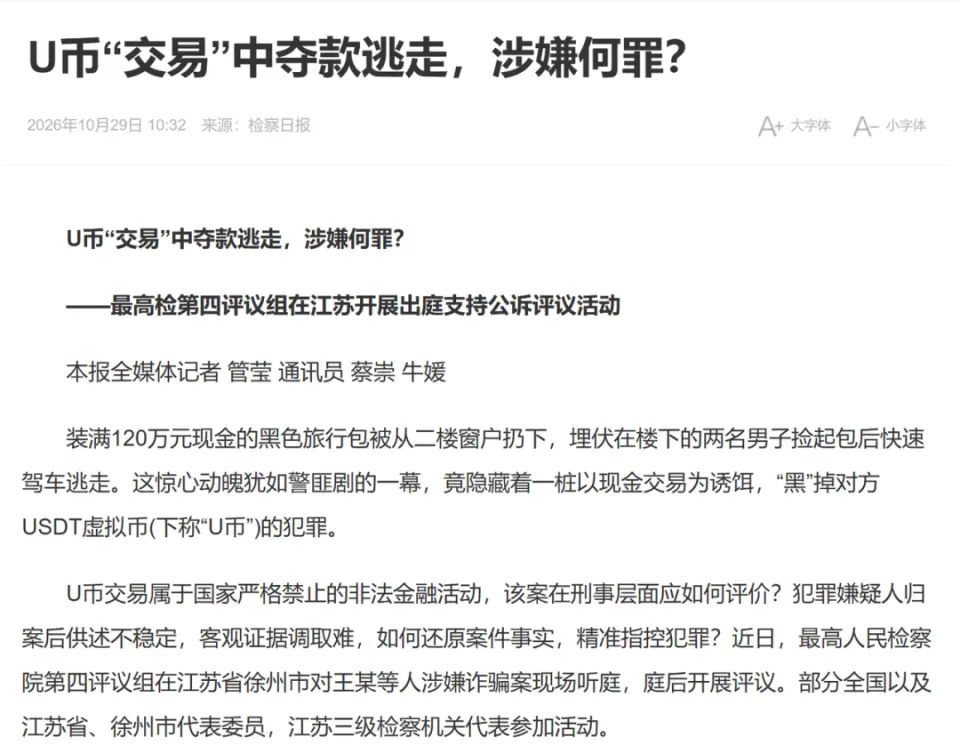
The matter did not end there. At trial, the defense counsel raised an argument for the crime of contract fraud, creating a new dispute over characterization with the prosecuting authority. As of the time of writing, the case has not yet been adjudicated.
In the same transaction, why are there three possible characterizations: the crime of snatching, the crime of fraud, and the crime of contract fraud?What truly warrants attention is what the perpetrator actually intended to take, and by what means it was obtained.
01 With 1.2 million yuan in cash placed on the table, why did the procuratorial organ conclude that what was defrauded was USDT?
According to public reports, Wang had previously purchased USDT from Xiao with cash on two occasions; the parties were not transacting for the first time. Later, Wang learned that China strictly regulates virtual currency transactions, and conceived the idea of obtaining USDT without paying consideration; Wang then gathered other individuals to plan the division of roles and conduct advance reconnaissance.
On March 23, 2026, Wang again proposed to purchase USDT and agreed to complete a cash transaction offline. After Xiao arrived at the scene, Xiao first inspected the 1.2 million yuan in RMB brought by Xu, and then transferred the corresponding amount of USDT to the designated receiving address.
However, Wang and the others did not intend to actually complete payment. According to the procuratorial organ's allegations, Wang falsely claimed that the coins had not been received; while Xiao was verifying the records, Xu threw the cash bag out of the window, where accomplices downstairs picked it up and fled, while other individuals were responsible for blocking Xiao from pursuing.
The first impression most easily formed in this case is that several people took the cash, and therefore it is suspected of snatching. However, after reviewing the dashcam footage, on-site surveillance, mobile phone electronic data, and the statements of relevant persons, the procuratorial organ reached a different conclusion:The 1.2 million yuan in cash was at all times within the control of Wang and the others; the cash was merely a tool to make the seller believe the transaction was genuine and willing to transfer the coins first.
Under this theory of the charge, what Xiao truly lost was the USDT already transferred into the counterparty's wallet. Wang and others used the display of cash, the trust built through prior transactions, and false promises of payment to induce Xiao to transfer the coins.
If this factual account can be proven in court, the case must be assessed not only as to the final act of 'grabbing the bag and fleeing,' but as to the entire criminal plan formed before the transaction even began.
02 Whether this is fraud or forcible seizure turns on who originally controlled the property and how the property was transferred
Both fraud and forcible seizure are crimes against property, but there are important differences in their behavioral structure.
In a typical fraud case, the perpetrator fabricates facts or conceals the truth, causing the victim to form a mistaken understanding, and the victim disposes of property on the basis of that understanding, ultimately resulting in property loss. A typical forcible seizure case, by contrast, emphasizes that the perpetrator, taking the victim off guard, openly seizes property in the victim's possession; the property leaves the original possessor's control not through the victim's voluntary delivery after being deceived.
Therefore, in this case two questions must first be answered: what property did Xiao actually lose? And through what conduct did the relevant property leave his control?
If one observes only the final few seconds, it is indeed possible to see someone throwing a bag of cash from the building and accomplices receiving it and fleeing. The problem, however, is that this cash was brought by Wang and others in the first place; according to the evidence currently in the procuratorate's possession, Xiao only inspected the cash and did not actually obtain independent possession of it.
Conversely, the USDT had already been transferred to the address designated by Wang in accordance with the transaction arrangement. Xiao was willing to transfer the coins first precisely because he believed the counterparty would pay the cash as agreed.
This gives rise to two entirely different paths of factual explanation: if the perpetrator obtained benefit by suddenly seizing property already in the victim's possession, there is room to discuss forcible seizure; but if the perpetrator designed a sham transaction from the outset, causing the other party to mistakenly believe the transaction was genuine and voluntarily transfer USDT, then what requires focused examination is the constitution of the crime of fraud.
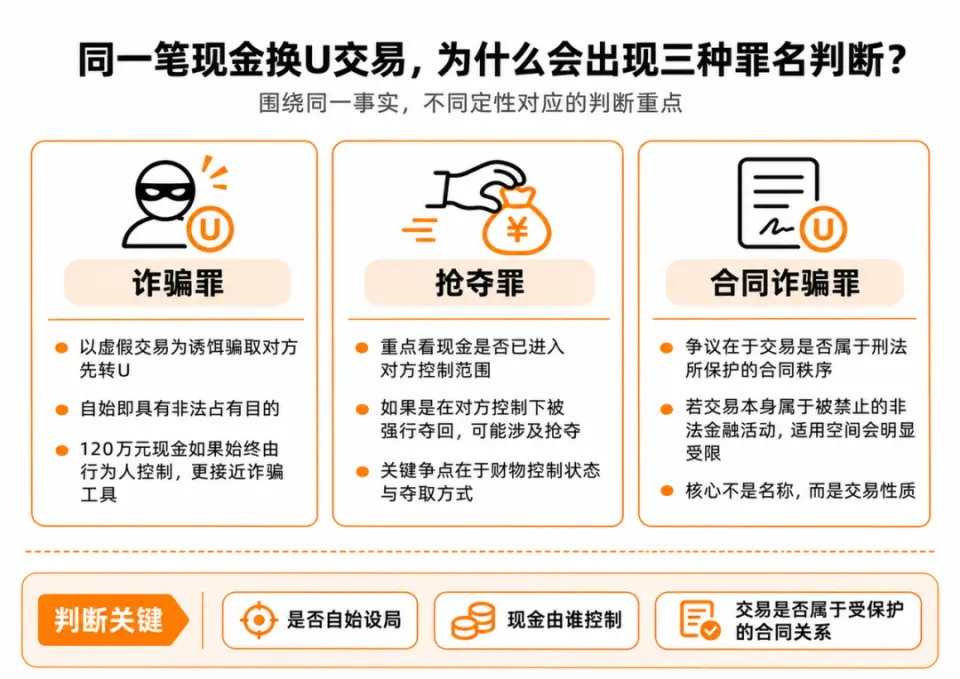
The key issue in this case is not whether the perpetrator ultimately fled, but at what time and for what reason the victim lost control of which item of property.
Of course, establishing fraud still requires proof of the relationship among the intent of illegal possession, the deceptive conduct, the victim's mistaken understanding, the disposition of property, and the corresponding loss. The mere fact that payment was ultimately not made under a transaction does not permit ordinary breach of contract to be directly characterized as fraud. Particularly in virtual asset transactions, failed on-chain transfers, differences in arrival times, erroneous wallet addresses, and differing understandings between the parties as to settlement conditions may all give rise to transactional disputes, and these must be strictly distinguished from conduct involving a premeditated scheme to obtain assets by deception.
03 The transaction was agreed by both parties, so why did defense counsel raise the crime of contract fraud?
At the trial in this case, there was another dispute more deserving of attention from criminal defense counsel than the question of “robbery or fraud”: defense counsel argued that the defendant's conduct should constitute the crime of contract fraud rather than ordinary fraud.
On its face, this argument is not difficult to understand. There was an explicit transaction arrangement between the parties, under which the conditions for exchanging cash and USDT were agreed; the seller performed the obligation to transfer the coins, but the buyer failed to pay the consideration as agreed. The relevant conduct occurred in the course of the transaction agreement and its performance, and thus appears to possess some of the outward features of contract fraud.
However, the crime of contract fraud is not an umbrella term for all fraudulent conduct occurring in the course of contract performance.
The crime of contract fraud under Article 224 of the Criminal Law of the People's Republic of China requires that the perpetrator, with the purpose of illegal possession, defraud the other party of property in the course of concluding or performing a contract. Compared with the ordinary crime of fraud under Article 266, the crime of contract fraud also involves the protection of the order of market transactions.
In the Supreme People's Court's case included in its database, the Chen Mou Rong Contract Fraud Case, the Court pointed out that in determining whether contract fraud is constituted, one must not rigidly insist on whether the contract was in written form; even an oral contract, provided that it genuinely occurs in the field of production and business operations, disrupts the order of market transactions, and meets the requirements of the Criminal Law, may fall within the scope of evaluation for the crime of contract fraud. What truly matters is whether the relevant contract possesses the market-transaction attributes required by the Criminal Law, and whether the perpetrator carried out the fraud by means of concluding or performing the contract.
The distinctive feature of this case is that the subject matter of the transaction is USDT, and the transaction method is the exchange between RMB cash and virtual currency.
In February 2026, the document Yin Fa [2026] No. 42 issued by the People's Bank of China and seven other departments once again made clear that virtual currency does not have legal tender status and should not and cannot be circulated or used as currency in the market, and included such related business activities as the exchange between domestic legal tender and virtual currency within the scope of illegal financial activities that are strictly prohibited.
At the trial in this case, the public prosecutor accordingly argued that the crime of contract fraud protects the order of the socialist market economy, whereas virtual currency transactions are illegal financial activities expressly prohibited by the State and do not fall within the regulatory scope of the crime of contract fraud, and should therefore be evaluated as the ordinary crime of fraud.
This argument has a clear basis in legal analysis, but it should still be noted that it is the prosecution's reasoning at trial in this case, and not a judicial rule that has already taken effect.
From the perspective of criminal defense, what truly merits further discussion is: where a transaction is prohibited by administrative regulation, or the relevant civil act may be determined to be invalid, does that necessarily exclude the application of the crime of contract fraud? This cannot be decided mechanically on the sole basis of “a contract was signed” or “the transaction was non-compliant”; rather, further analysis should be made of the order of market transactions protected by the crime of contract fraud, the actual nature of the transaction relationship, and whether the specific deceptive conduct meets the constitutive elements of that crime.
How this case is ultimately characterized should still be governed by the facts ascertained by the court and the effective judgment.
04 USDT transactions are subject to strict regulation; why can defrauding others of USDT still potentially constitute the crime of fraud?
This issue is also the point in this case most likely to give rise to misunderstanding.
Some may argue that, since domestic law strictly prohibits virtual currency exchange business, the seller's participation in the relevant transaction itself carries legal risk, and therefore, when the buyer obtains USDT without paying consideration, is this merely a risk that the parties to the transaction bear themselves?
Here, two distinct sets of legal assessments must be distinguished.
One is the financial regulation of virtual currency-related trading activities. What regulators focus on is whether activities such as fiat currency and virtual currency exchange, transaction matching, pricing, and payment settlement violate currently effective rules, and whether the relevant civil acts have legal effect.
The other is the assessment under criminal law of conduct that unlawfully appropriates or fraudulently obtains another person's property interests. The latter requires determining whether the actor, with the purpose of illegal possession, obtained property interests through means satisfying the constituent elements of a specific offense.
The fact that a transaction is not protected by civil law, or involves prohibited financial activity, does not automatically mean that one party to the transaction may obtain, without consideration, the property interests controlled by the other party through deception, theft, or other means.
In relevant judicial practice, some case-handling authorities have expressly included virtual currencies with economic value within the scope of review for property-infringement crimes. For example, in a case reported by Procuratorate Daily in June 2026 concerning the exchange of RMB 300,000 in cash for USDT in Beibei, Chongqing, the actor likewise falsely claimed after the seller transferred the coins that the funds had not arrived, and arranged for accomplices to seize the cash. The procuratorial authority took the view that the cash was merely a tool to induce the other party to deliver USDT, ultimately initiated a public prosecution on suspicion of fraud, and the court also entered a guilty verdict for fraud.
It must also be made clear, however, that whether virtual currency can serve as the object of a specific crime, how its property interests are to be determined, and how the amount involved is to be calculated still require review in different cases in light of the legal policies in force at the time the conduct occurred, the specific offense, and the evidentiary circumstances. It cannot be directly inferred from the outcome of one case that all virtual currency transactions have the same civil effect, nor can any platform quotation simply be treated as the basis for pricing in a criminal case.
Returning to this RMB 1.2 million case in Jiangsu, the core of the procuratorial authority's current charge is not whether the seller's conduct of engaging in USDT transactions was compliant, but whether Wang and others used sham transactions to fraudulently obtain the USDT controlled by the seller. The two may be investigated and assessed separately, and there is no logic under which the existence of risk in one party's trading conduct necessarily means that the other party's conduct does not constitute a crime.
05 In the same transaction, why are chat records, on-chain data, and on-site surveillance all important?
This case has another detail worthy of attention: among the five defendants, the statements of some individuals were unstable during the investigation and prosecution review stages, and differing explanations also emerged at trial.
Therefore, relying solely on confessions makes it very difficult to fully determine what each person actually did before and after the incident.
According to a report in the Procuratorate Daily, in addition to examining the defendant's statements, the procuratorial authorities also focused on investigating the dashcam footage, on-site surveillance video and mobile phone electronic data, and at trial questioned the parties regarding the source of the receiving address, confirmation of receipt of funds and the prior division of roles.
These pieces of evidence are not intended to answer the same question.
On-chain transaction records can help verify whether the USDT was transferred out, when it was transferred out, which address it entered, and whether it was subsequently transferred further; however, a single successful transfer is usually insufficient to directly confirm the person who actually controls the wallet, and even less capable of independently proving that the counterparty intended to commit fraud from the outset.
On-site surveillance and dashcam footage can reconstruct the time the individuals arrived, the movement of the cash bags, the position of the vehicles and the escape process, but they may not necessarily explain why the actors arranged these actions.
Only chat records, call content, wallet control materials and communications among the relevant persons may further reveal whether there was prior collusion, who provided the receiving address, who was responsible for falsely claiming that the funds had not arrived, who arranged the cash transfer, and what role each participant played in the overall plan.
In particular, in this case, Wang had previously made two genuine purchases of USDT; this fact may be used to analyze why the seller believed the third transaction, and it also needs to be assessed together with other evidence to determine whether the earlier transactions were merely normal purchases or were intended to build trust for the subsequent crime. The fact that fraud charges were later brought does not automatically mean that every earlier transaction must be characterized as preparation for a crime.
For purposes of criminal liability, the different participants cannot simply be equated with one another. Whether acts such as providing the receiving address, arranging the cash, being responsible for on-site obstruction, and assisting in contacting the counterparty were part of a prior joint criminal plan must be determined separately in light of each person's subjective knowledge, time of participation, actual division of roles and the role played by the conduct.
Therefore, the case cannot be criminally established on the basis of a single statement that "they conspired to defraud the other party of the coins"; rather, the pre-transaction conspiracy, the deception during the transaction, the on-chain asset transfers and the post-transaction reception and support conduct should be examined on the same timeline.
06 Does a transaction price of RMB 1.2 million necessarily equal the final criminal amount?
There is another issue in the case that is easily overlooked but may directly affect sentencing: does the fact that the parties agreed on RMB 1.2 million to purchase a certain quantity of USDT necessarily mean that the criminal value of the USDT involved is RMB 1.2 million?
According to the publicly available reports so far, the procuratorial authorities brought charges based on USDT valued at RMB 1.2 million, but the reports have not fully disclosed which specific valuation materials were used or how the objectivity of the transaction price was examined.
For ordinary property crimes, the value of the property involved is an important factor affecting the amount of the crime and sentencing. However, USDT is not RMB and does not have the same legal status as legal tender; a quotation on a particular platform, an exchange price offered by an informal dealer, or an amount agreed upon by the parties themselves cannot simply be adopted, without examination, as the final standard for criminal determination.
In a specific case, it remains necessary to verify the actual quantity of the USDT involved, the timing of the transactions, the process by which the parties agreed on the price, whether the transactions were genuine, and whether the relevant value evidence is lawful, relevant and objective. Where there are abnormal quotations, false transaction records, double counting, or unclear facts regarding asset transfers, such matters must be further excluded.
Although this question is related to whether fraud is constituted, it is not entirely the same. Criminal characterization requires an analysis of the conduct and subjective purpose, while the amount of the crime requires further proof of the value of the property; the mere confirmation that an on-chain transfer occurred does not mean that the amount involved is no longer in dispute.
This is particularly so in coin-related cases.Proving how many coins were transferred away and proving how much property value should be recognized under criminal law are two separate evidentiary tasks that must each be completed.
Final remarks
In this Jiangsu case involving the purchase of USDT with RMB 1.2 million in cash, what is most noteworthy is not that someone threw a bag of cash down from upstairs, but that this seemingly ordinary offline transaction may present a completely different structure of conduct under criminal law.
On the surface, someone took the cash away; but according to the transaction process ascertained and alleged by the procuratorial authority, the cash may have been merely a tool to create the false appearance of a genuine transaction, and what was actually unlawfully obtained was the USDT that the seller had already voluntarily transferred out. It is precisely for this reason that the case shifted from the public security authority's initial characterization of suspected robbery to the procuratorial authority's prosecution on suspicion of fraud, and further gave rise during the trial to a dispute between ordinary fraud and contract fraud.
For Web3 practitioners, this case shows that the criminal risks in offline cash transactions cannot be judged solely by what action occurred at the end; for criminal defense, it also reminds us that cases involving virtual assets cannot be concluded solely on the basis of the transaction name, wallet balance or a certain video segment, but require a joint examination of the actual flow of property, the relationships of control, the purpose of the transaction and the division of roles among the actors.
What appears to have been taken away is cash, but what may actually have been unlawfully obtained is USDT.The key to determining whether this was robbery or fraud lies in fully reconstructing how the property left its original control and whether the actor brought about that result through deception.
This is the most valuable discussion that this case leaves for coin-related criminal cases.
This article is written on the basis of public information as of November 4, 2026. The Jiangsu case has yet to be pronounced by the court; the views of the public prosecution authority and the defense counsel set out in this article are views expressed in public court proceedings and do not represent the final judicial determination. The specific legal assessment is subject to the facts of the case, the evidence and the effective judgment.
Main References
• Procuratorate Daily report dated October 29, 2026: Seizing funds and fleeing during a USDT “transaction” — what offense is suspected?
• Supreme People's Court case database reference case: The Chen Mou-rong contract fraud case
• Procuratorate Daily: Robbery or Fraud? Unraveling the Mystery of a 300,000-Yuan USDT Transaction
• 2026 Notice of Eight Departments on Further Preventing and Addressing Risks Associated with Virtual Currencies and Related Matters
