
If you open the Monetary Authority of Singapore (MAS) directory of financial institutions, you will see a list that is not particularly long, yet carries considerable weight. Digital asset and payment institutions of various types, including Coinbase, Circle, Triple-A, StraitsX and BitGo, have each obtained, through a Singapore entity, a Major Payment Institution licence that includes Digital Payment Token Service.
As of 4 August 2026, the public MAS directory contained 38 institutions approved to provide digital payment token services as Major Payment Institutions, and there are currently no institutions providing such services as Standard Payment Institutions. This means that the existing digital payment token licence holders in Singapore have, as a whole, already moved up to the Major Payment Institution tier, which carries more comprehensive regulatory requirements.
Compared with some jurisdictions that have shorter application cycles and primarily perform a basic anti-money laundering registration function, Singapore is not an easy path. A project needs to commit a local team, compliance personnel, audit and technical resources, and approval is by no means guaranteed; yet even so, a large number of crypto payment, stablecoin, trading, custody and institutional service projects still hope to include Singapore in their group's licensing footprint.
The reason is not complicated. For projects that have already entered the real financial system, the value of a Singapore licence is not merely that it "permits the conduct of a certain crypto business"; rather, it helps the company answer a more critical question:
Can this company, in accordance with the standards of a regulated payment institution, handle clients, assets, accounts and cross-border transactions over the long term?
What the industry calls "queuing for a licence" does not mean that an applicant is certain to obtain a licence simply by queuing; rather, it describes companies that, even knowing the high threshold and the long preparation period, are still willing to commit resources to obtain this regulatory status.
What Singapore issues is not a standalone "crypto licence"
When many projects first learn about Singapore, they simply understand Digital Payment Token Service as a "Singapore crypto licence". This description is easy to communicate, but it is not accurate.
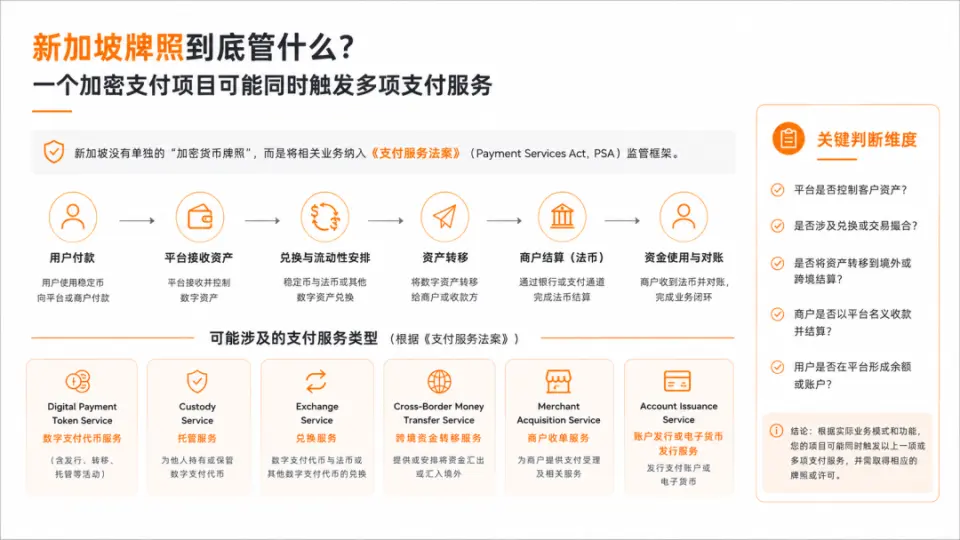
Singapore's Payment Services Act brings payment service providers into a unified licensing system, and its regulatory scope covers seven categories of business, including account issuance, domestic money transfer, cross-border money transfer, merchant acquisition, e-money issuance, digital payment token services and money-changing. What a company applies for is not a virtual asset certificate existing separately from the payment system, but rather, based on its own business, approval to provide one or more payment services under the corresponding payment institution licence.
This is very important for crypto payment projects.A stablecoin merchant collection platform may, in its actual business, simultaneously involve digital payment token services, cross-border money transfer and merchant acquisition; an account product aimed at corporate clients may also involve account issuance and fiat currency payments. If a project applies only for digital payment token services but expects to automatically obtain fiat remittance, merchant settlement and account balance management capabilities after approval, there will be a mismatch between the scope of the licence and the actual product.
Therefore, what truly attracts projects to the Singapore path is not that it opens a separate door for crypto business, but that it allows companies, within a single payment regulatory framework,Combine digital asset functions with traditional payment functions. As for which services ultimately need to be applied for, this still depends on the functions the project actually performs within the overall funds chain, the funds pathways, and its ongoing compliance capabilities.
Why does this licence readily attract the attention of banks and institutional clients?
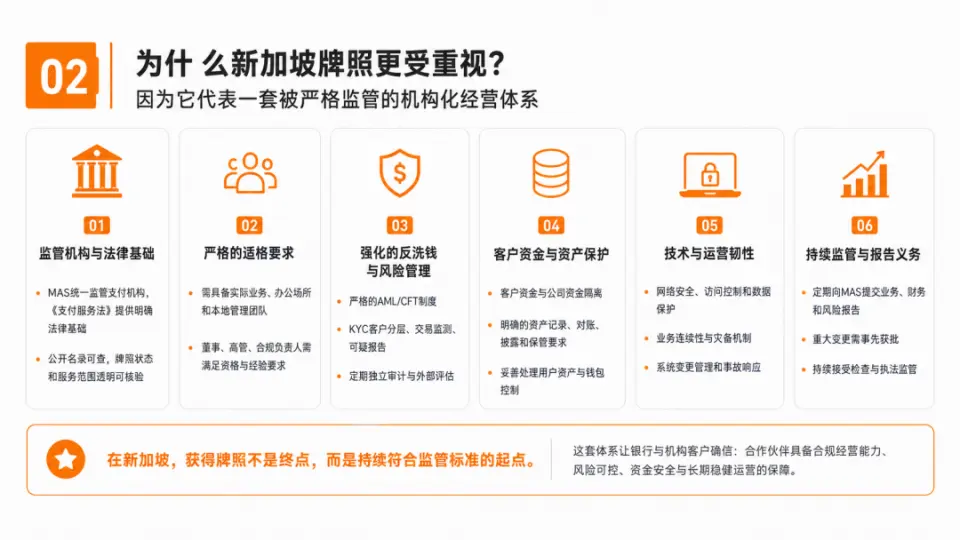
When crypto projects choose a licence at an early stage, they often focus more on cost and speed; but once the business begins to connect with banks, card issuers, large merchants and institutional clients, what the counterparty usually cares about is not "whether there is a certificate", but who issued the certificate, what business it covers, and whether the licensed entity is subject to ongoing supervision.
MAS's public register lists the licensed entities, the licence types and the specific payment services they are approved to provide.For banks and partner institutions, this means the project's regulatory status can be directly verified, without having to rely solely on certificates, legal opinions or promotional materials provided by the company. The 38 institutions currently approved to provide digital payment token services are all listed in the MAS directory as Major Payment Institutions, including institutions of different business types such as Coinbase, Circle, BitGo, Triple-A and StraitsX.
Compared with lighter-touch licences, a Major Payment Institution is subject to more comprehensive supervision, including, where applicable, protective measures for customer funds. For institutional partners, this level of supervision means the project has not merely completed basic registration, but is required to meet higher standards in areas such as governance, risk management, customer assets and ongoing reporting.
Such verifiability does not mean a bank will necessarily open an account, nor does it mean institutional clients will necessarily accept the project.Counterparties will still continue to examine how customer assets are controlled, how transactions are monitored, who settles fiat currency, whether funds are segregated, and whether the project involves high-risk countries and customer groups. But it can at least resolve the first-layer question in due diligence: whether this company is a payment institution that genuinely exists, has a clear licence scope and is subject to ongoing supervision.
For platforms preparing to serve corporate clients, funds, family offices or large merchants, this institutional status often has greater long-term value than merely obtaining a low-threshold registration.
What Singapore is really screening for is whether an enterprise has "substantive operations"
In the past, some projects would set up a company in Singapore but place all their customers, teams and core business outside Singapore, then use the Singapore entity to sign contracts or present themselves externally. This structure of "the company is in Singapore, but the business is not" is already difficult to continue to regard as a light-touch pathway under the new regulatory framework.
From 30 June 2025, a Digital Token Service Provider established in Singapore but providing digital payment token or capital markets product token services only to overseas customers is required to obtain the corresponding licence under the Financial Services and Markets Act. MAS has expressly stated that this type of business model carries a higher money laundering risk, and that when the substantive activities all take place overseas, it is difficult for the regulator to conduct effective supervision; therefore the relevant licensing threshold has been set very high, and MAS will generally not grant such licences; operators that have not obtained a licence are required to cease the relevant activities.
The signal sent by this change is very clear:Singapore welcomes regulated digital asset businesses, but does not want enterprises merely to borrow Singapore's company registration location and financial centre reputation while placing the actual customers, personnel, systems and decision-making entirely outside regulatory sight.
Therefore, when assessing a Singapore licence, a project needs to prepare not only registered capital and application documents, but also a clear local business plan, experienced management and compliance teams, actual office and operational arrangements, and customer, system and decision-making chains that enable MAS to maintain ongoing supervision.
Singapore does not fail to welcome global businesses; rather, it does not accept global businesses that have only a "Singapore shell" without Singapore substance.
Why are projects still willing to wait despite the high difficulty of applying?
The first value comes from the Asian market and group structure.Singapore itself is a mature international financial centre, with a high concentration of banks, payment institutions, investment institutions and regional headquarters. For projects that wish to serve Asian corporate clients, or that need to place payment, stablecoin and institutional digital asset services within the same group structure, a Singapore entity is more readily able to become the central point of explanation for regional operations and institutional cooperation.
The second value comes from the linkage between payment and digital asset regulation.Singapore has not placed digital payment token services entirely outside the traditional payment system; rather, it regulates them together under the Payment Services Act. If a project simultaneously requires digital asset exchange, cross-border transfers, merchant collection and account services, it can assess multiple payment services around its real business, instead of using multiple unrelated entities to explain one product.
The third value comes from the predictability of regulatory policy.Singapore is not uniformly permissive towards digital assets; rather, it continuously strengthens anti-money laundering, customer protection, business conduct and technology risk requirements. Digital payment token service providers must continuously perform AML/CFT obligations relating to customer identification, transaction monitoring and suspicious transaction management; under the new DTSP regime, overseas service models are likewise subject to clear restrictions.
Singapore has also published a regulatory policy framework for single-currency stablecoins, mainly directed at specific single-currency stablecoins pegged to the Singapore dollar or G10 currencies, and setting requirements around reserve assets, capital, redemption and disclosure. However, an ordinary Digital Payment Token Service licence does not automatically equate to stablecoin issuance eligibility, and a project still needs to make a separate assessment based on the latest legislation and implementing rules.
For early-stage projects, these requirements mean greater investment; but for banks and institutional clients, they are also an important basis for judging whether a project has long-term capability.
Which projects are suitable for a serious assessment of a Singapore licence?
The first category is projects that have completed product validation and plan to serve Asian enterprise and institutional clients on a long-term basis.Such platforms are usually no longer satisfied with a basic crypto asset registration status, but need a complete regulated entity capable of supporting bank partnerships, merchant settlement, cross-border payments and due diligence on large clients.
The second category is projects that connect both stablecoins and fiat-currency payments.For example, an enterprise client pays with stablecoins, and the platform completes fiat-currency settlement to the supplier through a bank or payment channel; or a merchant accepts digital assets and then needs settlement in Singapore dollars, US dollars or other currencies. Such models cannot be assessed solely by reference to digital payment token services; further analysis is also required of cross-border fund transfers, merchant acquiring, account issuance and which functions are respectively undertaken by the partner institutions.
The third category is groups preparing to make Singapore their Asian operational hub.A Singapore entity can undertake specific regulated business, but the technology, intellectual property, other market operations and licensed entities in different countries still need to be reasonably allocated. A genuinely sustainable structure is not one that stuffs all global business into a single Singapore company, but one in which the Singapore entity undertakes the parts for which it has the licences, personnel and operational capability.
Conversely, if a project is still validating its product, lacks stable customers and genuine transactions, and is unable to deploy a local management team, compliance officers, technical risk management and audit resources, then Singapore may not be the current top-priority route.If an enterprise merely wants to incorporate a Singapore company, serve all its overseas clients and borrow local reputation, the DTSP regime implemented in 2025 has already significantly narrowed the room for this.
Before applying, a project should first answer at least five questions
A project first needs to determine whether what it actually needs is a Digital Payment Token Service, or whether it also involves other payment services such as cross-border fund transfers, merchant acquiring, account issuance or electronic money.If the scope of the application is too narrow, it will not cover the product after approval; if the scope is too broad, it will increase the burden of documentation, systems and ongoing compliance.
Second, it is necessary to determine whether the platform controls client assets.Who holds the client private keys, whether stablecoins enter the platform's collection wallets, whether user balances represent a claim against the platform for redemption, and whether the platform can freeze, return or change the direction of funds will all directly affect the regulatory analysis.
Third, the fiat currency pathway must be clearly mapped.Who completes stablecoin conversions, in whose name bank accounts are opened, where fiat currency enters and to whom it is ultimately settled, and whether the platform creates client fund balances are questions that cannot be explained merely by saying they are "handled by a partner."
Fourth, the substance of the Singapore market must be confirmed.Which local or regional clients the project intends to serve, how directors and core management personnel are allocated, and whether compliance, risk management and technical decisions genuinely take place in Singapore rather than all important functions remaining offshore.
Fifth, long-term costs must be assessed.The cost of a Singapore licence is not limited to the application fee; it also includes local personnel, independent assessments, AML/KYC/KYT, cybersecurity, regulatory reporting, financial audits and ongoing maintenance of systems. If a project can only bear the costs of the application stage but cannot sustain the operating system after approval, even if it enters the application process, it will be difficult to obtain a genuinely usable licence.
What can Mankun deliver for the project?
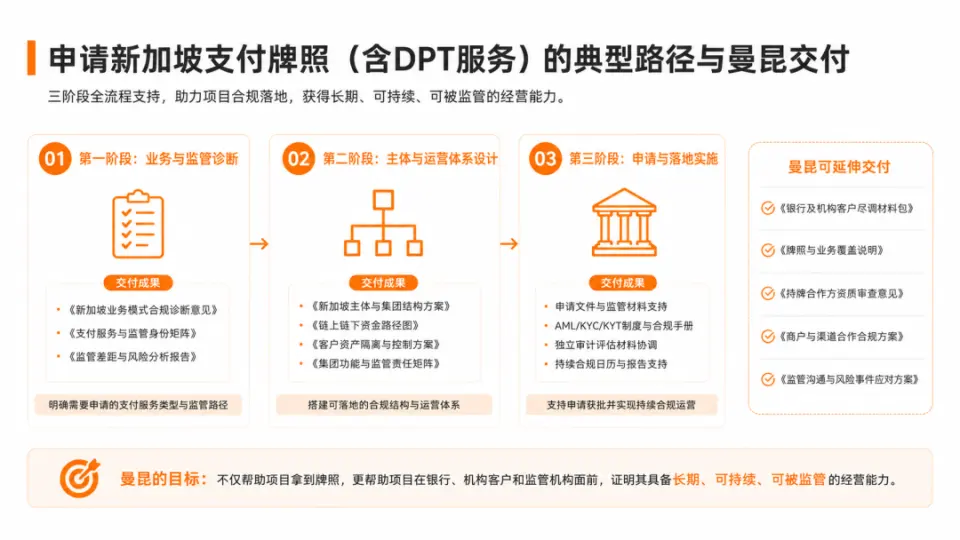
For crypto payment projects preparing to enter Singapore, Mankun can first, based on product functions, client locations, the manner of control over digital assets and fiat settlement processes, produce a Singapore Business Model Compliance Diagnostic Opinion, a Payment Services and Regulatory Status Matrix and an Analysis of Regulatory Gaps in Existing Business, to determine which payment services the project needs to apply for, which functions should be adjusted, and whether Singapore is suitable as the licensing jurisdiction at the current stage.
Once the pathway is determined, Mankun can further design the division of functions among the Singapore entity and the group holding company, the technology entity, offshore operating entities, banks and payment channels, and produce a Singapore Entity and Group Structure Proposal, an On-Chain and Off-Chain Fund Flow Map, a Client Asset Control and Segregation Analysis and a Group Functions and Regulatory Responsibility Matrix. Such materials not only serve the licence application but can also be used to explain the business to banks, audit institutions and investors.
Once the application stage begins, Mankun can assist in preparing the regulatory business plan, business processes and transaction volume projections, management and key personnel materials, AML/KYC/KYT policies, technology and cybersecurity documentation, outsourcing arrangements, and materials required for independent assessment, and can support responses to regulators' follow-up questions and business explanations.
For projects that have already entered the institutional cooperation stage, Mankun can further develop a Bank and Institutional Client Due Diligence Package, a Statement of Licence and Business Coverage, a Qualification Review Opinion on Licensed Partners, and a continuing compliance calendar, helping enterprises continue to apply the policies established during the application stage to account opening, channel access, merchant cooperation and financing, rather than treating the licence application as a one-off project.
What Mankun delivers is not a "Singapore licence application checklist", but a complete solution that demonstrates why a project is suitable for operating in Singapore, how it will be subject to ongoing supervision, and how it will actually operate after approval.
What everyone is striving for is not a certificate, but eligibility for trust under Singapore standards
The reason crypto projects are willing to invest more time and higher costs in Singapore is not that Singapore's regulation is lenient, but precisely that the standards here are sufficiently strict and can be understood by banks, institutional clients and global markets.
A Digital Payment Token Service licence cannot automatically resolve issues of account opening, customer growth and global market access, nor can it replace licences in other countries. However, it can demonstrate that an enterprise has established customer identification, transaction monitoring, technical security, governance and ongoing compliance capabilities in accordance with the requirements of Singapore's payment regulatory system.
For projects that merely seek to quickly obtain a promotional identity, Singapore may appear too expensive and too slow; but for platforms preparing to serve institutional clients, connect fiat currency with stablecoins, and operate in Asian markets over the long term, this strictness is itself part of the value of the licence.
When crypto projects "queue for licences" in Singapore, what they are really queuing for is not the order of applications, but eligibility to enter the mainstream financial system.
/ END.
*This article is an original article of Mankun Law Firm and represents only the personal views of the author. It does not constitute legal consultation or legal advice on any specific matter. For reprinting and legal consultation, please add our customer service:mankunlawyer。

