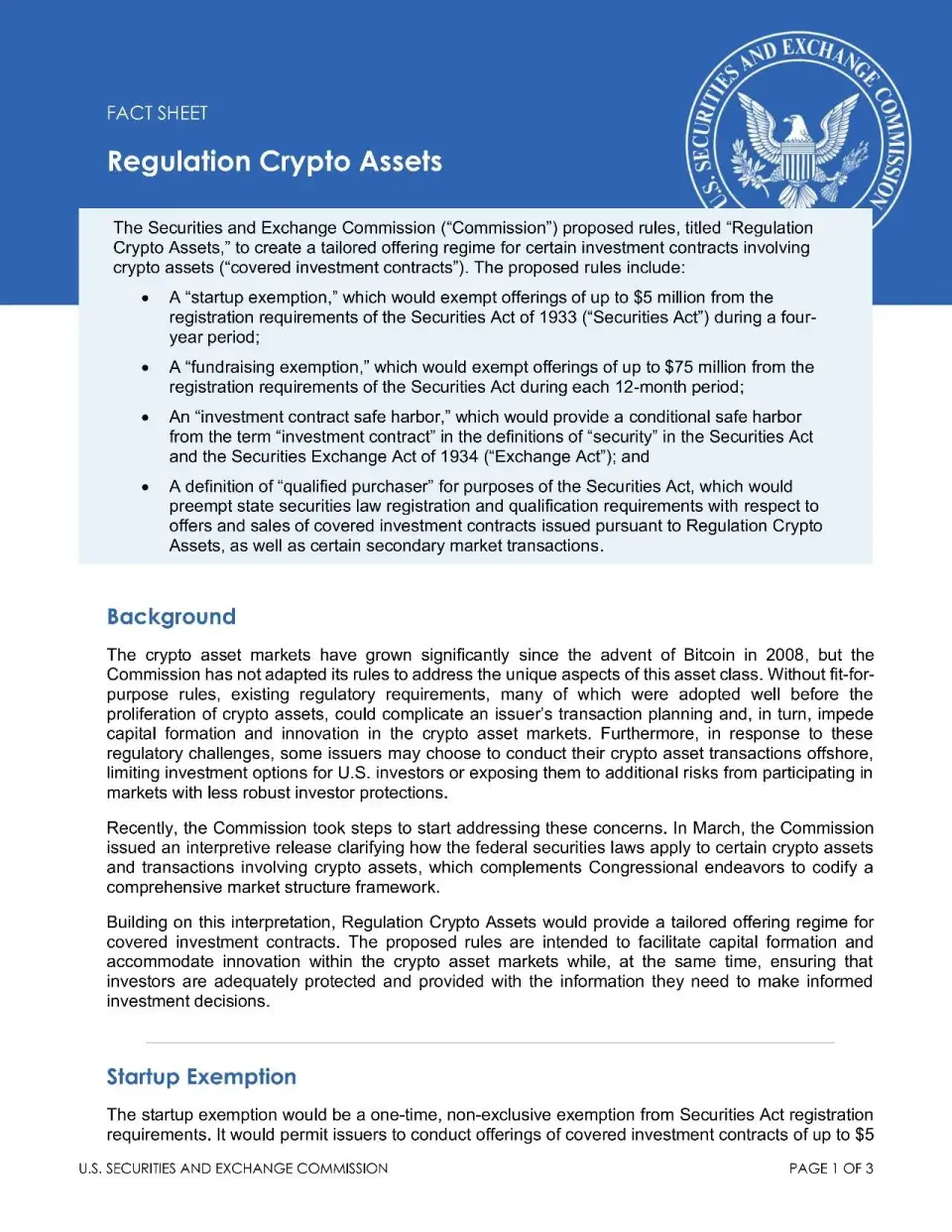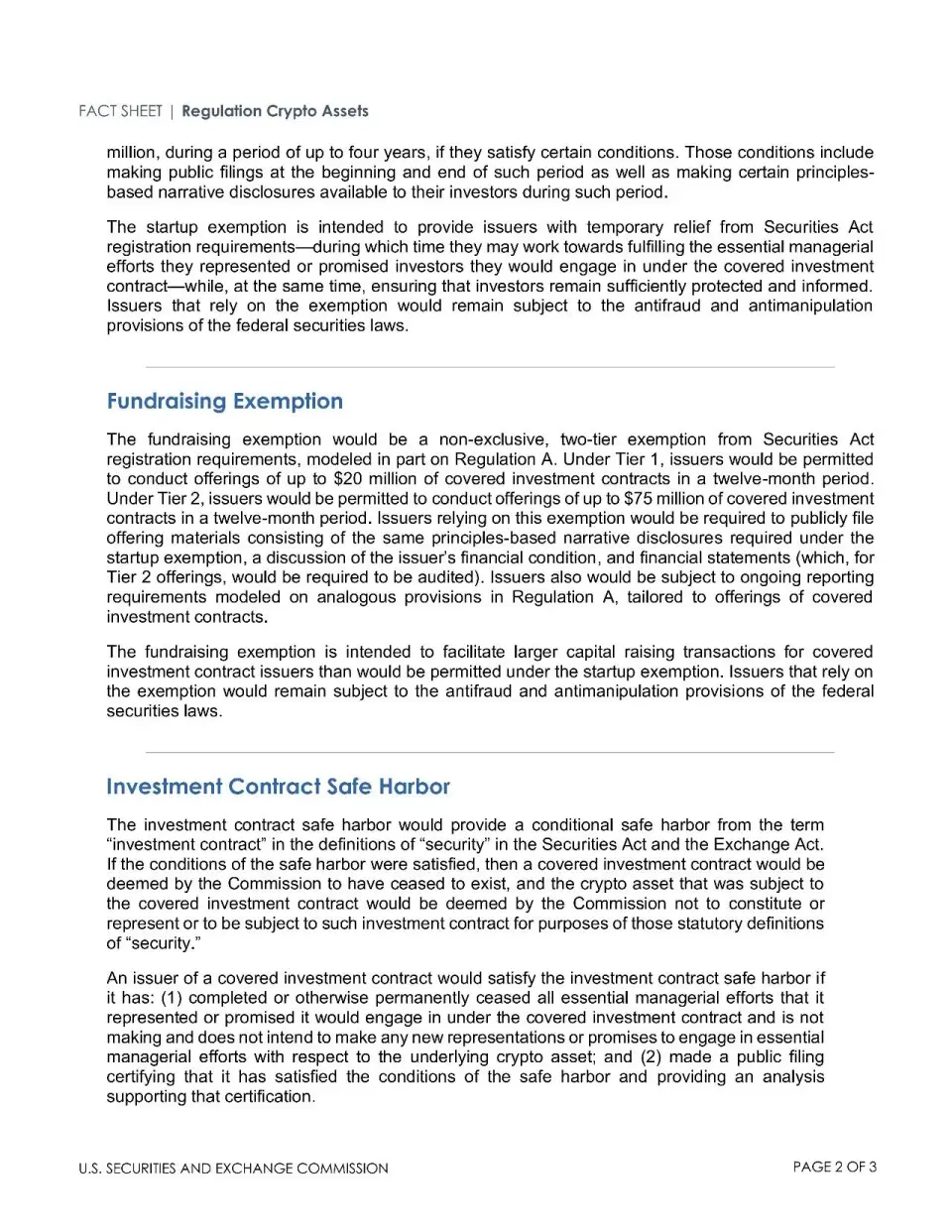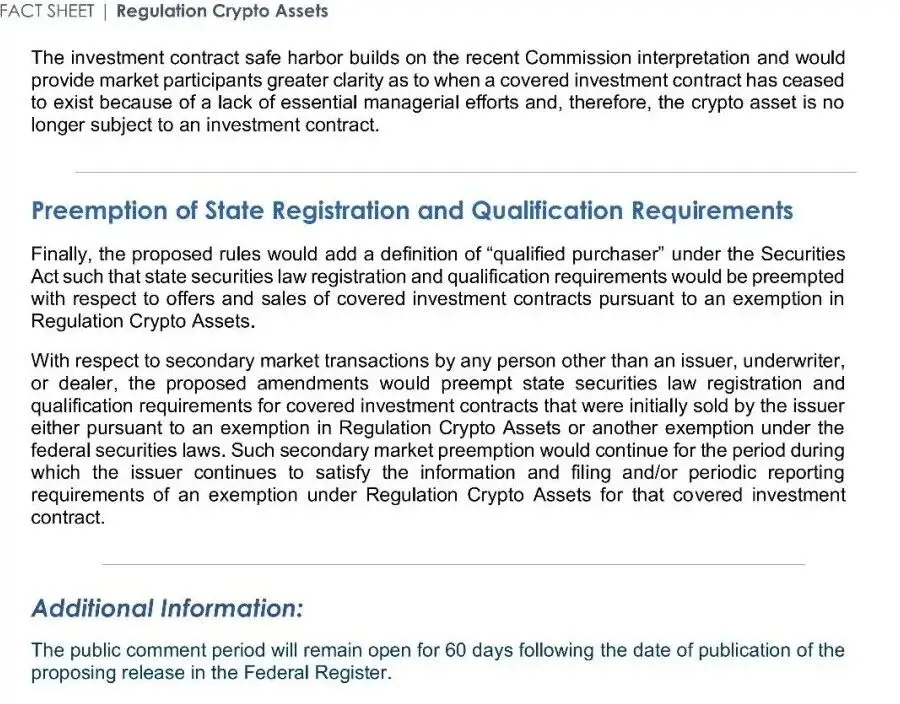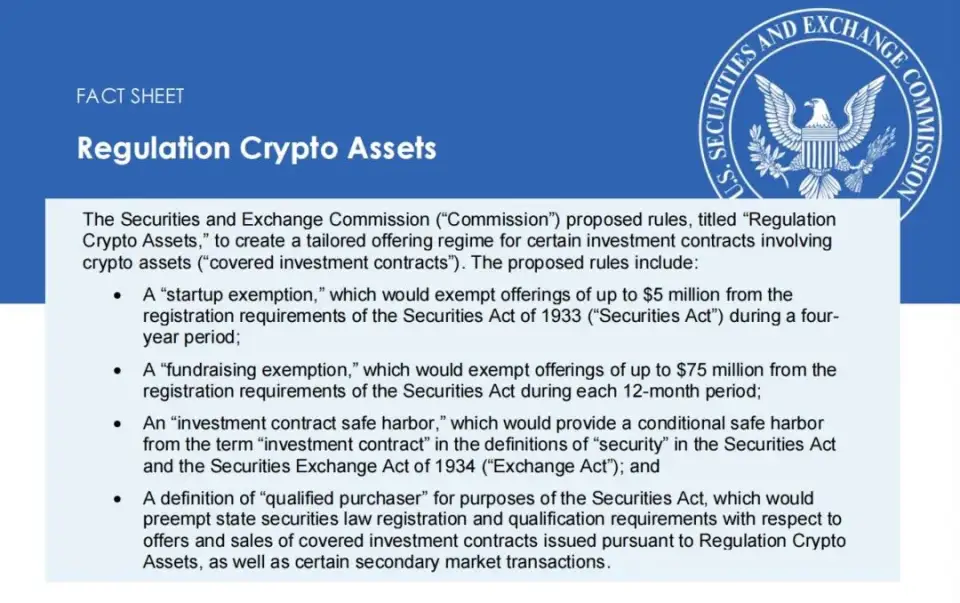
On August 18, 2026, the U.S. Securities and Exchange Commission (SEC) proposed a new framework titled "Regulation Crypto Assets."This is the SEC's most significant attempt to date to establish clear, tailored rules for crypto projects raising funds within the United States.
The proposal builds on interpretive guidance the SEC issued in March of this year (guidance jointly issued by the SEC and the CFTC that distinguishes tokens into different categories and recognizes that most crypto assets are not themselves securities). This vote came several days later than originally scheduled—a meeting previously scheduled for the prior week was cancelled. The SEC has now opened a 60-day public comment period, after which it can move toward a final rule. As things stand, this is merely a proposal.
I. Key Rules Under the Proposal
The core of the framework is three offering mechanisms, plus a state-law preemption provision:
•"Startup exemption"——Early-stage projects may raise up to USD 5 million over a four-year period while being mutually exempt from full Securities Act registration, provided they make public filings at the beginning and end of the period and provide plain-English narrative disclosure on an ongoing basis during the period.
• "Fundraising exemption"——A two-tier regime modeled on Regulation A: up to USD 20 million in Tier 1 and up to USD 75 million in Tier 2 during any 12-month period; disclosure requirements are more substantial, and Tier 2 requires audited financial statements and ongoing reporting obligations.
• "Investment contract safe harbor"——The most novel element. Once an issuer demonstrates that it has completed or permanently ceased the promised "essential managerial efforts," the token can effectively "graduate" out of securities regulation; at that point, the underlying crypto asset is deemed no longer subject to an investment contract.
• State-law preemption——The newly added “qualified purchaser” definition would prevent states from imposing separate registration and qualification requirements on such offerings and certain secondary market transactions.
It should be noted that fraud liability is not exempted—any issuer relying on the above exemptions remains subject to the anti-fraud and anti-manipulation provisions of federal securities laws.
II. What This Means for Businesses Involving Crypto Assets
First, the scope of application must be clarified.“Businesses involving crypto assets” is a broad category—token issuers, exchanges and trading venues, brokers and intermediaries, custody and wallet service providers, stablecoin issuers, miners and staking services, asset managers, and infrastructure providers, among others. However, this proposal targets only one of these categories:issuers of “covered investment contracts”—that is, token projects that raise funds through token issuance and whose investors rely on the efforts of the founding team. It does not directly regulate crypto exchanges, broker-dealers, custodians, or stablecoin issuers—the latter are governed respectively by the SEC’s 2026 companion rules (broker amendments and trading venue/ATS rules) or by separate frameworks (such as the stablecoin regime). Therefore, for any client, the first question is which category it falls into: token issuers need to plan around the Regulation Crypto Assets, while exchanges or custodians should focus on the corresponding companion rules.
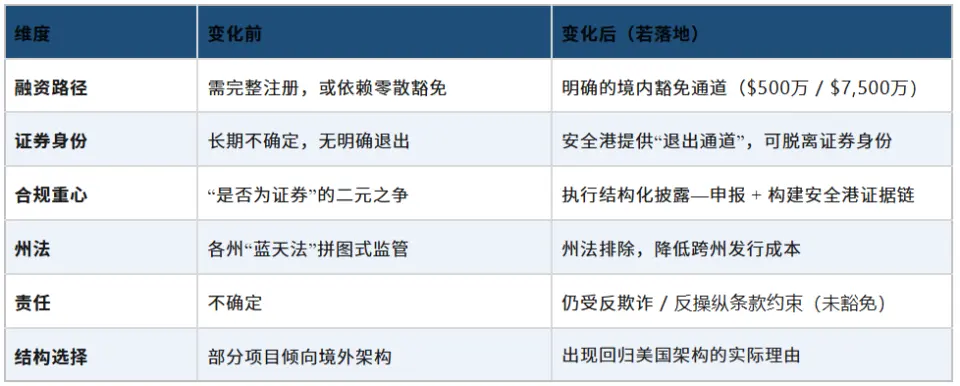
For issuers, this is a genuinely viable domestic financing path that avoids the cost and delay of full registration; moreover, it provides for the first time a clear “exit pathway” that allows issuers to shed securities status rather than remain in prolonged uncertainty. In practice, the focus of compliance work will shift from the binary determination of “whether we are a security” to implementing a structured disclosure and filing regime and building a defensible evidentiary chain for safe harbor certification (recording when and how core managerial efforts gradually recede). The state-law preemption provision eliminates the “blue sky law” patchwork regulation that has long made interstate offerings costly, and gives projects currently opting for offshore offering structures a practical reason to reconsider returning to the United States. The cost lies in: substantive filing obligations, principles-based disclosure, and a continuing anti-fraud exposure—this is “light-touch regulation,” not “zero regulation.”
Table 1 · Scope of Application: Which Crypto Businesses Are Directly Regulated by This Proposal
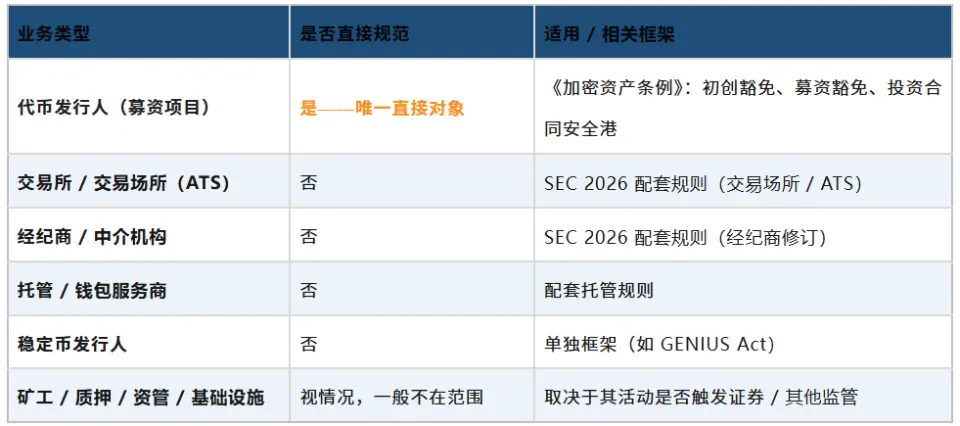
Table 2 · Practical Impact on Token Issuers (If the Proposal Is Adopted)
III. Relationship with the CLARITY Act
The relationship between the “Regulation Crypto Assets” and the CLARITY Act should be understood as two complementary paths rather than substitutes for each other:
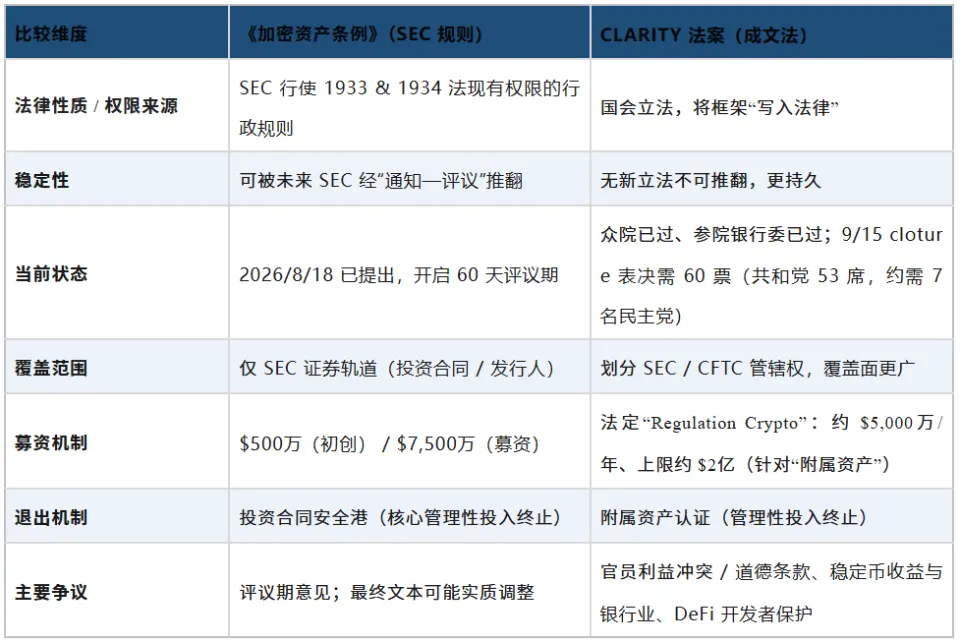
•Rules versus legislation (different sources of authority).The Crypto Asset Regulation is the SEC exercising its existing authority under the 1933 and 1934 Acts; the Digital Asset Market Clarity Act (H.R. 3633) is legislation—a statute that "writes the framework into law." Chair Atkins has expressly stated that legislation is "indispensable" to durable, forward-looking rules that cannot be readily overturned by a future Commission. Rules can be overturned by a future SEC through the notice-and-comment process; a statute cannot, absent new legislation.
•The SEC did not wait for Congress.The prevailing view is that this rule is the first of several rulemakings the SEC will undertake to provide regulatory certainty after the Senate failed to advance CLARITY before the August recess. In substance, the Crypto Asset Regulation is the "administrative version" of what the capital-formation chapter of CLARITY is intended to achieve through legislation—with the bill stalled, the SEC is building the mechanism first.
•Overlapping mechanisms, but different figures.The Senate Banking Committee version of CLARITY itself contemplates a statutory "Regulation Crypto" exemption for "ancillary assets," with separately specified thresholds (roughly the greater of approximately US$50 million per year over a four-year period and 10% of outstanding value, capped at approximately US$200 million), and its own certification that managerial efforts have ceased. Thus its concepts—limited exemption for issuances, disclosure obligations, and an exit mechanism upon cessation of managerial efforts—are highly consistent with the SEC's, but the specific thresholds and definitions differ from the SEC's US$5 million/US$75 million rule. If CLARITY is enacted, the SEC may need to harmonize its rule with the statute.
•The allocation of jurisdiction is the larger divergence.CLARITY would divide regulatory authority between the SEC and the CFTC, making the CFTC the primary regulator of mature "digital commodities." The SEC's rule, by contrast, operates only within its own securities track (investment contracts). Once CLARITY is enacted, it would reshape "who regulates what," potentially moving certain assets entirely outside the SEC's jurisdiction—something rules alone cannot achieve.
•Current progress of CLARITY.The Senate entered the August recess without a floor vote; Majority Leader Thune filed a cloture motion on the motion to proceed, with a procedural vote requiring 60 votes scheduled for September 15. Republicans hold 53 seats, so roughly seven Democratic senators' support is needed. The points of contention remain: ethics/conflict-of-interest restrictions on federal officials' crypto holdings, stablecoin yield and banking issues, and DeFi developer protections. Given the limited working days before the October election recess, if the cloture vote fails, enactment could effectively be pushed to 2027.
In short: if CLARITY is enacted, it will provide a durable statutory skeleton and an SEC/CFTC division of jurisdiction, and the SEC rule will be harmonized with it. If CLARITY stalls, the Crypto Asset Regulation will become the de facto framework for compliant token financing—operational as of now.
Table 3 · Core comparison: SEC rule vs. CLARITY Act (complementary, not substitutive)
IV. How It Would Reshape the Industry If Adopted
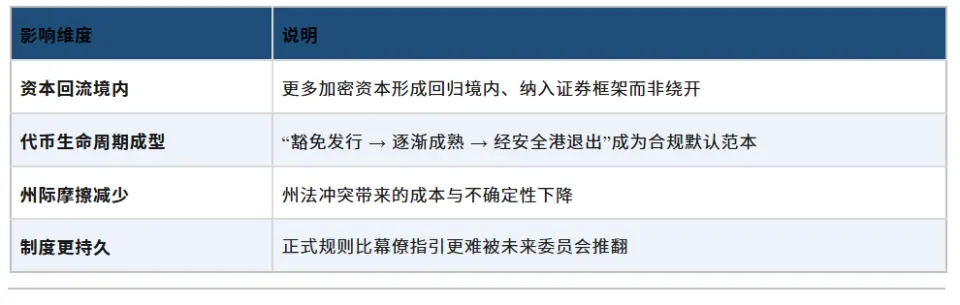
If adopted in a form close to the current version, the possible impacts include: (1) more crypto capital formation returning onshore and being brought within the securities framework rather than bypassing it; (2) a workable token lifecycle—issued under an exemption, gradually maturing, and then exiting securities regulation through a safe harbor—becoming the default model for compliant issuance; (3) reduced friction from conflicts among state rules; and (4) because formal rules are harder for future commissions to overturn than staff guidance, a more stable and predictable regime than the enforcement-driven approach of prior years.
Table 4 · If Adopted: Four Ways It Would Reshape the Industry
Note:This article remains at the proposal stage; the final text may change substantively after comment; its long-term stability depends on whether Congress acts. This memorandum is provided for general informational reference only and does not constitute legal advice.
SEC Proposes First Major Rulebook for Crypto Fundraising
On August 18, 2026, the SEC — the agency that oversees U.S. investment markets — proposed a new set of rules for crypto called “Regulation Crypto Assets.” In plain terms, it is the SEC’s biggest effort yet to give crypto projects a clear, legal way to raise money in the U.S. It builds on March 2026 guidance (issued with the CFTC) that most crypto tokens are not, by themselves, “securities.” This is only a proposal: the public has 60 days to comment before it can become final.
What the proposal does
At its core, it creates three ways for a project to raise money, plus one rule that stops states from piling on:
●Startup exemption — raise up to $5M over four years without full, costly registration; in return, file a few public notices and keep investors updated in plain language.
●Fundraising exemption — for bigger raises, up to $20M or up to $75M in a year, with more disclosure; the larger tier needs audited financials and regular reports.
●Investment-contract safe harbor — the novel part: once the founding team finishes (or permanently stops) its promised work, the token “graduates” and is no longer treated as a security.
●State preemption — a new “qualified purchaser” definition stops individual states from adding their own sign-up rules — one national path instead of fifty.
None of this excuses fraud: a project using any exemption is still fully liable if it misleads investors.
Who it covers
The proposal targets only token projects that create and sell a token to raise money. It does not directly cover exchanges, brokers, custody/wallet services, or stablecoin issuers — those fall under the SEC’s other 2026 rules (still coming) or separate laws such as the GENIUS Act for stablecoins. The first question for any client is simply: which group are you in?
SEC rule vs. the CLARITY Act — complementary, not rivals
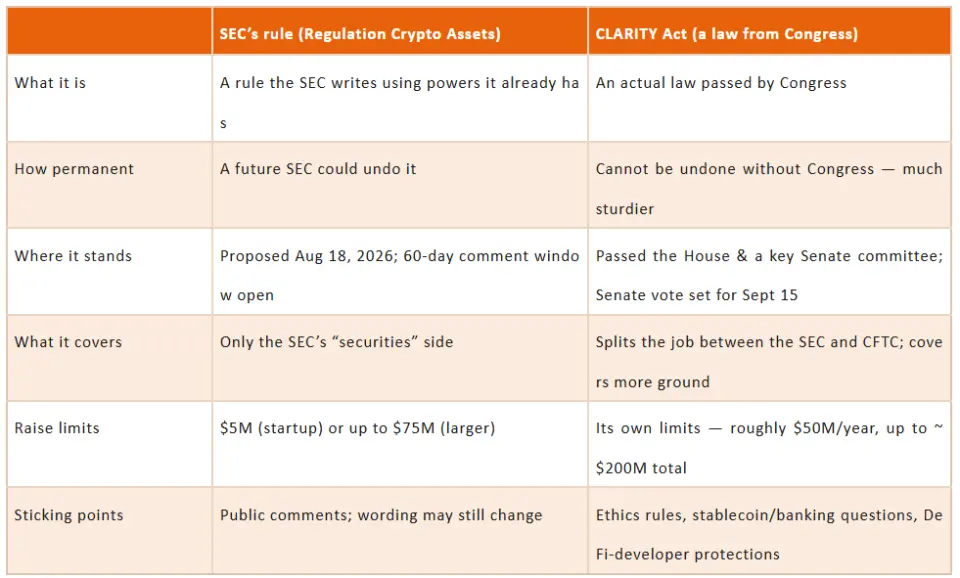
Why it matters
If adopted close to its current form, four things are likely to change: (1) more crypto stays in the U.S., raising money onshore and inside the law; (2) tokens get a repeatable life cycle — start under an exemption, grow, then “graduate” out of securities rules; (3) fewer state-by-state headaches, thanks to one national path; and (4) steadier rules, since a formal rule is harder to reverse than informal guidance.
Keep in mind: This is still a proposal; the final wording may change after public comments, and how lasting it proves depends partly on whether Congress passes the CLARITY Act. This note is general information, not legal advice.For further inquiry or legal compliance, please contact: Joanna.fan@mankunlaw.com.