

The new rules released by the SEC this time not only directly respond to the long-standing difficulty of applying the Howey Test that has plagued the Web3 industry, but also establish, in a highly groundbreaking manner, a 'dynamic unbundling' exit mechanism for token attributes, and draw clear safe harbors for core on-chain interactions such as protocol mining, staking and asset wrapping.
On March 17, 2026, the U.S. Securities and Exchange Commission (SEC) finally took a historically significant step in the field of crypto asset regulation:
On that day, SEC Chairman Paul S. Atkins delivered a speech at the Washington Blockchain Summit. In response to the industry's long-standing demand for regulatory clarity, Atkins stated explicitly in his speech that the era in which the SEC failed to provide clear guidance had ended. He then formally announced at the summit that the SEC is implementing a new framework for token classification and the interpretation of investment contracts. At the same time,the SEC officially released the interpretive document 'Application of the Federal Securities Laws to Certain Types of Crypto Assets and Related Transactions.' The release of this document marks that the SEC's regulatory approach in the crypto asset field will undergo a fundamental change.
In this regard, this official account will publish a series of articles interpreting the above new rules.
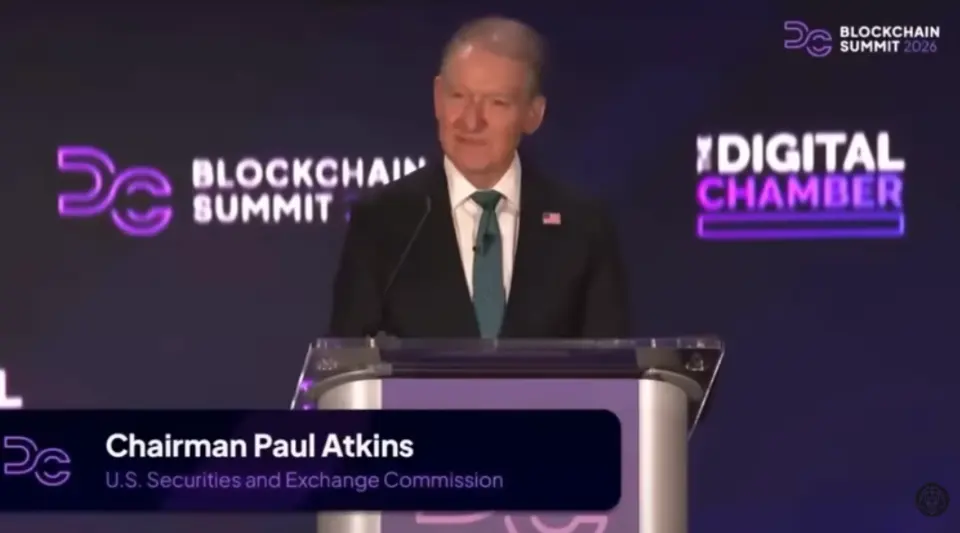
In his speech, Atkins joked that 'We are not the Securities and Everything Commission, anymore.'
1. Determination of an 'investment contract'
In the U.S. federal Securities Act of 1933, 'security' is a broad statutory concept. In addition to expressly enumerated traditional financial products such as stocks and bonds, legislators also establishedthe 'investment contract'as a catch-all provision to regulate transactions that are non-traditional but substantively possess financing attributes. However, the statute does not provide a specific definition of 'investment contract.'
In 1946, the U.S. Supreme Court filled this gap when it heard SEC v. W.J. Howey Co. In that case, the Howey Company sold Florida citrus grove land to investors and provided accompanying grove cultivation services. In its judgment, the Supreme Court held that this transaction model of 'land sale + service contract' was in essence an 'investment contract' subject to legal regulation. Marked by this case,the U.S. Supreme Court established the famous 'Howey test,' which is the legal standard for determining whether a transaction constitutes an 'investment contract' and is therefore legally characterized as a 'security' and subject to U.S. SEC regulation.
Under the Howey Test, a transaction or schememust simultaneously satisfy the following four elementsbefore it will be characterized as an investment contract (i.e., a security):
1. Investment of money: The investor contributes funds or other forms of substantive consideration.
2. In a common enterprise: The investors' funds are pooled together, and their profits and losses are closely tied to the fate of the project promoter or other investors.
3. Reasonable expectation of profits: The core motivation for the investor's participation in the transaction is to obtain a financial return, rather than for consumption or direct use of a product.
4. Derived from the efforts of others: The returns expected by the investor depend entirely or substantially on the core operations and management of the project team, management, or a third party.
2. The Howey Test and the "friction" with the Web3 industry
However, the Howey Test, which originated nearly eighty years ago against an agricultural economic backdrop, has given rise to pronounced incompatibilities in legal application when applied to crypto asset projects, and has continued over the years to constitute a core compliance obstacle for the Web3 industry.
Among these, the most prominent contradiction lies inthe conflict between "efforts of others" and the path of "decentralization"Specifically, the vast majority of crypto projects inevitably rely in their early stages on the building and promotion efforts of a core development team, but as the mainnet evolves and community governance matures, the network will gradually transition toward decentralization. However,the Howey Test is a static standard; it lacks a clear "exit mechanism" or temporal threshold to define when a token can shed its "security" attributes as the network decentralizesIn addition, because crypto tokens often possess the dual characteristics of "expectation of investment profit" and "network utility function," the element of "reasonable expectation of profits" is highly prone to ambiguity in actual adjudication.
The above-mentioned high degree of uncertainty in legal application has caused the U.S. SEC to rely for a long time on an enforcement model of "regulation through penalties" in conducting industry governanceThis not only plunges project parties into the quagmire of litigation over unlawful securities offerings at every turn and substantially drives up compliance costs, but also, to a large extent, creates a chilling effect that suppresses innovation in token economic models and lawful liquidity in secondary markets.
3. The SEC's New Rules and Their Objectives
In order to break the above-mentioned regulatory deadlock of "regulation through penalties" and respond to the crypto asset industry's long-standing demand for clear compliance boundaries, the U.S. SEC officially released on March 17, 2026 a landmark interpretive release, namely the Application of the Federal Securities Laws to Certain Types of Crypto Assets and Certain Transactions Involving Crypto Assets.
The background to the issuance of this document stems precisely from the enormous friction in legal application generated over the past decade or more when regulators mechanically applied the static "Howey Test" to dynamic, decentralized crypto networks.In order to remedy this framework-level defect, the SEC this time seeks to systematically resolve three core issues:
First, establish a clear asset classification system.For the first time, in the form of a formal interpretation, the document sets out clear categories for crypto assets and draws the baseline boundary between "securities" and "non-securities" under the federal securities law framework.
Second, establish a dynamic "binding and unbinding" mechanism.The document clarifies the conditions under which a non-security category of crypto asset will be "bound" as an investment contract by virtue of the promoter's commitments, and for the first time provides a clear "exit mechanism", namely how, as network functionality improves or the degree of decentralization increases, a token may shed the constraints of an investment contract and thereby cease to be subject to securities regulation.
Third, eliminate a series of blind spots in the legal characterization of specific on-chain transaction behaviors.The document provides targeted guidance on the application of securities law to specific transaction models that are widespread in the industry, such as protocol staking, airdrops and wrapped tokens.
4. Establishment of crypto asset classification standards
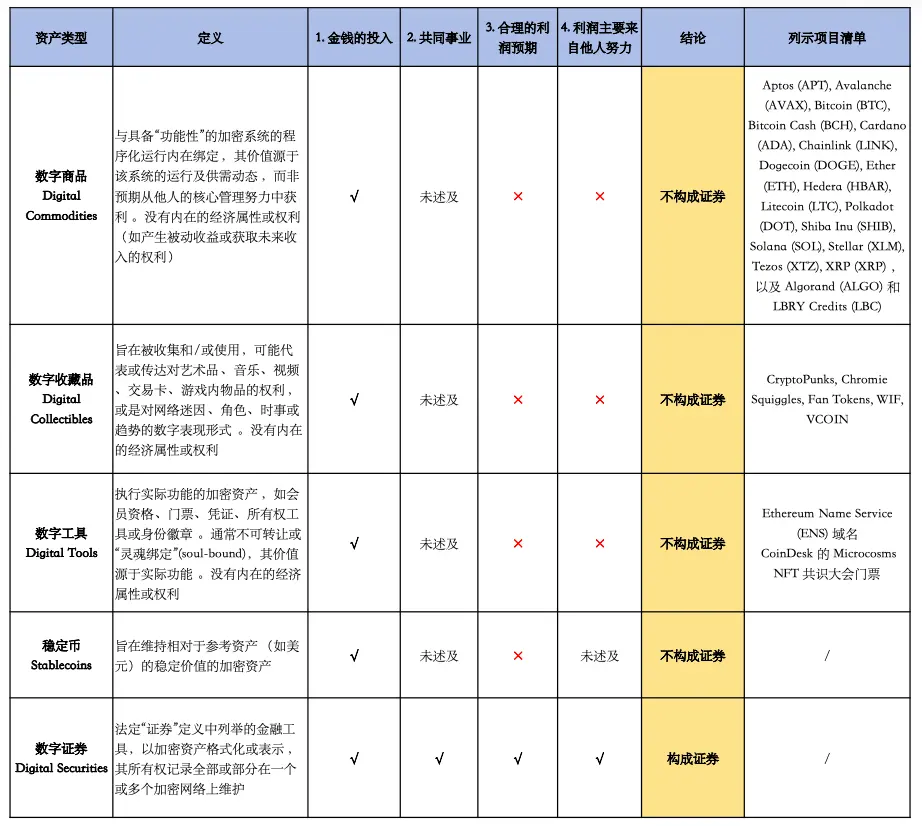
In this release, the SEC divides crypto assets into five major types: digital commodities, digital collectibles, digital tools, stablecoins and digital securities, and, closely following the four elements of the Howey test, determines separately whether each constitutes a security, with corresponding examples of crypto projects listed (see the table below):
(Click to view the full-size image)
(1)Regarding "digital commodities": the SEC expressly excludes "digital commodities" from the scope of securities, the core legal rationale being that such assets cannot satisfy the "profits derived primarily from the efforts of others" element under the Howey test. Specifically, the SEC considers digital commodities to be "an indispensable part" of participating in or maintaining the operation of the relevant system, with their value deriving from the programmatic operation of the underlying functional system and the market's "supply and demand dynamics", rather than from the commercial operations of any centralized entity.Because the system "has no central party to oversee participation or distribute rewards to users" and instead relies on preset code and economic mechanisms to incentivize voluntary user collaboration, the SEC considers that "given that digital commodities are associated with a functional crypto system, purchasers would not reasonably expect to profit based on the essential managerial efforts of others."
(2)Regarding "digital collectibles": the SEC considers that such assets are usually acquired for "artistic, entertainment, social and cultural purposes", and that the purchase "is not an investment in any business enterprise or other entity, promisor or obligor associated with the creator of the digital collectible". Under the Howey test framework, the value of digital collectibles is based primarily on "supply and demand relationships" and depends on their "theme, popularity or scarcity", rather than on an expectation that the creator will "undertake any essential managerial efforts to obtain profits".Therefore, because they lack reliance on the essential managerial efforts of others and a reasonable expectation of profits, they do not satisfy the elements of an investment contract.
However, the SEC also clarified the exceptions under the Howey test: if the offering and sale of digital collectibles involves a "fractional ownership" model, because such a mechanism "may involve essential managerial efforts from which purchasers could reasonably expect to derive profits," it then satisfies the relevant elements and may therefore "be offered and sold as an investment contract."
(3)Regarding "digital tools": the SEC considers that, from the perspective of the Howey test, digital tools directly negate the two key elements of "a reasonable expectation of profits" and "reliance on the efforts of others." The SEC considers that people acquire such assets purely "for their functional utility, and do not have any rights or interests in a business enterprise or other entity, promisor, or obligor." Therefore, even if digital tools can be resold on the secondary market, their price is "based on their functional utility, rather than on an expectation of profits from any essential managerial efforts of their developers."Furthermore, although the developer's activities may affect their value, creators typically "do not make any representations or promises that they will undertake essential managerial efforts from which purchasers could reasonably expect to derive profits." Therefore, because of the complete absence of investment motive and reliance on the essential managerial efforts of third parties, digital tools are expressly excluded from securities regulation.
(4)Regarding "stablecoins": the SEC considers that "payment stablecoins" regulated under the GENIUS Act are designed in their core use "as a means of payment or settlement," and that issuers are obligated to maintain their "stable value relative to the value of a fixed amount of monetary currency." To sever their connection with investment contracts entirely, the law strictly "prohibits the payment of any form of interest or yield to permitted stablecoin holders solely by reason of their holding, using, or retaining payment stablecoins." This design, which structurally deprives them of financial returns, directly negates purchasers' expectation of profits under the Howey test; therefore, after the Act takes effect, such crypto assets will "clearly not constitute securities.".
(5)Regarding "digital securities": the SEC expressly states that "a security is a security regardless of whether it is issued or represented off-chain or on-chain,"and that "all devices and instruments possessing the economic characteristics of a security are securities, regardless of their format or label." From the perspective of the elements of the Howey test, some digital securities may not directly confer off-chain legal rights, but they authorize holders to obtain economic distributions from the central party that manages the entity. In such cases,purchasers are in substance "investing in a business enterprise or other entity, promisor, or obligor operated by the central party, and expecting to receive such distributions from that central party," which perfectly matches the statutory elements of investing money in a common enterprise with an expectation of profits derived from the essential managerial efforts of others.In addition, the SEC specifically notes that even if digital securities, like digital commodities or tools, "provide holders with non-economic benefits," they "will not be excluded from the definition of 'security' merely because they provide such non-economic benefits."
5. The milestone significance of the establishment of crypto asset classification standards
In earlier years, SEC officials hinted on multiple public occasions that almost all cryptocurrencies created through ICOs or token generation were securities, and that only a very few, such as Bitcoin, were regarded as commodities. At the same time, in prior enforcement activities, the SEC often, intentionally or not, conflated "the underlying code/asset of the token itself" with "the project party's financing and sales conduct." The above circumstances have led the market to form a fearful perception over many years, namely thata token carries "original sin as a security" merely by being createdThe above circumstances once placed the entire Web3 industry in a state of extreme compliance uncertainty.
In this interpretive release, however, the SEC, by establishing a positive list, for the first time expressly identified 18 mainstream tokens as digital commodities. Through this classification approach and its explanation, the SEC expressly acknowledged that a large number of crypto assets in fact lack inherent financial-return characteristics, thereby excluding them from the scope of securities-law regulation and greatly narrowing the SEC's room for over-enforcement.More importantly, the new rules substantively implement the understanding that "a token is merely code," emphasizing that crypto assets such as digital commodities and digital collectibles do not themselves possess the economic characteristics of securities, and that a so-called "investment contract" in fact exists only in specific issuance and marketing contexts, thereby ending the fallacy that "a token is itself an investment contract.".
The original article was first published on the WeChat public account "Crypto Meridian"; author: Su Zitao (lawyer).