According to news reports, on November 3, Pan Gongsheng, Governor of the People's Bank of China, entrusted by the State Council, reported on the financial work since October 2025 to the 25th session of the Standing Committee of the 14th National People's Congress. The report, as usual, covered monetary policy, financial reform and risk resolution, but one passage concerning virtual currencies and real-world assets (RWA) requires a word-by-word reading:
Improve the regulatory policy framework for virtual currencies, strengthen the analysis of leads concerning underground banks involving virtual currencies, improve the mechanism for full-chain, routine rectification of virtual currency "mining," and strengthen regulation of the tokenization of real-world assets (RWA).
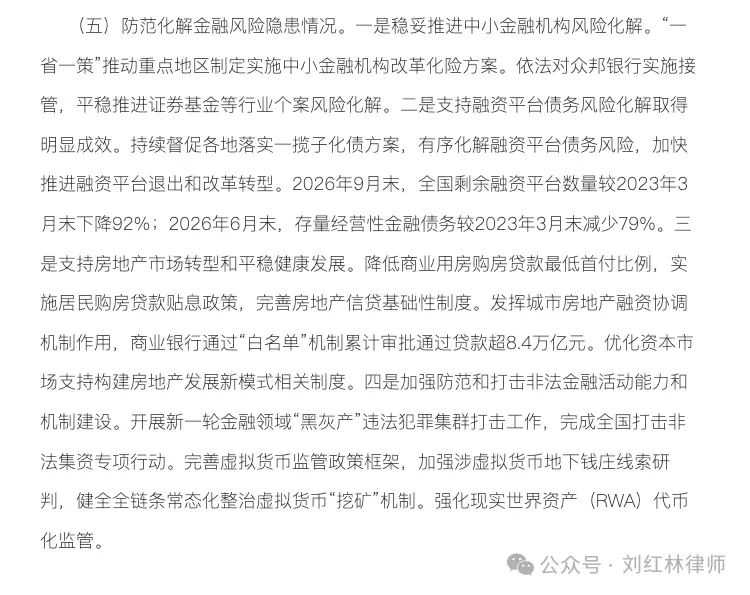
"Report of the State Council on Financial Work," republished from a release by the People's Bank of China
RWA (Real World Assets) refers to the business model of mapping real-world assets such as real estate, bonds and carbon assets onto the blockchain for issuance and circulation; over the past few years it has been a term treated with considerable caution in regulatory wording.
Now that it has been written into the State Council's financial work report, the market has two readings: some read it as tightening, believing that regulation will be stepped up again; others read it in the opposite direction, wondering whether inclusion in such a formal document signals that rules will be established and a path provided.
Both readings may have missed the same layer of fact—what has really changed this time is who regulates RWA and how it is regulated.
First, where this passage appears.
In the first part of the report, "Main Progress and Results of Financial Work," there is a section entitled "Preventing and Resolving Hidden Financial Risks," and this passage appears within it; in the same paragraph are the cluster crackdown on illegal and gray-market criminal activities in the financial sector and the nationwide special campaign against illegal fundraising, and the subheading for this item is "Strengthening Capacity and Mechanism Building for Preventing and Combating Illegal Financial Activities."
The location of the section is itself a regulatory classification: RWA has been placed among the risks of illegal financial activities to be prevented and combated, and has not entered the agenda of financial innovation and opening-up.
How RWA entered the regulator's routine
This is not the first time RWA has been named by regulators. In February this year, the People's Bank of China and seven other departments jointly issued the "Notice on Further Preventing and Addressing Risks Relating to Virtual Currencies and Other Matters" (Yin Fa [2026] No. 42), which for the first time listed RWA tokenization alongside virtual currencies as an object of risk resolution; in its report on implementing the deliberative opinions, the State Council summarized this approach as "strictly prohibited domestically, strictly regulated abroad."
At the enforcement level: the names and business scopes of enterprises and individual industrial and commercial households may no longer contain words such as "RWA" or "real-world asset tokenization"; internet platforms may not provide business premises, display, marketing or traffic direction for related business; and financial institutions and payment institutions may not provide account opening, fund transfer or clearing and settlement services.
That notice addressed the problem of "blocking" by shutting down domestic business channels one by one.
What changed in the November report is that real-world assets (RWA), along with the analysis of leads on illegal payment-settlement schemes and the full-chain rectification of mining, were written into the State Council's annual work report to the National People's Congress, and moreover in the section summarizing the work of the past year—for regulators, this is already day-to-day work being carried out.
In other words, RWA is no longer merely a new term appearing in a particular special notice; it has been incorporated into the regular agenda of financial regulation. Constraints on this type of business will no longer require a dedicated document to give notice; routine regulatory and enforcement actions will cover it.
Is technical service no longer merely neutral?
The practical impact of this change on practitioners lies in regulatory attribution.
Over the past year or so, many clients have come to ask about RWA, and the structures are mostly similar: the underlying assets are real estate, debt claims, carbon assets or equipment revenue rights, wrapped in a layer of technical services or on-chain data structures, with the issuance and fundraising stages given different labels, in an attempt to define the whole matter as a technical business or a data business and circumvent financial regulation.
Such packaging was already strained after Circular No. 42, and this report has removed the remaining room for imagination.
For issuance, trading and settlement after assets are put on-chain, regulatory attribution is clearly within the financial framework, and the criteria return to the most basic questions: where the money comes from, where it flows, who promises returns, and to whom the promotion is directed. No matter how elaborate the structure, as long as these questions point to public fundraising and return promises, the claim that "we only provide technology" will not help.
There is another detail in the report that is easy to overlook:Strengthen the analysis of leads on illegal payment-settlement schemes involving virtual currencies.
This sentence targets channels for the return of funds. Some teams place issuance offshore and believe that an offshore structure isolates them from domestic regulation, but as long as promotion is directed at domestic users and returns flow back into the mainland through exchange channels, they fall squarely within this line.
Strict offshore regulation is not about the place of registration; it is about where the users are and how the money flows.
In the same report, there is another statement that should be read in conjunction with it. In the section on "Financial Reform and Opening Up," placed alongside the Cross-Border Payment Connect, RMB swap arrangements, and panda bonds, is this sentence: the positioning of the digital renminbi is to shift smoothly from cash to deposit money.
One appears under "Preventing and Combating Illegal Financial Activities," and the other under "Financial Reform and Opening Up." The placement of the sections itself reflects the regulator's classification of the two on-chain pathways.
This shift was completed earlier this year. Pan Gongsheng publicly confirmed it at the Annual Conference of the Financial Street Forum in October. Its inclusion in this report means that it has moved from a pilot arrangement to an established framework.
This matter appears unrelated to real-world assets (RWA), but it is in fact the other side of the same chessboard.
The original positioning of the digital renminbi was as a digital substitute for cash, bearing no interest and not entering the credit creation system, with small-value payments as its primary use. After the shift to deposit money, the digital renminbi of bank-type operating institutions is brought under deposit reserve management, real-name wallet balances may bear interest, and commercial banks may incorporate it into full-scenario business covering deposits, lending, remittances, and investment.
The Digital RMB International Operations Center is already exploring the on-chain issuance, registration, custody, and fund settlement of assets such as bills, trade finance instruments, and carbon emission rights—precisely the application stories that the real-world assets (RWA) industry has repeatedly told over the past few years.
Looking at the two lines together, the direction becomes relatively clear: the regulator has not denied the matter of putting assets on-chain itself. The domestic prohibition targets spontaneous, public-facing tokenized issuance by private parties; what the digital renminbi system is building is an officially recognized on-chain asset track.
For private real-world assets (RWA), this is a two-way squeeze—prohibitive enforcement on one side and substitution by official infrastructure on the other. The judgment that the regulator will first block and then release, reopening a window for private issuance, finds no basis at least in this report.
How should real-world assets (RWA) business teams view this?
For teams currently engaged in or preparing to engage in real-world assets (RWA)-related business, Lawyer Honglin's judgment has three layers.
For domestic business, do not continue to package issuance and fundraising activities under the guise of technical services or putting data on-chain. The regulator has clearly treated such business as financial activity; packaging only increases the cost of explanation afterward and does not change its characterization.
For overseas issuance, first understand clearly how it is regulated. Article 14 of Document No. 42 sets out a regulated path: tokenized business conducted overseas that is based on the ownership or income rights of domestic assets and that is akin to asset securitization or has an equity nature shall, in accordance with the principles of "same business, same risk, same rules," be strictly regulated by the National Development and Reform Commission, the China Securities Regulatory Commission, and the State Administration of Foreign Exchange according to their respective duties and divisions of responsibility; the regulatory guidelines issued by the China Securities Regulatory Commission in tandem on the same day require that domestic enterprises controlling the underlying assets first file with the China Securities Regulatory Commission, and that intermediary institutions providing services also obtain approval or file reports. In other words, it is not that overseas routes are impermissible; they must follow the filing path. Bypassing this path, promoting to domestic users, and channeling returns back through exchange channels fall precisely on the line of clues for underground money house analysis—a structure built overseas has never been a safety cushion.
In terms of pace, there is no need to panic, but planning should be done according to the direction. The report currently consists of policy statements and does not yet have supporting specific rules or effective dates, so existing business operations do not need to adjust their processes immediately on this basis. However, if your business model is built on the assumption that 'regulators will sooner or later open up domestic tokenized issuance,' this report indicates that this assumption does not hold within the foreseeable cycle. The positions where opportunities genuinely remain are in the segments that do not touch funds or issuance: technical services, compliance tools, custody and audit, data services, and directions that connect to official channels.
Summary
The story of real-world assets (RWA) is not over; only the narrative authority has changed hands. Over the past few years, the industry has been accustomed to framing tokenization as a technological transformation of the financial system; the answer given by this report is that, within China's framework, putting assets on-chain either follows a regulator-recognized track or there is no track at all.