AI summaryChoosing a reliable exchange is crucial.This article is an original work by Mankun Law Firm. It represents only the personal views of the author and does not constitute legal consultation or legal advice on specific matters.…
Choosing a reliable exchange is crucial.
Special Disclaimer:
This article is an original work by Mankun Law Firm. It represents only the personal views of the author and does not constitute legal consultation or legal advice on specific matters. For permission to reprint this article, please contact Mankun Law Firm staff at: MankunLawFirm
Is Another Exchange About to Collapse?
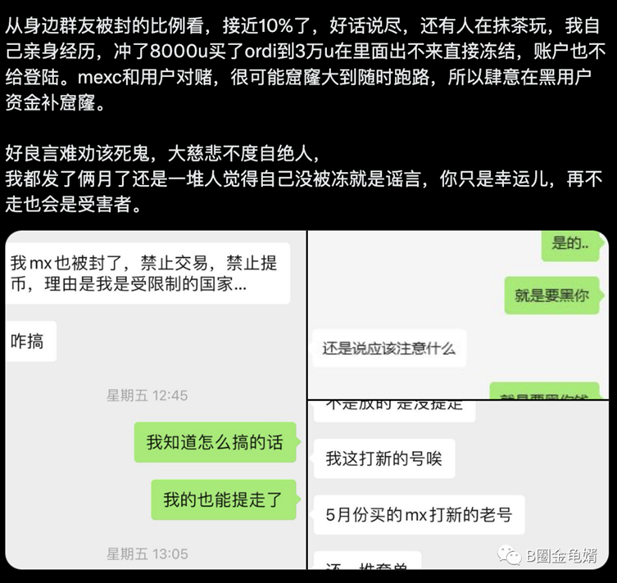
Recently, news broke online that "a certain 'Tea' exchange has suspended withdrawals and absconded with funds," drawing significant attention. A key opinion leader (KOL) on X (formerly Twitter) stated that after depositing funds intoMEXC(i.e., the "Tea" exchange), they were unable to withdraw funds or execute trades. After negotiations with the platform's officials, the "Tea" exchange cited the reason as "the user's IP address being located in a country/region restricted by the Tea exchange." Meanwhile, an increasing number of users have come forward alleging that their accounts on the "Tea" exchange have been frozen, preventing them from accessing their funds.
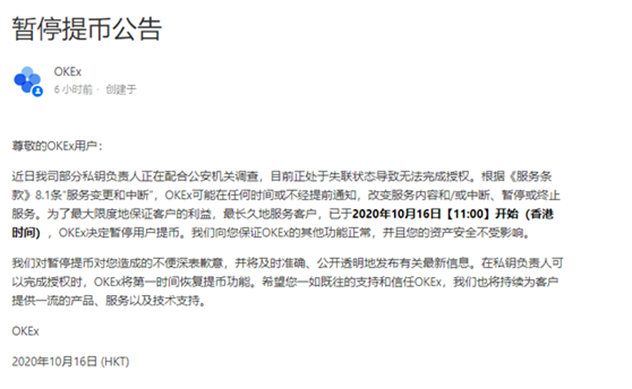
In 2020, the OKEx platform issued an announcement suspending withdrawals.
Image source: Securities Times Network
Consequently, the issue of fund security on virtual currency exchanges has once again become a major concern for users: Could my account be frozen by the platform without cause? Are the funds in my exchange account secure? Could the platform abscond with user funds due to a broken capital chain?...
In mainland China, due to requirements for financial security regulation and other factors, as early as September 2021, ten departments including the People's Bank of China issued a statement declaring that business activities related to virtual currencies constitute illegal financial activities. Subsequently, major virtual currency exchanges withdrew from mainland China and offboarded mainland Chinese users. This means that under these circumstances, when mainland users engage in trading activities on exchanges through various methods, and given that these exchanges are not located within mainland China, it becomes extremely difficult for users to seek legal recourse if situations such as the exchange absconding with funds or suffering cyberattacks occur.
By reviewing a series of reports on the "unexpected closure" of virtual currency exchanges in recent years, we can gain insight into the concerns prevalent among users of these platforms:
-
In September 2023, netizens reported that the MIIX exchange had "shut down its website and absconded with funds." Users alleged that the platform committed fraud under the guise of offering USDT rewards for deposits, resulting in losses for multiple victims;
-
In September 2023, users of the Hong Kong-based cryptocurrency trading platform JPEX reported an inability to withdraw fiat currency ("cash out"). The Hong Kong Police Force stated that the case involved "conspiracy to defraud" and has intervened in the investigation.
-
In 2019, the unexpected death of the founder of the Canadian virtual currency exchange QuadrigaCX resulted in the loss of access to private keys. This locked the funds of a large number of users, causing thousands of users to lose control over their assets, which triggered widespread attention and investigations.
-
In 2018, Coincheck, one of Japan's largest cryptocurrency exchanges, suffered a severe hacking incident that caused losses totaling up to USD 400 million for users. During this period, user trading and withdrawals were suspended.
-
In 2014, Mt. Gox, once one of the world's largest Bitcoin trading platforms, declared bankruptcy. The platform claimed that a hacker attack led to the theft of a large quantity of Bitcoin, causing significant losses for numerous users.
Reasons for Inability to Withdraw Funds
Given the unique nature of the underlying technology of virtual currencies and the strict regulatory environment surrounding them, there are various reasons why users may be unable to withdraw funds from virtual currency exchanges. Broadly speaking, these include the following categories.
For example, some large virtual currency exchanges, due to their vast user base, may experience server overload caused by a surge in transaction volume within a specific timeframe, leading to an inability to process withdrawals. Additionally, certain special mechanisms may apply; for instance, after a user performs specific security operations, the system may "technically" suspend the withdrawal function for a period (e.g., 24 or 48 hours) for security reasons. Upon expiration of this period, the function automatically resumes.
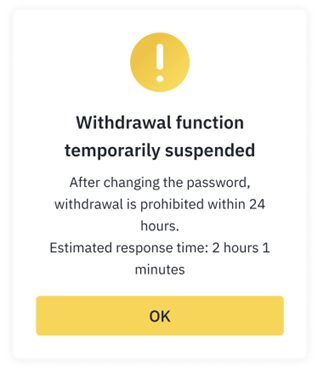
(Due to special mechanisms, Binance suspended the withdrawal function)
If the inability to withdraw is caused by such reasons, there is generally no need for excessive concern. The function will typically resume once the platform resolves the technical issues or the "technical" suspension period ends.
Virtual currencies, based on decentralized blockchain technology, possess anonymity, making it extremely difficult to trace the flow of funds. Consequently, they often become targets for unlawful cyberattacks. For example, in 2020, the Singapore-based cryptocurrency exchange KuCoin disclosed a large-scale hacking attack resulting in losses exceeding USD 150 million. If users encounter an inability to withdraw due to such reasons, they should promptly contact the exchange, monitor exchange announcements, preserve relevant evidence, and actively seek legal assistance.
3. Suspected Illegal or Criminal Activities
A virtual currency exchange may be implicated in money laundering, fraud, or other illegal trading activities conducted through its platform by the platform itself or its key personnel, thereby constituting criminal offenses. Subsequent police intervention may lead to the freezing of the platform and user accounts, preventing withdrawals. For example, in October 2020, the virtual currency exchange OKEx temporarily froze its withdrawal services after its actual controller, Xu Mingxing, was arrested for suspected cross-border money laundering. During this period, users were unable to extract digital assets. This measure was taken to assist in the ongoing investigation and ensure the legitimacy of user assets. Subsequently, OKEx unfroze the withdrawal services and announced a series of measures to enhance the platform's security and compliance.
 If users encounter such situations, they should promptly follow the platform's announcements and monitor the progress of investigations by public security organs, taking further action depending on the severity of the platform's involvement in the case.
4. Platform "Absconding with Funds"
This is the scenario that causes users the greatest concern. Currently, due to insufficient actual regulation of virtual currencies and their trading, this concern is particularly pronounced. Investors' trust in a platform often depends on its operational transparency and compliance. Regulatory loopholes may allow irresponsible platforms the opportunity to escape liability while carrying away user funds. In the absence of robust regulation, user anxiety regarding platforms absconding with funds has become a severe issue in the field of virtual currency trading. The recent "Tea Exchange Crisis" is a prime example of this situation.
If users encounter such situations, they should promptly follow the platform's announcements and monitor the progress of investigations by public security organs, taking further action depending on the severity of the platform's involvement in the case.
4. Platform "Absconding with Funds"
This is the scenario that causes users the greatest concern. Currently, due to insufficient actual regulation of virtual currencies and their trading, this concern is particularly pronounced. Investors' trust in a platform often depends on its operational transparency and compliance. Regulatory loopholes may allow irresponsible platforms the opportunity to escape liability while carrying away user funds. In the absence of robust regulation, user anxiety regarding platforms absconding with funds has become a severe issue in the field of virtual currency trading. The recent "Tea Exchange Crisis" is a prime example of this situation.
Recommendations from Mankun Lawyers
1. Identify the Root Cause of the Problem.In the event of an inability to withdraw funds, investors should first ascertain the specific cause of the problem, whether it stems from technical failures, compliance issues, or other factors. This helps provide a basis for subsequent legal recourse.
2. Actively Collect Evidence.Users should meticulously record and preserve communication logs with the exchange, transaction records, and other relevant documentation to provide sufficient evidentiary support during the rights protection process.
3. Seek Legal Assistance.When facing issues with withdrawing funds from a virtual currency exchange, users should seek assistance from professional lawyers. Lawyers can provide appropriate legal advice based on the specific circumstances and assist investors in protecting their rights. If the platform is found to be involved in illegal activities, users may choose to report the case to Chinese public security authorities and assist law enforcement agencies in their investigations.
4. Strengthen Risk Prevention.When selecting a virtual currency exchange, users should heighten their risk prevention awareness. They should strive to trade on licensed exchanges with good industry reputations and robust compliance systems, while regularly monitoring changes in regulatory policies. Most importantly, it is advisable to store large amounts of virtual assets in personal cold wallets.

To submit articles or request permission for reprinting, please add WeChat ID: MankunLawFirm