AI summaryAn acquaintance introduces a currency exchange, and the "intermediary" is unexpectedly convicted as a principal offender and sentenced to eight years — is this unjust?
An acquaintance introduces a currency exchange, yet the 'middleman' is unexpectedly convicted as the principal offender and sentenced to eight years—is this an unjust outcome?
Special statement: This article is an original article by Attorney Shao Shiwei and represents only the personal views of the author. It does not constitute legal consultation or legal advice on any specific matter. To repost the article, seek legal consultation, or engage in peer exchange, please add: sswls66.
A child studying abroad calls their parents to say they need a large amount of foreign currency;
A boss abroad asks the finance staff of the domestic office to transfer funds urgently because he has an urgent overseas project to invest in;
A client asks a bank account manager whether the bank can help find a way, because the funds the client is handling are relatively large and the bank cannot approve them;
Doing business overseas has earned a lot of US dollars, and the person wants to exchange them into RMB, but there is a quota limit;
Under the relevant provisions of our country, any organization or individual engaging in foreign exchange trading or foreign exchange settlement business within the territory of our country must obtain permission from the State foreign exchange administration department and conduct the business at designated venues. For some individuals or enterprises, the limits on foreign exchange quotas and the related approval requirements may make it impossible for their demands to be met, or to be met in the short term.
At this point, what will this group of people with urgent large-sum foreign exchange needs do? Of course, they will ask around for people 'with connections.' It is said that in this world, any person can be connected to any otherperson through five or six people acting as intermediate links.
Therefore, for anyone, it is not difficult to find someone who can help them exchange foreign currency through unconventional means. In the figure above, how does client 1, who has a foreign exchange need, find foreign exchange boss 6? The middlemen 2, 3, 4, and 5 are all introducers.
Client 1 does not need to painstakingly search offline in various ways and communicate face to face to raise the demand; it is enough to send a voice message and push a WeChat contact card, and the matter is settled. What remains is simply to pay, transfer the money, receive the money, cooperate happily, and come back if satisfied
Statement of the issue:
Currency-exchange brokers are generally underground banking operators. Underground banks use foreign-exchange "matched trades" to help clients move funds across borders, which constitutes the crime of illegal business operations; there is little dispute on this point. The question, then, is:does an intermediary who brokers an introduction commit the crime of illegal business operations? If so, is the intermediary a principal offender or an accessory??
01
Does the [introducer] commit the crime of illegal business operations?
Here we introduce a case whose legal relationships are highly complex and which involves numerous individuals (the judgment runs over 20,000 Chinese characters).【Case number:(2016) Hu 0115 Xing Chu No. 4154]For ease of description, we will for nowsimplify the facts as follows::

Bao needed to exchange currency and approached his cousin Wang A; Wang A asked his colleague Ge whether Ge knew anyone, and Ge introduced Sun; Sun introduced Ma, who could provide currency-exchange services, and CAD equivalent to RMB 40 million was exchanged. (Does this not perfectly confirm that through no more than six people you can find the person you are looking for?) )
A, B and C above are all introducers; Bao and Ma are the actual buyer and seller in the currency-purchase service.
Next, in light of the legal provisions, let us consider whether A, B and C, as intermediaries who introduced the buying and selling of foreign exchange, commit the crime of illegal business operations.
2008 Regulations of the People's Republic of China on Foreign Exchange Administration
Article 45 Buying and sellingforeign exchange without authorization,disguised trading inforeign exchange,profiteering by buying and resellingforeign exchange, orillegally introducingothers to buy or sell foreign exchange, where the amount is relatively large, shall be given a warning by the foreign exchange administration authority, have the illegal gains confiscated, and be fined not more than 30% of the illegal amount; where the circumstances are serious, a fine of not less than 30% of the illegal amount and not more than an equivalent amount shall be imposed; where the act constitutes a crime, criminal liability shall be pursued in accordance with law.
2019 Interpretation of the Supreme People's Court and the Supreme People's Procuratorate on Several Issues Concerning the Application of Law in Handling Criminal Cases of Illegally Engaging in Fund Payment and Settlement Business and Illegally Buying and Selling Foreign Exchange
Article 2: Whoever, in violation of State regulations, carries outprofiteering by buying and resellingforeign exchange ordisguised trading inforeign exchange or other illegal foreign exchange trading activities, disrupting the order of the financial market, and where the circumstances are serious,shall be convicted and punished for the crime of illegal business operations in accordance with the provisions of Article 225, Item 4 of the Criminal Law.
The 2008 Foreign Exchange Administration Regulations are relatively early and provided for four types of illegal trading: unauthorized trading, disguised trading, buying and selling for profit, and illegal brokering. Where any of these four types of conduct exists, the foreign exchange administration authority shall impose administrative penalties.
In the 2019 judicial interpretation, only two types, namely buying and selling for profit and disguised trading, are characterized as criminal conduct.
It therefore appears that illegal brokering of trading should be regulated only by administrative penalties?
Sun in this case was also a woman with considerable experience: in 2001 she was sentenced to seven months' imprisonment for the crime of illegal business operations, in 2009 she was sentenced to one year's imprisonment for the crime of illegal business operations, and in 2012 she was sentenced to one year and six months' imprisonment for the crime of illegal business operations. Because on the previous occasions she had been sentenced for directly participating in foreign exchange trading,a third term of imprisonmentafter her release she was very careful, and after carefully reading the statutory provisions she continued to engage in business related to foreign exchange trading, butonly brokered and did not participateUnfortunately, Ms. Sun's understanding of the statutory provisions was not thorough.
It is not only the parties involved; even some lawyers are not able to thoroughly understand this provision. Here, another case is inserted for reference [Case No.: (2012) Pu Xing Chu Zi No. 4796]:
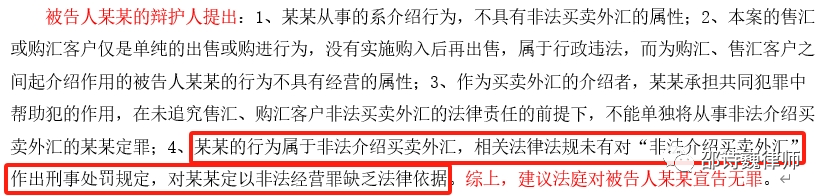
The final court judgment is as follows:

Note 1:A not-guilty defense should be handled with caution. Sometimes, in light of the facts of the case, the charges, and the evidence in the case file,a defense of lesser culpability may achieve a better defense outcome;
Note 2: Both of the above cases occurred before the 2019 judicial interpretation was issued, but this does not affect the analysis, because the 2019 judicial interpretation likewise does not expressly provide that illegally introducing foreign exchange trading constitutes the crime of illegal business operation.
02
Can conduct still constitute a crime where the law has no express provision?
1. The legal basis is quite vague, but it cannot be said to be entirely absent!
Article 45 of the 2008 Foreign Exchange Administration Regulations left a catch-all clause: "if a crime is constituted, criminal liability shall be pursued in accordance with law." Article 2 of the 2019 judicial interpretation also mentions "...and other illegal foreign exchange trading conduct" to be handled as the crime of illegal business operation. These catch-all formulations are precisely the basis for determining whether introducing trading conduct constitutes a crime.
Why is introducing others to trade foreign exchange not expressly provided as criminal conductWhat about it?
In practice, there may be various scenarios: Is the introducer making an introduction for the buyer or for the seller? Or is the introducer acting as an intermediary for both sides? If the introduction is for the buyer, is the buyer purchasing purely for personal use, or is the buyer in fact an illegal foreign-exchange broker? Is the introducer helping purely on a pro bono basis, or is the introducer being paid? Is the introducer taking money from both sides or only from one side? In addition, if an offense is constituted, the charge must be distinguished according to the different scenarios: Is it a case of imaginative concurrence of offenses or cumulative punishment for multiple offenses?【Therefore, I advise those seeking consultation not to ask the lawyer right away: How many years will I be sentenced to? Because legal issues are truly complex...】
The various complex scenarios described above can be summarized simply and bluntly into two points (Attorney Shao hopes that friends who are considering acting as introducers for foreign exchange will read them carefully and memorize them!):
1) If the buyer purchases purely for personal use (for example, for daily expenses while studying overseas), and the introducer also helps free of charge, thenthe introducer does not constitute an offense(However, the buyer and the introducer may be subject to administrative penalties; but if the buyer says it is for personal use, is it really for personal use? Why would the other party tell you the truth?)
2) In all scenarios other than the above, there is suspicion ofthe crime of illegal business operations(It is only a question of distinguishing between minor and serious offenses based on status and role in the transaction, etc.)
2. The "business operation" conduct in the crime of illegal business operations
Whether the actor has a profit-making purpose is one of the key points in determining whether the crime of illegal business operations is constitutedIf the actor has long been engaged in this introduction business rather than doing so only occasionally, and obtains profit from it, it is very easy to characterize the conduct as business operation.
In addition, let us look at the entire transaction chain illustrated in the first case above. Bao found Xiao Ma through A, B, and C; both parties dealt through intermediaries and completed the collection of RMB within China and the payment of foreign currency outside China. Without the intermediaries, the transaction between Bao and Xiao Ma could not have been completed.
Under the relevant provisions, the buying and selling of foreign exchange must be conducted at venues designated by the State, but these intermediariesobjectively created a trading platform for those buying and selling foreign exchange(outside the foreign exchange trading venues designated by the State), and therefore they will be found by the judicial authorities to have illegally traded in foreign exchange.
The preceding content mainly addressed, in the case of Sun's suspected crime of illegal business operations,why the intermediaries who brokered the introductions constituted the crime of illegal business operations.Next, I will continue by explaining why Sun is a principal offender rather than an accessory.
03
Cards on the table—no more pretending
Ms. Sun is in fact a well-known Shanghai figure in currency-exchange introductions.
(This diagram was not drawn by me; it was drawn by the police officers in this case.)
From this diagram, Ms. Sun appears to be the ringleader of the scalpers. However,will the ringleader of the scalpers necessarily be found to be a principal offender?After all, having already been imprisoned three times before, Ms. Sun kept firmly in mind that she could only make introductions and could not directly participate in the buying and selling. So why was she still arrested this time? Moreover,in the previous instances, directly participating in foreign-exchange trading also resulted in sentences of only six months to a year—small-scale matters. This time, she merely helped make introductions, yet she was actually sentenced to eight years.!
Underground banks form a circle, and the scalpers form a circle too; naturally, clients seeking currency exchange also have their own circle. Within each circle, everyone must be responsible for their own conduct.
Scalpers, or introducers, may be recognized as accessories (accessories may receive a lighter or reduced punishment), but to seek accessory status, several points should be avoided as far as possible. Let us see what scalpers can learn from Ms. Sun as a "cautionary example":
1. Keep a low profile; it is enough to make a little money
Underground banks are also in the business of earning the spread, just like U merchants. The difference is that U merchants merely earn the spread between buying and selling, whereas this trade, in addition to the interest-rate spread, also charges a separate service fee. Ms. Sun said that generally, for every USD 100 transaction, the underground bank adds an interest-rate charge ranging from RMB 0.20 to RMB 0.60, while the scalpers' commission depends on how they agree with the underground bank.
In Shanghai, these lower-level scalpers all dealt with Ms. Sun, who was a top figure of the Ma family underground bank in Shanghai. Clearly, Ms. Sun was not low-profile at all. Judging from her extensive prison record, she presumably also wanted to build a big enterprise (the secrets of making money are all written in the Criminal Law), so how could her eyes be fixed only on a few scattered coins?
2. Controlling the finances equals status
Just as a boss pays employees their wages, the introduction fees of other intermediaries were arranged and paid by Ms. Sun;
the accounts of the Ma family underground bank were also provided externally by Ms. Sun;
3. Queen of the circle
Although clients with currency-exchange needs approached intermediaries they knew, these intermediaries all dealt uniformly with Ms. Sun. As the diagram shows, Ms. Sun was "the center of the universe."
If one wishes to argue for accessory liability, then one certainly cannot operate on such a high-profile and large scale. Being too conspicuous makes it very difficult not to be treated as a principal offender.
04
Send over a contact card, and congratulations on a three-year sentence with a four-year reprieve.
Who exactly are these underlings of Ms. Sun?
Answer:Bank client managersand the like. In any case, they are all people who have opportunities to get to know big shots.
Still this same image. In the preceding content, the facts of the case have already been introduced: Bao had a need for foreign exchange and approached his cousin Wang A; Wang A asked his colleague Ge whether Ge knew anyone, and Ge introduced Sun; Sun introduced the Ma family, who could provide foreign exchange services, and CAD equivalent to RMB 40 million was exchanged.
The identities of A and B are both client managers at a Shanghai branch of a certain bank.(Do you feel surprised and caught off guard?)
But this is actually normal, because bank staff are the people closest to clients with foreign exchange needs.
( Dedicated image; content sourced from the internet)
Moreover, A and the foreign exchange client Bao are also cousins. A thought that a cousin's matter certainly had to be helped with! So A asked colleague B whether B had any resources, and B merely recommended Ms. Sun,But in this single transaction alone, B made a net profit of RMB 40,000.。This was only one transaction; the judgment also records many people and many transactions. What these introducers had to domay have been nothing more than forwarding a WeChat contact card, just like B, and then waiting to collect an introduction fee(and waiting to be summoned by the public security authorities)and that was all.。
The court held: A (with 11 years of banking experience) and B, as bank employees, were more aware of the State's foreign exchange administration policies than ordinary "scalpers." Outcome: a sentence of three years' imprisonment with a four-year suspension.
05
Other related legal issues
1. Is it safe to exchange currency for others in Hong Kong?
Because Ms. Sun's household registration is in Hong Kong, she also travels back and forth between the mainland and Hong Kong. The Hong Kong region is not subject to foreign exchange controls. If an actor's illegal foreign exchange trading activity, in its entire transaction chain, takes place in Hong Kong, then of course there is no problem. But if it is done by way of "matched trades" (duiqiao), with RMB transactions existing in the mainland, then it breaks through our country's criminal jurisdiction. Under the Criminal Law, if either the act or the result of a crime occurs within the territory of the People's Republic of China, it is deemed to be a crime committed within the territory of the People's Republic of China.
Many friends who trade virtual currencies also ask Lawyer Shao: Can I just go to Hong Kong and do xxx? Truly, no.
2. If I made no profit or extremely little profit, can the punishment be reduced?
Introducing others to exchange currency,If there is no profit, then it depends on whether the other party is using it for personal use or has other illegal purposes. Providing free introductions to persons using it purely for personal use (a regular Good Samaritan) may result in an administrative penalty, but will not involve criminal liability.
If money is received, judicial practice does not look entirely at whether the amount received is large or small; conviction may also be based on the business volume (the total amount of foreign exchange exchanged). For example, in Case No. (2020) Hu 0114 Xing Chu 1598, the intermediary obtained a benefit fee ofseveral thousand yuan,and was sentenced to fixed-term imprisonment oftwo years and two months(while the seller who provided the foreign exchange was sentenced to two years, meaning the intermediary was sentenced more heavily than the seller). From the perspective of the judicial authorities, the intermediary is not a minor-role offender.
06
The Ma Group in this case (Ma Mou in the image) is truly a rather mysterious organization. According to reports, when the police were investigating this case, one "Ma Mou" of this Ma Group had previously appeared in the "Ma" Group "underground bank" case cracked by the Ministry of Public Security many years ago, but at that time slipped through the net due to insufficient evidence.
Ms. Sun, arrested this time, is the Ma Group's representative in Shanghai, but it seems that the Ma Group has still not been apprehended to date. This is not necessarily because Ms. Sun is loyal and refuses to disclose information; the truth is generally that... she probably really does not know. If anyone has leads on the Ma Group, they can provide them to the police.