On August 4, a reader noticed that the copyright information page of Huaxia Publishing House's New Translation of the Huangting Jing and Yinfu Jing bore the following line: "Using the content of this book for artificial intelligence training is prohibited, and violators will be held accountable."
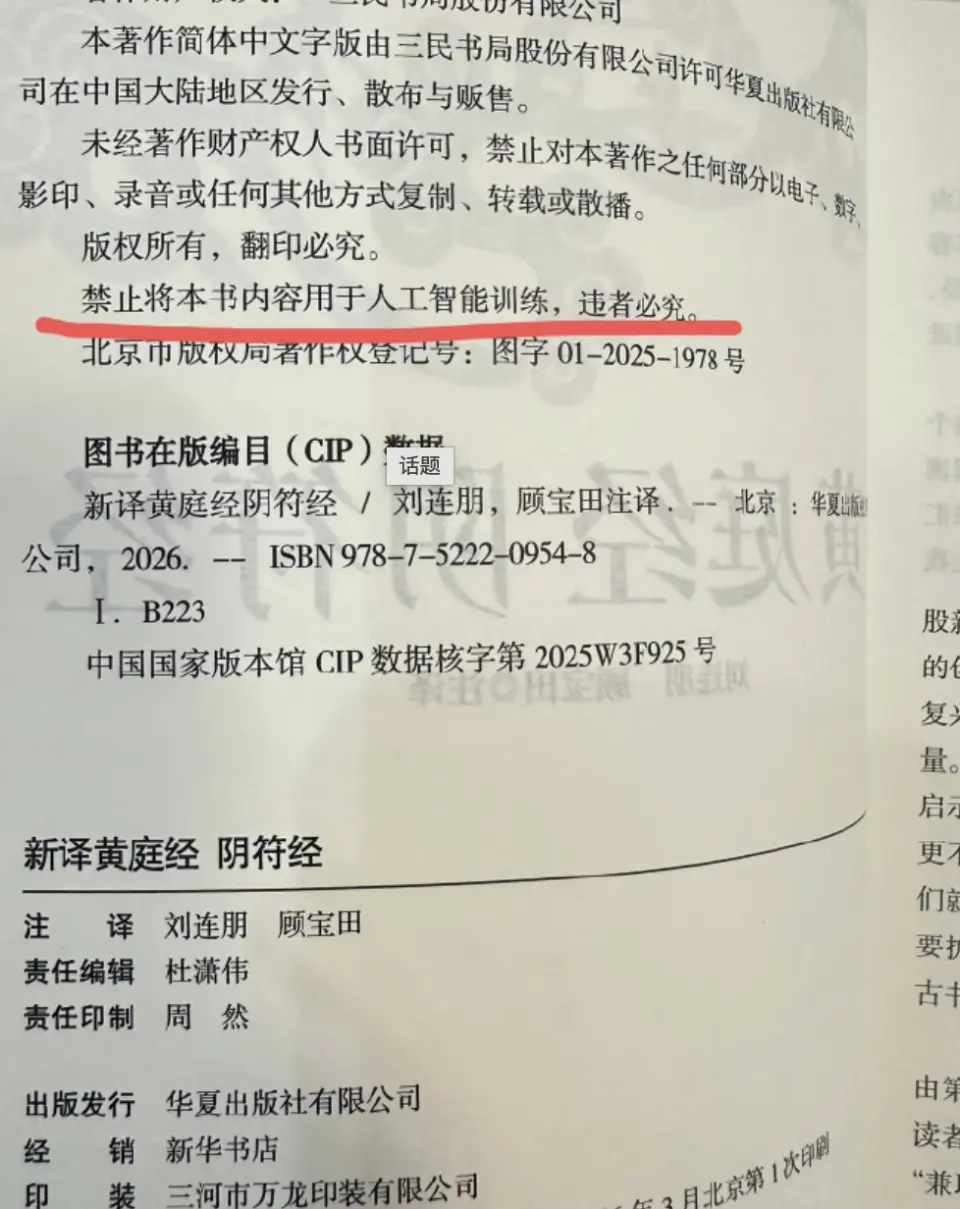
The response of the person in charge at the publishing house is more worth pondering than the line itself. He said that when importing foreign-language books, the rights holders add clauses to the copyright contract prohibiting the book text from being used for artificial intelligence training, and that "as the performing party, we must account to the rights holder, so we print this sentence"; at the same time, he also acknowledged thatif it really is used for training, "it is in practice very difficult to enforce the rights"and that the notice "is mainly a statement of position."
The industry has nicknamed this line a gentleman's agreement. The reasoning sounds solid: websites can deploy robots.txt, but physical books have no technical interception layer, and a line of printed text cannot stop any scanner.
But this judgment actually has some problems; it misidentifies the issue.
If you are building AI products, procuring training corpora, or holding a batch of content assets and considering whether to add a notice, the following points directly determine your next steps: what this sentence gives to whom under Chinese law, exactly which stage it cannot stop, and what still needs to be added for it to become something usable rather than a mere statement of position.
The same sentence, and the difference between China and Europe
First, set the coordinates accurately; otherwise everything that follows will be misjudged.
The EU rule is "usable by default unless reserved." Article 4 of the Digital Single Market Copyright Directive creates an exception for text and data mining for general purposes: reproducing and extracting lawfully accessed works for mining does not constitute infringement, unless the rights holder has expressly reserved the rights in an appropriate manner. So in the EU, a notice is a necessary act for the rights holder; without it, one falls into the exception. European publishers have spent recent years desperately studying how robots.txt, ai.txt, and metadata should be written, and this rule is what has forced them to do so.
China's rule is exactly the opposite: without a notice, the content is not usable in the first place.
Article 24 of China's Copyright Law makes the situations in which one may "neither ask for permission nor pay" into a closed list—twelve categories plus one catch-all—and AI training is not among them. Article 7 of the Interim Measures for the Administration of Generative Artificial Intelligence Services says only that one "shall not infringe upon the intellectual property rights lawfully enjoyed by others," and likewise creates no exception for training.
Article 7: Providers of generative artificial intelligence services (hereinafter referred to as providers) shall lawfully conduct training data processing activities such as pre-training and optimization training, and shall comply with the following provisions:
(1) Use data and foundation models that have lawful sources;
(2) Where intellectual property rights are involved, the intellectual property rights lawfully enjoyed by others shall not be infringed;
(3) Where personal information is involved, the consent of the individual shall be obtained or other circumstances prescribed by laws and administrative regulations shall be met;
(4) Take effective measures to improve the quality of training data and enhance the authenticity, accuracy, objectivity and diversity of training data;
(5) Other relevant provisions of laws and administrative regulations such as the Cybersecurity Law of the People's Republic of China, the Data Security Law of the People's Republic of China and the Personal Information Protection Law of the People's Republic of China, and the relevant regulatory requirements of the competent authorities.
In other words, current Chinese law simply has no channel under which "if you do not opt out, you are deemed to have consented," and a rights holder does not run the risk of losing rights merely by staying silent. To read that line on the copyright page as "the Chinese version of a rights reservation statement" is to measure a Chinese book with a European ruler. In China, it is not a source of the right to prohibit; unauthorized reproduction is infringing in the first place, and the conclusion is the same whether or not this sentence is added.
Incidentally, here is a detail that is widely overlooked. The EU requirement that content be "machine-readable" in fact extends only to online content. Recital 18 of the Directive states clearly:
In the case of content that has been made publicly available online, it should only be considered appropriate to reserve those rights by the use of machine-readable means, including metadata and terms and conditions of a website or a service. Other uses should not be affected by the reservation of rights for the purposes of text and data mining. In other cases, it can be appropriate to reserve the rights by other means, such as contractual agreements or a unilateral declaration.
Put plainly:content already made publicly available onlinecounts only if it is declared in a manner that machines can read;other circumstancesA contractual agreement or a unilateral declaration therefore constitutes an appropriate method. A printed book falls squarely within "other circumstances."
This leads to a conclusion that runs counter to intuition: the line of Chinese text on the copyright page is, in the sense of EU regulation, precisely a unilateral declaration in its standard form, and its legitimacy as a means of reserving rights is more secure than that of a robots.txt that prohibits only a few crawlers.
The DPG Media v. HowardsHome case decided by the Amsterdam District Court of the Netherlands on 30 October 2024 (ECLI:NL:RBAMS:2024:6563) is a counterexample: the robots.txt files of the three media-publisher plaintiffs listed only a few AI crawlers such as GPTBot and ChatGPT, and the court held that this was insufficient to constitute a machine-readable, explicit reservation of rights; the defendant could rely on the general mining exception and did not infringe. An incompletely implemented technical measure is less effective than a clearly worded declaration.
That raises the question. Since in China it is not a source of a right to prohibit, what exactly is this statement there for?
The three things this line of declaration actually does
First, it closes off the fallback of "I thought you consented"。
The most commonly used defense by a party engaged in large-scale collection of corpora is that the source was public, that it was industry practice, and that no objection had ever been seen. The express prohibition on the copyright page closes off that route: every physical copy of this book carries with it a manifestation of an intention to object that can be produced at any time.
Second, it fixes the other party's subjective state as "intentional"。
This is the most valuable point. Article 54, paragraph 1 of the Copyright Law:
Article 54 Where a copyright or a right related to copyright is infringed, the infringer shall pay compensation on the basis of the actual loss suffered by the right holder as a result thereof or the unlawful gains of the infringer; where the actual loss of the right holder or the unlawful gains of the infringer are difficult to calculate, compensation may be given by reference to the royalty for that use. Where copyright or a right related to copyright is intentionally infringed and the circumstances are serious, compensation may be given at not less than one time and not more than five times the amount determined in accordance with the above methods.
Punitive damages require two conditions to be met at the same time: intent, plus serious circumstances. "Intent" is in many cases the hardest element to prove, and the copyright-page declaration happens to be the piece of material that proves it with the least effort.
The cause of this controversy is that AI companies acquired scarce books in large quantities, scanned them with high-speed equipment that cuts off the spines, and pulverized the paper originals after scanning. According to Jiemian News, Anthropic had an internal project codenamed "Project Panama," whose goal was to obtain "all the books in the world"; after shifting to bulk purchases of second-hand physical books, approximately two million paper books were destroyed in the collection process.
The act of destructive scanning has an unavoidable feature:one must first obtain the physical book and feed every page into a scanner, and the copyright page is among the first pages to be turned to.The party obtaining the material cannot claim it did not see it.
Third, giving an account to upstream rights holders.。
Almost no one raised this point in the discussion, but it is the direct reason Huaxia Publishing House printed this line. The publisher put it plainly: the rights holder under the imported-edition contract required this clause to be added, and we are the performing party.
The first-priority reader of that line is not an AI company, but the counterparty to the contract. By following through, the publisher fulfilled its contractual obligation and, should the corpus later leak, is thereby exempted from liability for breach of contract toward upstream; the overseas rights holder simultaneously obtains publicly available evidence usable within China.
With these three things stacked together, this sentence is far from an empty phrase. But the publisher is also not wrong in saying that "enforcement is difficult." Where the difficulty lies must be seen in the next section.
Proof is a difficult problem.
Chinese courts have already made this hurdle clear through three judgments.
The first comes from the Guangzhou Internet Court, (2024) Yue 0192 Min Chu No. 113. The plaintiff was the exclusive licensee of the Ultraman series characters in mainland China and, in addition to claiming infringement by the generated images, requested that the Ultraman material be deleted from the defendant's training dataset. This claim was not supported, on the ground that there was a lack of direct evidence proving that the defendant had actually used the plaintiff's works for training.
This is the core difficulty of the whole matter: what AI outputs you can see, screenshot, and notarize, but what was input lies in the other party's server room, beyond the rights holder's reach.
The second comes from the Shanghai Intellectual Property Court, (2025) Hu 73 Min Zhong No. 1189, pronounced on April 29, 2026, and is the second-instance ruling in China's first AI large-model copyright infringement case. The court made a key clarification regarding the right of reproduction: the right of reproduction is essentially a right of reproduction in the sense of re-presentation; the act of inputting works into a model for training,Infringement of the right of reproduction is constituted only when the model, acting on user instructions, again generates a work that is substantially similar to the copyrighted work input.The reason is that only when the output reproduces the work can others gain access to the work, and only then is the reproduction of the work completed.
The third judgment comes from the Hangzhou Internet Court, (2024) Zhe 0192 Min Chu No. 1587. The court of first instance took a consistent position: using others' works during the training phase is essentially learning and analyzing the expression, linguistic features and style of prior works, is not aimed at reproducing original expression, and does not display the works to the public; absent contrary evidence, it may be regarded as fair use. The same judgment also draws a dividing line: a relatively lenient and accommodating standard of assessment should be adopted for data input and data training, while a relatively strict standard should be adopted for the output of generated content and the use of generated content.
With the three judgments taken together, the location of China's liability gate is clear:It is installed at the output end, not at the input port。
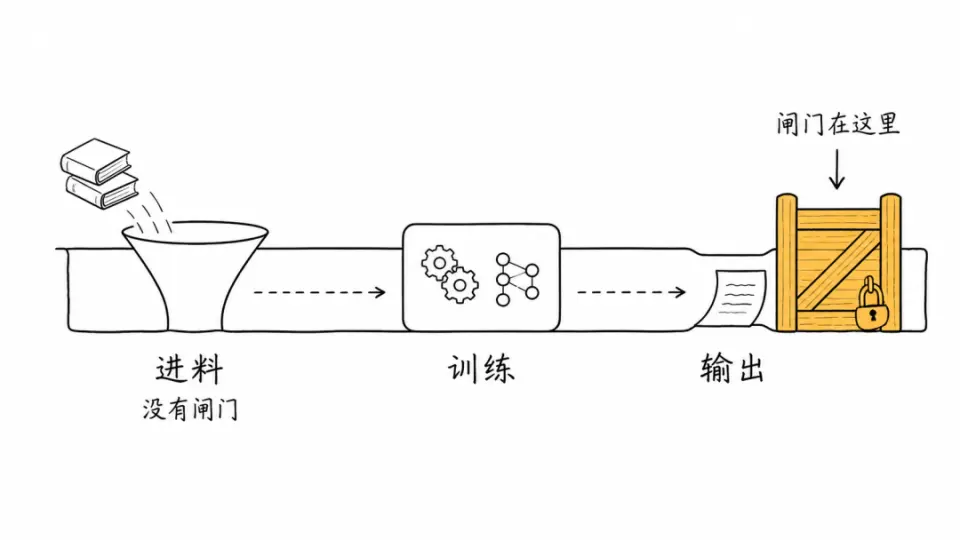
China's liability gate is installed at the output end
For book corpora, this conclusion is quite uncomfortable. What a model learns from an annotated translation of an ancient text is knowledge and a manner of expression; under normal use, it is almost impossible for the model to regurgitate verbatim the original expression of that book. Substantial similarity on the output side is difficult to establish, and on the input side the right holder again cannot produce evidence proving that the other party used the work. This is precisely the accurate meaning of the phrase "very difficult to enforce rights": it is not that the line of text has no legal effect, but that relying on it alone to pursue civil litigation cannot reach either end.
Fill in the gaps from five aspects and turn life into a mechanism
A single statement does not constitute a mechanism; only when five lines are stacked together does it. Each of the following has a clear basis in current law, and publishers and copyright owners can directly match themselves to them.
The contractual line is the most concrete, and it is already in operationIn import contracts, commissioned-writing contracts and digital licensing contracts, write "must not be used for machine learning or artificial intelligence training" as an independent clause, and pair it with a method for calculating liquidated damages and an obligation to cooperate with audits. The key is that the definitions must be separated: pre-training, fine-tuning, and vectorized storage for retrieval-augmented generation are three different modes of use, and writing only "AI training" will leave an interpretive gap in retrieval scenarios. A contract action does not require proving that copyright infringement is established, and it also bypasses the hurdle that "input for training does not necessarily constitute reproduction." The Huaxia Publishing House matter itself is a product of this line.
Under the administrative line, the burden of proof is reversedArticle 19, Paragraph 1 of the Interim Measures:
Article 19: Where the competent authorities conduct supervision and inspection of generative artificial intelligence services in accordance with their duties, providers shall cooperate in accordance with the law, explain the source, scale, type, labeling rules, algorithmic mechanisms and principles of the training data as required, and provide necessary technical, data and other support and assistance.
Where a rights holder reports the matter, the regulatory authorities will require the provider to explain the source of the corpus; if the provider cannot explain clearly, it will face orders to rectify and even suspension of service. The rights holder does not need to prove what the other party used; this is an entirely different logic from civil litigation. For individual authors and small and medium-sized publishers with relatively weak evidentiary capacity, this route is far more cost-effective than litigation.
The technical measures route is only effective for electronic versions, but it provides a basis on which a separate lawsuit can be broughtArticle 49, Paragraph 3 of the Copyright Law:
The term "technical measures" as used in this Law means effective technologies, devices or components used to prevent or restrict the browsing or appreciation of works, performances, sound recordings or video recordings, or the provision of works, performances, sound recordings or video recordings to the public through information networks, without the permission of the rights holder.
Please note the two qualifiers "effective" and "prevent or restrict." Encryption, login walls, paywalls and interface authentication fall within this scope because they genuinely block access. robots.txt and ai.txt most likely do not: they are merely a statement placed in the website's root directory, and crawlers that do not comply can still take all the content; they are a request, not a device. I must make this clear, because many discussions directly treat anti-crawling protocols as technical measures under the Copyright Law, and that position does not hold.
The significance of falling within Article 49 lies in Article 53, Item 6:
(6) without the permission of the copyright owner or a rights holder related to copyright, intentionally avoiding or destroying technical measures, intentionally manufacturing, importing or providing to others devices or components mainly used to avoid or destroy technical measures, or intentionally providing technical services to others to avoid or destroy technical measures, unless otherwise provided by laws or administrative regulations;
The act of bypassing a login wall can itself support a separate case; there is no need first to prove that training constitutes reproduction. The correct approach for publishers is to separate the two: make declarations and public notices for paper books, and implement genuine technical measures for electronic versions.
The corpus licensing route already has an established channelOn May 23, 2026, in Shenzhen, the first batch of 22 publishing, media, copyright and technology entities signed the Convention on the Construction of High-Quality Artificial Intelligence Corpora, establishing "authorization first, use later," requiring that materials used for AI training obtain lawful copyright authorization in advance, and introducing blockchain to create a full trace of deposit, authorization transfer and commercial transactions. The Convention is an industry self-regulation document, not a statutory opt-out mechanism, but it has a reflective effect in litigation: the fact that compliant procurement channels exist during the same period will weaken the infringing party's defense that "authorization simply cannot be obtained." For publishers, rather than only writing prohibitions, it is better to simultaneously post a licensing entry point and pricing. Only when prohibition becomes "a separate price list" does this right begin to generate cash flow.
The written-notice track elevates "should have known" to "actually knew"A copyright-page statement is a public notice to the world; a written notice is a communication directed at a specific party. Send letters to major model vendors and corpus service providers specifying the scope of rights, the bibliography and ISBNs, and the specific uses prohibited, retain signed acknowledgments of receipt, and also maintain a searchable list page on the official website. The cost is low, but it raises the other party's subjective state by one notch, giving direct evidence for the "intentional" element under Article 54.
Of the five, only the technical-measures track depends on technical capability; physical-book publishers can begin the other four tracks the same day.
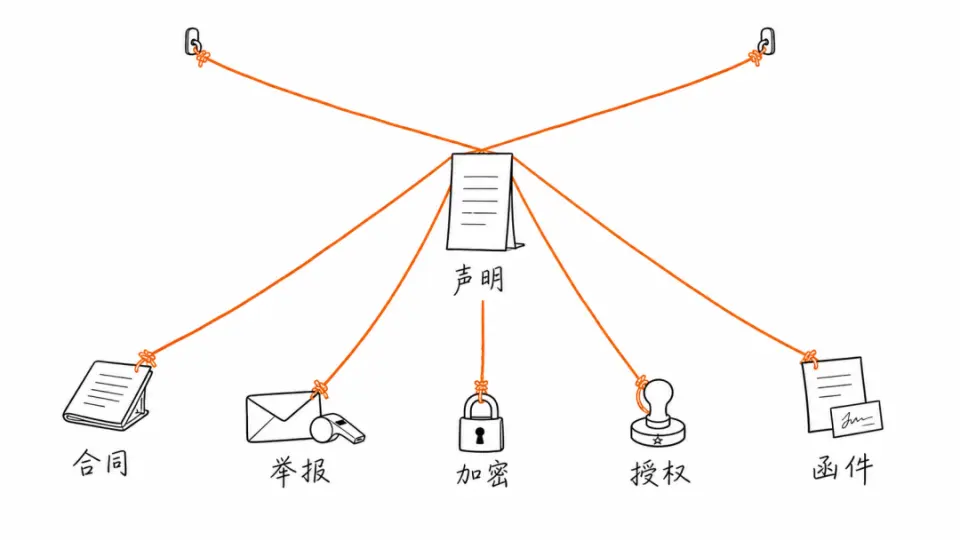
Five tracks shore up the statement
On the corpus-procurement side, it is the same list
Viewed from the other side, for companies that procure corpora and train models, each of the above items is an entry on the due-diligence checklist.
Buying a physical book does not mean obtaining a licenseThis layer is the one most often skipped in procurement processes. Buying a book obtains ownership of that book, not the right of reproduction or the right of communication through information networks. Scanning a lawfully purchased physical book into a corpus differs from downloading from a piracy site only in the means by which the carrier was obtained, not in the characterization of the subsequent act of reproduction. In Anthropic's USD 1.5 billion settlement, what was bought out was precisely the act of "taking," not the results of using what was taken.
A corpus ledger must be built in advance, not filled in after the factArticle 19 requires being able to explain, at any time, the source, scale, type and annotation rules of training data; this is not material to be written only after a problem arises. For each batch of corpus, at minimum four questions must be answerable: where it came from, on what basis it may be used, who approved it, and when it will be deleted.
The overseas-compliance timetable is already pressingArticle 53(1)(d) of the EU Artificial Intelligence Act requires providers of general-purpose AI models to publish, using the template of the EU AI Office, a sufficiently detailed summary of the training content, with penalties of up to 3% of global turnover for the preceding financial year or EUR 15 million, whichever is higher. Enforcement authority for this obligation was launched only on August 2, 2026, and today is the fourth day. Once the summary is published, it simultaneously hands rights holders worldwide a key to enforcing their rights.
Return to that line of text. Its problem was never that it 'does not count as a statement'; rather, it is that after the statement is made, no one follows through. PRC law directly grants the right to prohibit to the rights holder; there is no need to rely on a declaration to secure it. But what the law grants is a right, not evidence, and certainly not a path to obtaining evidence.
According to 21st Century Business Herald, Tao Kaiyuan, Vice President of the Supreme People's Court, stated in March of this year that the state is actively advancing the drafting and formulation of judicial policy documents concerning artificial intelligence and data property rights. Before that document is issued, the variable most worth watching closely is how the burden of proof is allocated: after the rights holder completes its prima facie evidentiary showing, can the burden shift to the model provider to explain the source of the corpus? Once this point is relaxed, the logic of the administrative track described above will be transplanted into civil litigation, and the conclusions of this article will need to be recalculated.
Until then, draft the contract clauses in detail, get the reporting channel working, lock the electronic copies, publish the licensing price list, and send out the letters while keeping the acknowledgments of receipt. Only after these five things are done does that line of text turn from a statement of position into something usable.
The reason a gentlemen's agreement remains merely a gentlemen's agreement is not that it is written politely, but that no one has equipped it with the hands and feet of enforcement.
If you currently hold a batch of content assets, or are procuring corpus for a model, you are welcome to leave a comment below, and we will go through them one by one together.
Reference Sources
- Jiemian News, 'Books Marked as Prohibited for AI Training, Huaxia Publishing House: Difficult to Enforce Rights, but Must Take a Stance' (August 5, 2026)
- IT Home, 'Huaxia Publishing House Marks Book Content as Prohibited for AI Training, Person in Charge Says Enforcement of Rights Is Very Difficult, but a Stance Must Be Taken' (August 4, 2026)
- Copyright Law of the People's Republic of China (2020 Amendment), Articles 24, 49, 53 and 54
- Interim Measures for the Administration of Generative Artificial Intelligence Services (Order No. 15 of the Cyberspace Administration of China and Six Other Departments), Articles 7 and 19
- Directive (EU) 2019/790 on Copyright in the Digital Single Market, Article 4 and Recital 18
- Regulation (EU) 2024/1689 (Artificial Intelligence Act), Article 53(1)(d)
- Civil Judgment of the Guangzhou Internet Court, (2024) Yue 0192 Min Chu No. 113
- Civil Judgment of the Shanghai Intellectual Property Court, (2025) Hu 73 Min Zhong No. 1189
- Civil Judgment of the Hangzhou Internet Court, (2024) Zhe 0192 Min Chu No. 1587
- District Court of Amsterdam, the Netherlands, DPG Media v. HowardsHome, ECLI:NL:RBAMS:2024:6563
- China News Service, "Tackling Copyright Disorder in AI Corpora: 22 Institutions Jointly Build a High-Quality Artificial Intelligence Corpus" (May 24, 2026)
- 21st Century Business Herald report on Tao Kaiyuan, Vice President of the Supreme People's Court, discussing judicial adjudication of intellectual property in generative artificial intelligence (March 2026)
Author of this article:Lü Yinghui, a lawyer at Mankun (Shenzhen) Law Firm. A graduate of China University of Political Science and Law, with nearly ten years of deep engagement in the legal industry, having previously worked at a court in Shenzhen. Focused on legal services in the new-generation economy, with extensive practical experience and profound insights in fields such as Web3 and artificial intelligence. Account across all platforms: Lao Lü Talks New Money; you are welcome to follow.