
01
Event Timeline: From Outrageous Conduct to Legal Accountability
February 24, 2025: The core tortious acts occurred — Tang (17 years old) and Wu (17 years old), after dining in a private room at a Haidilao restaurant in Shanghai, successively stood on the dining table and urinated into the hot pot, and filmed each other on video.
February 27, 2025: The impact of the tort spread — Wu posted the video at issue to WeChat Moments, and it rapidly spread through the internet, causing strong public revulsion and widespread attention.
Early March 2025: Emergency handling by the company + police intervention — after Haidilao identified and confirmed the restaurant involved, it destroyed the tableware involved and carried out deep disinfection of the entire restaurant; on March 8, the Shanghai Huangpu police determined that the two individuals had committed the offense of picking quarrels and provoking trouble and imposed administrative detention penalties.
March 12, 2025: Remedial measures by the company — Haidilao issued a statement on its official Weibo account, providing full refunds for all 4,109 orders at the restaurant involved during the period from February 24 to March 8, and granting compensation of 10 times the amount.
March 14, 2025: The company formally filed suit — a Sichuan catering company (the parent company of Haidilao) and a Shanghai catering company filed a lawsuit with the Shanghai Huangpu District People's Court, requesting that the defendants make a public apology and compensate for various losses totaling CNY 23,259,300 (including CNY 23,000,000 in goodwill losses).
September 12, 2025: The court pronounced its first-instance judgment — finding that the two defendants had committed joint tort, and ordering them and their guardians to publish an apology in a newspaper, and ordering the guardians to compensate for various losses totaling CNY 2,200,000 (CNY 130,000 for tableware damage and disinfection costs + CNY 2,000,000 for operational and goodwill losses + CNY 70,000 for rights-protection expenses).
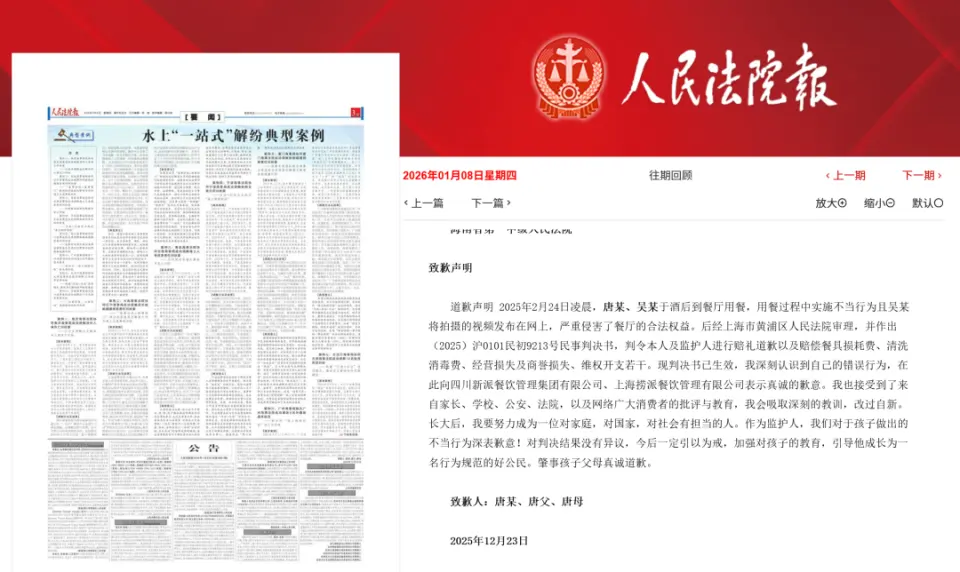
January 8, 2026: Performance of the apology statement — Tang, Wu and their parents published an apology statement in a designated newspaper as required by the judgment; the minors expressed that they "deeply acknowledge their mistakes and will reform and start anew," and the guardians acknowledged "failure to properly perform guardianship duties."
02
In-depth Lawyer's Analysis: The Legal Logic and Cautionary Significance Behind the Judgment
(1) The legal basis for the CNY 2,200,000 in compensation: a reasonable delineation of the scope of losses
The court's determination of compensation was not an "exorbitant demand," but strictly followed the "compensation for losses" principle of the Civil Code, clearly distinguishing lawful losses from expenditures based on the company's own business decisions:
Supported portions: The CNY 130,000 for tableware damage and disinfection costs arose from the necessary expenditure the company had to incur to replace the tableware involved after contamination, and constitutes direct property loss; the CNY 2,000,000 for operational and goodwill losses was determined at the court's discretion, taking into account the sustained impact of the video's spread in severely damaging brand trust, together with factors such as Haidilao's brand recognition and the severity of the tortious circumstances; the CNY 70,000 for rights-protection expenses consists of reasonable attorney fees, evidence-collection costs and other expenses incurred by the company in pursuing accountability, and complies with legal requirements.
Rejected in part: the company's claim for '10 times the price as compensation' was not supported. The core reason is that such compensation was an autonomous business strategy adopted by the company to stabilize customers and repair its brand image; it has no direct legal causal relationship with the infringing act and exceeds the scope of 'necessary losses.' This reflects the rigor of judicial adjudication.
(2) Dual liability of minors and guardians: failure of guardianship requires accountability
The determination of tort liability for minors in this case reflects both special protection for minors and an absolute refusal to condone unlawful conduct:
Liability to apologize: although the two defendants are 17-year-old persons with limited capacity for civil conduct, the court held that their mental development was sufficient for them to understand the unlawfulness of their conduct and the legal significance of an apology. It ordered them to publish an apology in a newspaper jointly with their guardians. This neither exceeds their capacity to bear responsibility nor fails to serve an educational and disciplinary function, helping them develop an awareness of rules.
Liability for economic compensation: under Article 1188 of the Civil Code and the relevant opinions of the Supreme People's Court, where a minor causes harm to another person, the guardian bears tort liability. In this case, the guardians failed to fulfill their duties of education and supervision, and the court therefore ordered them to bear liability for compensation of 2,200,000. If the minors have personal property, payment shall first be made from that property, and the guardians shall make up any shortfall. This both complies with the law and takes account of fairness in liability.
Boundary of privacy protection: the judgment expressly required the newspaper apology to be made 'while protecting the minors' privacy,' avoiding improper effects on their future development from excessive exposure of identity information and reflecting the judicial principle of 'the best interests of the minor.'
(3) Protection of corporate goodwill: intangible assets are strictly protected by law
Goodwill is a core intangible asset of an enterprise and derives from consumer trust accumulated over the long term. The judgment in this case sends a clear signal:
Damaging corporate goodwill by means such as insults or disseminating harmful videos not only violates public order and good morals but also constitutes infringement of the right of reputation, giving rise to civil liability including apology and compensation for losses.
Reasonable measures taken by an enterprise to repair its goodwill (such as full refunds in this case) constitute direct losses caused by the infringing act, and the enterprise has the right to seek recovery from the infringer; however, the court will not support commercial compensation beyond the necessary limit, indicating that enterprises seeking to protect their rights must follow the principle of 'reasonable necessity.'
(4) Broader warning: the internet is not outside the law, and public order and good morals must not be breached
At the individual level: whether minors or adults, all should observe public order and respect the lawful rights and interests of others. The conduct of 'filming videos and posting them online' in this case amplified the consequences of the infringement and became an important factor in the court's finding of aggravated liability. In similar cases, consumers who posted false statements online to criticize merchants were held liable for infringement and ordered to pay compensation, all confirming that 'online speech requires caution'—the boundary of freedom of speech is not infringing the lawful rights and interests of others.
At the guardian level: The Supreme People's Court has made clear that guardians bear primary responsibility for supervising minors' conduct and shaping their values. The award of 2,200,000 in this case serves as a warning to all guardians: guardianship is not merely about providing for daily life; it also requires strengthening legal education and guiding children to respect the law and respect others.
At the enterprise level: When brand goodwill is infringed, enterprises should promptly take measures such as preserving evidence and pursuing lawful remedies, and protect their rights through judicial channels. In this case, Haidilao's rapid response and litigation provide a reference for enterprises responding to similar crises.
03
Lawyer recommendations: Three practical approaches to making the calculation of reputational loss clearer
In light of the judgment in this case, in which only 2,000,000 of the 23,000,000 claim for goodwill loss was supported, the lawyers offer the following professional recommendations to make the calculation of reputational loss clearer and more quantifiable, balancing both the efficiency of enterprise rights protection and the likelihood of judicial acceptance:
(1) Establish a "tiered loss assessment" standard and clarify the calculation basis
It is recommended that industry associations or enterprises themselves develop a quantitative reference framework for reputational loss, with assessment tiered according to the severity of the infringing conduct:
Basic dimensions: the scope of dissemination of the infringement (e.g., online clicks, reposts, geographic coverage), duration (the period from dissemination to deletion or public clarification), and means of infringement (e.g., whether malicious filming or deliberate dissemination was involved);
Enterprise dimensions: brand awareness (which may reference industry rankings and market share), the proportion of the affected business (e.g., the revenue of the store involved as a proportion of total revenue), and historical investment in goodwill (e.g., advertising expenses and brand-building costs);
Loss dimensions: comparison of revenue before and after the infringement (excluding interfering factors such as market conditions and seasonal factors), customer attrition rate, changes in repurchase rate, and direct losses from counterparties' breach or suspension of cooperation.
A quantitative formula can be established using the above dimensions (e.g., basic loss + loss from revenue decline + additional brand restoration expenditure × severity coefficient of the infringement), so that loss claims follow a clear methodology.
(2) Strengthen a closed evidence chain to avoid "insufficient evidence"
When claiming reputational loss, enterprises must retain a complete evidence chain to avoid claims being only partially supported due to vague evidence:
Real-time evidence: original media containing the infringing content (videos, screenshots, webpage archives), notarized dissemination data (click and share counts that may be fixed through third-party data institutions), and public-opinion feedback (such as media reports and summaries of social-platform comments);
Loss evidence: financial statements before and after the infringement (to be confirmed by an audit institution), customer refund records and explanations of the reasons, vouchers for special expenditures on brand restoration (such as public relations fees and advertising placement fees), and goodwill impairment reports issued by third-party assessment institutions;
Causation evidence: through timeline comparison, market research data and the like, prove that the decline in revenue and customer loss are in a direct causal relationship with the infringing acts, excluding other interfering factors such as industry cycles and policy changes.
(3) Adapt to the logic of judicial adjudication and assert claims reasonably
When bringing suit, enterprises should avoid "exorbitant demands" and should assert claims precisely in light of the rules for determining reputational loss in judicial practice:
Distinguish between "necessary losses" and "voluntary expenditures": assert only losses directly related to the infringing acts (such as the tableware replacement costs and reasonable rights-protection costs in this case); voluntary commercial compensation (such as 10-fold compensation) may serve as a corporate public relations strategy but need not be included in litigation claims;
Refer to the adjudication standards of similar cases: by searching for the compensation amounts in reputation-right disputes in the same industry and of the same type, and adjusting the claimed amount in light of the enterprise's own brand value and the circumstances of the infringement, increase the proportion of claims supported by the court;
Apply for professional judicial assessment: for large goodwill losses, the enterprise may, in the litigation, apply to the court to commission a third-party professional institution to conduct a goodwill impairment assessment, and use the assessment report as core evidence to enhance the objectivity and persuasiveness of the claims.
In short, the calculation of reputational loss is not a "vague determination"; rather, enterprises need to establish standardized loss-assessment logic, retain a closed-loop evidence chain, and adapt to the rules of judicial adjudication. Only in this way can they achieve "precise rights protection" when their rights and interests are harmed, both avoiding the waste of judicial resources caused by excessively high claims and maximizing compensation for the actual loss suffered by brand goodwill.