What truly needs to be compared is not merely the application fees and timelines, but the target customers, business functions, account capabilities and long-term compliance costs.
When a project prepares to enter an overseas market, a "global license comparison table" often appears on the team's desk: the left column lists jurisdictions such as the EU, Hong Kong, Singapore, Dubai and the Cayman Islands, while the right side sets out, in order, the application timeline, minimum capital, local personnel, office premises, legal fees and difficulty of opening a bank account, and finally a location that looks the most cost-effective is selected based on budget and time.
This approach appears rational, yet it can easily lead a project to take the wrong first step. This is because a license is not a commodity that can be purchased separately from the business; the same applies to virtual asset exchange, wallets, custody, stablecoin payments()or trading platforms — the scope of services permitted, target markets and ongoing regulatory requirements differ across jurisdictions. The place with the lowest application price may not be able to cover the actual business; the place with the strongest regulatory reputation may not be suitable for an early-stage project that is still testing its product.
When choosing a jurisdiction under the global license pathway, market access, regulatory clarity and long-term costs should be considered together, rather than simply following the logic of "go wherever it is cheapest."
Therefore, the question a project should really ask is not "which VASP license in the world is the best," but rather:
What problem is our project currently trying to solve, and which regulatory status can genuinely support the business in the next stage?
VASP is not a globally uniform license
VASP is the abbreviation of Virtual Asset Service Provider, and is better understood as a generic term used by regulators for virtual asset service providers, rather than a standard license issued by a globally uniform authority.
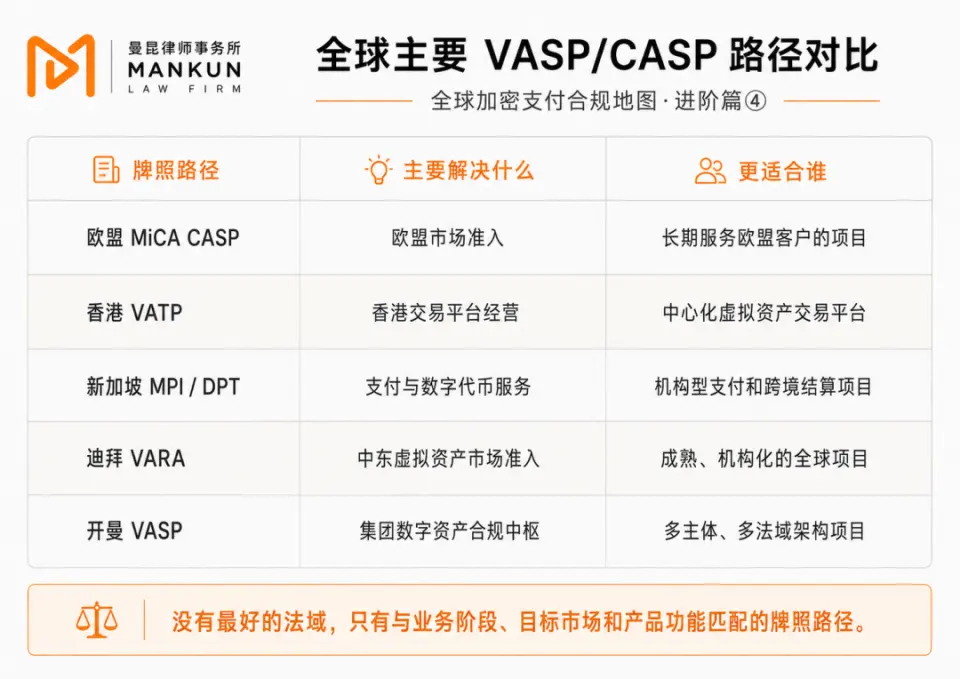
Upon entering different jurisdictions, both the name and the regulatory logic change. Under the EU MiCA framework, the term used is CASP(), i.e., Crypto-Asset Service Provider; Hong Kong adopts the SFC's VATP licensing regime for centralized virtual asset trading platforms; Dubai's VARA directly issues a VASP Licence to institutions that meet the requirements; Singapore regulates digital payment token services under the Payment Services Act; and the Cayman Islands distinguishes between VASP registration and licensing according to the specific business.
These names look similar, but the problems they address are not the same. The EU MiCA() established unified rules for the crypto-asset market, under which institutions authorized as CASPs may, after completing cross-border notification procedures, provide the corresponding crypto-asset services in other EU Member States; Hong Kong VATP() licences are mainly directed at entities operating centralized virtual asset trading platforms in Hong Kong; Dubai requires enterprises conducting regulated virtual asset activities within or from Dubai to obtain a VARA licence before commencing operations, while the DIFC is subject to a separate regulatory regime.
Therefore, a project should not assume that several regulatory statuses are interchangeable merely because the industry collectively refers to them all as "VASP licences". What genuinely needs to be compared is what business each jurisdiction permits an enterprise to conduct, which customers it may serve, and what continuing obligations attach once the status has been obtained.
Before choosing a licence, first confirm what problem the project is actually intended to solve
When different projects apply for licences, the stated need may in each case be "compliance", but the problem they actually seek to solve is usually not the same.
Some projects need clear market access. For example, where an enterprise has determined that its main customers are located in the EU and plans to provide trading, custody, exchange or other crypto-asset services on a long-term basis, the CASP route under MiCA may merit priority assessment, because it can support operations across Member States within a unified framework. The EU route entails relatively high investment and continuing supervisory requirements, but it addresses formal access to a vast market, rather than merely adding another certificate for display.
Some projects place greater emphasis on local business implementation and institutional recognition. For example, enterprises preparing to operate a centralized trading platform in Hong Kong, or planning to conduct regulated virtual asset activities from Dubai, need to focus on local licensing, team, governance and substantive-operations requirements. The core value of such licences lies in the ability to conduct business formally within a specific market and to be subject to continuing supervision, rather than in helping an enterprise circumvent regulation in other jurisdictions.
Other projects do not need to serve end customers directly, but rather to establish a group-level digital asset function entity. A Cayman VASP may be placed within a multi-entity structure to undertake specific digital asset services, group governance and institutional due diligence; however, since April 2025, the Cayman Islands has introduced a licensing regime for virtual asset custody and trading platform business, and other activities falling within the VASP scope must also be registered, licensed or exempted in accordance with the law, so it is no longer appropriate to understand this as an offshore status requiring only simple registration.
There are also projects still at the stage of product testing and commercial validation, for which what is genuinely needed at this stage may simply be to define business boundaries, restrict target markets, and complete certain fund or asset steps through licensed partners. For such projects, proceeding directly to the heaviest licence application may not be the best choice, but a complete failure to assess regulatory risk may likewise mean that, once the product is up and running, the entity and fund flows have to be restructured.
The value of the same licence to different projects depends on whether it addresses market access, business operations, group structure, or early-stage validation.
Different business models also give rise to entirely different licensing requirements
If the project operates a centralized trading platform or a custodial walletif the platform is able to control client assets, private keys or the trade execution process, regulators will generally focus on client asset protection, capital and liquidity, technical security, conflicts of interest, market surveillance and ongoing reporting. In such circumstances, it is difficult for a project to explain its business by relying solely on a general anti-money laundering registration; it will often need to enter a more comprehensive licensing regime.
If a project operates stablecoin payments, merchant collections or cross-border settlement,the choice of licence will become more complex. Such business not only involves the on-chain receipt, exchange and transfer of stablecoins, but may also simultaneously involve fiat currency accounts, payment execution, merchant settlement and client balances. A project may need both a virtual asset service status and a local payment institution, bank or other licensed partner to undertake the fiat-side functions.
If a project merely provides non-custodial software, wallet interfaces, node services or other technical tools,and the client always controls the private keys, with the platform neither receiving nor controlling assets nor transferring assets at the client's instruction, then its regulatory character may be relatively lighter. However, whether the project markets to local users, whether it participates in exchange and settlement, and whether it charges fees directly related to trade execution may still affect the final determination.
Therefore, a project cannot directly deduce which licence it needs from "we are a Web3 company" or "we do crypto payments"; it should first break down the product functions: who receives assets, who controls the private keys, who completes the exchange, who determines the flow of funds, and who bears responsibility for the final delivery outcome.
When determining the jurisdiction, at least five questions must be answered
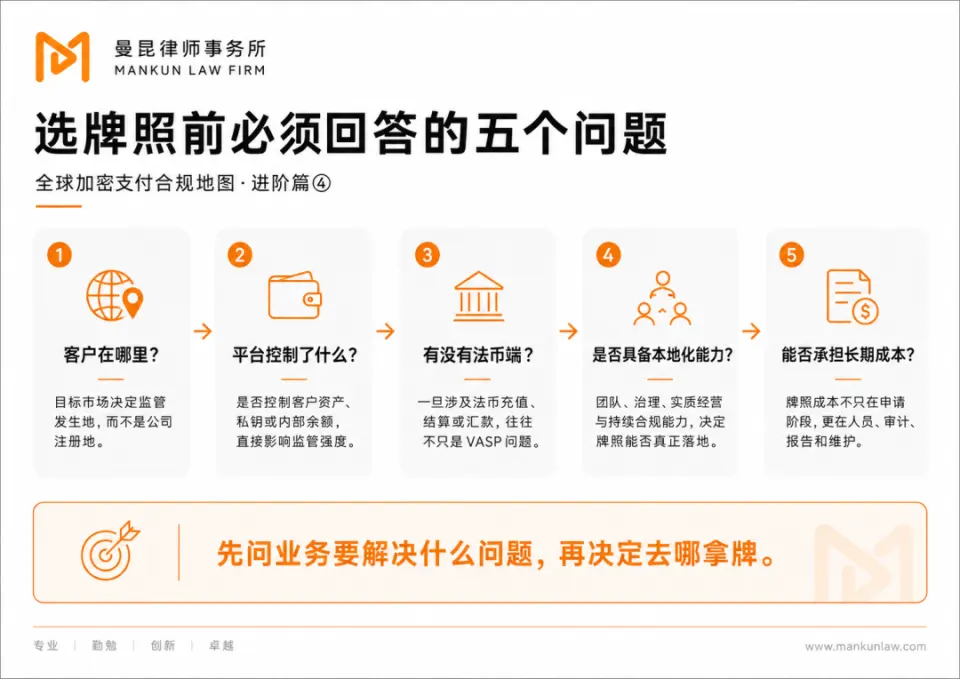
The first question is where the clients are.A company's place of incorporation is not the same as the place where regulation occurs. The regions in which a project provides services to residents and businesses, and the markets in which it actively promotes its products, are usually more important than the location of its servers and technical team. The EU CASP cross-border mechanism has clear regional market value, but a regulatory status in Hong Kong, Dubai, Singapore or the Cayman Islands does not automatically translate into a licence to operate in other regions.
The second question is what the platform controls.If the platform safekeeps client virtual assets, controls private keys, manages internal balances, or can complete transfers when the client is no longer operating, the intensity of regulation will usually increase significantly. The Cayman Islands' current regime brings virtual asset custody and trading platforms within the licensing pathway, rather than continuing to remain at the level of general registration.
The third question is whether the business has a fiat side.Once stablecoins enter the platform, are they transferred directly to another on-chain address, or must they be converted into US dollars, euros or other fiat currencies and settled to merchants? If there is fiat currency top-up, account balances, payment execution or cross-border remittance, the project needs to assess not only VASP requirements but potentially also payment, money transmission, foreign exchange and customer fund protection requirements.
The fourth question is whether the project has genuine localisation capabilities.Regulators are paying increasing attention to whether the applicant has qualified management personnel, substantive operations, internal controls, technical security and ongoing compliance capabilities. Singapore currently establishes different licence categories for payment service providers and regulates digital payment token services; for entities that provide digital token services only from Singapore to overseas locations, the DTSP regime implemented in 2025 also expressly sets a relatively high licensing threshold and is not suitable to be treated as a lightweight offshore pathway.
The fifth question is whether the project can bear the long-term costs.The true cost of a licence includes not only application fees and legal fees, but also compliance personnel, directors and management, capital and security deposits, audits, system security, transaction monitoring, regulatory reporting and annual maintenance. Even if a project can bear the application costs, if it cannot sustainably maintain a local team and meet regulatory requirements, the licence will be difficult to convert into a stable business.
Why is "applying for the cheapest licence" often the most expensive?
Low-threshold jurisdictions most easily attract early-stage projects, because company formation is fast, the materials are relatively simple, and there is no need to invest substantial capital and personnel before the product has matured. However, if that status cannot be understood by banks, payment channels and institutional clients, or cannot cover the locations of the main clients, the project will still need to readjust its entity and licence later.
At that point, the costs incurred by the enterprise are not limited to applying for a licence again; they may also include migrating client contracts, redesigning wallets and accounts, adjusting fund flows, completing additional client KYC, reconnecting with banks and channels, and explaining to counterparties why the original structure has changed.
Conversely, although heavily regulated jurisdictions require greater initial investment, if the target market is clear, the business has matured, and the project is capable of maintaining personnel and governance requirements over the long term, such investment may yield more stable market access and institutional cooperation capabilities.
Therefore, so-called "cost-effectiveness" cannot be assessed solely on the fees in the year the licence is obtained; it must be calculated over the full cycle of approval, account opening, operations, financing and business expansion.
A cheap licence that cannot support a real business is the most expensive licence.
Projects are not limited to the single path of "obtaining a licence themselves"
For projects with a single target market, a mature business model, and plans for long-term localized operations, a single-market deep-cultivation path may be adopted: prioritize obtaining the local core license and concentrate team, systems, and compliance resources in the most important market.
For projects already operating across multiple regions, a more common approach is to establish a group-level digital asset entity, with different local operating or licensed entities undertaking business in each region. Cayman VASP, EU CASP, Hong Kong, or Dubai entities may perform different functions within the group, but such a structure must be built on genuine contractual, personnel, systems, and funding allocation, and must not exist only in an organizational chart.
For projects still in the business-validation stage that cannot yet bear the full cost of licensing, a licensed-partnership model may be used, under which banks, payment institutions, custodians, or local VASPs undertake business within the scope of their licenses, while the project's own control over client assets and transaction processes is limited. However, a partner's license can cover only the functions that partner actually performs and must not be understood as allowing the project to "borrow a license" without limit.
Other projects are suited to a phased path: first complete a business-model diagnosis and target-market screening, then gradually add licenses based on client numbers, transaction scale, and requirements of partner institutions, rather than building an excessively heavy global structure all at once before the product has been proven.
What can Mankun deliver for a project?
The real difficulty in global license selection is not finding a table of fees by country, but placing the business model, target clients, fund flows, and group structure within a single analytical framework.
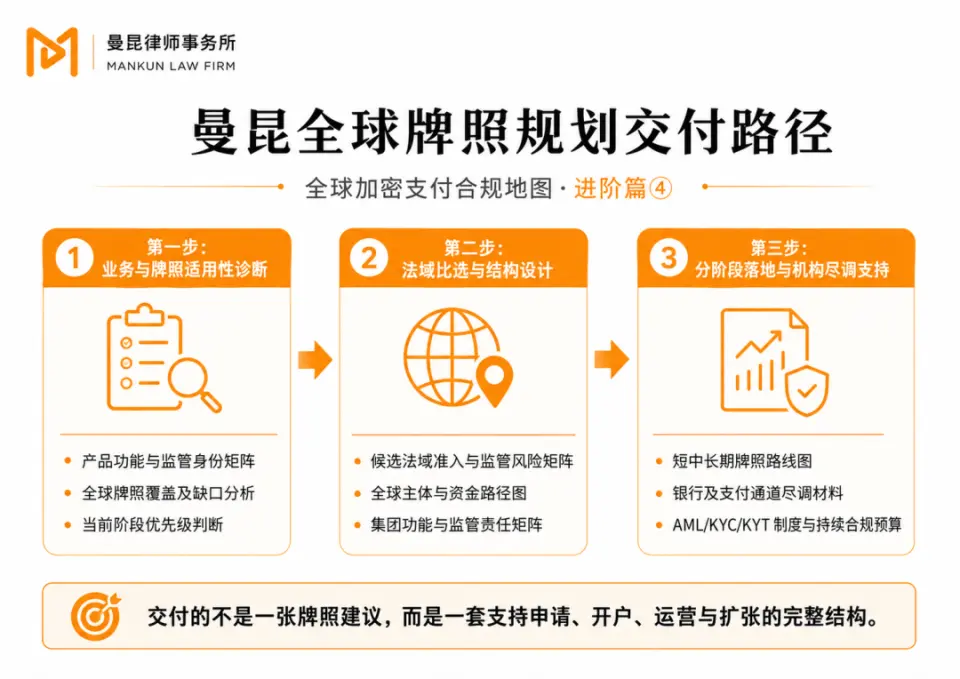
First, Mankun can, based on the project's product functions, client regions, wallet control arrangements, fiat settlement, and market plans, produce a Global Business and License Applicability Diagnostic Opinion and a Product Function and Regulatory Identity Matrix, clarifying which businesses must be undertaken by a licensed entity, which functions may remain with the technology company, and whether it is necessary at the current stage to enter heavily regulated markets directly.
Second, Mankun can compare candidate jurisdictions across dimensions such as market access, scope of licensing, local personnel, capital requirements, accounts and payment channels, ongoing compliance, and overall cost, and produce a Global License Path Comparison Report, a Jurisdiction Access and Regulatory Risk Matrix, and a Short-, Medium-, and Long-Term License Roadmap. The focus of such deliverables is not to conclude which country is best, but to explain what problems each option can solve and what limitations each will bring.
After the target jurisdictions are determined, Mankun can further map out a Global Entity and Fund Flow Chart, clarifying the relationships among the holding entity, the digital asset service entity, the local payment entity, and licensed partners, and produce a Group Function and Regulatory Responsibility Matrix, a License Application Implementation Plan, a Bank and Institutional Due Diligence Materials Package, as well as an ongoing compliance budget and annual maintenance calendar.
The final deliverable is not an isolated licensing recommendation, but a complete structure capable of supporting the project's applications, account opening, operations, financing, and subsequent expansion.
Conclusion: There is no best jurisdiction, only a licensing path that matches the business
Global VASP regulation has gradually moved from "whether rules exist" to "how the rules are implemented." EU MiCA provides regional market access; Hong Kong and Dubai emphasize locally regulated operations; Singapore maintains relatively high access and ongoing supervisory standards; and the Cayman Islands can, under appropriate business conditions, undertake group-level digital asset functions.
There is no single unified ranking across these jurisdictions, because different projects require different answers.
A trading platform serving individual users in Europe, a stablecoin payment platform serving corporate clients globally, and a group entity that carries the group's digital asset functions should not, from the outset, choose the same licensing path.
What a project should truly seek is a structure that can be repeatedly explained to regulators, banks, customers and investors, and that can support the operation of real funds and business.
Choosing a license is not about finding the jurisdiction with the most lenient regulation; it is about ensuring that the right business, in the right market, is undertaken by the right entity.
Next article
Global Crypto Payment Compliance Map · Advanced Series ⑤
Why do crypto payment businesses that truly scale ultimately move toward multi-license coordination?
Stay tuned.
/ END.
*This article is an original work of Mankun Law Firm and represents only the personal views of the author. It does not constitute legal consultation or legal advice on any specific matter. For reprinting and legal consultation, please add our customer service:mankunlawyer。
About the Author

About Mankun