
Introduction
Over the past two days, CZ posted on X: Futu Niuniu has officially launched BNB deposit and withdrawal services. When reposting, he specifically emphasized that Futu is a brokerage listed on Nasdaq.
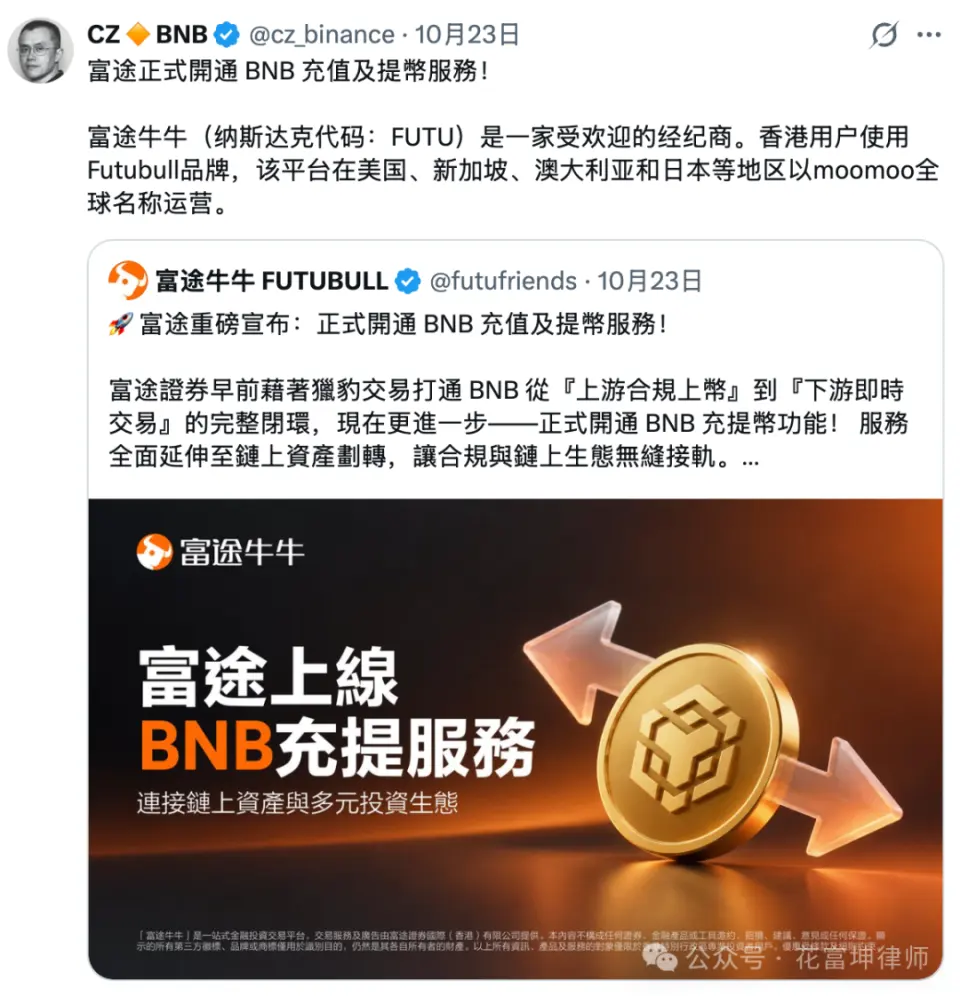
Since June 2023, Hong Kong has imposed a mandatory licensing regime on virtual asset trading platforms. Any platform operating in Hong Kong or promoting such services to Hong Kong investors must obtain a license from the Securities and Futures Commission (SFC). Futu Niuniu's launch of BNB deposits and withdrawals this time has two aspects worth examining under Hong Kong's regulatory framework:
1. Whether on-chain BNB deposits and withdrawals have entered the Hong Kong SFC-licensed virtual asset trading platform (VATP) system for the first time;
2. If not the first case, what unique significance Futu's launch of on-chain BNB deposits and withdrawals carries.
I. On-chain BNB deposits and withdrawals have long been implemented within Hong Kong's licensed system
The Hong Kong SFC has formally licensed multiple virtual asset trading platforms (VATPs), including OSL, HashKey Exchange, HKVAX, PantherTrade and others. Before Futu, OSL was the only licensed platform publicly supporting on-chain BNB deposits and withdrawals.
On September 3, 2025, OSL HK launched BNB for professional investors, offering three trading pairs: BNB/USD, BNB/USDT and BNB/USDC, and billed itself as "Hong Kong's first licensed platform to support BNB trading." OSL's launch announcement also stated that the deposit and withdrawal opening time was "already open," and that both deposits and withdrawals could be made via the BNB Chain network.
Here, a distinction must be drawn between [on-platform trading] and [on-chain deposits and withdrawals]:
[On-platform trading] means tokens are bought and sold and settled only within the account system of the licensed platform. The underlying assets are held in trust by the platform's affiliated entity [a wholly-owned Hong Kong subsidiary holding a TCSP license], segregated from the platform's own assets. Clients do not hold on-chain private keys, and the transfer of assets out must be executed through the platform;
[On-chain deposits and withdrawals] means assets, relying on the public blockchain, undergo real on-chain transfers between the client's own self-custodial wallet and the platform's custodial account, establishing an on-chain channel between the client's self-custody system and the platform's licensed custody system.
What OSL opened in September 2025 was precisely full on-chain deposits and withdrawals, 13 months earlier than Futu, and likewise conducted via the BEP20 network of BNB Chain.
Therefore, Futu is the second licensed platform to support on-chain deposits and withdrawals of BNB [undertaken by its subsidiary PantherTrade], but it is the first licensed broker to offer this capability to clients.
II. The Boundaries of the Matter Remain Unchanged
(1) The eligibility threshold remains unchanged.
The service is still limited to PIs [qualified professional investors]; an individual must hold, alone or jointly with their spouse and children in a joint account, an investment portfolio of not less than HKD 8 million. For the vast majority of crypto users, this asset threshold constitutes a substantive exclusion; BNB remains on the PI side, and clients who do not meet the threshold cannot access this coin even if they have already opened an account with Futu.
(2) The scope of services remains unchanged.
This offering is available only to qualified local clients in Hong Kong, which is also an inevitable consequence of the nature of the licence. The VATP licence is a local licence issued under Hong Kong's Anti-Money Laundering and Counter-Terrorist Financing Ordinance; a licensed platform is required to operate within the jurisdiction in which it is licensed, and promoting or providing services outside that jurisdiction is subject to local law, and holding a licence in Hong Kong does not automatically confer the right to operate in other markets.
In its announcement, Futu also expressly limits the target of this service to professional investors in the Hong Kong Special Administrative Region; although Futu Niuniu and moomoo cover multiple markets including Hong Kong, North America, Singapore, Australia and Japan, the opening in Hong Kong alone cannot be extended to other jurisdictions.
(3) The nature of the function remains unchanged.
The [deposits and withdrawals] enabled this time are merely an on-chain transfer channel for assets, and not a new trading channel or funding channel:
[Deposit] means a client transferring BNB via the public blockchain from their self-custody wallet to the custody address of PantherTrade, and upon receipt it is recorded as a book balance in the Futu Niuniu account;
[Withdrawal] means a client applying to transfer that book balance from the custody pool via the public blockchain to their self-custody wallet, and upon completion of the transfer the corresponding book record is extinguished.
If a PI client wishes to use Hong Kong dollars to buy BNB, they still trade within the platform as before; the crypto-to-crypto trading function and this newly added on-chain deposit and withdrawal channel are two independent functions; if a client does not already hold BNB in their account, this deposit and withdrawal channel alone cannot be used to buy BNB or establish a new position.
In summary, this event represents an improvement in compliance infrastructure rather than a shift in regulatory policy.
III. What is the significance of Futu's launch of BNB on-chain deposits and withdrawals?
The licensed entity carrying Futu's on-chain deposit and withdrawal capability is PantherTrade, a licensed VATP under the Futu Group [PantherTrade, licensed in January 2025], while the party providing services to clients and establishing legal relationships with clients is the licensed broker Futu Securities, with the Futu Niuniu App as the entry point, limited to qualified professional investors in Hong Kong, and with matching, custody and settlement undertaken by PantherTrade.
The main significance of the launch of the BNB deposit and withdrawal function is as follows: OSL, as a crypto-native trading platform, serves its existing clients directly, whereas Futu, as a licensed broker, provides services to its securities clients, with the on-chain functions undertaken by a licensed VATP within the group:
(1) Connectivity of the user pathway
OSL's clients are already existing participants in the crypto assets sector; Futu's client base, by contrast, consists mainly of traditional securities investors in Hong Kong stocks, US stocks, options and the like, and through its two brands Futu Niuniu and moomoo it covers multiple markets including Hong Kong, North America, Singapore, Australia and Japan, with a client base not on the same order of magnitude as the former.
Following this launch, stock assets and BNB can be custodied and transferred within the account system of the same broker, with stocks custodied by Futu Securities and BNB custodied at the underlying level by the group's VATP PantherTrade; the two belong to two separate accounts, but unified access is achieved within the same App interface, enabling one-stop allocation across traditional securities and virtual assets and a closed loop between the Web2 and Web3 ecosystems.
For BNB, this is its first access to the securities client account ecosystem of a licensed broker, and the attributes of the reached group have changed, expanding from investors of independent virtual asset exchanges to professional investors of a broker who allocate traditional securities.
(2) Differences in the endorsing entity
OSL's listing of BNB is an expansion of product offerings by a digital asset platform within the scope of its own main business, constituting a compliance action within the crypto industry, and its endorsement effect is basically limited to the industry; the Futu Group's main business is traditional securities brokerage, and its listed entity, Futu Holdings, is a US-listed public company subject to public audit and continuous disclosure obligations. For Futu, incorporating BNB is not routine business within its main business, but rather the addition of a new asset class beyond stocks, funds and derivatives.
A compliance action within the industry proves that the industry can be regulated; whereas a entity such as Futu voluntarily incorporating a token issued by an exchange into its own system proves that the asset has begun to enter the asset allocation horizon of traditional finance.
(3) The return of asset attributes
PantherTrade, the licensed VATP wholly owned by Futu and known as Cheetah Trading, had already opened order-book trading in BNB to professional investors (PIs) in July of this year, but at that time BNB could only be bought and sold within the platform's books, and clients could not transfer the asset back to their own wallets.
The two-way deposits and withdrawals added this time enable PI clients to transfer BNB freely between self-custodial wallets and compliant custodial accounts, returning the asset from a "bookkeeping symbol" to a freely disposable on-chain asset.
Therefore, the significance of this event lies not in any new regulatory determination that BNB has obtained, but in the fact that a listed securities broker whose principal business is traditional securities brokerage has connected the on-chain deposit and withdrawal capability of its licensed VATP to its own client account system.
This does not, however, indicate that the SFC has relaxed its risk assessment of BNB, nor that BNB will be opened to retail investors (RIs) in the near term.
IV. Why BTC, ETH and SOL Can Enter the Retail Pool but BNB Cannot
The admission criteria for retail tokens are set out in the SFC's Guidelines for Virtual Asset Trading Platform Operators, and comprise three requirements:
1. The virtual asset does not fall within the definition of "securities" under the Securities and Futures Ordinance;
2. The underlying asset must meet the large-cap qualified virtual asset standard: it must be included in a recognized index published by at least two independent institutions, at least one of which has experience in compiling traditional securities indices; the index must be compiled using objective and quantitative rules, have sufficient liquidity, and its compilation rules must be publicly disclosed;
3. Prior written approval from the SFC must be obtained.
Looking at the current retail list, BTC, ETH, SOL and AVAX are native gas tokens of public blockchains, and their issuers are independent of the trading platforms, so there is no situation of proprietary issuance by the platforms; LINK is the token of an oracle network, and the project team is an independent technical team with no equity or actual-controller ties to any exchange, and there is no doubt as to its characterization as a security. LINK's entry into the retail pool came after it completed, in sequence, the two procedures of index inclusion and written approval.
The situation with BNB is different. There is no obstacle with respect to the large-cap qualified virtual asset standard: in January 2026, BNB was simultaneously included in four indices of the CoinDesk index series, and in August of the same year, the crypto index series launched by CME Group in cooperation with CF Benchmarks also listed it as a constituent, with CF Benchmarks being an institution regulated by the UK Financial Conduct Authority and possessing experience in compiling indices for traditional financial markets.
The regulator has not publicly explained its specific review conclusion on BNB, but if one were to speculate, the real obstacles to BNB's entry into the retail pool lie in two points:
(1) Token characterization. BNB has a dual nature: it is both the gas token of BNB Chain and a platform token issued directly by the exchange operating entity. Regulators will assess whether the token carries securities-like features such as dividends or distribution of profits to holders; if, upon assessment, it is found to carry such features, there is a risk that it will be characterized as a "security" under the Securities and Futures Ordinance.
(2) Issuer identity. The issuer of BNB itself operates the world's largest cryptocurrency trading platform and thus has the dual identity of token issuer and trading platform operator. The issuer operates its own trading platform and inherently faces conflicts of interest in market capitalization management, listing and delisting decisions, proprietary trading and other respects, and regulators will inevitably assess this prudently at the pre-approval stage of prior written approval for retail access.
In summary:
BNB's on-chain deposits and withdrawals are not the first to enter Hong Kong's licensed regime. The distinctiveness of Futu's offering this time lies in the fact that the principal of the client relationship has changed from a crypto-native platform to a licensed securities firm. This is not a turning point in regulatory policy, but a normalized extension of compliance infrastructure.
The only point truly worth pondering is this: the account systems of traditional securities firms are beginning to open up to on-chain assets.
"Disclaimer: The content of this article is for legal education purposes only and does not constitute any legal advice or legal consultation. Reading or forwarding this article does not create any lawyer-client relationship. Individual legal issues are highly specific; it is recommended that you obtain professional legal advice from a practicing lawyer regarding your specific circumstances."

