

At the methodological level, the SEC's new rules have in substance developed a set of analytical tools applicable to decentralized networks, enabling the Howey Test, which originated in the last century, to be applied to the entirely new technologies of the 21st century in a more reasonable manner. Future rulemaking and judicial practice have thus acquired a methodological foundation capable of further extension. At the institutional level, it further marks a paradigm shift in U.S. crypto regulation from "rulemaking through enforcement" to "rules first."
For a long time, from Bitcoin miners to Ethereum validators, from liquid staking protocols to cross-chain bridges, from token issuers to airdrop recipients, almost every market participant has at some point asked the same question: Is what I am doing, in the SEC's eyes, a securities transaction? The reason this question has no answer is not that the question itself is complex, but that regulators have never answered it directly. The strategy adopted by the SEC during the tenure of former Chair Gary Gensler was "enforce first, explain later": rather than clarifying boundaries through rulemaking, it delineated boundaries through one enforcement action after another.The problem with this strategy is that when boundaries are drawn by punishment, every market participant does not know whether they have already crossed the line until they are sued.
The definition of "security" under U.S. securities law originated in 1933, while the Howey Test, used to assist in the determination, was established in 1946. This framework was originally designed to analyze citrus grove shares and corporate stock, not to analyze a decentralized network that has no central issuer, operates automatically by algorithm, and distributes rewards through code. When the Howey Test confronts questions of its application to proof of work and proof of stake, each of its four elements runs into conceptual difficulties:Is a miner's contribution of computing power in exchange for block rewards a "monetary investment"? Is a staker's locking of tokens in a smart contract an "investment in a common enterprise"? Is stETH issued by a liquid staking protocol a "security" or a "receipt"? These questions have long been debated, yet regulators have never given a clear answer.
1. Review of SEC Enforcement Cases
In August 2018,in the Tomahawk case, the SEC for the first time explicitly brought "token airdrops" within the securities regulatory framework in an enforcement action.In that case, Tomahawk was an oil and gas exploration company that sought to raise USD 5,000,000 through an ICO by issuing a token called "Tomahawkcoin" (TOM). As it turned out, the ICO itself likewise failed to raise any funds, but the company also designed a so-called "bounty program," providing third parties with 10 to 4,000 TOM as compensation for services such as promoting the token on social media, writing articles on forums, designing promotional materials, and producing videos, and ultimately distributed more than 80,000 tokens to approximately 40 wallet addresses.In response, the SEC argued that even though the token recipients paid no cash, they provided the issuer with promotional services of economic value, and the issuer thereby obtained the actual benefit of "cultivating a secondary market for the token," which was sufficient to satisfy the "consideration" element under the Howey Test.Although this case was resolved through an administrative settlement, the above regulatory view was adopted in the SEC's 2019 "Framework for 'Investment Contract' Analysis of Digital Assets," which expressly states that "the free distribution of digital assets through airdrops and other means does not mean that the 'monetary investment' element is not satisfied, and therefore an airdrop may constitute the sale or distribution of a security.".
In March 2023, the SEC pushed the logic established in the Tomahawk case further into more complex practical scenarios. In the case brought by the SEC against Justin Sun and his affiliated companies, the SEC alleged that an airdrop plan formulated by the companies involved distributed 10.1% of the total supply of BTT to investors who held TRX in Tron wallets or on participating partner trading platforms.The SEC alleged that the substance of this design was to require investors to first commit funds to purchase and hold TRX as a precondition for receiving the BTT airdrop, thereby converting an ostensibly free airdrop into a disguised securities offering, with the investors' expenditure of funds to purchase TRX itself constituting consideration.Thereafter, the case went through nearly three years of litigation and concluded in a settlement in March 2026.
Together, these two cases constituted the SEC's most deterrent regulatory stance on "airdrops" to date, significantly influencing token distribution strategies in the crypto industry. Under this regulatory position, a large number of projects were forced to impose geographic fencing restrictions on U.S. users, and airdrop activities required participants to confirm that they were not U.S. residents or citizens. Token issuance structures across the industry thus drifted toward offshore and anonymized arrangements, which in turn increased the difficulty for ordinary investors to obtain information and vindicate their rights.
During the same period, the SEC took successive legal actions against staking services offered by exchanges.In February 2023, the SEC filed suit on the ground that Kraken's "Staking-as-a-Service" program constituted an unregistered securities offering. In that case, the SEC's core contention was that Kraken pooled user assets and staked them on users' behalf, advertised annualized yields of up to 21%, and unilaterally determined how returns would be distributed; its series of arrangements caused the staking service to substantively satisfy all elements of the Howey test, namely:users invested funds, a common enterprise was formed, and profits were expected based on Kraken's technical and managerial efforts, thereby constituting an "investment contract", which fell within the scope of federal securities law. Faced with the SEC's forceful allegations, Kraken chose to settle rather than litigate and immediately and permanently shut down its staking service for U.S. users.
Only four months later, in June 2023, the SEC turned its attention to the larger Coinbase, with broader allegations—in addition to staking services, it alleged that Coinbase had operated as an unregistered securities exchange, broker and clearing agency since 2019. In March 2024, the U.S. District Court for the Southern District of New York held that,with respect to staking services, the court found that the "slashing" risk and loss of control that users faced after entrusting assets to Coinbase already constituted an "investment of money," while Coinbase's substantial technical and managerial efforts in node operation, liquidity maintenance and asset pool management satisfied the "efforts of others" element.In February 2025, with the new SEC leadership taking office, the SEC withdrew all allegations in the case.
Under the SEC's prior enforcement logic, staking services were regarded as inherently constituting securities offerings, and any platform offering a product of "staking on behalf of users and distributing returns pro rata" faced the legal risk of being alleged to be an unregistered securities underwriter. If the above legal characterization were upheld, it would mean that the business model of the entire staking services sector could not lawfully exist within the United States at all.
On February 26, 2025, Jesse Powell, co-founder of the cryptocurrency exchange Kraken, issued a strongly worded tweet stating"Fighting the U.S. Securities and Exchange Commission (SEC) can cost you USD 100,000,000 even if you win, and possibly 10 times that if you lose", and directly likened the SEC's investigation to "a gun held to your head."
Jesse Powell tweeted: "The investigation itself is the punishment. Merely being under investigation puts you in the crosshairs of many other agencies and makes you appear radioactive to business partners. Fighting the SEC can cost you USD 100,000,000 even if you win, and possibly 10 times that if you lose. We once had a gun held to our head."
2. Analysis of the Key Points of the New Rules
Addressing the long-unresolved issue of the regulatory characterization of a range of crypto asset activities, the U.S. SEC, in its "Application of the Federal Securities Laws to Certain Types of Crypto Assets and Certain Transactions Involving Crypto Assets" issued on March 17, 2026, provided interpretive guidance on whether four typical categories of on-chain crypto asset activities constitute offers and sales of securities under the federal securities laws.
1. Protocol Mining does not constitute an offer or sale of securities
The SEC is of the view that, whether in solo mining or pool mining,the block rewards obtained by miners derive from administrative or ministerial acts performed by the miners themselves, namely contributing computing resources to solve cryptographic puzzles, validate transactions and add blocks,rather than relying on the essential managerial efforts of any third party, and therefore the key element of the Howey test—that profits derive from the essential managerial efforts of others—is not satisfied.
Even under the mining pool model, miners still personally carry out the actual mining activity,and the functions assumed by the mining pool operator, such as coordinating resources, maintaining equipment and distributing rewards, are administrative or clerical support work in nature and do not constitute substantive managerial effortsMoreover, the purpose of miners joining a mining pool is not to passively profit from the operator's activities, but rather to expect that the computing power they contribute will generate a return.Therefore, the essence of the reward is remuneration for the network services provided by the miner, not an investment return, and differences in the organizational form of mining do not change the nature of the conduct.
2. Protocol Staking does not constitute an offer or sale of securities
In these new rules, the SEC classifies protocol staking activities into the following four categories according to their behavioral characteristics (see the table below):
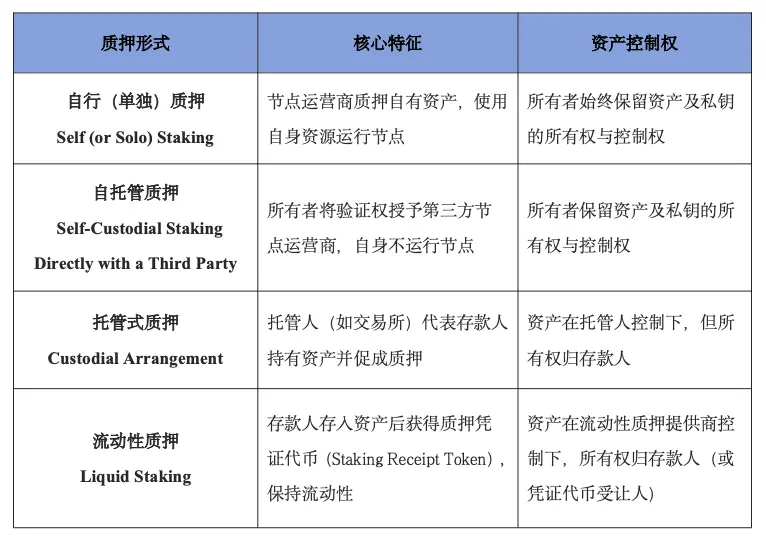
The SEC considers that none of the above forms of protocol staking activity constitutes an offer and sale of securities.Although the four forms progress step by step in terms of participant structure and the manner of asset control, the role of each type of service provider does not exceed the administrative and clerical scope and does not satisfy the requirement under the Howey test that "profits are derived from the substantive managerial efforts of others"Specifically:
(1)Self-staking, the node operator contributes its own resources and assets, and the reward derives entirely from the protocol staking activity itself.
(2)Self-custodial stakingIn this regard, although node operators provide validation services to owners, such services are administrative in nature, and operators do not guarantee, set, or fix the amount of rewards; there is no difference in the nature of the conduct between staking one's own assets and being granted the right to validate on behalf of others.
(3)Custodial stakingIn this regard, the custodian does not decide whether to stake, when to stake, or the amount to stake, and acts solely as an agent; its custody of assets and its selection of node operators are likewise administrative and administrative in nature.
(4)Liquid stakingSimilar to custodial arrangements, the provider does not determine the specific staking arrangements and likewise acts solely as an agent; its selection of a third-party node operator is the only decision in the staking process, and that decision may even be automated.
It can be seen that, by introducing the concept of "administrative or administrative" conduct, the new rules clearly distinguish service providers' routine operations in maintaining network operation from "substantial management efforts." At the same time, they further indicate thatin a decentralized network, the source of rewards is the protocol itself, not the operational capability of any management team. This characterization as "compensation for services" rather than "return on investment" is an important correction to the understanding of the Howey test in the decentralized context.
It is noteworthy that the new rules further set out four explicit prohibited conduct requirements with respect to the deposited digital commodities held by custodial staking providers, liquid staking custodians, and liquid staking providers, specifically including:
First, they must not be used for business operationsDeposited digital commodities must not be used by the custodian or liquid staking provider for its own operations or general commercial purposes, meaning that such assets may be used only for staking itself and must not become a business tool of the service provider.
Second, they must not be lent or rehypothecatedDeposited digital commodities must not be lent, staked, or rehypothecated for any reason, which means that service providers cannot use assets deposited by users as a means of financing or credit expansion for themselves.
Third, the deposited assets must not be exposed to the risk of third-party claims.Digital commodities deposited must be held in a manner designed to keep them free from third-party claims, meaning that the service provider must make arrangements at the asset-segregation level so that even if the service provider itself faces debt disputes or insolvency, the assets deposited by users will not be subject to claims by third-party creditors.
Fourth, the deposited assets must not be used for speculative activities.The custodian or liquid staking provider must not use the deposited digital commodities for leverage, trading, speculation, or discretionary activities, meaning that the service provider has no authority to actively deploy user assets in any way.
The above prohibitions together constitute a core principle,namely that during the staking period the deposited digital commodities may only be "locked and staked," and the service provider has only the authority to custody them and to stake them as agent, without any form of right to use or dispose of them.It is precisely because the service provider's role is strictly confined within these boundaries that the SEC was able to find its conduct to be ministerial or administrative in nature and not to constitute substantial managerial efforts, thereby excluding the application of the Howey test. In other words,compliance with the above prohibitions is a precondition for custodial staking and liquid staking to be characterized as "non-securities.".
In addition, with respect tothe characterization of staking receipt tokens,the SEC followed the "look-through to the underlying assets" approach.principle. The SEC considers that if the underlying asset is a non-security crypto asset and is not subject to an investment contract, the staking receipt token is merely a receipt for the deposited asset, does not constitute a security, does not require registration, and secondary market trading likewise does not require registration. Conversely, if the underlying asset is a digital security, or is a non-security crypto asset subject to an investment contract, then its staking receipt token constitutes a security and must still be registered or satisfy an exemption.
3. Redeemable wrapped tokens for non-security crypto assets (and not subject to an investment contract) do not constitute securities
The SEC considers that redeemable wrapped tokens for non-security crypto assets that are not subject to an investment contract do not satisfy the Howey test; specifically:
First, there is no "investment in a common enterprise"Holders' funds are not pooled for the development of any enterprise; the deposited assets are fully locked and may not be used by the wrapped token provider; and holders' wealth is neither tied to nor shared with the efforts of the promoter or any third party.
Second, there are no "profits derived from the essential managerial efforts of others"The value of the token derives entirely from the value of the underlying deposited crypto asset itself, rather than from the efforts of any third party in the wrapping process; the wrapping process itself is merely an administrative, ministerial function that facilitates cross-chain interoperability.
Third, there is no additional economic incentiveRedeemable wrapped tokens can only be redeemed for the deposited assets at a fixed one-to-one ratio, and the act of wrapping itself generates no return, yield or profit opportunity.
At the same time, the SEC further clarified in this instance that,if the underlying asset is a digital security or a non-security crypto asset subject to an investment contract, then its redeemable wrapped token constitutes a security, thereby establishing a determination framework in which the legal status of a derivative receipt is determined by the nature of the underlying asset.
4. Airdrops for which recipients provide no consideration are not subject to securities law
The SEC expressly stated that the rules it established apply only to specific types of airdrops. Under the"whether the recipient provided consideration to the issuer in exchange for the airdropped tokens"standard, it classifies airdrops into the following four categories:
(1)The recipient provided no consideration of any kindThat is, the recipient did not pay funds to the issuer, provide goods, perform services, or give any other form of consideration, and therefore there is no "investment of money" as required by the first prong of the Howey test,The SEC considers that such airdrops do not constitute securities transactions.
(2)The recipient previously provided consideration to the issuer, but that consideration was not provided in exchange for the airdropped tokensFor example, a user may have used a certain protocol or participated in a testnet before the airdrop was announced. Although such use may formally be regarded as a form of "contribution," because the airdrop had not yet been announced when the conduct occurred, the user's purpose was not to obtain the airdropped tokens, and therefore the consideration does not have an "exchange purpose,"The SEC considers that such airdrops do not constitute securities transactions.
(3)The recipient provided funds, goods, services, or other consideration in exchange for the airdropped tokensFor example, the recipient performed promotional tasks designated by the issuer, wrote articles, or fixed code vulnerabilities in order to obtain the airdrop. In such cases, there is a clear exchange of consideration with the tokens as the object,The SEC expressly stated that such conduct falls outside the scope of application of the new rules.
(4)Airdrops of digital securitiesThe SEC expressly stated that regardless of whether consideration exists for an airdrop of digital securities,such conduct falls outside the scope of application of the new rules.
Unfortunately, because the new rules expressly exclude from their scope of application the scenario in which "the recipient provides funds, goods, services or other consideration in exchange for airdropped tokens," and do not give a positive determination as to whether such airdrops constitute securities transactions. In practice, however, many airdrop campaigns require users to complete social media tasks, provide liquidity, participate in governance voting and other actions in order to obtain tokens. Accordingly, the legal nature of such airdrops, which bear clear hallmarks of an exchange of consideration, remains unsettled.
3. Summary and Outlook
Mining and staking are two forms of consensus mechanisms; without them, a blockchain cannot operate. Wrapping is the foundational mechanism for cross-chain interoperability; without it, assets on different chains cannot flow freely. And airdrops are the core tool for token distribution and community building; without them, decentralized governance cannot be launched.When the SEC announced that the above activities do not constitute securities transactions, it had in substance indicated that the core operating mechanisms of a decentralized network consistent with the new rules all fall outside the jurisdiction of securities regulation.
The nature of the four categories of crypto asset activities clarified by the new rules all essentially concern operations at the network infrastructure level, but the world of DeFi extends far beyond this. Whether a series of activities—such as deposits and borrowings in lending protocols, liquidity provision in automated market makers, strategy execution in yield aggregators, and contract trading in derivative protocols—satisfy the Howey test was not addressed in this instance.
At the methodological level, however, the new rules have in substance developed a set of analytical tools applicable to decentralized networks, enabling the Howey test, which originated in the last century, to be applied in a more reasonable manner to the entirely new technologies of the 21st century. Future rulemaking and judicial practice have thus acquired a methodological foundation capable of further extension. At the institutional level, moreover, this marks a paradigm shift in U.S. crypto regulation from "rulemaking through enforcement" to "rules first."
The original article was first published on the WeChat public account "Crypto Meridian," authored by Su Zitao (lawyer).