
Chen Mo (pseudonym) is the most typical "technical partner-type" defendant I have represented over the past two years.
He spent six years as a core developer at a quantitative private fund; the underlying framework of the trading system and the strategy backtesting engine were largely his work. In 2024, he and two colleagues decided to leave and start their own business, building quantitative products in the same track. One week before resigning, he packaged the source code repositories on his work computer and several sets of strategy parameters that had been run in live trading, and uploaded them to his personal cloud drive. His thinking was simple: "I wrote the code line by line; taking my own hard work with me is at most a violation of rules, and the worst case is paying compensation."
Half a year later, his former employer discovered that a new team had appeared on the market with a trading curve highly similar to its own product, and reported the matter directly to the police. The public security authorities opened a case on suspicion of the crime of infringing trade secrets, and following the leads also discovered that several fund transfers in the new company's account had used the original company's testing channel quota, so leads on the crime of occupational embezzlement were investigated together in the same case. On the day of criminal detention, Chen Mo's wife asked me: "It's a matter of a few lines of code—how did it come to involve the economic crime investigation unit?"
The answer is harsh: in today's judicial environment, source code and quantitative strategies are no longer "a few lines of code," but trade secrets expressly defined by Article 219 of the Criminal Law; and "I wrote it, so I can take it with me" is the most expensive misconception in this field. (The case is adapted from public court documents and public reports; the names of the individuals have been changed.)
01 First, get clear: which line did your conduct actually cross?
Article 219 of the Criminal Law provides: Whoever commits any of the following acts of infringing trade secrets, if the circumstances are serious, shall be sentenced to fixed-term imprisonment of not more than three years, and shall also or only be fined; if the circumstances are especially serious, shall be sentenced to fixed-term imprisonment of not less than three years but not more than ten years, and shall also be fined: (1) obtaining the right holder's trade secrets by theft, bribery, fraud, coercion, electronic intrusion, or other improper means; ... (3) disclosing, using, or allowing others to use the trade secrets in his possession, in violation of a confidentiality obligation or in violation of the right holder's requirements concerning the preservation of trade secrets.
When technical personnel cross the line upon departure, they mainly cross item (3):disclosing, using, or allowing others to use trade secrets in their possession in violation of a confidentiality obligation.The prerequisite for constituting a crime is that the source code or strategy in question actually constitutes a "trade secret" in the legal sense—it must simultaneously satisfy three elements:
- Element one: secrecy (not known to the public). The information must not be publicly known information in the relevant field. A self-developed system architecture, and the factor combinations and parameter configurations of a self-developed strategy, usually satisfy this; open-source code published on GitHub and textbook-level general algorithms do not. This is the first battleground in quantitative cases: is your strategy a "proprietary recipe" or "industry common knowledge"?
- Element two: value (having commercial value). It must be able to bring economic benefits and have practicality. A strategy that is profitable in live trading, and a system that supports tens of millions in transaction volume, inherently possess it; experimental code that has not yet been made to work raises doubts as to value.
- Element three: confidentiality (the right holder has taken corresponding confidentiality measures). The company must have taken actual action: signing confidentiality agreements, tiered authorization for code repositories, download traceability, and exit audits. A "bare company" that has none of these will be inherently deficient in asserting trade secrets.
All three elements are indispensable. The Interpretation of the Supreme People's Court and the Supreme People's Procuratorate on Several Issues Concerning the Application of Law in Handling Criminal Cases of Infringement of Trade Secrets (Fa Shi [2025] No. 9), which took effect in 2025, systematically refined the determination of the three elements, the calculation of loss amounts, and the linkage between criminal and civil procedures, substantially tightening the previously broad discretion in determination—favorable to enterprises, unfavorable to technicians who "casually copy code." One further line must be watched: copying code is often not an isolated act. Using the original company's resources to run strategies, taking customer lists, misappropriating testing funds, using the company's computing power for private projects—each additional act casts the shadow of another charge in the case file, and embezzlement and illegal acquisition of computer information system data may all be joined in the same case. From "taking the code" to "taking half the company" is only one step away.
02 How Judicial Practice Determines
Appraisal Practice for the "Three Elements" of Source Code and Quantitative Strategies
The technical core of trade secret cases lies in appraisal. The appraisal logic in cases I have handled is roughly as follows:
Criminal-Civil Intersection: Two Procedures, One Set of Evidence
The most significant procedural feature of trade secret cases is that criminal complaints and civil litigation often run in parallel or even in relay. The conventional approach of enterprises is: first file a criminal complaint to obtain investigative powers (the public security authorities' search, seizure, and electronic data forensics capabilities far exceed those of civil investigation) and secure evidence of infringement; when criminal proceedings are unavailable or as a fallback, then turn to civil claims. Conversely, for defendants, appraisal opinions and seizure lists in criminal cases will also appear verbatim in civil court.
A reminder to enterprises: the threshold for criminal case filing is not low; the public security authorities will first conduct a preliminary investigation and will not readily file a case where evidence is insufficient, so the complaint materials must assemble evidence of all three elements at once. A reminder to individuals: do not assume that "the company is merely suing civilly for money" means there is nothing to worry about—I have seen many civil cases transferred to the public security authorities in the course of trial.Characterization Comparison of Four Common Scenarios
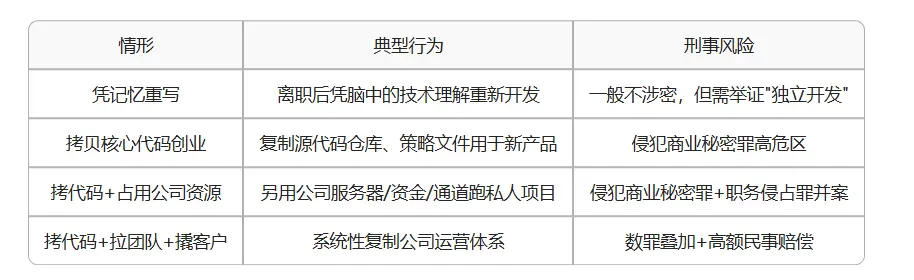
Joined Complaints: Why Enterprises Favor the "Trade Secrets + Embezzlement" Combination
This is the approach most commonly used by enterprises and also the harshest, and it merits separate discussion. If an enterprise complains solely of trade secret infringement, it must first pass the appraisal of the three elements, which is time-consuming and full of variables. But if the complaint materials also attach transaction records showing that "the suspect used company funds, computing power, and channels for private work," the resistance to case filing by the public security authorities will be much lower—embezzlement points to tangible "money," the evidence is intuitive, and the threshold for criminal liability is clear. With the two cases standing together, the breadth and intensity of the investigation are entirely different: investigating embezzlement requires obtaining all financial transaction records, and once the records are examined, traces of code exfiltration, the equity relationships of the new company, and the paths of benefit transfer all surface.For individuals, this means that an inconspicuous reimbursement form or a single misappropriation of a testing quota may become the fulcrum that collapses the entire defense.Anyone who took any advantage on the company's books before or after leaving must seek a lawyer's risk assessment as early as possible.
Recent Judicial Developments
According to public reports, in recent years, among source-code trade-secret cases concluded by courts in multiple jurisdictions, those in the fields of quantitative trading, game engines and industrial software have been especially prevalent. Judgments have generally recognized the trade-secret attributes of source code and algorithm parameters, and have directly characterized concentrated downloading before departure and external transmission via cloud storage as "obtaining by improper means" or "use in breach of confidentiality obligations." Among the typical cases published by the Supreme People's Court on protecting the rights and interests of private entrepreneurs, cases in which core enterprise technology was taken away by departing employees and ultimately resulted in criminal accountability were also selected, sending a clear signal: the threshold for criminal protection of intellectual property is being lowered, while enforcement intensity is increasing.
03 If You Are Already in the Crosshairs, Where Is the Room for Defense?
- First line of defense: attacking each of the three elements—prioritize challenging "secrecy" and "confidentiality" On secrecy: organize expert assistants to argue that the technical points at issue are common industry solutions, routine combinations of open-source components, or were long ago disclosed in relevant papers, public courses or patent literature, thereby dismantling the finding of "non-publicity." On confidentiality: examine whether the company actually had a confidentiality system—no confidentiality agreement signed, or an agreement with vague terms, code repositories readable by all staff, no audit of external transmissions, and, under an open-source culture, tacit permission for employees to sync code to personal repositories... A large number of companies in Web3 and the quantitative industry operate in an ad hoc manner, with remote collaboration and semi-open-source code being the norm; these are precisely the strongest defense materials against the "confidentiality measures" element.
- Second line of defense: the dispute over identity comparison—"similar" does not equal "the same" Similar functionality, similar approach, or even partial code similarity does not necessarily amount to substantial similarity. Key defense points: what proportion of the new company's code originates from lawful channels (open-source components, publicly known algorithms, technology sharing already made public by the former employer)? Is there evidence of independent development for the remainder (development logs, version iteration records, design documents)? A complete chain of evidence of independent development is more useful than ten assertions of "I wrote it myself."
- Third line of defense: the determination of the amount of loss and "serious circumstances." The amount is the switch that sets the sentencing tier. Directions for cross-examination: is there a causal relationship between the loss claimed by the rights holder and the conduct at issue? Was the decline in excess returns really caused by the strategy being copied, or by changes in the market environment? Is the sales revenue of the infringing product entirely attributable to the code at issue (the module at issue may account for only 5% of a product)? Pushing the amount back down from "especially serious" to "serious" is the difference between three to ten years and under three years.
- Fourth line of defense: a defensive posture on the criminal-civil boundary—preventing civil disputes from being criminalized.
This is the baseline defense: labor disputes, equity disputes and non-compete disputes should not be packaged as criminal cases. If there are unresolved equity incentive disputes or departure compensation disputes between the company and the person concerned, they should be presented in full to the investigating authorities at the earliest opportunity, and it should be argued that this case is driven by a civil dispute, so as to prevent criminal measures from intervening in economic disputes. The principle of restraint in criminal law()is not a slogan; in this type of case it is a concrete weapon of defense.
04 For Practitioners: Three Compliance Recommendations That Protect You
- First: Before leaving, reduce to zero anything you "take with you." The safest approach: Do not store any of the company's code or documents on personal devices, personal cloud drives, or personal email. When handing over upon departure, proactively ask the company to conduct a device inspection and confirm it in writing. There is only one thing you should want to take with you—the general technical ability in your head.Remember the dividing line: Taking skills with you is entirely legitimate; taking the medium (files, repositories, parameter tables) is handing over a weapon.Even if you are the sole author of the code, a work made in the course of employment()belongs to the company. This is not an unwritten rule; it is an express provision.
- Second: When starting at a new company, preserve full-process evidence of "independent development." From day one of the startup: Write the requirements documents yourself, start code repository submissions from an empty repository, keep meeting minutes of design discussions, and keep source records when using open-source components. Do not dismiss this as cumbersome—this set of practices is ordinarily engineering discipline, but when trouble arises it is "proof of innocence." A particular taboo: First copying a version and launching it, then "gradually rewriting it." An appraisal looks at the state at the time the infringing facts occurred; "it was changed later" cannot save you from "it was used back then."
- Third: Make a clean legal separation from the original company; do not leave behind grounds for a joint case.
Do not use any resources of the original company: servers, test accounts, customer lists, supplier relationships—do not touch any of them. Where funds transfers or computing power use are involved, settle them in writing. If there is a non-compete agreement, negotiate it if negotiation is needed and pay compensation if compensation is due—the cost of civil breach is predictable, while the price of a criminal case is uncontrollable. Settling every account with your former employer is the first investment in your new company.
05 Closing Remarks
There is a romantic saying in the code industry: A programmer's wealth is in their head. Criminal law recognizes this—your technical understanding and engineering experience are lawful wherever you go; but extensions of your head are not. Repositories on USB drives, compressed archives in cloud drives, and parameter tables in chat records are all assets the company built up with salaries and computing power.
Technology is not inherently wrongful, but conduct has its limits. The most tragic failure in entrepreneurship is not that the product fails, but that the product succeeds while the person goes to prison. If you are facing an intellectual property dispute with your former company over leaving to start a business, whichever side you stand on, obtain a professional assessment as early as possible and keep the battle where it belongs.
06 Aside
When handling cases of this kind, I often see technical people from the two camps trading insults: the company calls the employee an "ingrate," and the employee calls the company a "capitalist." In fact, most cases involve no such deep grievance—just a careless act, a remark to "copy it back for reference."
One detail left a deep impression on me: at the hearing in the Chen Mo case, he said what he regretted most was not starting the business, but that the night before he left, to save trouble, he did not choose to "walk away clean" with a few-thousand-yuan portable hard drive; what he traded away was several years of freedom. So now I nag everyone I meet: when handing over on departure, rather have IT format your computer three times than leave yourself a "reference file." The road is long; being clean matters most.
07 Relevant Legal Provisions
Article 219 of the Criminal Law of the People's Republic of China [Crime of Infringing Trade Secrets]
Whoever commits any of the following acts of infringing trade secrets, if the circumstances are serious, shall be sentenced to fixed-term imprisonment of not more than three years and shall also or only be fined; if the circumstances are especially serious, shall be sentenced to fixed-term imprisonment of not less than three years but not more than ten years and shall also be fined:
(1) obtaining the right holder's trade secrets by theft, bribery, fraud, coercion, electronic intrusion, or other improper means;
(2) disclosing, using, or allowing others to use the right holder's trade secrets obtained by the means specified in the preceding item;
(3) in violation of a confidentiality obligation or in violation of the right holder's requirements concerning protection of trade secrets, disclosing, using, or allowing others to use the trade secrets in his possession.
Whoever, while clearly knowing the acts listed in the preceding paragraph, obtains, discloses, uses, or allows others to use the trade secrets shall be deemed to have infringed trade secrets.
For the purposes of this Article, "trade secrets" means commercial information such as technical information and business information that is not known to the public, has commercial value, and for which the right holder has taken corresponding confidentiality measures.
Article 271 of the Criminal Law of the People's Republic of China [Offense of Occupational Embezzlement]()】
Where an employee of a company, enterprise or other entity, by taking advantage of the convenience of their position, unlawfully appropriates the property of their entity for themselves, if the amount is relatively large, they shall be sentenced to fixed-term imprisonment of not more than three years or criminal detention, and shall also be fined; if the amount is huge, they shall be sentenced to fixed-term imprisonment of not less than three years but not more than ten years, and shall also be fined; if the amount is especially huge, they shall be sentenced to fixed-term imprisonment of not less than ten years or life imprisonment, and shall also be fined.
08 Relevant Judicial Interpretations/Normative Documents
- Interpretation of the Supreme People's Court and the Supreme People's Procuratorate on Several Issues Concerning the Application of Law in Handling Criminal Cases of Infringement of Trade Secrets (Fa Shi [2025] No. 9)
- Interpretation (III) of the Supreme People's Court and the Supreme People's Procuratorate on Several Issues Concerning the Specific Application of Law in Handling Criminal Cases of Infringement of Intellectual Property Rights (Fa Shi [2020] No. 10)
09 Case Sources
- Typical Cases on the Protection of the Rights and Interests of Private Entrepreneurs Published by the Supreme People's Court (multiple batches)
- The cases in this article are adapted from publicly available judgment documents on China Judgments Online and public news reports. All names are pseudonyms, and some details have been literary embellished.

