
"The money is still in an overseas account and has not been transferred back to the mainland—do I still need to declare it?" "I just moved my coins to a different wallet, so why is there another transaction in my records?" "The internet says tax is paid at 20%—can I just calculate it that way?"
When sorting out tax issues relating to crypto assets, it is easy to start with these questions. Treating a bill received as tax due may put things in reverse. Money received in a bank account may include recovered principal; assets added to a wallet may come from work remuneration or purchases and sales, or may simply be transfers between one's own accounts. Without distinguishing among these situations, the same sum of money may be counted more than once.
Below, following the sequence of organizing materials, calculation and declaration, we explain seven questions clearly.
I. If the money is overseas, is there no need to declare it in the mainland?
You cannot look only at where the money is. First, you must determine whether you are a resident individual for purposes of PRC tax law.
Article 1 of the Individual Income Tax Law of the People's Republic of China provides that an individual who has a domicile in China, or who has no domicile but has resided in China for an aggregate of 183 days in a tax year, is a resident individual and shall pay individual income tax on income derived from within and outside China in accordance with law.
"Domicile" here does not depend on whether a property is held in one's name. Article 2 of the Implementing Regulations of the Individual Income Tax Law looks to habitual residence formed through household registration, family and economic interest relationships. Therefore, having an overseas bank card or having obtained overseas residence status does not necessarily change one's tax resident status in the mainland.
If you are indeed an "individual without domicile in China," you need to separately verify the conditions for exemption of overseas income under Article 4 of the Implementing Regulations. In that case, the number of days of residence in each year, the number of consecutive years, the duration of any single departure and the payer of the income may all affect the determination.
Next, look at where the income comes from.Receipt through an overseas platform does not necessarily mean the income is overseas-source income.Article 3(1) of the Implementing Regulations provides that income derived from providing services within China by reason of holding office, employment, performance of a contract or the like is, unless otherwise provided, income from sources within China regardless of where it is paid. For example, if a person remains in Shenzhen and develops software for an overseas company, it is not prudent to treat the remuneration as overseas-source income merely because the other party pays in digital assets.
When preparing in practice, you can first write a one-page annual summary: where you mainly lived during the year, where you worked, whether any cross-border relocation occurred, and who paid the main income. Entry and exit records and labor or service contracts can be placed afterward. Explaining your status and work facts clearly first is more helpful than directly submitting thousands of lines of transaction records.
II. If everything received is in crypto, why can it not all be uniformly calculated at 20%?
Because tax law must first distinguish:why you received this asset.
If it is remuneration for work or services, first examine the labor, employment or service relationship.Article 2 of the Individual Income Tax Law and Article 6 of the Implementing Regulations distinguish among categories such as wages and salaries, remuneration for personal services, and income from business operations. Receiving wages as an employee, independently providing development services, and organizing business in an operating manner absolutely must not be calculated under the same category.
If you purchased it yourself and then sold it, it is necessary to carefully examine whether theincome from transfer of propertyrules apply.On the premise that it is classified into this category in accordance with law, Article 6, paragraph 1, item (5) of the Individual Income Tax Law permits the original value of the property and reasonable expenses to be deducted from the transfer income. The original value of the property may first be understood as the acquisition cost confirmed under tax law. Article 3 of the same Law provides that the tax rate for this category of income is 20%. It should be noted that this 20% corresponds to the taxable income calculated in accordance with regulations, and does not refer to the entire amount received.
As for airdrops gifted by projects, rewards obtained from participating in staking, and returns obtained from lending assets, it is advisable to separately retain the project rules and acquisition records: was any service provided? was any asset contributed? was any obligation required to be assumed? Do not directly select an income category. For income items that are difficult to characterize, Article 6 of the Implementing Regulations expressly provides that they shall be determined by the competent tax authority under the State Council; when consulting, the applicable basis should be clearly asked about.
When organizing the table, the source of each asset may first be written in one sentence, for example, "remuneration for a certain development service", "purchased by myself and then sold", or "reward obtained from participating in a certain project". If remuneration was first obtained and the asset was later sold, the two acts should be recorded separately, and it should be checked how the taxable value at the time of acquisition connects with the subsequent cost.
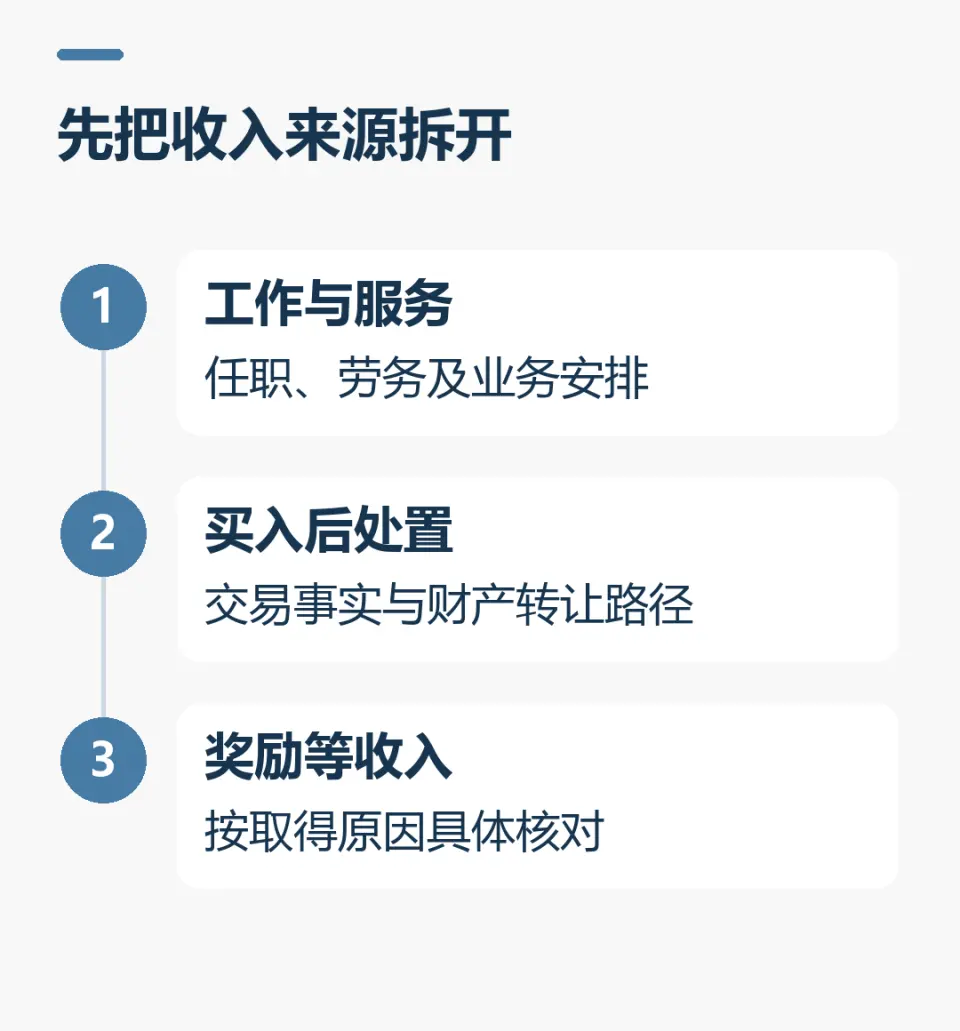
First explain where the income comes from, and then discuss which category of tax rules applies.
III. Moving funds between wallets may sometimes be nothing more than relocating assets
Suppose you transfer assets you hold from Platform A to your own wallet, and then transfer them to Platform B. Multiple records, such as withdrawals, on-chain transfers and deposits, may appear in the account, but these records do not in themselves mean that you earned money several times.
If the transfers were indeed only between accounts controlled by the same person, and no other conduct such as sale, exchange or receipt of remuneration occurred during the period, they should be distinguished from external transactions when organizing the records. You need to retain materials showing that the accounts at both ends belong to you, as well as the corresponding transfer-out and transfer-in records.
A practical approach is to assign a single number to the same transaction.Try to link together the bank payment, purchase order, wallet transfer, sale order and final receipt of funds. For each record, retain the date, type of asset, quantity, consideration, fees, order number or on-chain transaction number. If any link is missing, note beside it what still needs to be supplemented.
Crypto-to-crypto exchanges should be listed separately, recording what was exchanged out, what was exchanged in, and the price basis at the time. They differ from mere transfers between your own wallets, and their tax analysis cannot be excluded.
Accounts of family members or friends should also not be directly classified as "internal transfers by the person himself or herself." Where there are indeed arrangements such as collection or payment on behalf of another or custody on behalf of another, they should be explained separately, and the agreements and fund records at the time should be retained.
There is another detail that is easily overlooked:Keep one copy of the original files untouched, and perform cleaning and deduplication on a copy.One very important point is that after using software for categorization, you must spot-check several internal transfers, exchanges and rewards to see whether it has misidentified anything.
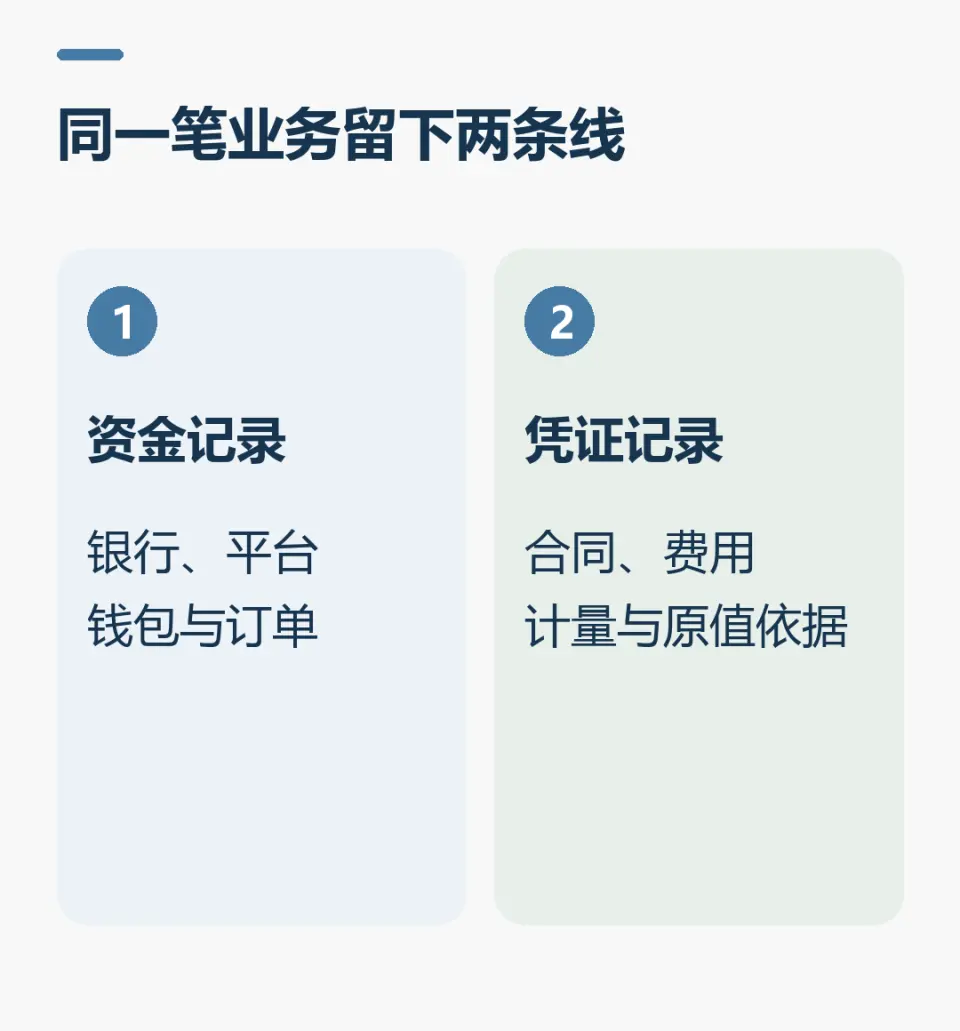
Only when the flow of funds corresponds one-to-one with the supporting materials can it be explained which amounts are income and which are merely transfers.
IV. If cost vouchers are incomplete, the tax amount may not be calculable
Assume a transaction has been confirmed to be subject to the property transfer income rules: the transfer revenue is equivalent to RMB 300,000, the recognized original value is RMB 200,000, and reasonable expenses are RMB 10,000. The taxable income is therefore RMB 90,000, and at 20%, the tax amount is RMB 18,000.
(RMB 300,000 − RMB 200,000 − RMB 10,000) × 20% = RMB 18,000
Accordingly, the key points to verify here are: what evidence supports the RMB 200,000 purchase cost? Did the RMB 10,000 in expenses actually occur, and are they deductible?
Article 16 of the Implementing Regulations provides that where complete and accurate original-value vouchers are not provided and the original value cannot be determined under the prescribed method, the competent tax authority shall determine the original value. Being able to match bank payments with platform transaction orders is the most convenient way to explain cost. Where records are missing, first apply to the platform for supplementary export, then cross-check against bank statements, on-chain records, and the contracts and correspondence from the relevant time. Reconstructed data must always be clearly marked as reconstructed.
Fees should also be organized by category. Article 16 of the Implementing Regulations defines reasonable expenses as the relevant taxes and fees paid in accordance with regulations when selling property. Whether platform commissions and on-chain fees can be included in cost or reasonable expenses should be verified against their purpose and basis.
Where purchases and sales occur in batches, the cost corresponding to each disposal must be explained. Article 17 of the Implementing Regulations calculates property transfer income on a per-transfer basis; do not offset the year's losses against gains without analysis. When using software, also verify whether the default cost method is applicable.
In addition, valuation and foreign exchange are two separate issues.Article 8 of the Implementing Regulations brings economic benefits other than cash within the scope of measuring personal income, while Article 32 separately provides for foreign currency conversion methods. When receiving digital asset remuneration, the date of acquisition, quantity, contract amount and price information should be retained; where foreign currency amounts are involved, they should then be converted into RMB under the applicable rules.
V. If tax has been paid overseas, is a mainland filing still required?
It is necessary to distinguish between "whether a filing obligation exists" and "whether additional tax is still payable."
For income obtained by resident individuals that is lawfully determined to be of overseas source, Article 13 of the Individual Income Tax Law provides that a filing shall be made between March 1 and June 30 of the year following the year in which the income is obtained. For example, 2026 overseas income falling within this scope should in principle be filed between March 1 and June 30, 2027.[1]
However, this deadline cannot be applied to all digital asset income. For example, Article 13, paragraph 1 provides that, in the general case of obtaining taxable income where there is no withholding agent, a filing and tax payment shall be made within the 15th day of the following month; overseas income has the special arrangement described above. Situations such as tax that should have been withheld but was not still require reference to the corresponding provisions, and cannot all be deferred until June of the following year.[1]
Where income tax has already been paid outside the mainland, tax credit relief may be considered. In plain terms, qualifying foreign tax already paid may be used, within the applicable limit, to offset tax payable in the mainland. Article 7 of the Individual Income Tax Law and Announcement No. 3 of 2020 of the Ministry of Finance and the State Taxation Administration provide for this.
Particular attention should be paid here: platform fees are not foreign income tax; foreign fines and late-payment surcharges likewise cannot be credited as foreign income tax. If no income tax has been levied outside the mainland, there is generally no actual tax paid available for credit; this is subject to any otherwise provision in an applicable tax treaty.
When preparing materials, keep the foreign tax returns, tax payment certificates or tax records together with the corresponding income and the year to which they relate. If the usual tax payment vouchers genuinely cannot be obtained, this need not be abandoned outright: Article 10 of the Announcement permits, subject to the corresponding conditions, the credit to be processed on the basis of the foreign income tax return or a confirmed tax payment notice, together with the corresponding bank payment voucher.
If returns for prior years have been omitted, it is advisable to review them year by year. Article 32 of the Tax Collection and Administration Law provides for a late-payment surcharge of 0.05% per day where tax is not paid on time. Whether it applies, from what date it is calculated, and whether any separate penalty applies should be checked against the specific circumstances and provisions.
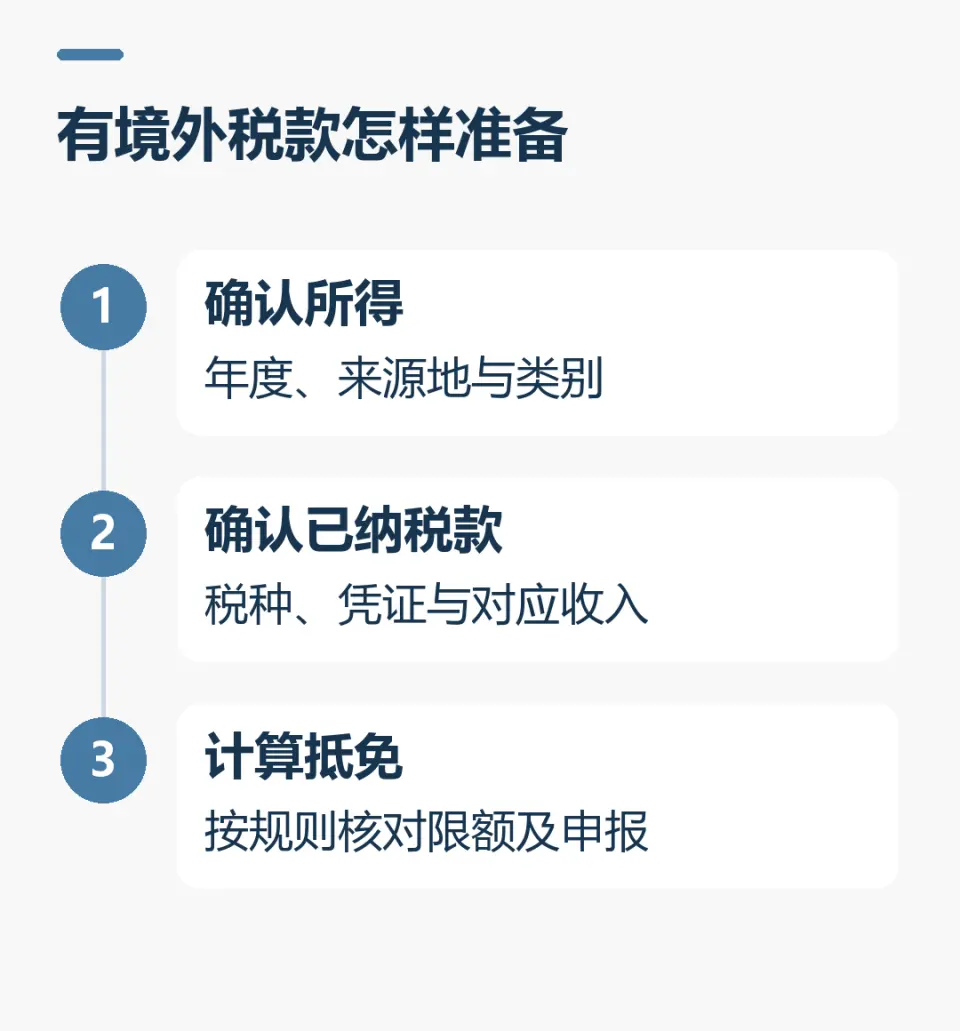
Even if tax has already been paid outside the mainland, the filing obligation still has to be fulfilled
VI. If CRS or CARF reports a certain amount, must tax be paid on exactly that amount?
Information reporting and individual tax payment are two different matters.
CRS is commonly referred to as the "Common Reporting Standard" and mainly concerns financial account information; CARF is the "Crypto-Asset Reporting Framework", which requires qualifying service providers to collect user identity and relevant transaction information and to report and exchange it under the applicable arrangements. They help tax authorities obtain information. The transactions covered by CARF include not only exchanges between crypto assets and fiat currency, but also exchanges between relevant crypto assets and related transfers.
Taking Hong Kong as an example, as at the time of verification for this article, the public statements of the Hong Kong Inland Revenue Department remain premised on the relevant draft legislation being passed: the CARF-related amendments are proposed to take effect from 1 January 2027, with the first automatic exchange arranged for 2028; the amended CRS is proposed to take effect from 1 January 2028.
At this point in time, the more useful preparation for individuals is to check the tax residency self-certification, taxpayer identification number and identity change records on the platform, and to complete them truthfully and update them promptly as required. If the total transaction amount shown on the platform differs from one's own calculation, identify the differences item by item: whether internal transfers are included, whether there is duplicate recording, or whether principal or other persons' funds are mixed in.
VII. When seeking advice, what materials should be brought and how can questions be asked more effectively?
Here, it is advisable to first prepare a two-to-three-page statement of facts, with detailed transaction records as attachments. The main text only needs to let the other party understand: who you are, which year the matter concerns, where the assets came from, how they were subsequently handled, which figures are supported by evidence, and which points remain unclear.
You can start by preparing three working papers:an annual identity schedule, setting out residence, work and cross-border changes;an income classification schedule, distinguishing remuneration, purchases and sales, rewards and internal transfers;a supporting-document index, mapping contracts, orders, bank records, on-chain records and gaps against one another.
When seeking advice, rather than merely asking "do I have to pay 20%", you should frame the question around the transaction. For example:
"This asset is remuneration I received for providing development services, and the contract and receipt records are here; I later sold part of it. At what category and at what value should it be taxed when the remuneration was received? On sale, how should the original value be carried forward? What materials are still missing?"
Article 8 of the Tax Collection and Administration Law provides that taxpayers have the right to understand tax laws, administrative regulations and tax payment procedures; Article 25 requires truthful filing in accordance with law. You may first learn about general policies and filing channels through 12366, and then submit the specific facts to the competent tax authority. As to the place of filing for overseas income of resident individuals, you may refer to Article 8 of Announcement No. 3 of 2020: filing is usually made with the competent tax authority at the place where the domestic employer or employing entity is located; where there is no domestic employer, the place is determined under the rules on registered residence, habitual residence and the like.
Where there is a large volume of materials, first select several representative transactions, present the original records, the calculation process and the proposed filing result, and then organize the remaining transactions according to the verified method. The date of the consultation, the facts submitted and the content of the reply should all be retained.
Finally, one boundary must be stated clearly:Handling tax matters does not mean making virtual asset transactions "legalized."The People's Bank of China and other authorities, in the Notice on Further Preventing and Handling Risks Associated with Virtual Currencies and Related Matters (Yin Fa [2026] No. 42), expressly prohibit, within the territory, the conduct of business such as exchange between legal tender and virtual currencies and exchange between virtual currencies, and provide for the corresponding legal liability. Where abnormal sources of funds, large-scale collection and payment of funds on behalf of others, or other disputes are involved, consideration should also be given to assessing financial regulatory, anti-money laundering and other legal risks at the same time.
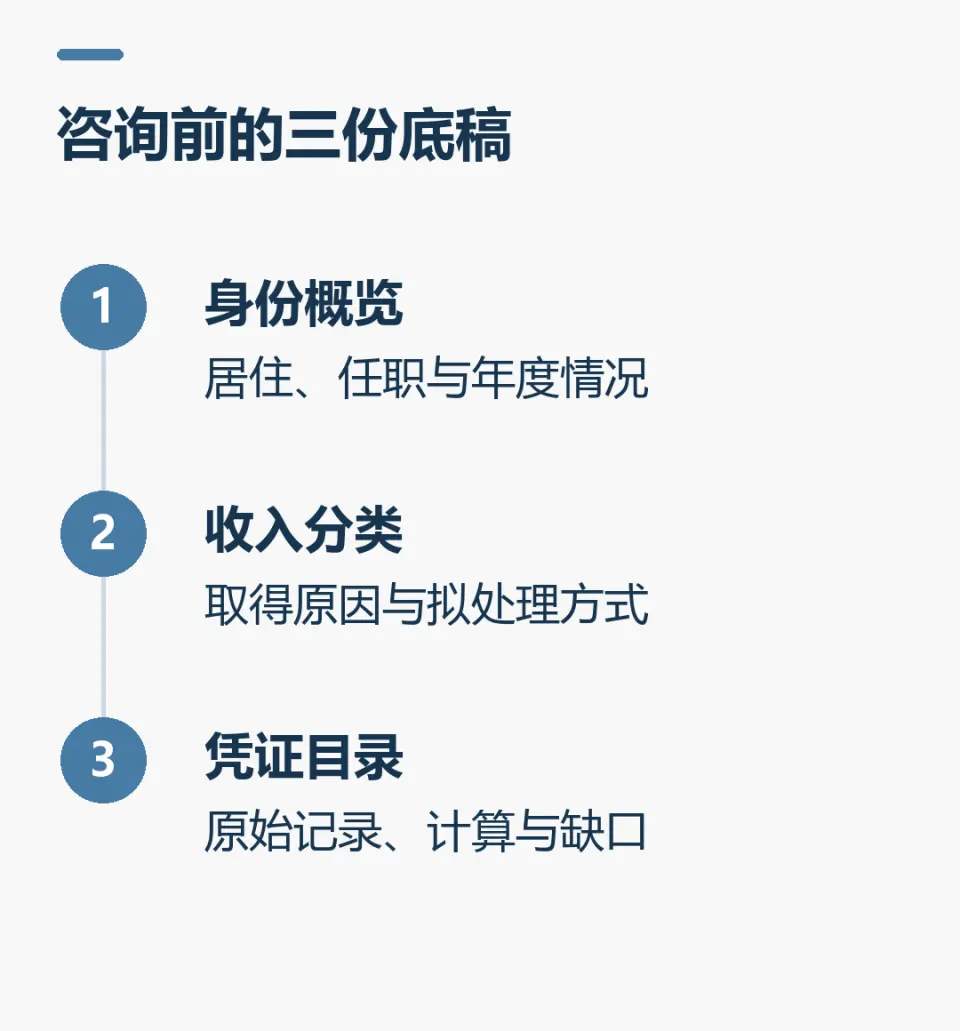
First prepare the facts and supporting documents, so that the consultation can focus on the specific transactions.
When beginning to organize the materials, there is no need to first pursue a "perfect tax schedule." Download and back up the original records, select a few typical transactions, and try to explain clearly where the money came from, why it was received, where it subsequently went, and how the cost can be proven. List, item by item, which questions already have answers and which still need to be confirmed. This statement is often the true starting point from which tax handling can actually move forward.
Note: This article is compiled on the basis of publicly verifiable rules as of October 31, 2026, for reference in legal popularization and risk identification. It does not replace legal or tax advice on specific facts, does not provide investment advice, and does not recommend or assist in carrying out unlawful transactions. Cross-border rules and implementation arrangements may change and should be re-verified before handling. The organizational suggestions in this article do not mean that the tax authorities have recognized any particular classification, valuation or cost method for crypto assets.
Main Laws and Regulations and Official Materials
The numbering in the main text corresponds to the following materials; legal rules and practical suggestions have been distinguished in the text. Verification date: October 31, 2026.
[1] Individual Income Tax Law of the People's Republic of China (2018 amendment)
Article 1 (resident status); Articles 2, 3 and 6 (classification, tax rates and tax basis); Article 7 (foreign tax credit); Articles 10, 12 and 13 (filing and deadlines); Article 16 (measurement in RMB).
Original text of the State Taxation Administration
[2] Implementing Regulations of the Individual Income Tax Law of the People's Republic of China (State Council Order No. 707)
Articles 2-4 (domicile, source location and non-domiciled individuals); Article 6 (classification of income); Article 8 (non-cash income); Articles 16 and 17 (original value, reasonable expenses and calculation on a per-transaction basis); Article 32 (foreign currency conversion).
Policy and Regulation Database of the State Taxation Administration
[3] Official Reply of the State Taxation Administration on Issues Concerning the Levy of Individual Income Tax on Income Derived by Individuals from the Purchase and Sale of Virtual Currency Through the Internet (Guo Shui Han [2008] No. 818)
Items 1–3. The applicable context is the purchase of virtual currency from players by individuals and its resale at a markup; this article does not treat this as directly equivalent to the rules governing all crypto asset transactions.
Original text of the State Taxation Administration
[4] Announcement on Policies Concerning Individual Income Tax on Overseas Income (Announcement No. 3 of 2020 of the Ministry of Finance and the State Taxation Administration)
Articles 1 and 2 (source and classified calculation); Articles 3 to 6 (credit limits, creditable tax amounts and exceptions); Articles 7 and 8 (time and place of filing); Article 10 (vouchers and supplementary credits); Article 12 (foreign currency conversion).
Policy and Regulation Database of the State Taxation Administration
[5] Law of the People's Republic of China on the Administration of Tax Collection (amended in 2015)
Article 8 (right to be informed of tax law and procedures); Article 25 (truthful filing); Article 27 (extension of the filing period subject to approval); Article 32 (late payment of tax and late payment surcharges).
Legal text of the State Administration for Market Regulation
[6] Hong Kong Inland Revenue Department: Crypto-Asset Reporting Framework
See "Overview", "Reportable Transactions", "Reporting Requirements" and "Due Diligence Requirements". These are used to explain the scope of the CARF, identity information and proposed implementation arrangements, and do not serve as a basis for tax calculation in the Mainland.
Chinese-language notes of the Hong Kong Inland Revenue Department
[7] Hong Kong Inland Revenue Department: Notes on the Inland Revenue (Amendment) (Crypto-Asset Reporting Framework and Amended Common Reporting Standard) Bill 2026
Regarding the proposed effective dates, scope of application and legislative progress of the CARF and the amended CRS. The text retains conditions such as passage of the bill and does not present planned dates as rules already in force.
Hong Kong Inland Revenue Department notes | Legislative Council bill progress
[8] People's Bank of China and seven other departments: Notice on Further Preventing and Addressing Risks Associated with Virtual Currencies and Related Matters (Yin Fa [2026] No. 42)
Part I, item (1) (legal status and related business restrictions); Part VI, items (18) and (19) (legal liability). This notice also repeals Yin Fa [2021] No. 237.
People's Bank of China publication page | Full text republished by the Shanghai Municipal People's Government
