
On September 24, 2026, a major security incident occurred at the crypto asset trading platform Bitget. According to the investigation results subsequently published by the platform, the affected assets involved in this incident were valued at approximatelyUSD 388 million。
As some of the stolen assets were cross-chain swapped through THORChain, a debate over the legal liability of decentralized protocols ensued.
On September 26, Bitget CEO Gracy Chen publicly called on X for THORChain to refuse to provide services to identified attacker addresses that were being tracked. THORChain subsequently cited Bitcoin, Ethereum and BNB Chain as examples, emphasizing its nature as a decentralized, permissionless network.
The controversy is this:THORChain does not entirely lack the ability to intervene. In May 2026, after it itself suffered an attack, its nodes suspended the relevant business through emergency measures and governance mechanisms. Since it can suspend transactions, why can it not prevent known stolen funds from continuing to be swapped?
This question has prompted discussion among different positions within the industry.
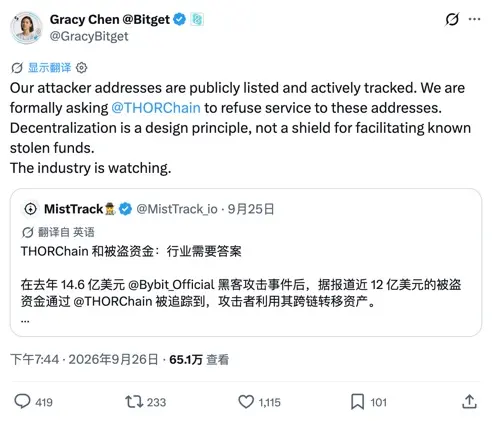
Gracy Chen called on THORChain to refuse to provide services to publicly disclosed attacker addresses. Source: X, September 26, 2026.
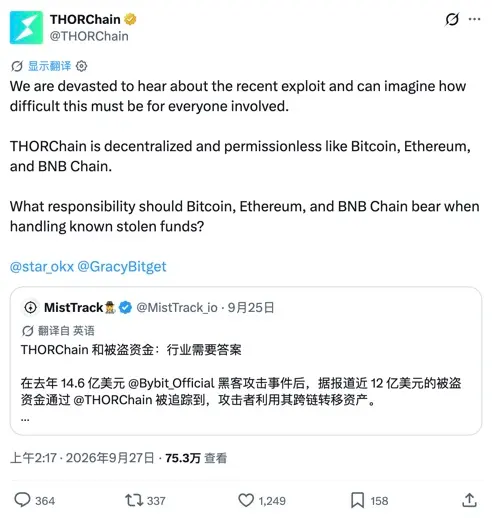
THORChain cited Bitcoin, Ethereum and BNB Chain by analogy in responding to what responsibility the network should bear. Source: X, September 27, 2026.
This debate appears to be between a trading platform and a decentralized protocol, but it actually involves three deeper questions: First, is THORChain a public chain that merely provides basic ledger-keeping functions, or does it also perform asset swap and fund operation functions? Second, when control over assets is dispersed among multiple nodes, is there still an entity that should bear legal liability? Third, when an attacker's address has already been publicly flagged, under what conditions are the relevant participants obliged to review, refuse the transaction, or even freeze the assets? Answering these questions requires first understanding THORChain's technical structure, and then returning to the regulatory rules of different jurisdictions.
What is THORChain, technically and legally?
Technically, THORChain is an independently operating blockchain that also provides cross-chain native asset swaps within its protocol.
The term "native assets" means that what the user receives is an asset such as BTC on the Bitcoin network, rather than a token on another chain that represents BTC. It has its own accounting and consensus system, as well as dedicated liquidity pools, vaults and node signature mechanisms for completing swaps.
Taking the swap of ETH for BTC as an example, the whole process mainly consists of three stages:
Step one: the user transfers in assets.
The user sends ETH to a THORChain vault address on the Ethereum network, and network nodes observe and confirm this deposit.
Step two: the protocol executes the swap.
THORChain completes internal pricing and swapping through liquidity pools. Its native token RUNE serves as the link between different asset pools, and users do not need to purchase or hold RUNE themselves.
Step three: the vault pays out BTC.
Based on the swap result, the protocol arranges for the Bitcoin vault to pay BTC to the address designated by the user, and the nodes jointly complete the outbound transfer through a threshold signature mechanism.
Throughout the process, ETH and BTC were received and paid on their respective native chains; there was no operation of moving ETH directly onto the Bitcoin network.
Who signed the transfer out of this BTC is key to understanding the dispute.
THORChain uses a Threshold Signature Scheme (TSS), which distributes the secret information required for signing among the nodes participating in vault management. Under the normal protocol rules, the relevant nodes can jointly produce a valid signature only after reaching the prescribed joint-signing threshold. Ordinary swap users do not hold signing shares for the vault, and a single node generally cannot independently complete a vault transfer.
This means that THORChain disperses authority over fund operations through technical mechanisms, but does not thereby eliminate the fund-control link in the swap process. It should be emphasized thattechnically dispersed control does not mean that security vulnerabilities or control risks are absent under all circumstances.。 The security incident that occurred at THORChain itself in May 2026 involved an attacker exploiting a vulnerability in the threshold signature scheme to gradually obtain information on other nodes' key shares and ultimately reconstruct the relevant vault private key.
From the perspective of business function, THORChain not only provides block validation and transaction record-keeping, but also continuously completes swaps and payments between different assets through liquidity pools, vaults and node mechanisms. This is also a distinction worth discussing between it and the base-layer consensus nodes of Bitcoin and Ethereum.
Legally, the key is not simply to classify THORChain as a "public chain" or a "decentralized trading protocol," but to further identify:which participants actually provide swap services, and which participants have control over or sufficient influence on funds and business operations.
It could be halted before, so why can addresses not be blocked now?
Whether THORChain has the ability to intervene is one of the most closely watched issues in this debate.
According to THORChain's official Q2 2026 report, after the protocol itself was attacked on May 15, the automatic solvency check mechanism first triggered the relevant suspension, and node operators subsequently took further manual suspension and governance measures. Following security remediation, the network gradually resumed operation around June 22.
This record shows that THORChain does not entirely lack mechanisms for coordinated intervention. But the issue is:the ability to suspend part of the business and the ability to precisely prevent a particular external address from making swaps are not the same technical capability.
According to THORChain's public development documentation, the protocol has pause mechanisms at several different levels.
Trading Halt, which is mainly used to suspend swap processing related to a specific chain.
Signing Halt, which can prevent new outbound transactions from being signed and executed, while pending transactions may enter a queue.
Chain Halt, which further affects nodes' monitoring and processing of transactions on a specific external blockchain.
In addition, the operation of THORChain's own blockchain and the suspension of cross-chain swap services cannot be fully equated. The suspension of part of the business does not necessarily mean that the entire chain will stop producing blocks. These mechanisms can be triggered through specific emergency operations, and they also involve nodes coordinating and governing through the Mimir parameter system.
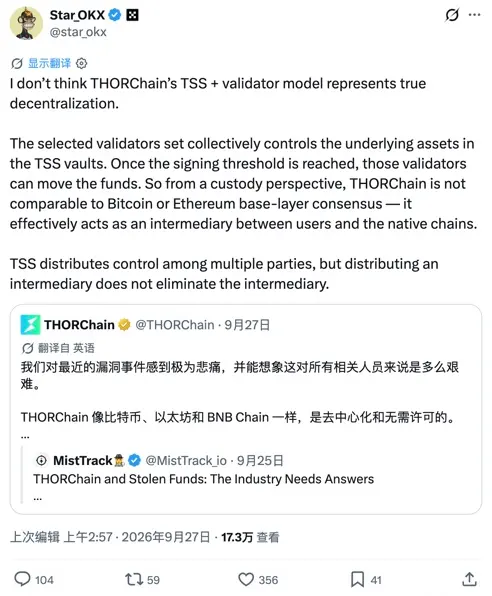
Star questioned the public blockchain analogy and emphasized the common control and intermediary function of the THORChain vault. Source: X, September 27, 2026.
From this, three issues can be further distinguished.
First, is there technical capability to intervene?
Yes. Publicly available information can establish that nodes may, under specific conditions, coordinate the suspension of swaps, signing, or external chain observation and other operations.
Second, can the existing mechanisms be used to impose a uniform block targeting only a particular attacker address?
No affirmative conclusion can be drawn directly. The existing public control documentation lists primarily mechanisms for intervention by business, chain, or network scope, and does not show a general-purpose operational switch that can directly impose a uniform block on any arbitrary external address.
If the relevant swaps on a given chain are suspended, other legitimate users may be affected at the same time; if only a particular web interface is restricted, that may not necessarily prevent users from using the underlying protocol through other access methods.
Third, does the ability to take a certain technical measure mean that the measure must be taken as a matter of law?
The answer is likewise not automatically affirmative. Technical capability can help regulators identify actual control, but it cannot independently determine whether a legal obligation exists. Whether specific measures must be implemented still requires an assessment of the legal status of the relevant entities, the applicable jurisdictions, the risk facts, and the specific legal basis.
In July 2026, the Financial Action Task Force (FATF) published a thematic report on DeFi that further discussed control mechanisms such as emergency switches and upgrade permissions. The report emphasized that the significance of such permissions for determining control should be assessed in light of the nature of the permissions, the manner in which they are used, and other facts.
Therefore,THORChain's prior suspension records can establish that it has certain business intervention capabilities, but it cannot be directly inferred from them that all of its nodes must execute the address-blocking request made by Bitget.
For decentralized protocols, who ultimately bears legal responsibility?
The more important legal question behind this debate isHow to identify the responsible entities in decentralized finance operations。
Traditional financial services often involve a relatively clearly defined operating company, fund manager or trading intermediary. In DeFi protocols, however, a single business may be carried out jointly bydevelopers, node operators, liquidity providers, governance participants and front-end service providersjointly.
When no single entity is able to independently control the entire business, does this mean that there is no one who should bear legal responsibility?
Existing international regulatory rules do not support such a simplistic conclusion.
FATF: Look not only at the protocol name, but also at control and business functions
In its 2021 guidance on virtual assets and virtual asset service providers, the FATF has already clearly distinguished the underlying technology from specific financial service activities. Among these,paragraph 63includes, within the scope of identifying relevant service activities, the provision of exchange between virtual assets for or on behalf of another person as a business;paragraph 67further points out that DeFi application software itself is not a virtual asset service provider (VASP), but if the relevant creators, owners, operators or other persons exercise control over the businesshaving control or sufficient influence, and actually providing or actively facilitating regulated services, may still meet the definition of a VASP. Correspondingly,Paragraph 83distinguishes entities that merely participate in basic network activities such as block creation, validation and broadcasting.
It follows that,although they likewise participate in the operation of a blockchain network, merely validating transactions and actually providing asset exchange services do not necessarily carry the same legal status under regulatory standards.
This analytical framework applies equally to THORChain. Nodes observe transactions, execute consensus and co-sign; liquidity providers supply the assets required for exchanges; developers maintain the code; and wallets or websites that integrate the protocol provide users with an operational entry point. Different participants differ in their permissions, sources of revenue and actual business roles,and they cannot be uniformly characterized as regulated operators merely because they are connected to the protocol。
Conversely,the absence of a unified operating company behind the protocol does not by itself preclude identification of the specific responsible entities。
collective control may also constitute control for purposes of legal assessment
In THORChain's vault arrangements, a single node generally cannot complete a transfer independently, and fund operations require the coordination of multiple nodes. However, when discussing the transfer, custody and administration of virtual assets, the FATF Guidance has expresslyMulti-signature arrangements and joint control by multiple parties do not automatically exclude regulatory oversightControl does not necessarily always manifest as a single person holding the complete private key.
International Organization of Securities Commissions (IOSCO) IOSCO In its 2023 policy recommendations on DeFi, it also discussed scenarios in which formal or informal groups jointly provide financial services. Accordingly, regulators may comprehensively examine whether nodes and other participantsare able to continuously influence business operations, adjust key parameters, control asset operations, or benefit from the relevant servicesHowever, the existence of collective operational authority does not mean that each individual node operator among them necessarily constitutes the same type of regulated entity.Whether relevant services are provided to others in a business manner remains an important condition for the assessment.
EU MiCA: Full decentralization requires case-by-case determination
RecitalMiCAof the EU Markets in Crypto-Assets Regulation (paragraph 22) excludes crypto-asset services provided in a fully decentralized manner and without intermediaries from the scope of the Regulation. In a response published by ESMA in May 2026 and adopted by the European Commission, the Commission reiterated that whether a platform is fully decentralized should be determined by the competent authoritiesassessed on a case-by-case basis according to the specific circumstances。
This means that the protocol's adoption ofdistributed nodes, automatic execution mechanisms, or self-described "non-custodial" status, is not by itself sufficient to determine its regulatory status. In particular, where the business in practice provides services to a specific jurisdiction, it is still necessary to assess the matter separately under local rules.
Taken together,decentralization changes the organizational form of financial services, but does not automatically eliminate the legal identification of the actual operator and controller.
After receiving a notification of a hacker address, who is obliged to cooperate in recovering the assets?
Returning to this incident. Bitget's request that THORChain refuse to provide services to the publicly disclosed attacker address is arisk notification and cooperation requestfrom the victim. It can provide transaction leads and help relevant participants identify risks, butit is not equivalent to a court judgment, a regulatory decision, or an asset freeze order capable of direct enforcementOn the other hand, if the relevant participants are already entities subject to anti-money laundering obligations under applicable law,Nor may one simply exclude one's own risk review and reporting obligations on the ground that no court order has yet been received.。
Here, four different legal acts must first be distinguished.
First, reviewing and reporting suspicious transactions.
Taking U.S. rules as an example, under the FinCEN provisions applicable to money services businesses (MSBs), money transmitters and other entities falling within the applicable scope may be required to file, with respect to transactions that they process or attempt to process, that meet the relevant monetary threshold and exhibit statutory suspicious circumstances,a suspicious activity report (SAR).。
The threshold ordinarily prescribed by the relevant rules isUSD 2,000 for a single transaction or for related transactions in the aggregate, and the criteria include circumstances in which the institution knows, suspects, or has reason to suspect that the transaction involves illicit sources, among others.
Such obligations do not require first obtaining a criminal judgment against the attacker. However, the precondition for applying these rules is that the relevant participant is in fact subject to the relevant U.S. law and meets the corresponding requirements as to the obligated entity and the transaction conditions.The mere fact that a node has participated in cross-chain transactions on a global scale does not give rise to a direct presumption that it bears the full anti-money laundering obligations of a U.S. money transmitter.
Second, refusing to continue providing services.
For service providers already subject to regulation, if the relevant address or transaction presents a clear risk, they may be required, under applicable law and their own risk management requirements, to adoptenhanced review, restrict business, or refuse to continue processing the transactionand other measures. The legal basis, factual foundation and operational authority required for these measures are not entirely the same.
For example, an operator controlling a conversion webpage or wallet front end may be able to restrict some operations at that entry point; however, if the underlying protocol remains open, users may also submit transactions through other entry points.
Therefore,a front-end restriction does not inherently amount to a network-wide ban。
Third, freezing existing assets
Freezing assets is another layer of legal issues. The guidance of the U.S. Department of the Treasury's Office of Foreign Assets Control (OFAC) on virtual currency explains that, where the relevant sanctions provisions apply and the conditions are met, such as the entity holding or controlling assets that should be frozen in accordance with law, entities subject to the rules need to adopt correspondingfreezing and reporting measures。
However, a distinction should be drawn:
• "a certain address being publicly labeled by Bitget as an attacker address"
• “The address involves property that must be frozen under applicable law.”
These twoare not the same legal fact.The former may serve as a lead for further investigation and review, while the latter requires the satisfaction of the corresponding legal conditions.
A suspicious transaction report itself does not automatically confer on a service provider the authority to seize another person's assets at will.
Fourth, return of stolen property
Even if the relevant assets have already been frozen in accordance with law, thisdoes not mean that they can be directly handed over to the party making the request.The return of assets generally also requires consideration ofownership, judicial proceedings, the content of orders and applicable law.A more practical issue is thatcontrol over cross-chain assets may have already changed.。
For example, after funds are exchanged intonative BTC through THORChain and paid to an external Bitcoin address, those BTC are no longer under the control of the original THORChain vault. Merely suspending subsequent exchanges does not allow the BTC already transferred out to be directly recovered.
This is also a practical difficulty faced in asset recovery in decentralized finance.
Asset recovery cannot focus solely on the underlying protocol
Even if the underlying protocol has no directly identifiable unified operator, other participants with operational authority may still exist in the course of fund flows.
In its July 2026 DeFi thematic report, the FATF further emphasizedthe importance of identifying control and tracing risk-management points along the flow of fundsimportance.
For example:
• Centralized trading platforms or custodial service providers: may take compliance measures with respect to accounts and assets they actually control.
• Stablecoin issuers: may freeze the relevant tokens when they have the corresponding control capability and the legal conditions are met.
• Wallet and swap front-end operators: the business they actually provide may be subject to independent regulation.
• Other regulated financial services institutions: when conducting business with DeFi protocols, they still need to fulfill their own applicable compliance obligations.
Of course, there are limits to the measures different entities can take. A stablecoin issuer may, under the corresponding conditions, restrict the tokens it is able to control, butcannot directly freeze native BTC that has already been exchanged and transferred to an external addressLikewise, the fact that a wallet connected to THORChain has front-end administrative permissions doesnot mean it can change the transaction rules of the entire underlying protocol。
Therefore, for the injured party, a more effective asset-recovery approach is not to broadly require all relevant nodes to bear the same obligation, but rather toidentify, along the asset flow, the participants that actually have control, statutory obligations and practical ability to dispose of the assets。
Mankun Law Firm Summary
The dispute between Bitget and THORChain cannot simply be reduced to the proposition that "decentralization should be subject to regulation" or that "decentralized networks inherently bear no liability."
Decentralization may change how control is allocated, but it does not automatically eliminate the legal liability that relevant participants may bear.
Whether THORChain is required to respond to the ban request raised by Bitget cannot be concluded solely on the basis of its public-chain identity, its vault multi-signature mechanism or its previous shutdown records. What truly needs to be identified is:which participants actually provide regulated exchange services, what operational authority they hold, and which jurisdictions' legal obligations apply to them.
It must likewise be made clear that refusing to continue providing services, reporting suspicious transactions, freezing existing assets and returning stolen property are four distinct legal issues. Public disclosure by the injured party may serve as an important lead for risk review, but it cannot directly substitute for the statutory conditions for freezing or the basis for judicial disposition. Entities that bear anti-money-laundering obligations under law also cannot delegate the compliance requirements they are required to fulfill entirely to community voting.
For the DeFi industry, legal liability does not automatically disappear merely because there is no unified operating company; for injured parties, asset recovery likewise cannot stop at demanding that the protocol as a whole shut down, but should further identify the participants that truly possess control and statutory obligations in the course of asset flows.
What merits attention in this dispute is not only whether THORChain should execute Bitget's request, but also how, when a financial service is jointly completed by multiple participants, the law should identify the actual operators, delineate the boundaries of liability, and establish enforceable rules among security, compliance and decentralization.

