
Since the second half of 2025, major global crypto exchanges have launched a wave of competition to list US stock trading. Leading platforms such as Kraken, Coinbase, Bitget and Binance have successively launched or announced tokenized US stock trading services. At the same time, traditional trading infrastructure such as the New York Stock Exchange and Nasdaq is also actively developing on-chain securities settlement solutions. Tokenized US stocks are rapidly evolving from a marginal experiment in the crypto industry into a core intersection between traditional finance and on-chain finance.
However, in this competition that appears to be led by exchanges, a fact that has received relatively little public attention is that:behind the vast majority of the above products, the same underlying infrastructure is shared, provided by a US-licensed self-clearing broker-dealer named Alpaca through its "instant tokenization network" solution.This article provides a comprehensive interpretation and analysis of how this infrastructure operates and why it is able to support almost the entire tokenized US stock market.
Mark Greenberg, Global Head of Consumer at Kraken, said: "Tokenized stocks are not a future concept... deepening our collaboration with Alpaca enables us to accelerate this trajectory and establish an institutional-grade baseline standard that defines how real-world assets (RWA) flow between traditional finance and on-chain rails."
Obstacles and dilemmas of the traditional tokenization model
Converting US-listed stocks into tokens transferable on a blockchain, the so-called "tokenization of US stocks", is a complex proposition spanning two sets of financial infrastructure. On one side of this proposition is a securities market system with more than two hundred years of history, composed of the US Securities and Exchange Commission (SEC), the Financial Industry Regulatory Authority (FINRA) and the Depository Trust & Clearing Corporation (DTCC); on the other side is a blockchain world that has existed for only a little over a decade and takes decentralization and permissionlessness as its core concepts.These two systems differ significantly in legal logic, clearing and settlement mechanisms, investor protection frameworks and operating models, making the tokenization of US stocks, for a considerable period of time, not only a technical challenge but also an institutional problem.
- Compliance custody dilemma for underlying assets
The primary premise of tokenizing US stocks is that for every token circulating on-chain, there must be one genuine US-listed security as underlying support; otherwise the token would become a synthetic exposure without a physical anchor and lose the core significance of tokenization.This means there must be an entity to legally purchase, hold and custody these underlying securities. However, this seemingly basic requirement faces severe institutional obstacles in reality.
Under the US Securities Exchange Act of 1934, only broker-dealers registered with the SEC may legally buy, sell and hold securities for others. The SEC's customer protection rules further require broker-dealers to maintain“Physical possession or control”.
The concept of “physical possession” for traditional securities is relatively intuitive: it means locking stock certificates in a vault, or having a record in the electronic book-entry system of a depository trust company (DTC). However,crypto asset securities exist on the blockchain and are controlled by private keys. In such contexts, what does “possession” mean? Does holding a private key equate to “physical possession”?For a long time, the SEC did not provide a clear answer to these questions. The direct consequence of this regulatory gray area is that the vast majority of traditional broker-dealers avoid business involving blockchain and crypto assets, fearing that once they are found not to satisfy customer protection rules, they will face severe regulatory penalties.
2. Friction across multiple stages in minting and redemption
Tokenization is not a one-time act but a continuous, dynamic process. Tokens need to be continuously minted (created) and redeemed (burned) driven by market demand, so as to maintain a balance between the token supply and the underlying assets. Under the traditional model, this process faces a serious dilemma of friction across multiple stages:
(1)First, the issue of settlement delayThe U.S. securities market operates a T+1 settlement regime. After a trade is executed, the change in ownership of the securities requires one business day to be finally completed at the level of the securities depository system (DTC). This means thateven if the tokenization platform issues a buy order for the underlying stock immediately after receiving a minting request, the formal settlement of the securities still must wait until the next daywhereas token transfers on the blockchain are instantaneous. This asymmetry creates a structural timing mismatch, namely that the on-chain tokens are already in circulation, but the underlying securities supporting them have not yet completed settlement.
(2)Second, the issue of process frictionIn the absence of unified infrastructure, a single minting operation may require the coordination of multiple systems and multiple intermediaries. Specifically, after an investor's buy order is sent to one broker-dealer, clearing must be handled by another clearing firm, custody confirmation must be issued by a third party, and finally the token issuer mints on-chain.Each step has its own timetable, interface protocols and points of failureThe entire process may take hours or even days. Redemption of the tokens is the reverse execution of the above process and likewise faces the same multi-step, multi-intermediary friction.
The direct consequence of this high friction is the failure of the arbitrage mechanismIn theory, when the secondary-market price of a token deviates from the value of the underlying asset, arbitrageurs should restore the price through minting or redemption. However, when minting and redemption themselves require hours or even days to complete, arbitrageurs cannot respond quickly to price deviations, and it becomes the norm for tokens to trade at a premium or discount over the long term.This not only harms investor interests but more fundamentally undermines the core function of "tokens tracking the underlying asset".
3. The liquidity fragmentation problem
Another structural problem in the early tokenized U.S. equities market is the fragmentation of liquidity.Owing to the absence of a unified infrastructure layer, tokenized products from different issuers cannot interoperateFor example: an investor holding Apple stock tokens issued by Issuer A cannot directly convert them into Apple stock tokens issued by Issuer B, even if both track exactly the same underlying asset.
In essence, the so-called "fragmentation" arises mainly at two levels.First, at the issuer level, different issuers use different legal structures (for example, some tokens legally represent a debt relationship, while others represent an equity relationship), blockchains and custody arrangements. The tokens they create are mutually isolated "islands."Second, at the exchange level, tokens from the same issuer may trade at different prices across centralized exchanges and decentralized exchanges, and the efficiency of cross-platform arbitrage is constrained by the speed of minting and redemption.
The above-described liquidity fragmentation directly limits the depth and efficiency of the tokenized U.S. equities market, making it difficult to attract institutional-grade capital and thereby trapping it ina vicious cycle of “low liquidity → low attractiveness → low liquidity.”vicious cycle.
Early Exploration of and Setbacks in Tokenization
To achieve the goal of tokenizing equities, the crypto industry began exploring multiple pathways around 2017. Classified by the method of underlying asset backing, these attempts can be broadly grouped into three categories: (1) the DeFi synthetic model without physical backing; (2) the centralized exchange custody model with physical backing but reliant on an offshore structure; and (3) the STO model of issuing new securities under an existing regulatory framework. All three made some progress along different dimensions, but ultimately all failed or were eliminated by the market due to their respective structural defects. Specifically:
First, in thesynthetic asset model, the underlying logic is to create synthetic tokens that track U.S. equity prices through an on-chain over-collateralization mechanism, without any need for a broker, underlying securities or regulatory license. This model completely bypasses the core difficulty of holding real U.S. equities. However, because there are no real shares as underlying backing, investors obtain only a “price-tracking contract,” not economic exposure to real assets. When the value of collateral fluctuates sharply, the peg may collapse within hours. At the same time, the lack of institutional market-maker participation results in extremely shallow on-chain trading depth. More importantly, such “synthetic U.S. equity tokens” are essentially financial derivatives that track the prices of U.S.-listed securities and are highly likely to constitute “securities” or “security-based swaps” under federal securities law; if the issuer has not made any registration or applied for an exemption, this will give rise to significant regulatory compliance issues.
Second, in thecentralized exchange custody modelIn this model, exchanges attempt to provide real underlying asset backing while circumventing U.S. domestic regulatory constraints through offshore legal structures. However, the structural flaw of such models is that four layers of intermediaries separate investors from the underlying assets, namely “exchange → offshore subsidiary → financial intermediary → brokerage firm.” The excessively long chain renders investor protection nominal, and the segregation and transparency of the underlying assets depend entirely on the exchange's unilateral statements and cannot be independently verified. At the same time, these tokens have never obtained formal recognition from the SEC or FINRA, nor do they possess genuine on-chain circulation characteristics. They can only be traded within the platform and are essentially records in the exchange's database rather than blockchain-native assets.
Third, in thesecurity token offering (STO)model, issuers primarily rely on the SEC's existing exemption framework to issue tokens representing securities interests, and complete registration or exemption applications and make disclosures in accordance with federal securities law requirements. However, the core scenario that the STO model addresses is the issuance of new securities, not the mapping onto the blockchain of existing shares already listed and traded on Nasdaq or the New York Stock Exchange; this model cannot comprehensively resolve the other issues involved in tokenizing U.S. stocks.
From the above analysis, it can be seen that the obstacles to traditional tokenization models essentially point to the same core contradiction, namely:the deep conflict between the immediacy, permissionlessness and global reachability of blockchain and the heavy regulation, long cycles and high thresholds of the U.S. securities marketThe crypto industry's three attempts each confirm, from different angles, the difficulty of resolving this contradiction. Together, the above attempts and failures outline the key elements that stock tokenization must break through:
First, one (or several) self-clearing broker-dealers holding complete U.S. securities market qualifications is needed as the underlying anchor, providing the indispensable compliant custody and clearing capabilities for tokenization.
Second, a low-friction, near-real-time minting and redemption mechanism is needed so that arbitrageurs can effectively maintain the peg between token prices and the value of the underlying assets.
Third, tokenization models need to obtain explicit recognition at the regulatory level from the U.S. SEC and the Financial Industry Regulatory Authority, rather than operating in a gray area.
Fourth, the tokens themselves need to possess genuine on-chain native characteristics—free circulation, cross-platform trading and embeddability in DeFi protocols—otherwise tokenization is merely a marketing label rather than substantive technological progress.
How does Alpaca and its “Instant Tokenization Network” solution innovate, and why did it succeed?
Alpaca was founded in Silicon Valley in the United States in 2015. Its core business is to provide clients with trading, clearing and custody services for U.S. securities in the form of APIs (application programming interfaces) through its licensed broker-dealer subsidiary, Alpaca Securities LLC. Alpaca can independently complete all stages of securities trading, from execution to clearing, settlement and custody, without relying on third-party clearing institutions. Building on these core capabilities, Alpaca launched the "Instant Tokenization Network" in October 2025, bringing a new integrated solution to the aforementioned structural obstacles to the tokenization of U.S. equities.
To understand why this solution is effective, one must begin with its underlying architecture. The "Instant Tokenization Network" is not a single technology, but a complete institutional and technical framework involving three types of participants and spanning both the off-chain securities world and the on-chain token world. Specifically:
1. The three-party participation structure of the "Instant Tokenization Network"
To fully understand the operating mechanism of this tokenization network, it is first necessary to understand the three core types of participants involved and their respective roles:
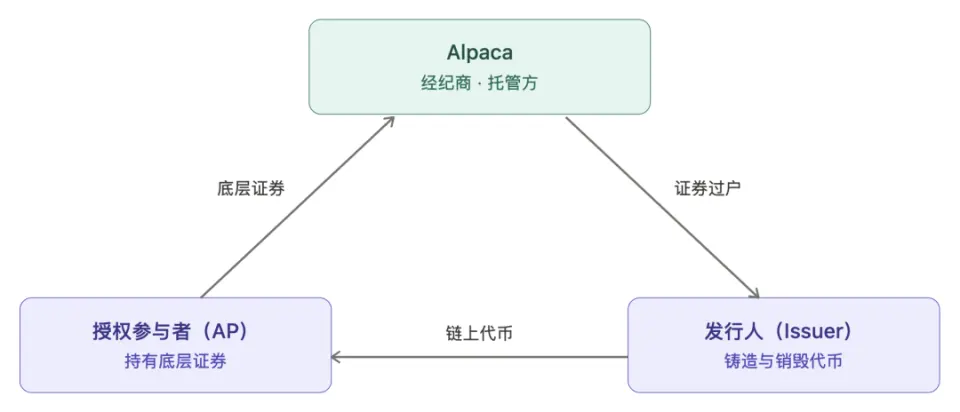
The first type of participant is the "Issuer"Issuers are the creators that issue tokens; they are third-party companies entirely independent of Alpaca. Issuers are responsible for designing the legal structure of the tokens, selecting the blockchain network for deployment, and executing the minting (creation) and burning of tokens on-chain.
The second type of participant is the "Authorized Participant" (hereinafter "AP")APs are institutional clients that use the tokenization service, typically non-U.S. affiliates of crypto exchanges, professional market makers or digital asset brokers. As the bridge connecting the off-chain U.S. equities world and the on-chain token world, APs' core function is to complete the minting and redemption of tokens in the primary market. APs are required to open a brokerage account with Alpaca, hold genuine U.S.-listed securities in that account, and on that basis apply to the issuer to mint a corresponding number of tokens.
The third type of participant is Alpaca itselfAlpaca's role in the tokenization network is precisely defined as "broker and custodian." Alpaca itself neither issues tokens nor distributes tokens on-chain; its own core function is, as a licensed U.S. self-clearing broker, to purchase, clear and custody the underlying U.S. equities, and to execute securities transfer operations between APs and issuers.
The design logic of the above three-party structure almost precisely replicates the classic architecture of the traditional ETF marketIn the ETF market, fund companies (such as BlackRock) are responsible for designing and managing products, authorized participants (such as Goldman Sachs and Jane Street) are responsible for maintaining the balance of supply and demand for ETF shares through the creation/redemption mechanism, and custodian banks (such as State Street) are responsible for holding the underlying assets. The only difference between the two is that ETF "shares" exist in the traditional fund share registration system, whereas the "shares" of the tokenization network exist on the blockchain in the form of tokens.
2. Token Minting and Redemption Mechanisms of the "Instant Tokenization Network"
How exactly does a genuine U.S.-listed share, through tripartite collaboration, become step by step a token on a blockchain? This is precisely the core operational process of the "Instant Tokenization Network," namely the task to be accomplished by "minting":
Step One: The AP purchases the underlying shares at AlpacaThrough its brokerage account opened at Alpaca, the AP purchases genuine U.S.-listed shares (such as Apple AAPL, Tesla TSLA, etc.) on the U.S. securities market.This step is identical to any normal U.S. equities trade, that is, Alpaca as broker executes the purchase order, clearing and settlement are completed through DTCC/NSCC, and the underlying shares are ultimately held in DTC's electronic book-entry system, recorded in Alpaca's name.
Step Two: The AP initiates a minting requestBy calling the standardized API interface provided by Alpaca, the AP submits a minting request. The key information contained in this request includes: the ticker of the underlying security (such as AAPL), the minting quantity, the selected issuer, the target blockchain network, and the on-chain wallet address provided by the AP to receive the tokens.
Step Three: Dual verificationThe minting request is verified separately by Alpaca and the issuer. Alpaca verifies: whether the AP has been authorized to conduct tokenization operations, and whether the AP holds a sufficient quantity of the underlying shares in its brokerage account. The issuer verifies: whether the wallet address provided by the AP has been registered on the issuer's platform, and whether the requested tokens are available on the designated blockchain network.
Step Four: Alpaca executes the securities transferThis is the most core innovative element of the entire minting process. After verification is passed, Alpaca, in its internal book-entry system, "transfers" the underlying securities from the AP's brokerage account to the brokerage account opened by the issuer at Alpaca.
It should be particularly noted that the so-called "journaling" here is not a new market purchase or sale transaction, but rather a book-entry transfer of securities ownership between two accounts within the same self-clearing broker-dealer.Precisely because this is merely an internal bookkeeping operation within Alpaca, and Alpaca itself is a direct participant in the Depository Trust Company (DTC) system, this transfer can be completed instantaneously. It does not need to go through the T+1 settlement cycle, does not need to be externally cleared through the NSCC, and does not need to wait for confirmation from any third party. This design fundamentally breaks the "T+1 delay at the minting stage" dilemma described above.
Step Five: The issuer mints tokens on-chainAfter receiving Alpaca's transfer confirmation, the issuer mints the corresponding number of tokens on the designated blockchain network and delivers them to the wallet address designated by the AP. At this point, a complete minting process is concluded: one token has been added on-chain, and one genuine underlying share has been added off-chain to the issuer's brokerage account at Alpaca, thereby establishing a 1:1 physical backing relationship.
Meanwhile, "Redeem" is the reverse operation of "minting," namely the process of "converting on-chain tokens back into real U.S. equities"In short, the AP first sends the tokens it holds on-chain to a burn address designated by the issuer, and the issuer burns these tokens on-chain. Subsequently, Alpaca executes a reverse transfer in its internal bookkeeping system, transferring the corresponding number of underlying securities from the issuer's brokerage account back to the AP's brokerage account. The AP thereby regains the real underlying U.S. equities, which it may sell in the regular U.S. securities market or continue to hold.The above redemption mechanism ensures the bidirectional enforceability of the anchoring relationship between the tokens and the underlying assetsIf tokens could only be minted but not redeemed, investors would be unable to convert the tokens back into real assets, and the value of the tokens would lose its ultimate exit channel.
3. How is the "instant tokenization network" solution innovative, and why is it effective?
If viewed in isolation, none of the steps in the above minting and redemption process constitutes a major technological breakthrough. Buying stocks, book-entry transfers, and on-chain minting each have mature practices in their respective fields.The true value of this tokenization solution does not lie in inventing some entirely new technology, but rather in the fact that, through a carefully designed institutional and technical architecture, it integrates operations originally scattered across multiple intermediaries and multiple systems into a complete, efficient, and compliant assembly line, thereby systematically responding to the various structural obstacles previously faced by U.S. equity tokenization solutions. Its innovativeness can be summarized as follows:
**First, achieving a compliance closed loop through a single self-clearing broker-dealer.The "Instant Tokenization Network" consolidates the entire lifecycle of the underlying securities (purchase, clearing, settlement, custody, and transfer) within Alpaca, a single self-clearing broker-dealer holding full U.S. securities market qualifications.The underlying securities are at all times held in custody at the U.S. central securities depository system (DTC) and remain fully covered by the regulatory regime. Regardless of how the on-chain tokens circulate, the legal status of the underlying assets and the level of investor protection are not downgraded by tokenization. **This design fundamentally resolves the "compliant custody dilemma" described above; it no longer requires the participation of multiple layers of offshore intermediaries, and the safety of the underlying assets is backed by the institutional safeguards of U.S. federal securities law.
Second, bypassing the T+1 bottleneck through a "transfer rather than trade" mechanism. The most ingenious design of the "Instant Tokenization Network" lies in the fact that, in the minting and redemption process, the transfer of the underlying securities is not effected by buying and selling anew on the market, but is accomplished through book-entry transfer within Alpaca. If each minting required purchasing a new block of shares on the market, it would be necessary to wait for the T+1 settlement cycle to complete before confirming that the underlying securities were in place. However, if the AP already holds the underlying shares in its Alpaca account, the transfer is merely a book-entry adjustment between two accounts within the same broker-dealer and can be completed instantaneously.As a result, the delay in the entire minting process is compressed from "several hours to several days" under the traditional model to near real-time.
Third, instant minting and redemption promote the formation of efficient price anchoring.Because minting and redemption can be completed in near real-time, arbitrageurs are able to respond rapidly when the secondary market price of the tokens deviates from the net asset value of the underlying assets. When the tokens trade at a premium, arbitrageurs profit by minting new tokens and selling them. When the tokens trade at a discount, they redeem the tokens to recover the underlying shares. This mechanism is consistent with the logic by which authorized participants in the ETF market maintain the anchoring of ETF market prices to net asset value.
Fourth, a common infrastructure layer supports liquidity interoperability across issuers.As noted above, tokens issued separately by different issuers were originally isolated from one another, forming liquidity "islands." The "Instant Tokenization Network" provides a path to resolve this problem.Because the underlying U.S. equities of different issuers are all custodied at Alpaca, an AP may first redeem Issuer A's tokens to recover the underlying shares, and then use the same batch of shares to mint new tokens with Issuer B. The entire process involves only two instantaneous book-entry transfers within Alpaca, without any need to buy and sell the shares anew on an external market.This mechanism successfully establishes a liquidity bridge between the tokens of different issuers, achieving liquidity interoperability.
Fifth, standardized API interfaces enable global access. The API-centric architectural design of the "Instant Tokenization Network" means that any authorized partner—whether a crypto exchange, a market maker, or a fintech company—can access the U.S. equity tokenization infrastructure through standardized interfaces without having to obtain the full set of U.S. securities market licenses itself.Once a token is minted on-chain, it possesses all the characteristics of a crypto asset: it can be freely transferred to any compatible wallet, traded across platforms, and embedded in DeFi protocols as collateral or liquidity pool assets. This enables global investors to gain exposure to U.S. equities through their existing crypto infrastructure.
To date, the 'instant tokenization network' solution has had a significant impact on the landscape of the U.S. equity tokenization market. As the only compliance-ready infrastructure provider operating at scale that combines self-clearing broker capabilities with on-chain tokenization technology integration, Alpaca has rapidly become the dominant player in this field.According to data disclosed by Alpaca, as of the end of 2025, its assets under custody for tokenized U.S. equities and ETFs had exceeded USD 480,000,000, and it held approximately 94% of the tokenized U.S. equities market.The above developments show that this solution not only technically validates the feasibility of tokenizing U.S. equities within a compliance framework, but also commercially demonstrates that this model has genuine market demand and scalable growth potential.
The innovation of Alpaca's 'instant tokenization network' solution is, in essence, not an answer to a technical question, but an answer to an institutional question.The real bottleneck in tokenizing U.S. equities is not blockchain technology itself, but the lack of a connection point between the two financial systems that is simultaneously trusted and recognized by both. Alpaca occupies this unique connection point in its capacity as a licensed self-clearing broker, enabling the traditional securities system to connect with the blockchain world without changing its own rules. The solution succeeds precisely because it does not seek to subvert either side; rather, it finds a compatible gap within the respective logic of the two systems and embeds itself as an irreplaceable infrastructure layer. Its path offers an important insight for understanding the convergence of crypto finance and traditional finance: the force that truly drives the two worlds toward convergence is often not a challenge to existing institutions, but a clever reuse of them.
The original article was first published on the WeChat public account 'Mankun Law Firm', authored by Su Zitao (lawyer).