At the end of June this year, 62-year-old Ng Kai-wah (Wu Qihua) disclosed to Hong Kong media that he had licensed his likeness as a 20-year-old to an AI company to make a film in which he himself would not need to appear on set.
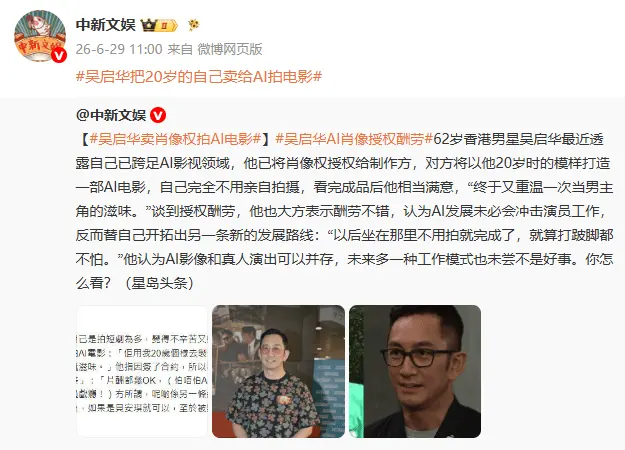
Image source: Internet
In mid-July, Wang Zuxian, who retired from acting 22 years ago, licensed her likeness from her peak years, between the ages of 20 and 30, to the NetEase game Tianxia; the AI-generated promotional short film Qianying went live, and Nie Xiaoqian spoke again.

Image source: Internet
These two deals look like endorsements, but they are not. An endorsement sells "the use of photos and videos I have already shot"; what is being sold here is "the use of data about my appearance to generate content I have never shot."
If your company is signing, or plans to sign, this kind of contract with artists or internet influencers, the template in hand is most likely still the traditional likeness licensing package. This article explains clearly: why copying it over will cause problems, and what those problems are.
Traditional likeness licensing licenses a single photograph
Let us start with the baseline. The law's position is simple: your face is yours to control, and anyone who wants to use it must obtain your consent. Consent is given through a licensing contract: you may license a magazine to print the photo on its cover, or license a brand to put your image in an advertisement.
Civil Code
Article 1018: A natural person enjoys the right to likeness and has the right to make, use, publicly disclose, or authorize others to use their own likeness in accordance with law.
Likeness is the external appearance of a specific natural person that can be identified as reflected in a certain medium through images, sculpture, painting, or other means.
The key point is that what is licensed is an image that already exists. The photo has already been taken, the video has already been edited, and where it will be used, for how long, and how many copies will be printed are all set out clearly in the contract. When the collaboration ends one day, the posters are taken down and the film is removed from distribution, and the matter is closed.
AI portrait licensing hands over a set of data
AI licensing follows an entirely different path. What the producer obtains is not a few stills, but images from Wu Qihua's early films Hail the Judge and Healing Hands, which are used for modeling: facial features, physique and other such characteristics are all turned into training data. Once trained, the model can generate any footage of him 'performing' at age 20, including scenes he has never filmed in his life.
By way of analogy: traditional licensing is selling printed posters to others, whereas AI licensing is handing over the printing press together with the template of your face. The analogy is also imprecise: a printing press only makes copies, while a model can be fine-tuned and layered with new data to generate things even you have never seen.
The law treats this set of data differently from a photograph. Faces and voiceprints are biometric information, which the Personal Information Protection Law places in the most strictly regulated tier: sensitive personal information.
Civil Code
Article 28 Sensitive personal information means personal information that, once leaked or illegally used, is likely to result in infringement upon the human dignity of a natural person or harm to the safety of his or her person or property, including biometric information, religious beliefs, specific identity, medical health, financial accounts, whereabouts and whereabouts tracks, and other such information, as well as the personal information of minors under the age of 14.
Personal information processors may process sensitive personal information only where there is a specific purpose and sufficient necessity and strict protective measures are taken.
Article 29 To process sensitive personal information, an individual's separate consent shall be obtained; where laws or administrative regulations provide that written consent shall be obtained for processing sensitive personal information, such provisions shall prevail.
To translate 'separate consent': one must ask specifically about this matter and obtain a separate nod of approval; it cannot be buried in some annex to a contract of a dozen or more pages. The departmental rule governing deep synthesis restates this in Article 14 of the Provisions on the Administration of Deep Synthesis of Internet Information Services:
Article 14 Deep synthesis service providers and technical supporters shall strengthen the management of training data and take necessary measures to ensure the security of training data; where training data contains personal information, the relevant provisions on personal information protection shall be complied with.
Where deep synthesis service providers and technical supporters provide editing functions for biometric information such as faces and voices, they shall prompt users of deep synthesis services to inform the individuals being edited in accordance with the law and obtain their separate consent.
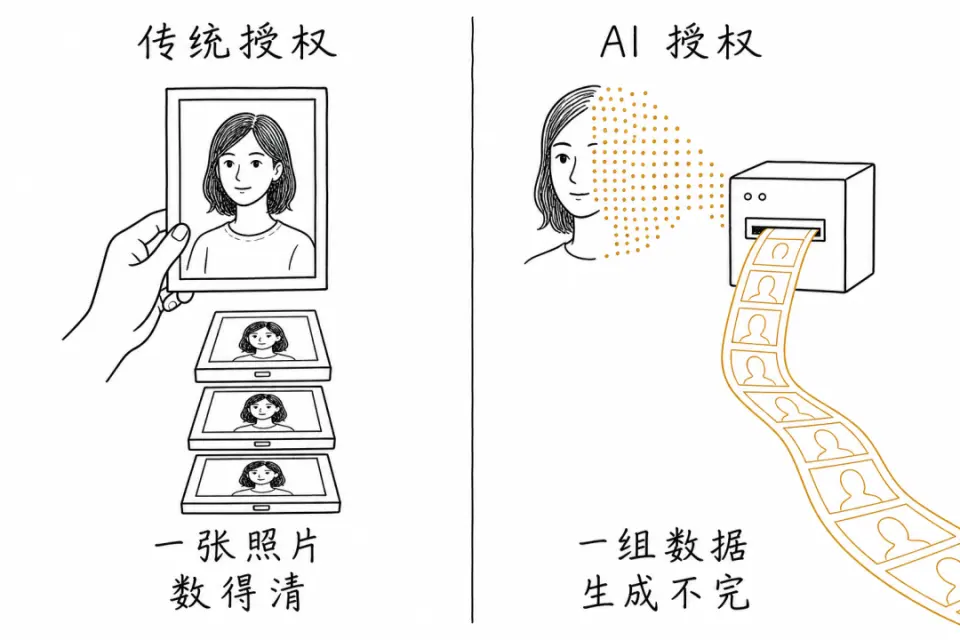
Differences between the two types of licensing
So a single AI portrait authorization is, legally speaking, at least two layers of transactions stacked together: one layer is a license of portrait rights, and the other is an authorization to process sensitive personal information. The rules, risks and exit mechanisms of the two layers are all different. The trouble starts right here.
Can a single authorization keep unlimited generation in check?
The first trouble: where are the boundaries of the authorization?
A traditional contract saying "Party A authorizes Party B to use Party A's portrait for promotional purposes" is good enough. In AI scenarios, that sentence is a bottomless pit. Does using the material to train a model count as "use"? Do new images generated by the model count as "Party A's portrait"? What about using the trained model for other projects?
The Beijing Internet Court has decided a case that I consider the most relevant judgment in this field. A voice actor had recorded an audio work for someone, and the rights license for the recording was granted cleanly and completely. The other party then handed the recording to a software company for AI processing and turned it into a text-to-speech product, in effect cloning her voice and selling it. The court's conclusion was clear: an authorization for the sound recording does not equal an authorization for AI-enabled use of the voice, and it awarded damages of RMB 250,000 (case number: (2023) Jing 0491 Min Chu No. 12142).
Replace the sound recording with a human face, and the reasoning is exactly the same:Having licensed the material does not mean having licensed the use of the material to train a model.If you want the right to train, the contract must state the word "training" in black and white.
What if it is written ambiguously? The Civil Code has long had the answer ready, and it is anything but gentle to the party receiving the authorization.
Article 1021: Where the parties dispute the understanding of the clauses on the use of a portrait in a portrait licensing contract, the interpretation shall be made in favor of the person holding the portrait rights.
Translated, this means that where the scope of authorization is disputed, the court will uniformly interpret it in the direction favorable to the celebrity. You think you bought it outright; the court says you only rented it for one specific purpose. When this rule was written into the Code, AI generation had not yet appeared, but its weight in the AI era is far greater than it was back then, because there is simply too much ambiguity in AI contracts.
If the celebrity changes their mind, what happens to the model?
The second problem is even more critical.
Assume the contract is perfectly drafted, with training permissions, generation boundaries, use scenarios and authorization periods all clearly set out. Two years later, the celebrity says: I don't want to continue; my image planning has changed; give my face back to me. Is that permissible?
In most cases, yes.
Civil Code
Article 1022 Where the parties have not agreed on the term of the license to use a portrait or the agreement is unclear, either party may terminate the portrait licensing contract at any time, but shall notify the other party within a reasonable period in advance.
Where the parties have clearly agreed on the term of the license to use a portrait, the portrait rights holder may terminate the portrait licensing contract if there are legitimate reasons, but shall notify the other party within a reasonable period in advance. If the termination causes losses to the other party, compensation shall be made, except where the cause is not attributable to the portrait rights holder.
In a portrait licensing contract, the law leaves the portrait rights holder a door that can be pushed open at any time: for a contract without a specified term, it can be terminated by giving advance notice; for a contract with a specified term, as long as there are legitimate reasons that can be justified, the portrait rights holder can still exit after compensating for losses. This right of termination is directly conferred by law, and contractual clauses cannot block it. What counts as "legitimate reasons" is determined by the court, but judicial practice has consistently shown a clear inclination toward protecting personality rights.
At the personal information level, the exit mechanism under the Personal Information Protection Law is even more direct.
Article 15 Where personal information is processed based on the consent of the individual, the individual has the right to withdraw their consent. Personal information processors shall provide convenient methods for withdrawing consent.
The withdrawal of consent by an individual does not affect the validity of personal information processing activities already carried out based on the individual's consent before the withdrawal.
Note the second paragraph; this is one of the few places that is friendly to AI companies: withdrawal does not affect prior processing, and a model that has already been trained will not become an illegal product merely because of the withdrawal. However, under the current understanding of the rules, from the moment of withdrawal, using the model to generate new content means each generation is a new processing activity, and the basis for authorization no longer exists.
The regulator intends to go further. In April this year, the Cyberspace Administration of China published the Measures for the Administration of Digital Virtual Persons for public comment, one provision of which states: after a natural person withdraws consent, the digital virtual person shall be deregistered. Note the wording: not suspended, but deregistered. These measures have not yet taken effect, and the provisions may change, but the direction is already on paper: if the person leaves, the model must follow.
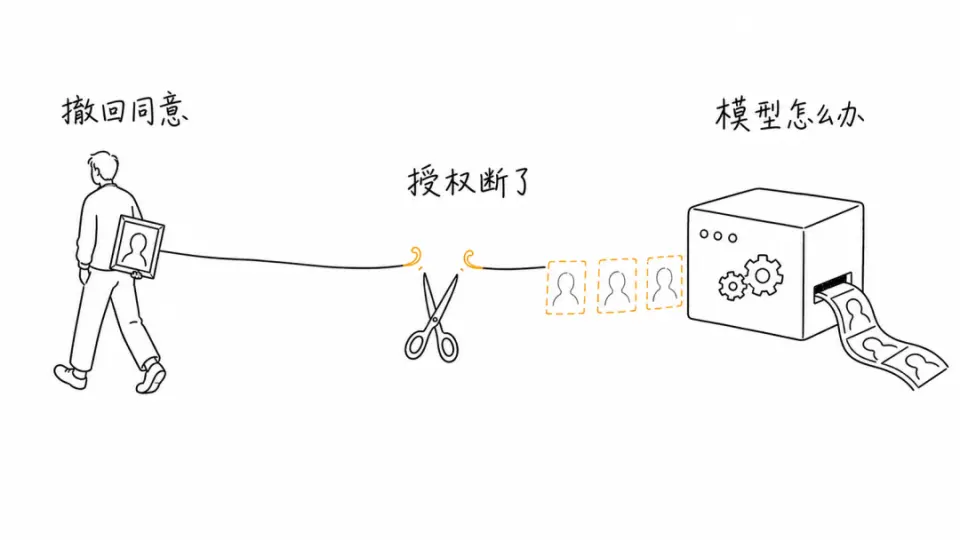
The model's position after withdrawal
For AI companies, this means the accounts must be recalculated. A model you spent millions training is a commercial asset, but legally it is something whose authorization may be revoked at any time. If the contract has no pre-established exit mechanism, then how much data is deleted, how the model is handled, and whether already published content can be retained all remain unresolved, leaving this investment in limbo.
What Wang Zuxian's contract did right
By comparison, Wang Zuxian's authorization appears to have circumvented each of the pitfalls above one by one.
There are only three use scenarios: the advertising short film "Qianying," a digital NPC in a game, and a set of exclusive costumes, with any extension to livestreaming, short videos, and film and television shooting expressly prohibited. The authorization serves only the single game "Tianxia," and no other projects are involved. Voice is simply not authorized; professional voice actors were engaged for dubbing, and no original voice is extracted at all. All generated content is labeled as AI-generated.
The scenarios are countable, the boundaries are firmly drawn, and the voice remains in her own hands; each item narrows the gray areas described above.
The Americans go further. At the federal level, the NO FAKES Act (still at the proposal stage) would require that a license agreement for a digital replica set out a specific description of the intended use; if it is not clearly stated, the license is invalid. A single license during a person's lifetime may not exceed 10 years and must be signed in writing. The collective agreement between the Hollywood actors' union and producers also provides that creating a digital copy of an actor requires 48 hours' advance notice and the actor's separate signature, and may not be buried in standard-form terms. Judgments on both sides of the ocean converge by different paths: in this type of contract, ambiguity equals invalidity.
Two authorizations, signed separately
Back to the question in the title. Selling your face to AI does not mean selling photographs of your face; it means selling the data of your face, plus a license to use that set of data to continuously generate new content. These are two separate matters and should be signed as two authorizations, or at least as two independent parts of one contract: one portrait-right license governing how generated content may be used, and one biometric data processing authorization governing how the data is collected, trained on, stored, and deleted.
If you are an AI company, game manufacturer, or short-drama producer about to sign, the contract should at minimum clearly address four matters. Authorize training and generation separately, with item-by-item pricing; list the scenarios, term, media, and territory one by one, and do not use "etc." or "related" as catch-alls, because when such wording is tested in court it will be interpreted against the drafter; make the data clauses a separate chapter, clearly stating the retention period and deletion mechanism and prohibiting transfer to third parties for retraining; and design the exit mechanism in advance, so that when a celebrity terminates or withdraws, how the data is deleted, what happens to the model, and whether already launched content can be retained are all set out as contract terms.
If you are an artist's team or an MCN, the logic is reversed: the right to terminate and the right to withdraw are natural bargaining chips in your hands, so do not contract them away; such an agreement may not be valid, but it will create obstacles to enforcing your rights. When quoting a price, remember that what you are handing over is not a usage fee for a few photographs, but rent for a set of data assets that can be reused indefinitely.
A word for ordinary people as well: these rules cover you too. If an app uses your selfie as a face-swap template or clones your voice from your recordings, the fact that content you have published is public does not mean you have consented. The Beijing Internet Court made this clear in the face-swap template case: public does not equal authorized (Case No. (2023) Jing 0491 Min Chu 3820).
Wu Qihua said he is "not afraid even if it cripples me"; that confidence comes from the contract, not from AI. Technology has turned a face into an asset that can continuously generate money, and the legal position has so far been consistent:Assets can be traded, but personality cannot be bought outrightWhen signing this type of contract, rather than litigating after the fact, it is better to set out the terms clearly, clause by clause, in advance.
I am a practicing lawyer, and in my daily work I help AI companies and content teams handle this type of licensing contract. If you happen to have an "AI portrait license" that you are about to sign, you are welcome to leave a message on our official account; whether the cage of terms is sturdy can be seen at a glance.
Reference Sources
- Articles 1018, 1021 and 1022 of the Civil Code of the People's Republic of China, official full text published by the Standing Committee of the National People's Congress
- Articles 15, 28 and 29 of the Personal Information Protection Law of the People's Republic of China
- Article 14 of the Provisions on the Administration of Deep Synthesis of Internet Information Services
- Cyberspace Administration of China, Measures for the Administration of Digital Virtual Human Information Services (Draft for Comment), April 2026
- Voice actor's voice used in AI-generated form case, Beijing Internet Court (2023) Jing 0491 Min Chu No. 12142
- AI face-swap template case, Beijing Internet Court (2023) Jing 0491 Min Chu No. 3820
- China News Service, "Wu Qihua Sells His 20-Year-Old Self to AI to Make a Film," July 2, 2026
- 36Kr · Wenyu Xiansheng, "From Francis Ng to Joey Wong: Why Are Celebrities Willing to 'Sell' Their Faces to AI?", July 24, 2026
- Guancha.cn · Xinchao Guanyu, "Joey Wong and Francis Ng Have Both Sold! The 'Older Generation' Returns with Their Peak Looks", July 24, 2026
- Guduo Network Film and Television, "From Francis Ng to Joey Wong: The AI Portrait Licensing Business Is Not So Simple", August 3, 2026
- U.S. NO FAKES Act (April 9, 2025 proposed version); SAG-AFTRA 2023 collective agreement
Author of this article:Lü Yinghui, a lawyer at Mankun Law Firm (Shenzhen). A graduate of China University of Political Science and Law, with nearly a decade of deep experience in the legal industry, having previously worked at a court in Shenzhen. Focused on legal services in the new-generation economy, with extensive practical experience and deep insights in fields such as Web3 and artificial intelligence. Account on all platforms: Lao Lü Talks New Money; you are welcome to follow.