On May 19, 2025, the Shanghai No. 2 Intermediate People's Court issued a final ruling on a case involvingstock-trading robots: the appeal was dismissed and the original judgment upheld.
The first-instance trial concerned Zhong, the CEO and actual controller of a technology company. The company developed quantitative stock-trading SaaS software, marketed under the name "DIY stock-trading robot." The Jing'an District Court found at first instance that he had committed the crime of illegal business operations and sentenced him to five years and nine months' imprisonment and a fine of RMB 2 million; for the crime of copyright infringement, it sentenced him to three years and nine months' imprisonment and a fine of RMB 3 million; with the penalties for the multiple crimes combined, he was to serve seven years and nine months and pay a total fine of RMB 5 million.
The form of this product does not sound unfamiliar at all today. Customers paid RMB 28,800 for VIP service and, within the software, using data, models and parameters provided by the company, determined for themselves which "track" to buy into and how to allocate funds; once preset conditions were triggered, the software automatically bought and sold the corresponding stocks. Translated into 2026 terms: the user configures the strategy, and the Agent is responsible for execution.
It was not only the boss who went to prison. I went through the judgments in the related cases: the director of the product technology R&D department, the technical lead, two technical department managers, the sales director, the deputy sales director, six sales managers and sales staff, plus an outside programmer who had sold only one interface program, were all convicted and sentenced. The case numbers are (2024) Hu 0106 Xing Chu Nos. 836, 1246 and 813, and (2025) Hu 0106 Xing Chu Nos. 66 and 214.
If you are currently building an AI product that can read the market, select stocks and place orders on behalf of users, or if you plan to integrate such functions into an existing business, this article is about the walls you will run into. They were not built in 2026; the most critical one was written in 2012.
The law does not look at what technology you use
In December 2012, the CSRC issued the Interim Provisions on Strengthening the Regulation of Securities Investment Consulting Business Conducted Through "Stock Recommendation Software," which took effect on January 1, 2013. When this document was drafted, large models did not yet exist; what was popular on the market were various "stock analysis master" CDs and dongles. But the definition it gives for "stock recommendation software" is based on function, not on technology.
1. "Stock recommendation software" as referred to in these Provisions means software products, software tools or terminal devices that have one or more of the following securities investment consulting service functions:
(1) providing investment analysis opinions concerning specific securities investment varieties, or predicting the price trends of specific securities investment varieties;
(2) providing recommendations on the selection of specific securities investment varieties;
(3) providing advice on the timing of buying and selling specific securities investment products;
(4) providing other securities investment analysis, forecasts or advice.
Software products, software tools or terminal devices that have the function of aggregating securities information or compiling historical data statistics on securities investment products, but do not have the functions listed in items (1) to (4) above, do not constitute "stock recommendation software."
If any one of the four items is met, your software is stock recommendation software in the legal sense. Whether behind it is a string of if-else statements, a gradient boosting tree, or an Agent connected to a large model, the law does not ask.
The proviso in the final sentence of this article is the only safe exit in the entire document: software that only aggregates information and compiles historical data statistics does not count as stock recommendation software.
The next article, Article 2, is the one that directly catches promoters.
II. Selling or providing "stock recommendation software" to investors and directly or indirectly obtaining economic benefits constitutes engaging in securities investment consulting business, and a license from the China Securities Regulatory Commission must be obtained to qualify for securities investment consulting business.
Without obtaining the qualification for securities investment consulting business, no institution or individual may use "stock recommendation software" to engage in securities investment consulting business.
Selling software, selling memberships, selling courses with bundled tools, or selling tablets with pre-installed software—as long as economic benefits are obtained directly or indirectly, this constitutes engaging in securities investment consulting business and requires a CSRC license. Please note the word "license." The 2019 revision of the Securities Law changed securities service businesses such as accounting, legal, valuation, rating and information technology to a filing system, leaving only investment consulting in the approval category.
Article 160, Paragraph 2: Engaging in securities investment consulting services shall be subject to approval by the securities regulatory authority under the State Council; without approval, no services may be provided for securities trading and related activities. Engaging in other securities service businesses shall be reported to the securities regulatory authority under the State Council and the relevant competent departments under the State Council for filing.
Filing is like registering with the market regulatory department to open a restaurant—once all materials are submitted, it counts; approval is like applying for a Pharmaceutical Business License to open a pharmacy—the authorities must first review you and then approve you before you may operate. The analogy is not entirely precise; the difference is that investment advisory licenses have basically not been newly approved in recent years, and the actual difficulty is much higher than opening a pharmacy.
What is the cost of not having a license?
Launching a service without obtaining a license means the first bill that comes due is an administrative penalty. There is a widespread misunderstanding that needs to be corrected first: many articles online say that unlicensed stock recommendation is subject to a fine of at least RMB 500,000 even without illegal gains. That is Article 213 of the Securities Law, which governs licensed securities investment consulting institutions conducting business beyond their permitted scope. If you do not hold a single license, that article does not apply to you.
What actually applies is the 1997 Interim Measures for the Administration of Securities and Futures Investment Consulting, which remains in force to this day.
Article 32: Anyone who, without the permission of the China Securities Regulatory Commission, engages without authorization in securities or futures investment consulting business as provided in Article 2 of these Measures shall be ordered to cease by the local securities regulatory office (CSRC), and shall be subject to confiscation of illegal gains and a fine of not more than the amount of the illegal gains.
An order to cease, confiscation of the money earned, and then a fine not exceeding the money earned. In other words, the monetary cost at the administrative level is roughly capped at twice the illegal gains.
The real numbers look like this. On November 4, 2024, the Guangdong Securities Regulatory Bureau penalized Wu Mou-ping, who used Xiaoe-tech to sell courses and drive traffic, recommended stocks in video courses and livestreams, shared settlement statements in WeChat groups, and took a share of profits from stock recommendations. From August 2017 to June 2022 he earned a total of RMB 2,551,700. The basis was precisely Article 3, paragraph 1, Article 12, paragraph 2, and Article 32 of these Interim Measures. He was ordered to forfeit RMB 2,551,700 and fined RMB 2,000,000, totaling more than RMB 4.5 million. The fine was lower than the illegal gains, which is the effect of the words "not more than the equivalent amount." Small amounts are punished the same way: in October 2024, the Qingdao Securities Regulatory Bureau penalized Li Mou-xin, whose illegal gains were RMB 16,900, with a fine of RMB 16,000. The significance of this figure is not the amount, but that the regulator has no line for "too small to bother with."
Licensed institutions are also being penalized. In 2025, 15 licensed investment advisory institutions had new client acquisition suspended; Beijing Zhongfang Xinfu and Qingdao Damos were revoked of their business licenses; in early 2026, five institutions including Jiufang Zhitou and Tianxiang Wealth were suspended again, and the regulator simultaneously made clear that during the suspension period they may not conduct business in disguised form under the name of "investor education."
So the real risk escalation is not at the administrative level, but at the criminal threshold. Under the filing and prosecution standards effective May 15, 2022, the prosecution standard for the crime of illegal business operations is an operating amount of RMB 1 million or more, or illegal gains of RMB 100,000 or more. Many articles online still cite the old thresholds of RMB 300,000 and RMB 50,000; those were the 2010 standards and were changed long ago. What does RMB 1 million mean for an AI tool sold on an annual fee: at a price of RMB 3,000, that is 333 paying users. Once you cross that line, the penalty is no longer a fine, but a fixed-term prison sentence.
Article 225: Whoever, in violation of State regulations, commits any of the following illegal business operations, disrupting market order, and the circumstances are serious, shall be sentenced to fixed-term imprisonment of not more than five years or criminal detention, and shall also, or shall only, be fined not less than one time but not more than five times the illegal gains; if the circumstances are especially serious, shall be sentenced to fixed-term imprisonment of not less than five years, and shall also be fined not less than one time but not more than five times the illegal gains or have property confiscated:
(3) illegally engaging in securities, futures, or insurance business without the approval of the relevant State authorities, or illegally engaging in fund payment and settlement business;
The parameters are set by the users themselves. Can that reduce liability?
This is what everyone who builds a tool says as their first reaction: the stocks are chosen by the users themselves, the parameters are adjusted by the users themselves, and we only provide the tool.
Xundong Quantitative did indeed leave the parameters to users, which is the source of the word "DIY." The second-instance court's answer was: although clients could independently set some parameters, those parameters played a relatively minor role, and the stock-selection model provided by the company played a decisive role in stock selection; the act of developing the stock-selection model should be recognized as an act of recommendation.
The explanation given by the handling procuratorate is even more direct: the robot automatically selects stocks and automatically places orders, which appears to be a machine operating according to fixed algorithmic logic without human intervention, but the machine's stock-selection logic is set by humans, and what the software actually provides to clients is still a machine selecting, on behalf of humans, stocks that conform to human stock-selection logic; in essence, it is still human recommendation of stocks.
This passage is even more damaging to today's AI products than it was when written. In the rule-engine era, one could still argue about who exactly set the parameter weights; by the large-model era, the things decided by the product provider are only more numerous: what data to train on, how to write the system prompt, which research reports to retrieve, what the output template looks like, and under what conditions to trigger reminders. The little input users can change carries ever less weight in the entire chain.
In other words, the criterion of "playing a decisive role" is almost automatically satisfied for AI Agents. The smarter you make the product and the less users have to worry about, the more you resemble, in legal terms, the person making the recommendation.
Letting AI press the buy button for users is another independent red line
The above discussion concerns the "advice" end. If your Agent does more than give advice and directly places orders, a different set of rules applies.
In May 2024, the CSRC issued the Provisions on the Administration of Programmatic Trading in the Securities Market (for Trial Implementation), which took effect on October 8 of the same year.
Article 2: For the purposes of these Provisions, "programmatic trading" means the conduct of automatically generating or placing trading instructions through computer programs to conduct securities trading on a stock exchange.
Not a single word needs to be changed; an AI Agent that automatically places orders falls squarely within this definition.
Article 8: Where a client of a securities company engages in programmatic trading, it shall, in accordance with the rules of the stock exchange and the agreement in the entrustment agreement, report the relevant information to the securities company accepting its entrustment. After receiving the reported information, the securities company shall, in accordance with the rules of the stock exchange, promptly verify the information reported by the client. Where the securities company's verification finds no error, it shall promptly confirm with the client and report to the stock exchange in accordance with the rules. The client may engage in programmatic trading only after receiving confirmation from the securities company.
The rule is report first, trade later. The client must report account information, funds information, strategy type, maximum order submission rate, and maximum daily number of order submissions to the broker; the broker verifies and confirms, then reports to the exchange, and the client may start only after receiving confirmation. The reporting channel can only be the broker; your third-party tool cannot complete this action on the client's behalf. Article 9 of the Measures for the Administration of Securities Brokerage Business draws this line even more strictly: every link of securities business, such as soliciting investors and receiving trading instructions, shall be completed independently by the securities company, and third-party carriers may not intervene.
How did the automated trading in the Xundong Quantitative case operate? The company bought from the internet a program that had cracked and copied the core trading interface of a certain market-quotation software, compiled it into its own server program, bypassed technical protection measures to call the trading channel and connect to the broker's server, and then charged clients using this channel interface service fees of more than three million yuan. This segment alone gave rise to two separate charges: the person who wrote the program and sold it to the company was convicted of the crime of providing programs for intruding into computer information systems, sentenced to three years' imprisonment suspended for three years and fined 300,000 yuan; the technical person in charge responsible for compiling the program into the product, in addition to the crime of illegal business operations, faced an additional charge of copyright infringement.
There is an even heavier layer: if you take over and manage the client's funds and order-placing authority together, that is no longer stock recommendation but illegal operation of securities asset management business, and it will also run into the prohibition on discretionary mandates.
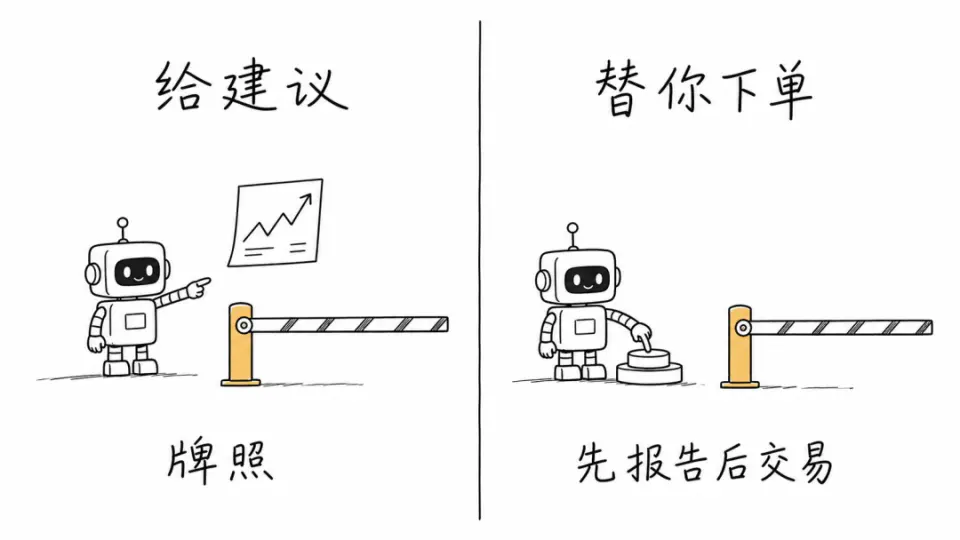
The former requires a licence, while the latter requires reporting before trading
Disclaimers and 'for reference only' are merely formalities in the eyes of regulators
The solution product managers like best is to add a line of small print. An administrative penalty decision published on 19 January 2026 rejected that solution.
Zhejiang Securities Regulatory Bureau Decision [2025] No. 45, issued on 31 December 2025. The party had 107,000 followers on Xueqiu, and his posts averaged more than 1.3 million reads each. From 2 September 2024 to 16 April 2025, he publicly published posts recommending 32 stocks, while at the same time controlling five accounts to conduct large-scale reverse sales on the day of or the day after posting, with trading value of RMB 631 million and illegal gains of RMB 41.6239 million. The outcome was confiscation of RMB 41.6239 million and a fine of the same amount, totalling RMB 83.2478 million, plus a three-year ban from the securities market.
At the hearing he raised seven points of defence. One was that most of the articles expressly stated that they did not recommend buying or selling, and therefore were not stock-recommendation articles. The decision's response was a single sentence: marking 'not a recommendation to buy or sell', 'not to be used as a basis for purchase' and 'operations will be decided according to market conditions' is merely a formal disclaimer and does not affect the characterisation of the conduct.
He also argued that he had voluntarily disclosed his holdings and future sell plans. The response was equally blunt: as a matter of law, disclosure of stock holdings and future sell plans is not a statutory ground negating the illegality of 'scalping' manipulation.
For AI tool providers, the significance of this characterisation is very concrete. If the operator or a related party itself holds a particular stock, and the tool then pushes that stock to users and subsequently sells in the opposite direction, that is the complete structure of scalping manipulation. On the administrative side, the provisions are Article 55, paragraph 1, item 6 and Article 192 of the Securities Law; on the criminal side, they are in the Criminal Law.
Article 182: Whoever commits any of the following acts to manipulate the securities or futures market, affecting the price or volume of securities or futures trading, and the circumstances are serious, shall be sentenced to fixed-term imprisonment of not more than five years or criminal detention, and shall also, or shall only, be fined; if the circumstances are especially serious, shall be sentenced to fixed-term imprisonment of not less than five years but not more than ten years, and shall also be fined:
(6) publicly making evaluations, predictions or investment recommendations regarding securities, securities issuers or the underlying of futures trading, while simultaneously conducting reverse securities trading or related futures trading;
Under Judicial Interpretation [2019] No. 9, the criminality threshold is securities trading turnover of RMB 10 million or more, or illegal gains of RMB 1 million or more. The very strength of AI tools lies in scaling up: a single push reaches tens of thousands of people at once, making this threshold far easier to cross than manual stock touting. Moreover, this offence applies to general subjects; it does not require you to be a securities practitioner. Internet influencers can commit it, and so can tool operators.
Within the same company, who will ultimately be held liable
Returning to the Xundong Quantitative judgments, the employees raised three defences, and the court answered each one.
The first is the technical staff member saying, "I really didn't know this was illegal." Wu, the technical department manager, argued at trial that, based on the objective circumstances, he could not have determined that the company's conduct constituted a crime. The court, taking into account his education level and degree of involvement, found that he was aware that the company was recommending individual stocks to clients without the qualification to provide securities advisory services, and stated: whether or not he was aware that the above conduct constituted a crime does not affect the finding that he committed the crime of illegal business operations.
The second is "this is a crime committed by the company; I was just an employee." The court found that this company, since its establishment in 2011, had no operating income for a long period and remained in the software development stage until it began selling the products at issue in 2017, after which its main business operations and income all derived from illegal business activities; this constituted carrying out criminal activities as its main activity, and therefore it was not treated as a unit crime. The corporate shell shielded no one.
The third is "at least my salary is clean, right?" The court's answer was: no person may profit from unlawful conduct; the employees illegally engaged in securities advisory services in the course of their work and obtained labor remuneration on that basis, and the acquisition of that remuneration had a direct causal relationship with the criminal conduct; even if the company's illegal business income was insufficient to pay wages, this does not affect the illegality of the employees' receipt of labor remuneration, and the illegal gains shall be recovered.
From the actual controller to an outside programmer who sold only one interface program, no link in this chain was excluded on the grounds of "I only do technical work," "I only handle sales," or "I'm an outsourced contractor."
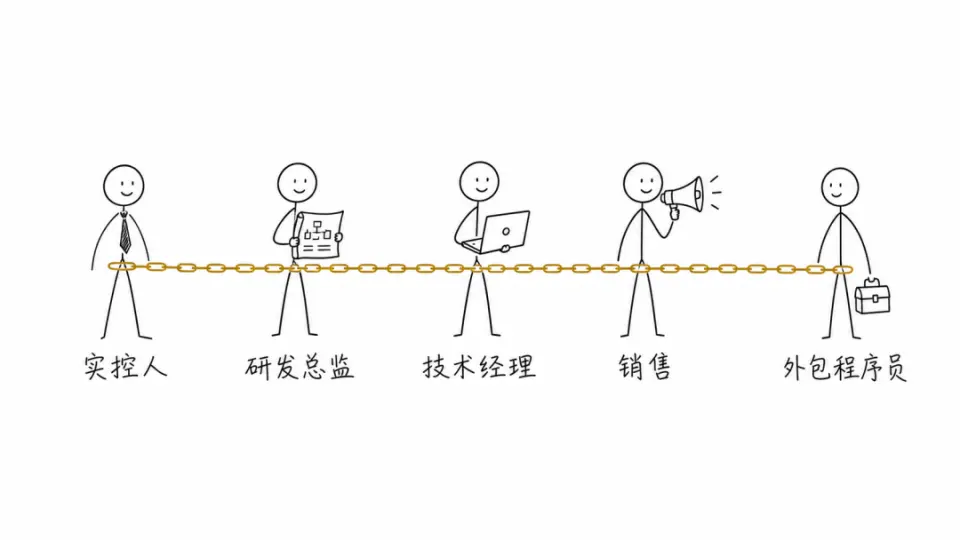
No link in the same chain of liability was singled out and excluded
What paths remain available
First, keep to the proper role of a data tool. The proviso in Article 1 of the Stock Recommendation Software Provisions is precisely the opening left: software that only performs information aggregation and historical data statistics does not count as stock recommendation software; market data, financial reports, indicator calculations, chart visualization, and backtesting frameworks all fall within the line. The acts that cross the line are also specific: outputting stock codes or names, giving buy or sell timing, giving target prices, or giving position recommendations; using code words, homophones, or candlestick charts to refer to the same likewise crosses the line, and the standard is whether an investor can determine the target security on that basis.
Second, become a technology supplier to licensed institutions. Selling tools to securities firms or licensed investment advisers, with the licensed party providing services externally and bearing compliance responsibility, is the most realistic path today. But the line in Article 9 of Order No. 204 must be watched closely: soliciting clients and receiving trading instructions must be completed independently by the securities firm; your product may be their production tool, but it cannot be their client-acquisition channel or order-entry point. Account-opening revenue sharing and embedding account-opening links into tools are both acts that cross the line.
Third, obtain a license yourself. In practice, this essentially means acquiring an existing licensed institution; the CSRC has not approved any new independent investment advisory license for many years, and the threshold continues to rise. The 2020 Measures for the Administration of Securities and Fund Investment Consulting Business (Draft for Comment) set the standard as: the applicant institution's net assets of no less than RMB 100 million; its controlling shareholder having been continuously profitable for the most recent three years and having net assets of no less than RMB 500 million; and a single business requiring more than 10 licensed personnel with three years of experience. These Measures have not yet been formally issued, and the CSRC's 2025 public fund action plan lists them as a task to be introduced. Once they take effect, the threshold will only become clearer, not lower.
Fourth, shift to acting as a private fund manager. Managing property on a fiduciary basis rather than selling advice comes at the cost of being subject to qualified investor and non-public fundraising constraints; the scope for user scale is not the same as that of a 2C tool.
Two other matters are easily overlooked. Where a product provides generative AI services to the public, algorithm filing and large-model registration must still be completed; that is another track running parallel to securities licensing. There is also Article 23 of the New Asset Management Rules, which settled the matter back in 2018: using artificial intelligence technology to conduct investment advisory business requires obtaining investment advisory qualifications, and non-financial institutions may not use intelligent investment advisers to operate beyond scope or conduct asset management business in disguised form.
Xundong Quantitative was established in 2011 and had no revenue for its first six years, remaining in software development throughout. One sentence in the judgment made me pause when I read it: since its establishment, the company had no operating income for a long period and remained in the development stage of the software at issue, until it began selling the stock trading products at issue in 2017, after which its main business operations and income all derived from illegal business activities. A technical team spent six years building something, chose the wrong monetization path, and the entire team went in.
The phrase “technology neutrality” has never been a shield from liability in the securities field. The law looks at only two things: what your software says, and whether you received money because of it.
If your product is sitting right on the line of “whether this counts as stock recommendation,” or if you are already in talks with a securities firm about cooperation and are unsure which parts you can touch and which you cannot, you are welcome to get in touch. That line sits much further forward than most people assume.
Reference Sources
- China Securities Regulatory Commission Announcement No. 40 [2012], Interim Provisions on Strengthening the Regulation of Securities Investment Consulting Business Conducted Through the Use of “Stock Recommendation Software,” Gazette of the State Council
- Interim Measures for the Administration of Securities and Futures Investment Consulting (Zheng Wei Fa No. 96 [1997]), National Database of Administrative Regulations of the Ministry of Justice
- China Securities Regulatory Commission Announcement No. 8 [2024], Provisions on the Administration of Program Trading in the Securities Market (for Trial Implementation), Gazette of the State Council
- Securities Law of the People's Republic of China (2019 Revision), Articles 55, 160, 192 and 213
- Criminal Law of the People's Republic of China (2023 Amendment), Articles 182 and 225
- Provisions of the Supreme People's Procuratorate and the Ministry of Public Security on the Standards for Filing and Prosecuting Criminal Cases Under the Jurisdiction of Public Security Organs (II) (2022 Revision)
- Interpretation of the Supreme People's Court and the Supreme People's Procuratorate on Several Issues Concerning the Application of Law in Handling Criminal Cases of Manipulating the Securities and Futures Markets (Fa Shi No. 9 [2019])
- Measures for the Administration of Securities Brokerage Business (Order No. 204 of the China Securities Regulatory Commission)
- Guiding Opinions on Regulating the Asset Management Business of Financial Institutions (Yin Fa No. 106 [2018]), Article 23
- Administrative Penalty Decision of the Zhejiang Regional Bureau of the China Securities Regulatory Commission [2025] No. 45
- Criminal Judgments of the Jing'an District People's Court of Shanghai: (2024) Hu 0106 Xing Chu No. 836, (2024) Hu 0106 Xing Chu No. 1246, (2024) Hu 0106 Xing Chu No. 813, (2025) Hu 0106 Xing Chu No. 66, and (2025) Hu 0106 Xing Chu No. 214
- Case Handling Bulletin of the Jing'an District People's Procuratorate of Shanghai regarding the case of Zhong [redacted] for illegal business operations and copyright infringement
- The Paper, "Illegal Stock Recommendation and Copyright Infringement: Developer of 'DIY Stock Trading Robot' Sentenced"
- Measures for the Administration of Securities and Fund Investment Consulting Business (Draft for Comment) and the Drafting Explanation, China Securities Regulatory Commission
- Relevant administrative penalty decisions of the Guangdong Regional Bureau and the Qingdao Regional Bureau of the China Securities Regulatory Commission
Author of this article:Lü Yinghui, a lawyer at Mankun (Shenzhen) Law Firm. Graduated from China University of Political Science and Law, with nearly ten years of deep engagement in the legal industry, and previously worked at a court in Shenzhen. Focuses on legal services in the new-generation economy sector, with extensive practical experience and profound insights in fields such as Web3 and artificial intelligence. Account on all platforms: Lao Lü Talks New Money; you are welcome to follow.