
人工智能正在快速从技术概念变成真实的商业基础设施。从大模型、AI Agent到智能硬件、AI 陪伴、企业软件,当越来越多产品真正进入市场之后,企业面对的问题已经不只是模型能力够不够强、融资成本够不够低,而是一个越来越现实的选择:同一个 AI 产品放在不同国家运营,可能需要面对完全不同的法律环境。
中美恰好提供了两个很有代表性的样本。
如果一定要用一句简单的话概括,可以说,美国整体更接近“先跑”,中国则更强调“先管”。但这样的概括只能作为理解两套制度的入口,而不能直接当作法律结论。美国并不是 AI 企业可以不受监管地先做起来,中国也并不是所有 AI 产品都必须经过审批才能上线。两国真正的差异,在于监管介入产品的时间、方式和风险承担机制不同。
对于准备进入中美市场的 AI 企业来说,这一点远比单纯讨论“哪个国家监管更严”重要。
真正的区别,不是一个管、一个不管,而是谁先承担风险
截至 2026 年 8 月,美国仍然没有形成一部统一覆盖所有 AI 产品和应用场景的联邦综合性 AI 法律。现实中的美国 AI 治理,更像是一套由既有法律、行业监管、州级立法、行政执法以及司法诉讼共同组成的网络。
这意味着,对于大多数一般性的 AI 产品而言,企业通常不会因为“使用了人工智能技术”本身,就需要先向某个统一的联邦 AI 监管机关申请许可。模型可以研发,产品可以上线,商业模式也可以先进入市场接受验证,但产品一旦真正触碰到版权、消费者保护、隐私、就业歧视、儿童安全、虚假宣传或者受监管行业的规则,既有法律就会迅速介入。
这也是为什么“美国先跑”这个说法具有一定解释力。美国监管更常见的逻辑并不是在产品出现之前判断“你能不能做”,而是在企业已经进入市场之后,通过监管执法、州级规则和具体案件不断划定边界。
但“先跑”绝不等于“出了事再说”。AI 企业在美国面对的真正压力,是很多风险不会在产品上线前以一张明确的审批清单出现,而是会在产品扩大规模之后,以版权诉讼、消费者索赔、监管调查或者州检察机关执法的形式出现。企业前期获得的创新空间更大,但也意味着需要自己承担更多判断成本。
中国的监管思路则明显不同。
近年来,中国并没有等到一部完整的《人工智能法》出台之后再统一管理 AI,而是围绕算法推荐、深度合成、生成式人工智能、AI 生成内容标识以及拟人化互动等不同场景,不断建立专门规则。监管因此更容易在产品上线和运营过程中提前出现。对于部分 AI 服务来说,备案、安全评估、内容治理、生成内容标识、未成年人保护和数据合规,已经不再只是产品发生问题以后才处理的事项,而逐渐变成产品上线之前就必须考虑的问题。
因此,“中国先管”真正值得企业理解的,并不是所有 AI 项目都需要等待审批,而是监管要求更容易被前置到产品设计和运营流程中。如果把这种差异进一步拆开来看,中美 AI 治理在产品上线、训练数据、AI 内容、未成年人保护、数据跨境以及监管逻辑上,已经呈现出较为清晰的不同路径。
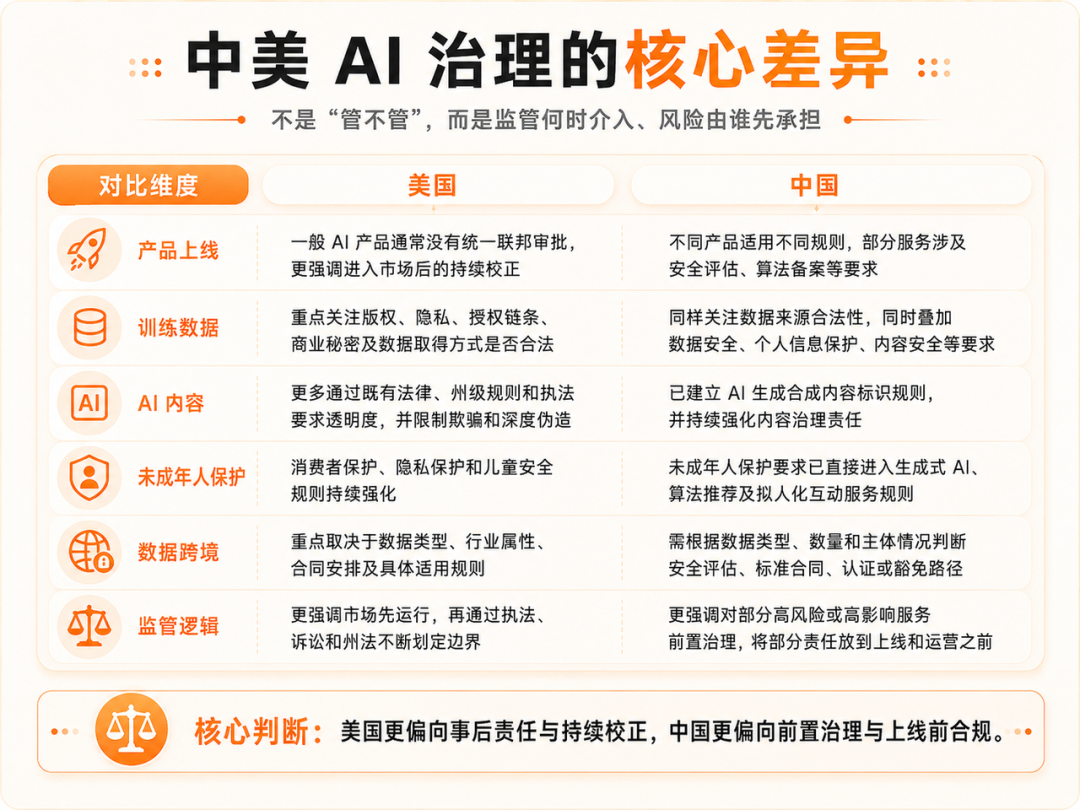
曼昆制图|中美 AI 治理的核心差异
美国划的是“行为红线”,中国越来越深入“产品机制”
这种差异,在具体规则层面会表现得更加明显。
美国现阶段对 AI 的监管,很大程度上仍然借助既有法律完成。如果一家企业夸大 AI 产品的能力、安全性或者收益,就可能落入消费者保护和虚假宣传监管;如果训练数据涉及版权作品,就可能进入版权法争议;算法用于招聘、信贷或者住房领域产生歧视结果,也可能直接受到已有反歧视法律约束。
换句话说,美国很多时候关注的并不是“你有没有使用 AI”,而是你使用 AI 之后做了什么,以及最终造成了什么法律后果。
这也是为什么美国的 AI 法律实践会高度依赖具体案件。AI 技术发展速度通常快于专门立法,很多新的问题最终只能先回到旧法律中寻找答案,再由监管机关和法院逐渐划出新的边界。
中国的变化则正在向更深一层发展。
最初的 AI 治理更多集中在内容是否合法、算法是否备案、数据来源是否合法等问题,但随着 AI 产品越来越具有交互性和人格化特征,规则开始直接进入产品功能本身。2026 年 7 月 15 日正式实施的人工智能拟人化互动服务相关规则就是一个很典型的例子。对于 AI 陪伴、拟人化聊天等产品而言,监管已经不仅关心模型会不会生成违法内容,而开始进一步关注平台是否清楚提示用户正在与人工智能互动、是否采取措施防止过度依赖、连续使用时间过长后是否进行提醒,以及未成年人能够接触什么类型的拟人化服务。
这些要求已经开始影响 UI、用户流程、账号体系、产品交互和风控机制。
从这个角度来看,中国 AI 治理正在出现一个非常值得企业关注的变化:合规正在从“内容审核”进入“产品设计”。
对于企业而言,这种变化意味着,法律部门如果只在产品准备上线时进行最后一次审核,往往已经太晚。真正有效的 AI 合规,需要在产品经理定义功能、技术团队设计模型交互、运营部门制定用户机制的时候就开始介入。
两国最大的风险,也不是简单的“罚款谁更高”
讨论中美 AI 治理时,另一种常见的简化方式,是把美国理解为“靠法院打官司”,把中国理解为“靠政府行政监管”。
这个判断有一定基础,但仍然不够准确。
美国当然存在大量私人诉讼,但 FTC、州检察长以及金融、医疗等行业监管部门同样会直接执法;中国以行政监管为重要手段,但 AI 企业同样可能因为版权、人格权、个人信息或者消费者权益问题遭遇民事诉讼。真正值得比较的,不是谁只用哪一种手段,而是哪一种风险更可能成为企业经营过程中最重要的约束。
Anthropic 的版权案件就是一个很典型的美国样本。2026 年 7 月,美国法院批准 Anthropic 与作者群体达成约 15 亿美元的版权诉讼和解。如果只把这个案件概括成“AI 公司使用版权作品训练模型,因此赔了 15 亿美元”,其实会忽略案件真正复杂的地方。
法院此前对于 AI 模型训练是否构成合理使用作出了非常值得关注的判断,而案件中另一个重要争议,则涉及企业取得和保存盗版书籍副本的方式。最终的 15 亿美元也是双方达成的和解金额,而不是法院直接判决的侵权赔偿。
这个案件真正给 AI 企业的提醒并不是“有版权的内容绝对不能训练模型”,而是:AI 时代的数据合规不能只检查最后模型怎么使用数据,还必须往前追溯数据究竟从哪里获得、企业是否有权取得、保存和使用这些数据。
很多美国 AI 企业真正需要担心的,也正是这种风险。产品可能已经运行几年、获得大量用户甚至完成多轮融资,之后才因为一个训练数据来源、一个产品设计或者一项宣传方式陷入长期诉讼。创新空间更大,并不意味着法律成本更低,只是风险出现的时间不同。
中国企业面临的压力则常常更加直接地体现在“产品能否继续经营”上。
备案没有完成、内容治理机制不符合要求、AI 内容标识没有落实、涉及未成年人保护的设计存在问题,或者某个产品功能与监管要求发生冲突,都可能带来整改、功能调整甚至暂停服务。
对于一家正在高速增长的互联网企业来说,这类风险未必能够简单用罚款金额衡量。一个核心功能被迫下线,或者产品需要重新设计用户流程,带来的商业成本可能远远高于行政罚款本身。
因此,从企业视角看,美国和中国的核心风险可以理解为两种不同的问题:美国企业要防止“跑起来之后被追责”,中国企业则更需要防止“产品因为前置合规没有做好而跑不起来”。
AI 出海真正应该比较的,不是哪里监管更松
正因为监管逻辑不同,AI 企业在选择市场时最容易犯的错误,就是直接比较“美国是不是更宽松”“中国是不是更严格”。
这种问题本身就把复杂的商业决策过度简化了。
同样是一家 AI 公司,做基础模型、企业内部 Agent、AI SaaS、教育产品、AI 陪伴、医疗 AI 和智能硬件,面对的监管问题完全不同。一个不直接面向消费者的企业级效率工具,与一个每天和数百万未成年人进行持续对话的 AI 产品,即使底层调用的是同一个模型,也不可能使用同一套法律判断。
企业真正应该先看的是自己的风险结构。
如果产品高度依赖大规模版权数据训练,那么进入美国以后,数据授权、合理使用边界以及潜在集体诉讼风险就必须成为核心问题;如果产品大量处理中国境内个人信息,并需要调用境外模型,则数据跨境路径和个人信息保护会成为重要事项;如果是一款 AI 陪伴产品,那么内容安全、未成年人保护、人格化设计和用户沉迷机制就会直接进入产品合规范围。
所以,一家 AI 公司决定去哪里落地,实际上不是简单地选择“宽松市场”或者“严格市场”,而是在选择自己更有能力管理哪一种法律风险。
这也是中美 AI 治理比较真正有价值的地方。
美国给予企业更大的前期创新空间,但要求企业有能力承担复杂而分散的后期责任;中国对部分产品设置了更多前置要求,但企业在规则明确之后,也更容易知道哪些合规事项必须提前解决。
两套制度都在管 AI,只是风险被放在了不同的位置。
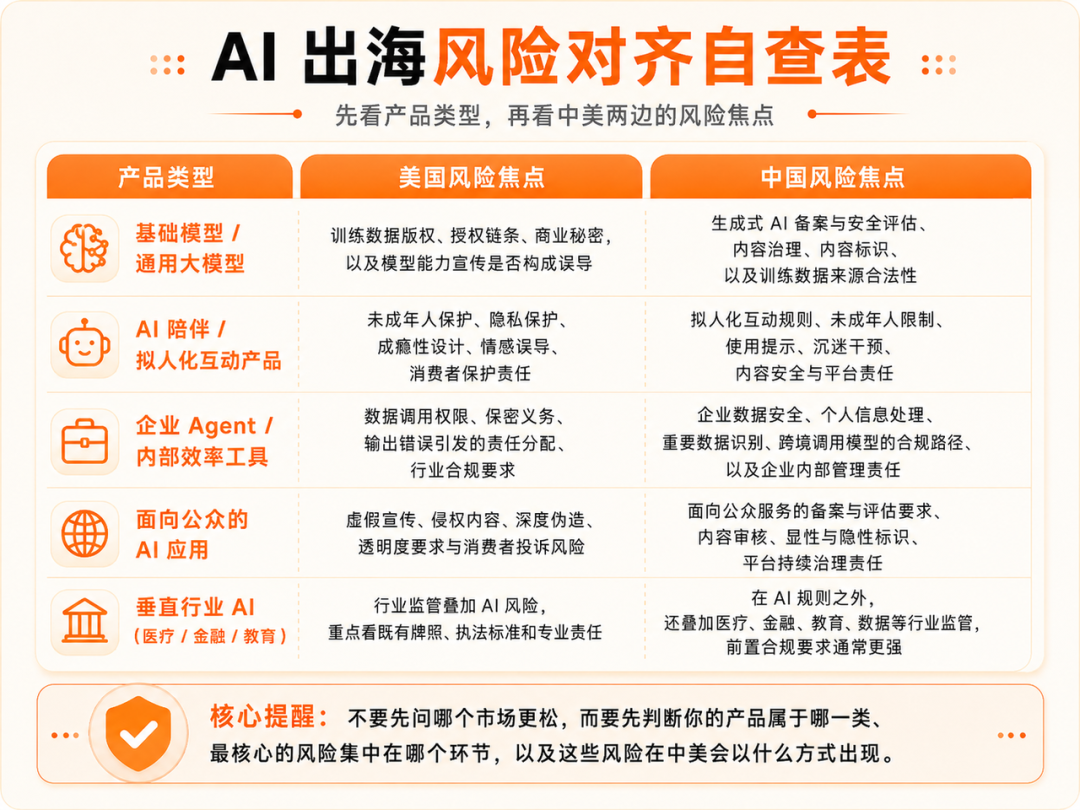
曼昆制图|AI 出海风险对齐自查表
接下来,中美都不会越来越“松”
如果再往前看,中美 AI 监管虽然选择了不同路径,但有一个趋势其实越来越接近:随着 AI 从工具进入真实社会关系,监管都在变得更加具体。
美国未来一个很重要的变量,是联邦政府与各州之间如何重新划分 AI 监管边界。联邦层面希望保持美国在全球 AI 产业中的技术竞争力,而加州、纽约等州已经围绕前沿模型、算法透明度、深度伪造、儿童保护等问题持续建立自己的制度。对 AI 公司而言,未来面对的很可能不是“美国到底管不管 AI”,而是如何同时处理联邦政策、州法、行业规则和既有法律之间的关系。
中国则在另一条路径上持续推进。过去几年形成的算法、生成式 AI、数据、内容标识以及特定应用场景规则,已经构成了一套相当具体的监管体系;2026 年国务院年度立法工作计划又进一步提出加快推进人工智能健康发展综合性立法。因此,未来中国 AI 治理大概率不会简单推倒现有规则重来,而是在现有制度基础上逐步形成更系统的上位法律框架。
对于企业来说,这意味着一个非常现实的结论:未来做 AI,很难再把法律合规理解成产品完成之后的辅助工作。
无论是在美国还是中国,真正成熟的 AI 公司最终都需要把合规能力放进研发、产品、数据、市场和运营全过程之中,只是两边最需要提前解决的问题不同。
结语
“美国先跑,中国先管”仍然是一个很容易理解的概括,但如果真正站在 AI 企业经营者的角度,这四个字只能解释第一层。
美国并不是允许企业不受约束地先跑,而是更多通过既有法律、监管执法、州级立法和司法诉讼,在市场运行过程中持续划定边界;中国也不是所有 AI 产品都要先审批,而是在部分高影响、面向公众或者涉及特定风险的服务中,把备案、评估、内容治理、用户保护和产品机制等要求进一步前置。
因此,中美 AI 治理真正的差别,不是“一个鼓励创新,一个限制创新”,而是两套制度选择了不同的风险分配方式。
对于准备出海或者同时进入中美市场的 AI 企业而言,与其先问“哪里监管更宽松”,不如先问三个更重要的问题:自己的产品究竟属于什么场景,法律会在哪一个阶段介入,以及一旦判断错误,哪一种风险是企业最承担不起的。
当这些问题想清楚以后,“去哪里做 AI”才不只是一个市场问题,而是一项真正意义上的商业与法律决策。
*本文仅代表作者个人观点,不构成针对任何具体项目的法律意见。具体 AI 产品及跨境业务,应结合产品功能、业务模式、用户所在地、数据处理方式及具体应用场景进行专项判断。
“Move Fast” in the U.S., “Govern First” in China? How AI Companies Should Understand Two Regulatory Approaches
Artificial intelligence is rapidly evolving from a technological concept into real commercial infrastructure. From foundation models and AI Agents to smart hardware, AI companions, and enterprise software, more and more AI products are entering real-world markets. For companies, the question is no longer simply whether their models are powerful enough or whether capital is sufficiently available. A more practical choice is emerging: the same AI product may face fundamentally different legal environments depending on where it is launched and operated.
The United States and China offer two particularly representative examples.
If we had to summarize the difference in one simple phrase, the U.S. is generally closer to a “move fast” model, while China places greater emphasis on “govern first.” But this is only a useful entry point for understanding the two systems, not a legal conclusion in itself. The U.S. does not allow AI companies to innovate without regulatory constraints, nor does China require every AI product to obtain approval before launch. The real distinction lies in when regulation intervenes, how it intervenes, and how legal risks are allocated.
For AI companies considering the U.S. and Chinese markets, understanding this distinction is far more important than simply asking which country has “stricter” AI regulation.
I. The Real Difference Is Not Whether AI Is Regulated, but When Risk Is Allocated
As of August 2026, the United States still does not have a single comprehensive federal AI law governing all AI products and use cases. In practice, U.S. AI governance resembles a network made up of existing laws, sector-specific regulation, state legislation, administrative enforcement, and litigation.
For most general-purpose AI products, this means that a company does not typically need to apply to a centralized federal AI regulator for permission simply because it is using artificial intelligence. Models can be developed, products can be launched, and business models can enter the market for validation. But once a product implicates copyright, consumer protection, privacy, employment discrimination, child safety, misleading advertising, or rules governing regulated industries, existing law can quickly come into play.
This is why describing the U.S. as allowing companies to “move fast” has some explanatory value. The more common regulatory logic is not necessarily to decide before launch whether a company is permitted to build a particular AI product, but rather to define and refine legal boundaries after products enter the market through regulatory enforcement, state-level rules, and specific cases.
But “move fast” should never be confused with “deal with the law only after something goes wrong.” The real pressure for AI companies in the U.S. is that many risks do not appear in the form of a clear pre-launch approval checklist. Instead, they may surface only after a product has scaled, in the form of copyright litigation, consumer claims, regulatory investigations, or enforcement actions by state attorneys general. Companies may enjoy greater room to innovate at an earlier stage, but they also bear more responsibility for making their own legal judgments before the boundaries are fully settled.
China follows a noticeably different regulatory approach.
In recent years, China has not waited for a single comprehensive Artificial Intelligence Law before regulating AI. Instead, it has continuously introduced rules targeting specific technologies and scenarios, including algorithmic recommendation, deep synthesis, generative AI, labeling of AI-generated content, and anthropomorphic interactive services. As a result, regulatory requirements are more likely to appear earlier in the product launch and operation cycle.
For certain AI services, filing requirements, security assessments, content governance, AI-generated content labeling, protection of minors, and data compliance are no longer issues to be addressed only after a problem occurs. They are increasingly becoming matters that companies must consider before launch.
What companies should therefore understand by China’s “govern first” approach is not that every AI project must wait for regulatory approval. Rather, compliance obligations are more likely to be embedded earlier into product design and operational processes.
When these differences are broken down further, the U.S. and China already show relatively distinct approaches across product launch, training data, AI-generated content, protection of minors, cross-border data transfers, and the overall logic of regulation.
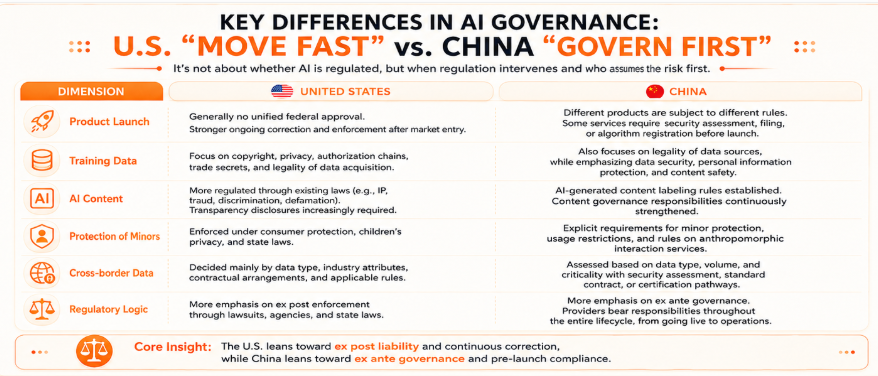
Mankun Graphic | Key Differences in AI Governance Between China and the U.S.
II. The U.S. Draws “Conduct Red Lines,” While China Is Moving Deeper into “Product Design”
These differences become even more apparent when we look at specific rules.
At present, much of U.S. AI regulation still operates through existing legal frameworks. If a company exaggerates the capabilities, safety, or expected benefits of an AI product, it may trigger consumer protection or deceptive advertising rules. If copyrighted works are involved in training data, copyright disputes may arise. If algorithms used in hiring, lending, or housing produce discriminatory outcomes, existing anti-discrimination laws may apply directly.
In other words, the U.S. often focuses less on the fact that a company is “using AI” and more on what the company does with AI and what legal consequences result from that use.
This is also why U.S. AI law is highly dependent on individual cases. AI technology typically develops faster than AI-specific legislation. New disputes therefore often have to be analyzed first under existing legal doctrines, with regulators and courts gradually defining new boundaries through enforcement and litigation.
China, meanwhile, is moving into a deeper stage of regulation.
Earlier AI governance focused heavily on questions such as whether content was lawful, whether algorithms had been properly filed, and whether data had been lawfully obtained. But as AI products become increasingly interactive and anthropomorphic, regulation is beginning to reach directly into product functionality itself.
The rules governing anthropomorphic AI interactive services that took effect on July 15, 2026 provide a useful example. For AI companions, anthropomorphic chatbots, and similar products, regulators are no longer concerned only with whether a model may generate unlawful content. They are also paying attention to whether platforms clearly inform users that they are interacting with AI rather than a human being, whether measures are in place to prevent excessive dependence, whether users receive reminders after extended periods of continuous use, and what types of anthropomorphic services may be provided to minors.
These requirements are already beginning to affect UI design, user journeys, account systems, product interactions, and risk-control mechanisms.
From this perspective, an important shift is emerging in China’s AI governance: compliance is moving from “content moderation” into “product design.”
For businesses, this means that if the legal team only conducts a final review when a product is nearly ready to launch, it may already be too late. Effective AI compliance increasingly requires legal considerations to enter the process when product managers define functionality, technical teams design model interactions, and operational teams establish user mechanisms.
III. The Biggest Difference Is Not Simply “Who Imposes Larger Fines”
Another common simplification in discussions of U.S. and Chinese AI governance is to say that the U.S. relies on litigation, while China relies on administrative regulation.
There is some truth to this distinction, but it is still incomplete.
The U.S. certainly has extensive private litigation, but the Federal Trade Commission, state attorneys general, and regulators in sectors such as finance and healthcare may also take direct enforcement action. China relies heavily on administrative regulation, but AI companies can likewise face civil litigation involving copyright, personality rights, personal information, or consumer rights.
What matters is therefore not which country relies exclusively on which enforcement mechanism, but which type of risk is most likely to become a meaningful constraint on a company’s business operations.
Anthropic’s copyright litigation provides a useful U.S. example. In July 2026, a U.S. court approved an approximately US$1.5 billion copyright settlement between Anthropic and a group of authors. Describing the case simply as “an AI company used copyrighted works to train its model and therefore paid US$1.5 billion” would overlook the complexity of the dispute.
The court had previously made an important determination regarding whether AI model training could constitute fair use. Another major issue in the case concerned the manner in which the company acquired and retained copies of pirated books. The US$1.5 billion ultimately represented a settlement between the parties, rather than a damages award directly imposed by the court.
The real lesson for AI companies is therefore not that “copyrighted materials can never be used for AI training.” It is that data compliance in the AI era cannot stop at examining how data is ultimately used by a model. Companies must also trace where the data came from, how it was obtained, and whether they have the legal right to acquire, retain, and use it.
This is precisely the kind of risk that many U.S. AI companies need to take seriously. A product may have operated for years, attracted a large user base, and completed several rounds of financing before a dispute over training data, product design, or marketing practices develops into prolonged litigation. More room to innovate does not necessarily mean lower legal costs. It may simply mean that the risks emerge at a different stage.
For Chinese companies, the pressure often appears more directly in the question of whether a product can continue operating.
Failure to complete required filings, inadequate content-governance mechanisms, failure to implement AI-content labeling, product designs that do not satisfy requirements for protecting minors, or functions that conflict with regulatory rules can all lead to rectification requirements, product modifications, or even suspension of services.
For a fast-growing technology company, these risks cannot be measured solely by the size of an administrative fine. If a core function must be taken offline or an entire user flow needs to be redesigned, the commercial impact may far exceed the financial penalty itself.
From a business perspective, the core risks in the U.S. and China can therefore be framed as two different problems: in the U.S., companies need to avoid being held liable after they have already scaled; in China, companies need to avoid being unable to scale because they failed to address compliance requirements early enough.
IV. For AI Companies Going Global, the Real Question Is Not Which Market Is More Relaxed
Because the two systems follow different regulatory logics, one of the easiest mistakes for AI companies to make when choosing a market is to compare whether “the U.S. is more relaxed” or “China is stricter.”
That framing oversimplifies a much more complex business decision.
A foundation model, an internal enterprise Agent, an AI SaaS product, an education application, an AI companion, a medical AI system, and an AI-enabled hardware product all face very different regulatory issues. An enterprise productivity tool that does not directly serve consumers cannot be evaluated under the same legal framework as an AI product that continuously interacts with millions of minors every day, even if both ultimately rely on the same underlying model.
What companies should examine first is their own risk profile.
If a product depends heavily on large-scale copyrighted training data, then data licensing, fair-use boundaries, and potential class-action litigation may become central issues in the U.S. If a product processes significant volumes of personal information in China while calling overseas models, cross-border data transfer mechanisms and personal information protection may become major concerns. If the product is an AI companion, content safety, protection of minors, anthropomorphic design, and mechanisms addressing user dependence may directly fall within the compliance framework.
Choosing where to launch an AI business is therefore not simply a choice between a “relaxed market” and a “strict market.” It is a choice about which type of legal risk the company is better equipped to manage.
That is where comparisons between U.S. and Chinese AI governance become genuinely useful.
The U.S. gives businesses more room for innovation at an earlier stage, but companies must be prepared to manage complex and fragmented downstream liability. China imposes more front-loaded requirements on certain types of products, but once the applicable rules are identified, companies may also have greater clarity about which compliance steps need to be completed before launch.
Both systems regulate AI. They simply place risk at different points in the product lifecycle.
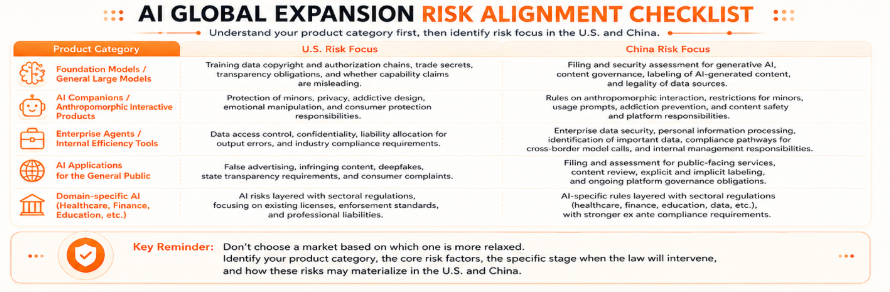
Mankun Graphic | AI Global Expansion Risk Alignment Checklist
V. Neither the U.S. nor China Is Likely to Become “More Relaxed”
Looking ahead, although the U.S. and China have chosen different regulatory paths, they are moving in one similar direction: as AI moves from being a tool into real social relationships and high-impact applications, regulation in both countries is becoming more specific.
One of the most important variables in the U.S. will be how the federal government and individual states ultimately divide authority over AI regulation. At the federal level, policymakers continue to emphasize maintaining U.S. technological leadership and competitiveness in AI, while states such as California and New York continue to develop their own rules around frontier models, algorithmic transparency, deepfakes, child safety, and related issues. For AI companies, the future challenge is therefore unlikely to be whether the U.S. “regulates AI at all.” It will be how to navigate the interaction between federal policy, state law, sector-specific regulation, and existing legal frameworks.
China is continuing down a different path. Rules developed over the past several years governing algorithms, generative AI, data, content labeling, and specific application scenarios have already formed a relatively detailed regulatory system. China’s 2026 State Council legislative agenda also calls for accelerating comprehensive legislation to promote the sound development and governance of artificial intelligence.
China’s future AI governance framework is therefore unlikely to discard the existing rules and start again. More likely, it will build a more systematic, higher-level legal framework on top of the regulatory architecture that already exists.
For businesses, the implication is increasingly clear: AI compliance can no longer be treated as an auxiliary legal review conducted only after a product has been completed.
Whether operating in the U.S. or China, mature AI companies will ultimately need to integrate compliance capabilities throughout research and development, product design, data governance, marketing, and operations. What differs is which risks need to be addressed first in each market.
Conclusion
“Move fast in the U.S., govern first in China” remains an easy way to understand the basic contrast between the two systems. But from the perspective of an AI business operator, those few words explain only the first layer.
The U.S. does not allow companies to move fast without constraints. Rather, it relies more heavily on existing law, regulatory enforcement, state legislation, and litigation to define legal boundaries as products operate in the market. China, likewise, does not require every AI product to obtain prior approval. Instead, for certain high-impact, public-facing, or risk-sensitive services, it places filing, assessment, content governance, user protection, and product-design requirements earlier in the product lifecycle.
The real difference between U.S. and Chinese AI governance is therefore not that one system “encourages innovation” while the other “restricts innovation.” The two systems allocate legal risk differently.
For AI companies preparing to expand internationally or operate simultaneously in both China and the U.S., the better questions are not simply “Which market is more relaxed?” Instead, companies should ask: What type of product are we building? At what stage will the law intervene? And if we make the wrong judgment, which risk would be the most difficult for the business to absorb?
Once those questions are clear, deciding “where to build AI” becomes more than a market-entry decision. It becomes a genuine business and legal strategy.
This article reflects the author’s personal views only and does not constitute legal advice regarding any specific matter. Compliance assessments for particular AI products and cross-border businesses should be conducted based on product functionality, business model, user location, data-processing practices, and specific application scenarios.
/ END.
*本文为上海曼昆律师事务所的原创文章,仅代表本文作者个人观点,不构成对特定事项的法律咨询和法律意见。如需转载及法律咨询,请添加客服:mankunlawyer。
关于律师