
本周回顾:2026年7月22日—7月29日本周三个关键判断
一、AI训练数据的“来源证明”,正在变成一项高成本的商业责任
本周,美国联邦法院最终批准Anthropic与作家群体达成的15亿美元版权和解协议。争议的核心并不是Anthropic是否可以利用书籍训练AI,而是其训练数据中是否包含通过盗版渠道取得的作品。
这起案件释放出的信号非常明确:对于AI企业而言,竞争已经不只是模型能力的竞争,也包括数据治理能力的竞争。企业不仅要回答“模型使用了哪些数据”,还要能够证明这些数据从哪里获得、通过何种方式取得,以及是否具备相应的使用权限。
同案此前的裁决也划出了一条重要边界:使用合法购买或取得授权的作品训练AI,可能具有主张合理使用的空间;但如果数据本身来源于盗版,即使最终被用于模型训练,也可能产生独立且高额的法律责任。
因此,训练数据是否“干净”,已经不再是一个附带的版权问题,而是直接影响企业估值、融资、诉讼成本和产品持续运营能力的商业问题。
二、AI能否使用受版权保护的作品训练,正在美国与欧洲同步接受司法检验
围绕AI训练数据的版权边界,美国与欧洲正在给出各自的司法答案。
在美国,波士顿联邦法院正在审理索尼音乐诉Suno案;在德国,慕尼黑法院将于当地时间7月31日对GEMA诉Suno案作出判决。两起案件都指向同一个核心问题:AI公司能否在未经权利人许可的情况下,使用受版权保护的音乐作品或录音训练生成式AI模型。
虽然美国与欧洲在合理使用、版权例外和权利人保护机制上存在明显差异,但两地法院作出的判断,都会对全球AI企业的数据采购、版权授权、训练记录以及商业合作模式产生直接影响。
对企业而言,真正需要关注的并不只是某一场诉讼的输赢,而是一个更加确定的趋势:AI训练数据正在从“技术团队自行处理的数据资源”,转变为需要经过法律审查、商业授权和持续留痕的核心生产要素。
三、美国加密监管正从“执法划线”转向“规则先行”,但落地仍然缓慢且不均衡
本周,美国加密监管出现了两个具有代表性的进展。
一方面,监管机构未能在《GENIUS法案》设定的期限内完成稳定币最终规则,意味着稳定币发行、储备、审计和反洗钱等具体合规标准仍存在不确定性。另一方面,《CLARITY法案》公布了新的草案版本,试图进一步划分SEC与CFTC对不同数字资产的监管权限,但该法案仍未进入参议院表决阶段。
这两项进展共同说明,美国正在尝试从过去依赖执法案件、诉讼和监管和解来界定加密业务边界,转向通过立法和规则制定提前明确市场准入与合规要求。但这一转型并不会迅速完成,不同监管机构、不同资产类型和不同立法议题之间,仍将长期存在节奏差异。
对企业而言,最稳妥的策略不是围绕当前尚未被明确禁止的空间设计业务,而是根据已经公开的立法方向和监管草案,提前搭建储备、审计、反洗钱、客户资产管理和信息披露体系。监管落地可能延期,但企业为此承担的合规责任不会因此消失。
本周全球监管动态
AI 监管观察
美国|创纪录的Anthropic和解案获批
7月22日,美国加州一家联邦法院对Anthropic与作家们的15亿美元和解协议作出最终批准。作家每本书大约可申领3000美元,目前已有超过44万本书被申领。Anthropic还须删除其使用过的盗版文件。需要注意的是,该和解并未回答“AI训练是否构成合理使用(fair use)”这一更大的问题——针对OpenAI、Meta、谷歌等公司的相关诉讼仍在继续。对任何做AI的公司来说,务实的启示是:保留清晰记录,随时能说明数据的来源。
美国与欧洲|两起AI音乐裁决即将落地
AI音乐应用Suno面临两项裁决。在波士顿,美国法院正在审理索尼音乐诉Suno案;据报道,调查人员在Suno的训练数据中发现了数百万首受版权保护的录音。在慕尼黑,法院将于当地时间7月31日上午9时对GEMA诉Suno案作出判决。这将是关于“用受版权保护的歌曲训练AI”的最早一批法院答案——两起都值得密切关注。
仍在生效|中国的AI陪伴与AI“智能体”规则
回顾本月早些时候:中国关于AI陪伴类应用和AI“智能体”(能自主采取行动、而不只是聊天的AI)的规则已于7月15日生效。陪伴类应用必须明确告知用户其对话对象是机器,须加入休息与安全提醒,禁止向未成年人提供“虚拟伴侣”功能,并对14岁以下用户取得家长同意。用于医疗、交通、媒体或公共安全领域的AI智能体,必须完成备案、测试,并具备在出问题时能够被叫停(召回)的机制。
Web3 监管观察
美国|稳定币规则错过期限(GENIUS法案)
《GENIUS法案》是美国的稳定币法律。它给了监管机构一年时间——到2026年7月18日——来完成详细规则的制定。该期限已过,却只有草案、没有最终版本。基本要求其实已经明确:稳定币必须由安全、流动性高的资产100%支持,每月接受审计,设立反洗钱机制,并且不得向持有人支付利息。但确切的合规标准仍未落定,因此发行方应按照草案规则来准备,并随时准备根据最终版本作出调整。
美国|CLARITY法案有进展——但仍只是一部法案
《CLARITY法案》的新草案于7月22日出炉。它将把数字资产的监管权在SEC(针对具有证券属性的资产)与CFTC(针对具有商品属性的资产)之间划分,并新增了关于加密货币ATM欺诈、冻结可疑资金和反洗钱的规定。该法案已通过众议院,但尚未安排参议院表决,且一场关于官员道德操守规则的争论正令其受阻。如果在参议院8月10日休会前无法通过,很可能要等到2027年。目前这些都还不是法律。此外,CFTC在7月23日至24日采取了两项较小的技术性举措。
欧洲与香港|规则手册持续收紧
在欧盟,MiCA(欧洲加密法律)的过渡期已于7月1日结束——任何面向欧盟客户提供服务的加密企业,现在都必须持有正式牌照,否则必须停止服务。同样在欧盟,针对大型“通用型”AI模型的《AI法案》处罚条款将于8月2日生效。在香港,稳定币制度持续成形,首批由银行支持的稳定币预计将在2026年下半年推出;只有持牌发行人、持牌平台和获授权银行才可提供。
全球监管雷达 —— 本周重点关注
7月22日|美国
Anthropic 15亿美元作家版权和解案获最终批准
当前状态:已批准
对企业意味着:须能证明训练数据合法取得,保留清晰记录
约7月|美国
索尼音乐诉Suno案 —— AI音乐裁决(波士顿)
当前状态:即将裁决
对企业意味着:美国首例“用受版权歌曲训练AI”的司法检验
7月31日 9:00 慕尼黑|欧盟/德国
GEMA诉Suno案 —— 慕尼黑法院判决
当前状态:判决在即
对企业意味着:欧洲首个重大AI音乐裁决,影响数据授权
7月18日|美国
GENIUS法案稳定币最终规则期限被错过
当前状态:已错过
对企业意味着:按草案准备:全额储备、审计、反洗钱、不付息
7月22日|美国
CLARITY法案新草案公布
当前状态:法案—待推进
对企业意味着:拟划分SEC/CFTC监管权,仍需参议院表决
7月15日|中国
AI陪伴+AI智能体规则(已生效)
当前状态:已生效
对企业意味着:须告知非真人、保护未成年人、智能体须备案
7月1日|欧盟
MiCA过渡期结束
当前状态:已生效
对企业意味着:服务欧盟客户须持牌,否则停止
8月2日|欧盟
《AI法案》针对大型AI模型的处罚条款生效
当前状态:即将实施
对企业意味着:完成文档、版权政策与风险评估
2026下半年|香港
首批银行支持的稳定币预计推出
当前状态:持续推进
对企业意味着:发行、交易、托管是否需要牌照要提前评估
已生效|美国—加州/纽约
加州SB 53已生效;纽约RAISE法案2027年1月1日起
当前状态:生效/已立法
对企业意味着:大型AI企业须公布安全计划并报告事件
范川理律师观察
本周AI与Web3领域的种种消息,指向同一个趋势:技术正在进入一个“规则的时代”。
过去几年,无论是AI还是加密,行业竞争主要围绕技术展开——更大的模型、更快的产品、更多的用户,企业希望靠速度取得先发优势。这个时代并未结束,但地基正在移动。核心问题已不再只是“我们能不能做出来”,而是“这款产品能否在我们看重的每一个市场里,长期、合法地运营”。
在AI领域,15亿美元的Anthropic和解案以及即将到来的Suno裁决表明:数据、版权与记录留存,如今是核心的商业风险,而非文书工作。在Web3领域,错过期限的《GENIUS法案》和进展缓慢的《CLARITY法案》,显示出美国正——不均衡地——从“靠诉讼定规则”转向“事先写下规则”。在这两个领域,最终的赢家,都会是那些理解各个市场规则、并据此设计产品的企业,而不是四处寻找监管空白的企业。
对于出海的科技企业而言,这是一个全新的阶段。过去,走向全球往往从市场机会和商业模式开始;未来,法律架构、牌照路径和风险管理,将从第一天起就成为产品设计的一部分。
—— 范川理律师
本周企业合规行动建议
AI 企业
从数据入手。对每一份数据集,都要能说明它来自哪里、你是否有权使用——保存好授权与记录,对来源存疑的数据予以退用或删除。其次,梳理你的产品:其中是否有能采取现实世界行动的AI“智能体”、拟人化/类真人的聊天机器人,或面向儿童及医疗、金融等敏感领域的产品?这类产品承担着最重的新增义务(中国自7月15日起,欧盟自8月2日起)。最后,如果你面向美国或欧盟销售,现在就把基础工作准备好——透明度告知、用户提示、风险评估——并把加州和纽约的AI安全规则列入日程。
Web3 / 加密企业
重新审视你的业务如何被定性:代币的法律属性、由谁发行、用户身处何地。如果涉及稳定币,重点关注储备、审计、客户资金如何保管以及信息披露——即便最终规则延后,也要按《GENIUS法案》的草案标准来搭建。如果你服务欧盟客户,请确认已持有MiCA牌照,因为宽限期已结束。如果你考虑进入香港,请核实在当地发行、交易或托管稳定币是否需要牌照。最重要的是,设计一个你真正能长期运营的全球业务架构,而不是追逐一时最宽松的司法辖区。
下周关注
AI方向:慕尼黑GEMA诉Suno案的判决(7月31日)以及美国Suno案的任何进展;美国FTC关于AI输出的政策征求意见期于7月31日结束。
Web3方向:参议院在8月10日休会前对《CLARITY法案》的任何动作;关于延后的《GENIUS法案》稳定币规则的进一步信号;以及香港稳定币制度的持续推进。
AI合规|Web3数字资产|全球科技企业出海法律服务。本简报仅供一般参考,不构成法律意见。
如果您正在寻求人工智能法律治理或Web3和数字资产合规,请联系我们的律师。
AI & Web3 Global Regulatory Weekly
Attorney Fan Chuanli's Observation | Cross-Border Compliance Watch for Technology Companies
Week in Review: July 22-29, 2026
Three Key Takeaways This Week
"Where does AI training data come from?" - The price of that question is no longer low
This week, a U.S. federal court gave final approval to the USD 1.5 billion settlement between AI company Anthropic and a group of authors. The authors alleged that Anthropic used pirated books to train its AI systems. This is the largest copyright settlement ever recorded.
In practical terms, the question for an AI company is no longer only how powerful its model is, but whether it can prove that every piece of training data was lawfully obtained. Earlier rulings in the same matter drew a clear line: training AI on books that were purchased or properly licensed will generally be treated differently from training on pirated copies. Whether data is "clean" is now a direct financial issue, not merely a legal footnote.
Whether AI may train on copyrighted works is being decided on both sides of the Atlantic
Two courts are about to address the question of whether AI may be trained on copyrighted music without permission. In the United States, a federal court in Boston is hearing Sony Music v. Suno. In Germany, the Munich court is scheduled to issue its judgment in GEMA v. Suno at 9:00 a.m. local time on July 31. It is the same core question, but under two legal systems. Whatever the outcomes, they will affect how global AI companies purchase, license, and document their training data.
U.S. crypto rules are being built - slowly and unevenly
Two crypto policy developments took place in the United States this week. First, regulators missed a statutory deadline to complete stablecoin rules under the GENIUS Act. Second, lawmakers released a new draft of the CLARITY Act, a bill that would determine which regulator - the SEC or the CFTC - oversees which categories of digital assets, although no Senate vote has been scheduled.
The business takeaway is that the United States is moving from defining rules through enforcement cases toward writing rules in advance, but the process is slow and repeatedly delayed. The prudent approach is to design businesses around the rules that are likely to arrive, rather than building around today's regulatory gaps.
Global Regulatory Developments This Week
AI Regulatory Watch
United States | Record Anthropic settlement receives final approval
On July 22, a federal court in California gave final approval to the USD 1.5 billion settlement between Anthropic and the authors. Authors may claim roughly USD 3,000 per book, and more than 440,000 books have already been claimed. Anthropic must also delete the pirated files it used.
It is important to note that the settlement does not answer the larger question of whether AI training constitutes fair use. Related lawsuits against OpenAI, Meta, Google, and other companies continue. For any company building AI systems, the practical lesson is straightforward: keep clear records and be ready to explain the source of the data.
United States and Europe | Two AI music decisions are approaching
AI music application Suno is facing two expected court decisions. In Boston, a U.S. court is hearing Sony Music v. Suno. According to reports, investigators found millions of copyrighted sound recordings in Suno's training data. In Munich, the court is scheduled to issue its judgment in GEMA v. Suno at 9:00 a.m. local time on July 31. These will be among the first court answers to the question of training AI on copyrighted songs, and both cases deserve close attention.
Still in force | China's AI companion and AI agent rules
As noted earlier this month, China's rules for AI companion applications and AI agents - AI systems that can take autonomous action rather than merely chat - came into force on July 15. Companion applications must clearly inform users that they are speaking with a machine, add rest and safety reminders, prohibit "virtual partner" features for minors, and obtain parental consent for users under the age of 14. AI agents used in healthcare, transportation, media, or public safety must be filed, tested, and built with a mechanism that allows them to be stopped or recalled when problems arise.
Web3 Regulatory Watch
United States | Stablecoin rules miss deadline under the GENIUS Act
The GENIUS Act is the U.S. stablecoin statute. It gave regulators one year - until July 18, 2026 - to complete detailed rules. That deadline has passed, but only drafts exist and no final rules have been issued. The basic requirements are already clear: stablecoins must be 100% backed by safe and highly liquid assets, audited monthly, supported by anti-money laundering controls, and may not pay interest to holders. The precise compliance standards, however, remain unsettled. Issuers should prepare under the draft rules and remain ready to adjust once the final version is released.
United States | The CLARITY Act moves forward - but remains only a bill
A new draft of the CLARITY Act was released on July 22. The bill would divide oversight of digital assets between the SEC, for assets with securities characteristics, and the CFTC, for assets with commodities characteristics. It also adds provisions on crypto ATM fraud, freezing suspicious funds, and anti-money laundering. The bill has passed the House but has not yet been scheduled for a Senate vote, and a dispute over ethics rules for public officials is slowing its progress. If it does not pass before the Senate recess on August 10, it may have to wait until 2027. At this stage, none of these provisions are law. Separately, the CFTC took two smaller technical steps on July 23 and 24.
Europe and Hong Kong | Rulebooks continue to tighten
In the European Union, the transition period under MiCA, Europe's crypto law, ended on July 1. Any crypto company serving EU customers must now hold a formal licence or stop providing services. Also in the EU, penalty provisions under the AI Act for large general-purpose AI models will take effect on August 2. In Hong Kong, the stablecoin regime continues to take shape. The first bank-backed stablecoins are expected to launch in the second half of 2026, and only licensed issuers, licensed platforms, and authorized banks may provide relevant services.
Global Regulatory Radar - Key Items This Week
July 22 | United States
Final approval of Anthropic USD 1.5 billion author copyright settlement
Current status: Approved
What it means for companies: Companies must be able to prove training data was lawfully obtained and keep clear records
Around July | United States
Sony Music v. Suno - AI music decision in Boston
Current status: Decision expected
What it means for companies: First U.S. judicial test of training AI on copyrighted songs
July 31, 9:00 a.m. Munich | EU / Germany
GEMA v. Suno - Munich court judgment
Current status: Judgment imminent
What it means for companies: Major European AI music decision that may affect data licensing
July 18 | United States
GENIUS Act stablecoin final rule deadline missed
Current status: Missed
What it means for companies: Prepare under draft standards: full reserves, audits, AML controls, and no interest payments
July 22 | United States
New draft of the CLARITY Act released
Current status: Bill pending
What it means for companies: Would allocate SEC/CFTC authority; still needs Senate vote
July 15 | China
AI companion and AI agent rules in force
Current status: In force
What it means for companies: Must disclose non-human identity, protect minors, and file AI agents where required
July 1 | EU
MiCA transition period ended
Current status: In force
What it means for companies: Companies serving EU customers must be licensed or stop providing services
August 2 | EU
AI Act penalty provisions for large AI models take effect
Current status: Upcoming
What it means for companies: Complete documentation, copyright policies, and risk assessments
H2 2026 | Hong Kong
First bank-backed stablecoins expected to launch
Current status: Ongoing
What it means for companies: Assess in advance whether issuance, trading, or custody requires a licence
In force | U.S. - California / New York
California SB 53 in force; New York RAISE Act starts January 1, 2027
Current status: In force / enacted
What it means for companies: Large AI companies must publish safety plans and report incidents
Attorney Fan Chuanli's Observation
This week's developments in AI and Web3 point to the same trend: technology is entering an era of rules.
Over the past few years, competition in both AI and crypto has mainly centered on technology - larger models, faster products, and more users. Companies have hoped to gain a first-mover advantage through speed. That era has not ended, but the ground is shifting. The core question is no longer only whether we can build something, but whether the product can operate lawfully and sustainably in every market that matters to us.
In AI, the USD 1.5 billion Anthropic settlement and the coming Suno decisions show that data, copyright, and recordkeeping are now core commercial risks, not administrative paperwork. In Web3, the missed deadline under the GENIUS Act and the slow-moving CLARITY Act show that the United States is moving, unevenly, from "rules by litigation" toward "rules written in advance." In both fields, the eventual winners will be companies that understand the rules of each market and design their products accordingly, rather than companies that search for regulatory gaps.
For technology companies expanding overseas, this marks a new stage. In the past, going global often started with market opportunity and business model. In the future, legal structure, licensing routes, and risk management will become part of product design from day one.
- Attorney Fan Chuanli
Compliance Actions for This Week
AI Companies
Start with data. For every dataset, be able to explain where it came from and whether you have the right to use it. Keep authorization documents and records, and retire or delete data whose source is uncertain. Next, review your products: do any of them include AI agents that can take actions in the real world, anthropomorphic or human-like chatbots, or products directed at children or sensitive sectors such as healthcare and finance? These products carry the heaviest new obligations, in China from July 15 and in the EU from August 2. Finally, if you sell into the United States or the European Union, prepare the basics now, including transparency notices, user disclosures, risk assessments, and a schedule for California and New York AI safety rules.
Web3 / Crypto Companies
Reassess how your business is characterized: the legal nature of the token, who issues it, and where your users are located. If stablecoins are involved, focus on reserves, audits, custody of customer funds, and disclosure. Even if final rules are delayed, build according to the draft standards under the GENIUS Act. If you serve EU customers, confirm that you hold a MiCA licence because the grace period has ended. If you are considering entry into Hong Kong, verify whether issuing, trading, or custody of stablecoins requires a local licence. Most importantly, design a global business architecture that you can genuinely operate over the long term, rather than chasing the most relaxed jurisdiction of the moment.
Next Week's Focus
AI: The Munich judgment in GEMA v. Suno on July 31 and any further developments in the U.S. Suno case; the U.S. FTC consultation period on AI outputs also ends on July 31.
Web3: Any Senate movement on the CLARITY Act before the August 10 recess; further signals on the delayed GENIUS Act stablecoin rules; and continued development of Hong Kong's stablecoin regime.
AI Compliance | Web3 Digital Assets | Legal Services for Technology Companies Going Global. This briefing is for general information only and does not constitute legal advice.
If you are seeking legal governance for artificial intelligence or compliance support for Web3 and digital assets, please contact our lawyers.
/ END.
*This article is an original publication of ManKun Law Firm and reflects only the author's personal views. It does not constitute legal advice. For reprints or legal consultation, please contact: mankunlawyer.
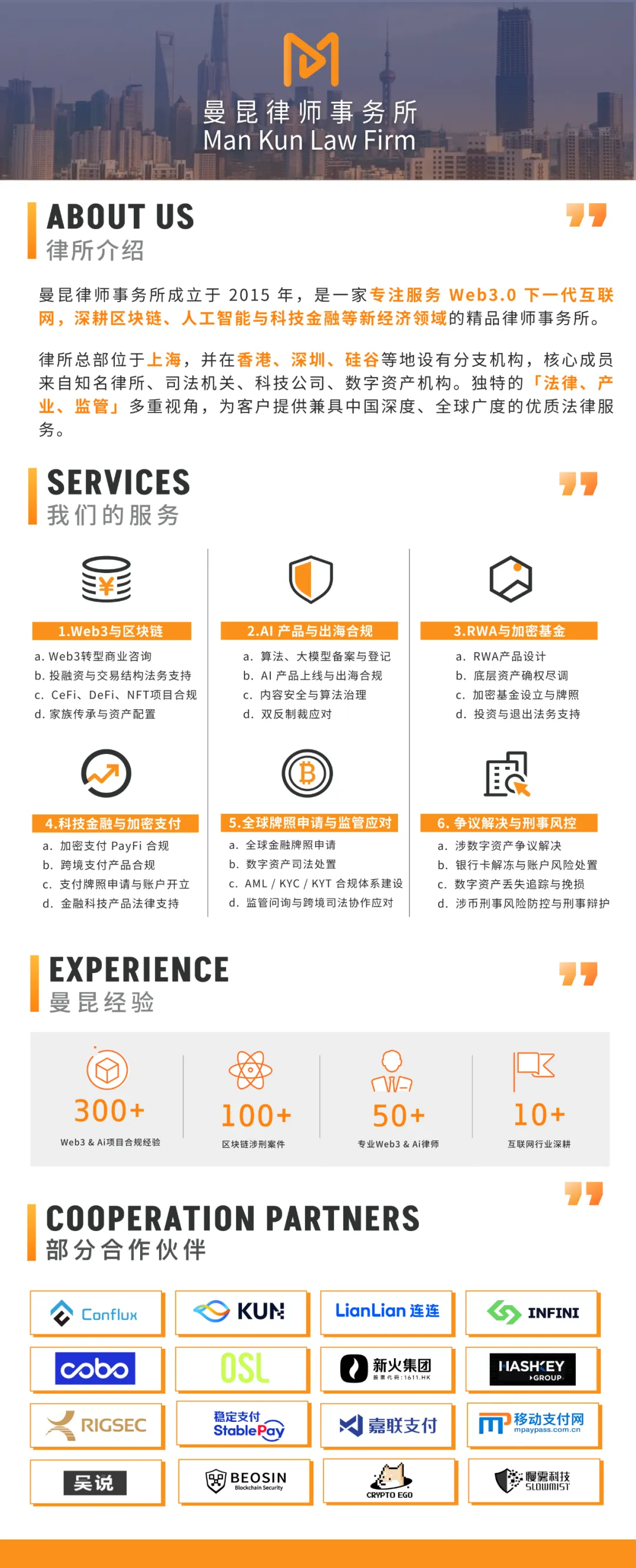
关于律师

关于曼昆