
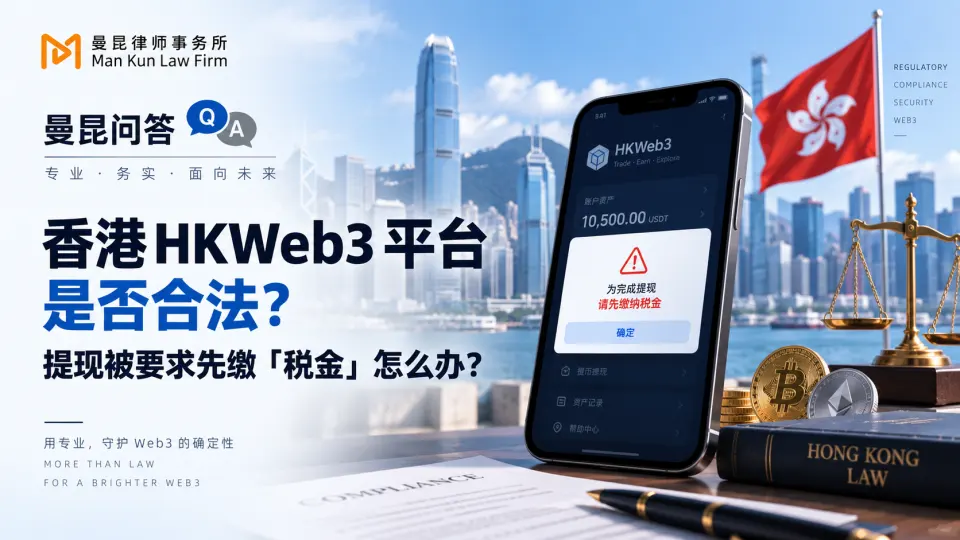
Netizen question
A netizen traded crypto assets on a platform calling itself "HKWeb3" in Hong Kong. The netizen has now applied to withdraw funds, and the platform's customer service requires payment of a "tax" before the funds can be released. Is this platform lawful? Should the netizen pay this "tax" to the platform?
Quick conclusion
This situationis highly suspected to be an "advance-fee" type of fraud; any further injection of funds should cease immediately。
There are two reasons: first, "HKWeb3" does not appear on the list of licensed virtual asset trading platforms published by the Hong Kong Securities and Futures Commission;
second, "paying tax before withdrawal" is a typical fraud script repeatedly warned about by regulators and the police — the Hong Kong Inland Revenue Department never collects tax from individual investors through trading platforms, and properly licensed platforms also do not make "tax payment", "deposit" or "unfreezing fees" preconditions for withdrawal.
Mankun lawyers' view
(1) Platform lawfulness: first check the licence list, then examine business conduct
Since 1 June 2023, Hong Kong has, under the Anti-Money Laundering and Counter-Terrorist Financing Ordinance (Cap. 615), implemented amandatory licensing regimefor virtual asset trading platforms: any centralised virtual asset trading platform that carries on a business in Hong Kong or actively promotes its services to Hong Kong investors must obtain an SFC licence, and unlicensed operation is a criminal offence. After the collapses of unlicensed platforms such as JPEX and AAX, this bottom line has become even clearer.
As of September 2026, the Securities and Futures Commission of Hong Kong has publisheda total of 13 formally licensed virtual asset trading platforms:OSL Exchange、HashKey Exchange、HKVAX、HKbitEX、Accumulus、DFX Labs、EX.IO、PantherTrade、YAX、Bullish、BGE、VDX、Bixin.com。"HKWeb3" is not on the listThe list is updated dynamically. It is advisable to rely on the latest publication on the "List of Virtual Asset Trading Platforms" page of the SFC's official website (sfc.hk), and to check both the "List of Applicants" and the "List of Removed Entities" at the same time—a platform that is still at the application stage likewise does not mean that it has obtained a licence.
(2) "Pay tax before withdrawal": untenable on all three levels
| Verification dimension | Facts and assessment |
|---|---|
| Tax system level | Hong Kong does not impose capital gains tax and, in principle, does not tax individuals on gains from the purchase and sale of virtual assets; even where a taxable matter is involved, the tax will only beassessed by the Inland Revenue Department and collected directlywith a formal receipt issued, and would never be "collected on behalf of" the tax authority by a trading platform |
| Regulatory level | SFC-licensed platforms are subject to the Anti-Money Laundering Ordinance and the Code of Conduct; client assets must be held in segregated custody, with more than 98% held in cold wallets,making "payment of fees" a precondition for withdrawal is itself a breach of a licensed platform's compliance obligations, and licensed institutions will not and are not permitted to operate in this way |
| Modus operandi | "Tax payment → unfreezing fee → security deposit → legal fees" is the standard sequential script of pig-butchering scams and fraudulent platforms: first, small rebates are used to build trust; after a large deposit is made, withdrawal is blocked in the name of "tax payment" and similar pretexts, and each payment is followed by a new "fee label" |
(III) Additional warnings for mainland investors
Even if the platform is not a scam, investors located in the mainland should still note that Yinfa [2026] No. 42 Notice expressly provides that overseas entities and individualsmay not, in any form, unlawfully provide virtual currency-related services to entities within the mainlandwhere any entity or individual invests in virtual currency and the relevant conduct violates public order and good morals,the relevant civil juristic act is void, and any losses arising therefrom are borne by the investor itselfThis means that disputes arising from transactions through such platforms are unlikely to obtain judicial relief under the framework of mainland law.
Recommended actions
- Stop investing immediately: Do not pay any further "taxes," "deposits," or "unfreezing fees" under any label, and do not expect that money already paid can be recovered by "paying one more sum"
- Preserve evidence: Save screenshots of the platform website and App, customer service chat records, bank statements for deposits, on-chain transfer TxIDs, and the counterparty's receiving addresses and account information;
- Verify and report: Check the platform's license status on the official website of the securities regulator; if you are in mainland China, you may call 110 or the anti-fraud hotline 96110 to report, and if a Hong Kong entity is involved, you may report to the Hong Kong police;
- Beware of secondary fraud: After a platform collapses, individuals posing as "rights-protection lawyers" or "asset-recovery teams" often commit fraud in the name of "upfront fees"; asset recovery should be entrusted only to properly licensed lawyers whose practice credentials can be verified;
- If you need on-chain tracing of fund flows, an assessment of criminal reporting options, or cross-border recovery paths, you may consult a professional lawyer with the evidentiary materials.
Mankun Law Firm continuously provides services in Chinese and English in the fields of Web3 tax compliance, cross-border identity planning, coin-related dispute resolution, and criminal risk prevention. If this article's issues require case-specific assessment, support for supplementary filings, or a formal written opinion, please contact:WeChat mankunlvsuo / Email service@mankunlaw.com。
Disclaimer:
This article provides a general introduction to legal and tax knowledge and is compiled based on regulatory documents publicly released before September 2026 (principally including: Yin Fa [2026] No. 42 Notice; the Individual Income Tax Law and its implementing regulations; Ministry of Finance and State Taxation Administration Announcement No. 3 of 2020; Guo Shui Han [2008] No. 818; the China-U.S. tax treaty; the Hong Kong Anti-Money Laundering and Counter-Terrorist Financing Ordinance; and others), and does not constitute legal advice, tax advice or investment advice for any specific case.
For the application of the provisions, tax rate standards and regulatory lists referred to in this article, please rely on the currently effective laws and regulations, the latest public notices of the competent authorities and the case-specific opinions of professional advisers.
