
In corporate internal anti-corruption efforts, one type of scenario increasingly merits attention: managers responsible for procurement, advertising placement, supplier admission, channel cooperation, or token listing review no longer collect traditional "kickbacks" through bank cards, but instead provide a wallet address to the counterparty, who transfers virtual assets such as USDT and Bitcoin in installments.
Such transactions appear very "clean" on the surface. There is no supplier transfer in the bank statements, sensitive words such as "kickback" or "rebate" may not be found in WeChat, and the wallet address does not directly bear the executive's name; if the transfer occurs between an overseas exchange account and a non-custodial wallet, the company's financial system may not see this transfer of benefits at all.
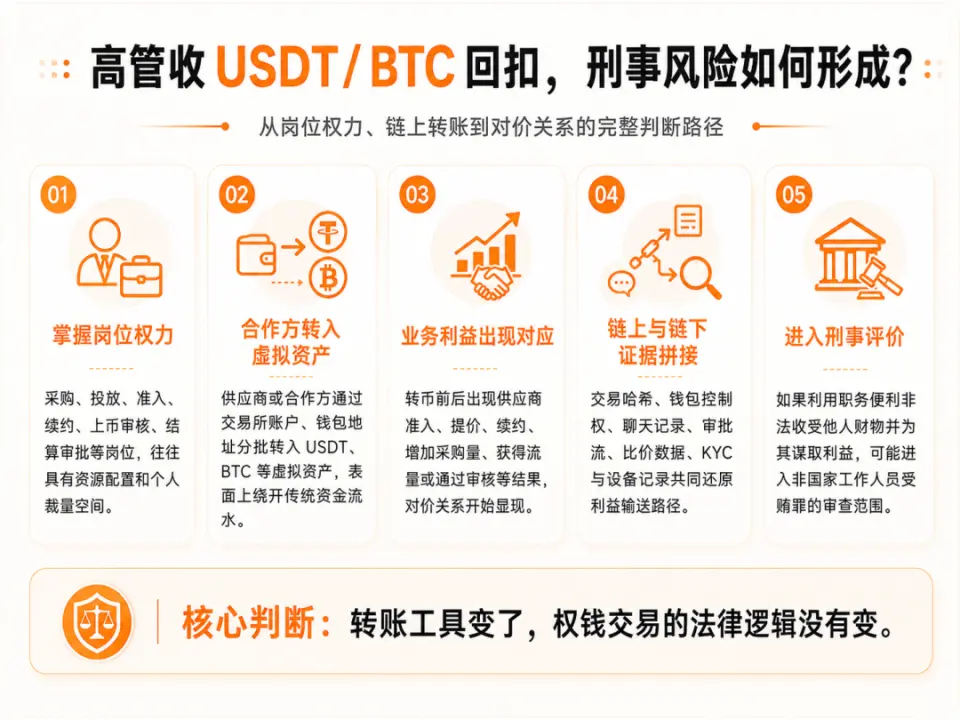
However, in a criminal case, what truly needs to be determined is not whether the benefit was delivered through a bank card or a blockchain, but three more specific questions:whether the virtual assets received can be evaluated as "property" under Article 163 of the Criminal Law, whether there is a consideration relationship between the supplier's transfer of tokens and the executive's conduct in the performance of duties, and what amount of bribery can ultimately be established.
The Judicial Interpretation on Embezzlement and Bribery (II), effective May 1, 2026, further adjusts the conviction and sentencing standards for the crime of accepting bribes by non-state functionaries and the rules for determining the value of property, which means that the issue of corporate executives accepting kickbacks in virtual assets can no longer be analyzed under the amount thresholds of several years ago.
I. The payment received is USDT, not RMB; why may it still fall within the crime of accepting bribes by non-state functionaries?
The core of Article 163 of the Criminal Law is not the single act of "accepting cash," but rather that personnel of a company, enterprise, or other unit, taking advantage of their position, solicit or illegally accept property from others in order to seek benefits for others; in economic dealings, taking advantage of their position, accepting kickbacks or handling fees under various names in violation of state regulations and retaining them for personal ownership is likewise handled under this article. The current filing and prosecution standards also make clear that where the relevant amount reaches 30,000 yuan or more, a case shall be filed and prosecuted in accordance with law.
The first issue to resolve here is the scope of "property."
The 2016 Judicial Interpretation on Embezzlement and Bribery issued by the Supreme People's Court and the Supreme People's Procuratorate makes clear that "property" in bribery crimes includes not only currency and goods, but also property interests that can be converted into currency. On the other hand, the latest 2026 virtual currency regulatory notice issued by eight departments makes clear that virtual currencies such as Bitcoin, Ether, and Tether do not have a legal status equivalent to legal tender and are not legal tender with compulsory acceptance.
These two rules are not contradictory.
USDT is not RMB, and BTC is not legal tender, but "not having the status of legal tender" and "whether it can be the object of a transfer of benefits" are inherently two different questions.If the bribe giver and bribe recipient in fact deliver a virtual asset as a benefit with economic value, the recipient can control, transfer, or dispose of the asset, and there is a corresponding relationship between this benefit and the recipient's conduct in the performance of duties, then the case may still fall within the evaluation of the crime of accepting bribes by non-state functionaries.
Procuratorial practice research has also begun to specifically discuss the issue of determining the amount in cases of 'accepting virtual currency as a bribe,' precisely because virtual assets are becoming a vehicle for new and covert transfers of benefits, and the truly difficult part is gradually shifting from 'whether there was a bank transfer' to 'who controls the wallet, when it was received, and how its value is determined.'
Therefore, corporate executives cannot simply form the judgment that:coins are not legal tender, so a supplier transferring coins does not constitute a kickback.
What truly requires further examination is why these coins were transferred to you.
II. There is no 'kickback' written on the chain—how do judicial authorities prove the existence of a power-for-money transaction?
The most distinctive aspect of virtual asset kickback cases is actually not the charge, but the evidence.
Suppose a supplier transfers 100,000 USDT to a wallet controlled by a certain executive. What the chain can directly prove is: at a certain time, an asset was transferred from address A to address B; but this record itself cannot automatically answer who controls address B, nor can it explain why the supplier made the payment, and even less can it alone prove that the executive used the convenience of his position to obtain benefits for the supplier.
Once it truly enters criminal proof, it is usually necessary to reassemble two sets of evidence—on-chain and off-chain.
The first set resolves'whose wallet it is'For example, whether the wallet address comes from chat records sent by the executive to the supplier, whether the relevant address appears in his mobile phone, wallet app, or exchange account, and whether exchange KYC, login devices, IP, withdrawal records, private keys, or signing behavior can further prove his actual control.
The second set resolves“Why transfer coins?”Before and after the supplier transferred virtual assets, whether the executive participated in supplier admission, contract renewal, quotation adjustment, procurement volume increase, advertising placement, settlement approval, or other allocation of company resources, and whether the relevant business decisions and on-chain transfers have a stable correspondence in time, amount, and interest relationship.
The third group addresses“whether the parties have genuine other transactional reasons”If the executive claims that the relevant USDT constitutes a loan, investment funds, consulting fees, or normal cooperation income, it is necessary to further verify whether there are genuine contracts, service results, repayment records, pricing bases, and normal financial treatment, rather than directly drawing conclusions solely based on the fact that the transfer occurred between the supplier and the employee.
In the typical cases of internal corruption in internet enterprises previously released by the Supreme People's Court, Shi Mouyu, by taking advantage of his position responsible for product design, customer demand exploration, and promotion of cooperation plans, accepted property worth 6.08 million yuan from a cooperation partner, and at the same time converted the company's virtual currency into cash and embezzled 3.66 million yuan. He was ultimately convicted of accepting bribes as a non-state functionary and embezzlement, and was sentenced to twelve years in prison under the combined punishment for multiple crimes. It should be noted that the public materials of the Supreme People's Court do not state that the 6.08 million yuan in bribes itself was paid through virtual currency. Therefore, this case cannot be written as a "typical case of accepting USDT as a bribe," but it clearly reflects that in the cooperative business of internet enterprises, the abuse of positional power, the transfer of benefits by cooperation partners, and the disposal of virtual assets can already simultaneously enter the judicial review of internal corporate corruption cases.
In the special work on commercial corruption in internet enterprises publicly disclosed by the Beijing procuratorial authorities, cases have also emerged in which virtual currency was used to transfer case-related funds layer by layer and technical evidence was used to assist in reconstructing fund relationships. This shows that virtual assets do indeed increase the technical complexity of investigations, but they do not naturally sever the chain of evidence.
III. How much BTC was received, and on which date should the amount of the bribe be calculated?
For cash kickbacks, 1 million yuan is 1 million yuan, but the biggest variable for virtual assets is price.
When an executive receives 1 BTC, it may be worth 400,000 yuan, and several months later it may rise to 600,000 yuan; if BTC, ETH, and USDT are received dozens of times over three years, and the price differs for each transfer, the final RMB amount determined may directly affect the sentencing range. Therefore, "when to value and at what price to value" is not a technical detail but one of the core issues of the case.
The 2026 Judicial Interpretation on Embezzlement and Bribery (II) provides a very important new rule on this point:The amount of a bribe is generally determined according to the value of the property at the time it was received; for property whose value is unclear, price determination shall be conducted in accordance with law.
In the context of virtual assets, this means that a case must first determine, transaction by transaction, the time of receipt and the quantity of assets, and then address the basis for pricing and the issue of conversion into RMB. For USDT, whose price is relatively stable, the dispute may mainly focus on the specific basis for conversion into RMB; for assets with pronounced price volatility, such as BTC and ETH, a time difference of even a few hours or a day may cause a change in value. Therefore, the wallet block time, the transaction confirmation time, the parties' understanding of when the transaction was completed, and the source of price data may all become important parts of the review of the amount.
At the same time, the 2026 Interpretation (II) also made important adjustments to the amount thresholds for the crime of accepting bribes by non-state functionaries, expressly providing that its conviction and sentencing standardsshall be applied by reference to the conviction and sentencing standards for the crime of accepting bribes, and shall no longer follow the old rule in the 2016 judicial interpretation of "applying two times and five times the corresponding amount thresholds for the crime of accepting bribes."
Under the current general amount thresholds, this may first be understood as follows:
Relatively large amount | not less than RMB 30,000 but less than RMB 200,000Fixed-term imprisonment of not more than three years or criminal detention, and a fineHuge amount | not less than RMB 200,000 but less than RMB 3 millionFixed-term imprisonment of not less than three years but not more than ten years, and a fineEspecially huge amount | not less than RMB 3 millionFixed-term imprisonment of not less than ten years or life imprisonment, and a fine
It should be noted that the judicial interpretation also requires comprehensive consideration of the nature of the crime, the specific circumstances, and the social harm when deciding whether to pursue criminal liability and when determining sentencing. Therefore, actual cases cannot simply be mechanically classified into the three amount tiers by reference to the three figures alone, and specific circumstances may also affect the final assessment.
This is also why, in corporate corruption cases involving virtual assets,wallet transaction records are not equivalent to the calculation of the amount of the crimewhich transfers constitute the alleged transfer of benefits, exactly when the acceptance was completed, and what the value was at the time all need to be matched transaction by transaction.
IV. A supplier transferring coins to an employee does not automatically constitute bribery
In internal corporate investigations, another extreme must also be avoided: treating all assets as kickbacks immediately upon discovering that a supplier once transferred coins to an executive's wallet.
The crime of accepting bribes by non-state functionaries still requires proof that the employee took advantage of his position and accepted property in connection with benefits for another person; therefore,a specific connection must be established between "holding authority" and "receiving payment."
For example, if a person in charge of a supplier has also had a multi-year private investment relationship with a company executive, and the two parties had previously had financial dealings independent of the company's business, then whether a particular USDT transfer constitutes a joint investment, a personal loan, or commercial bribery cannot be determined merely on the basis that a supplier relationship simultaneously existed between the parties; conversely, if the parties had no prior private financial dealings, yet large on-chain payments suddenly appeared at key junctures such as supplier competitive admission, price increases, contract renewals, or order expansion, and the payment amounts continuously corresponded to the commercial benefits obtained by the supplier, the probative force of the consideration relationship would be significantly strengthened.
In a case of accepting bribes by a non-state functionary published by the Supreme People's Procuratorate in 2026, in response to the defendant's explanation of RMB 300,000 as a "loan," the prosecuting authority did not directly find bribery merely because the funds came from a supplier; instead, it continued to examine the relationship between the parties, the loan formalities, the circumstances of demands for repayment, the ability to repay, and the supplier admission benefits before and after payment, and ultimately determined through these facts whether the so-called loan was genuine.
The same logic applies when the assets are USDT or BTC.
Although the form of the assets has changed, the evidentiary requirements for the consideration relationship in bribery cases have not changed.
V. What enterprises truly need to remedy is a "virtual asset edition" of their internal anti-corruption mechanisms
For companies in the internet, Web3, gaming, advertising, cross-border technology and other sectors, it is not unusual for employees to use virtual assets. If a company's internal policies still only provide that employees must not accept cash, gift cards or supplier red envelopes, those rules in practice can no longer cover the ways in which benefits are channeled today.
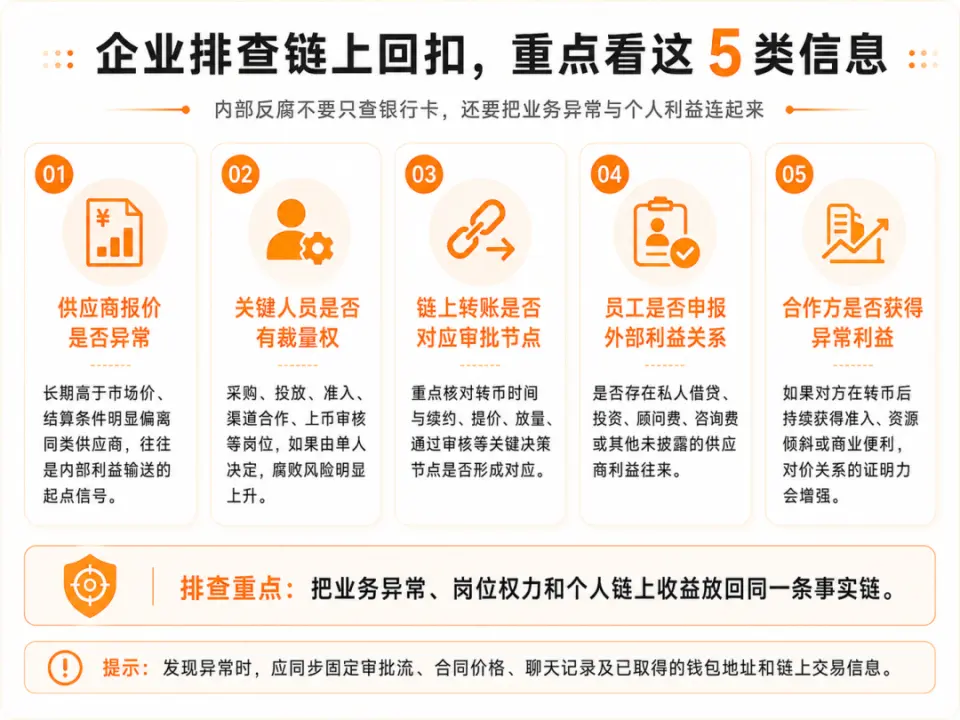
A more effective approach is to bring USDT, BTC, tokens, NFTs and other digital rights with economic value within the scope of employee gifts, conflicts of interest and supplier-dealing policies, and to focus on positions with relatively strong personal discretion—such as procurement, advertising placement, supplier admission, channel cooperation, technology outsourcing, token listing review and traffic resource allocation—by establishing dual-person decision-making, horizontal price comparison, related-party relationship declaration and abnormal transaction review mechanisms.
For internal corporate investigations, it is also not enough to examine only bank cards.
If signals have already appeared—such as a supplier's quotations remaining persistently high over time, settlement terms being clearly more favorable than market terms, the same person in charge repeatedly pushing a particular supplier, or anomalies at approval nodes—then, within the scope of legality and compliance, further steps may be taken to document supplier relationships, approval processes, contract prices, chat records, and wallet addresses and on-chain transaction information that have been made public or lawfully obtained, and only then to determine whether there is a correspondence between the business anomalies and personal benefit, rather than relying on a single screenshot from a blockchain explorer as the entire conclusion.
Lawyer's Observation
Virtual assets are changing the funding form of commercial bribery, but they have not changed the most basic analytical logic of the crime of accepting bribes by non-state functionaries.
In the past, a transfer of benefits might have been a bank transfer, a shopping card or an envelope stuffed with cash; now it may be a wallet address and several on-chain transactions without any memo. Technological tools have changed the path of funds and have also led internal corporate investigations to encounter new evidentiary issues such as wallet control, transaction hashes and on-chain asset valuation, but ultimately the analysis must still return to Article 163 of the Criminal Law itself: whether the employee took advantage of the convenience of their position, whether the supplier provided a benefit with economic value, and whether a consideration relationship can be established between that benefit and specific conduct in the performance of duties.
The new 2026 judicial interpretation on corruption and bribery further unifies the standards for conviction and sentencing in corruption cases within private enterprises, and clarifies the principle for determining the amount based on "value at the time of receipt," so that where virtual assets such as BTC and USDT, which differ in price and volatility, enter a case, there are calculation rules that merit greater attention. (Supreme People's Court)
The absence of the words "kickback" on the chain is not what matters; what truly matters is why a virtual asset moved from a supplier's wallet into the personal wallet of an individual who holds company decision-making authority.
/ END.
*This article is an original article ofMankun Law Firmand represents only the personal views of the author. It does not constitute legal consultation or legal advice on any specific matter. For reprinting and legal consultation, please add our customer service:mankunlawyer。

