
Comprehensive tracking and analysis of the stablecoin industry.
Over the past two years, many professionals in payments, digital wallets, and crypto products have been quietly focusing on one particular direction:U Cards.
In simple terms, users deposit USDTUSDT/USDC, and the system converts it into Hong Kong dollars or U.S. dollars, which can then be spent via a physical card orvirtual cardfor POS transactions, linking to Alipay, or even cash withdrawals at ATMs. You may have already used such services without realizing their underlying nature.
This raises the question:If I want to build a U Card project from scratch, where is the most convenient, cost-effective, and fastest place to launch?
My answer is clear:Hong Kong.
Why do we recommend Hong Kong as the first choice?
This is not because Hong Kong has the most lenient regulatory regime, but because it is practically workable, structurally resilient, and capable of securing necessary counterparties.
-
Hong Kong’s regulatory boundaries are clear: foreign exchange services fall underMSOthe Stored Value Facilities (SVF) regime, while stablecoin custody currently does not require an additional license;
-
crypto assets can be managed through a custodian (such as Fireblocks) without the need to apply for a license;
-
Locally, there is an abundance of resources including BIN partners, Money Service Operators (MSOs), KYC providers, and payment clearing networks;
-
In practice, project sponsors use structural designs (such as instant authorization combined with custodial wallets) to avoid falling within the definition of stored value facilities, thereby gaining breathing room in regulatory gray areas.
The ideal environment for U-Card ventures is not one devoid of regulation, but one where regulations are clear, enforceable, and conducive to operational feasibility.
What do you need to prepare to launch a U-Card business in Hong Kong?
A compliant and implementable U-Card structure requires at least the following five categories of core counterparties:

Which licenses are involved in U-Card operations?
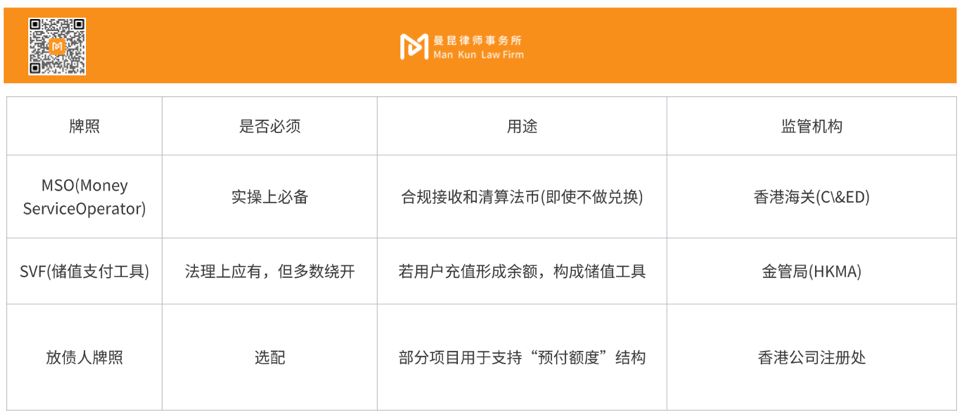
Current practical landscape:
-
Card projects such as RedotPay have not obtained SVF licenses, but insteadVoluntary disclosure as “non-stored value facilities”Emphasizing “non-wallet” and “non-balance” characteristics, and using a Money Service Operator (MSO) license to legitimize fund exchange functions;
-
Such cards are essentially SVF-avoidance structures based on “token-based payments + real-time authorization + third-party channel clearing.”
Why has no one obtained an SVF license? Why have regulators not taken action?
The reasons are straightforward:High costs, low returns, and a wait-and-see regulatory stance.
-
The barriers to obtaining an SVF license are extremely high:Requirements include paid-up capital of HK$25 million, technical review by the Hong Kong Monetary Authority (HKMA), three-lines-of-defense risk management, and ongoing reporting;
-
The operational scale of U-Card projects is relatively small:The user base has not reached scale, complaints are few, and there is no systemic risk;
-
Regulators currently maintain a wait-and-see attitude:The HKMA may view these U-Card products as “gray-area practices that do not currently affect monetary stability and can be monitored.”;
-
The compliance design is sufficiently sophisticated:Most USDT card projects are “designed not to create platform balances,” using a “instant settlement + no fund retention” logic to avoid being characterized as holding stored value.
My assessment is as follows:If such products experience explosive growth in the future (for example, exceeding 100,000 users), there may be a wave of Stored Value Facility (SVF) regulatory scrutiny.
Is a Money Service Operator (MSO) license truly necessary?
From a statutory perspective, if you do not engage in fiat-to-fiat exchange or cross-border remittances, an MSO license is indeed not subject to stringent regulatory requirements;
however, from a practical standpoint, banks, clearing institutions, and payment processors will all require you to provide an MSO license. Otherwise:
-
banks will not provide you with deposit accounts;
-
clearing institutions will not process your fiat currency transactions;
-
investors will also question your compliance capabilities regarding funding channels.
Moreover, Hong Kong’s upcoming “Virtual Asset (VA) MSO” regime will explicitly bring virtual asset exchange businesses under regulatory oversight.
Therefore: while an MSO license may not be strictly mandatory under the law, it is indispensable in practice.
Who handles the conversion from crypto assets to fiat currency?
This is the most easily misunderstood yet critically important link.
-
In practice, the “conversion” is not performed by Fireblocks, Circle, or exchanges;
-
Most project teams complete the fund flow from USDT/USDC to HKD/USD by engaging local OTC over-the-counter (OTC) service providers.
The actual process is as follows:
1. Users deposit USDT/USDC into the platform’s custodial wallet (e.g., Fireblocks);
2. The project team or clearing agent transfers these assets to a local OTC provider;
3. The OTC provider uses its bank account to remit fiat currency into the MSO or payment clearing account affiliated with the project;
4. The fiat currency flows to end users or merchant accounts at the time of card payments or withdrawals.
The advantages include flexibility, rapid settlement, avoidance of exchange-level scrutiny, and no need to provide compliance explanations for on-chain pathways.
A small number of large-scale projects also integrate with Electronic Money Institutions (EMIs) or Payment Service Providers (PSPs) (such as Checkout.com or XanPool), but the barriers are too high for small teams; currently, OTC clearing remains the mainstream pathway in the market.
Apart from Hong Kong, what other jurisdictions offer low-barrier entry options?

Summary:Hong Kong remains the premier practical starting point, offering the most viable operational pathway, high bank acceptance, and regulatory flexibility.
Finally: AsWeb3attorneys, how can we assist you?
If you are preparing a U-Card project, considering integration with card issuers, or launching a stablecoin acquiring structure, we can provide end-to-end compliance support, including but not limited to:
(I) Structural Design and Regulatory Interpretation
-
Assessing whether SVF regulation is triggered and whether an MSO license is mandatory;
-
Planning fund flows and structures for liability segregation;
-
Drafting structural disclosure documents, on-chain/off-chain interaction diagrams, and risk management statements.
(II) Drafting and Customization of Core Compliance Documents
Assisting in the preparation of the following compliance documents in accordance with the requirements of card schemes such as Visa and Mastercard:
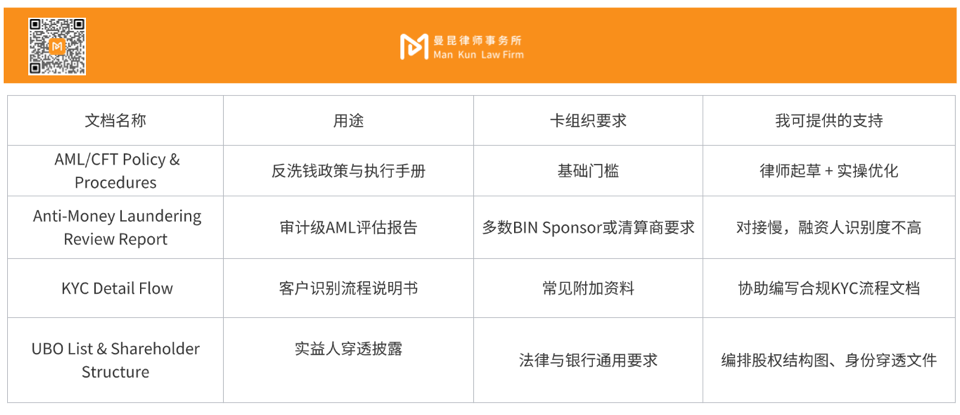
The aforementioned documents constitute not only the baseline for compliance but also the prerequisite for the successful issuance and launch of your card.
(III) Implementation Coordination and Negotiation Support
-
Assist you in coordinating with Money Services Operator (MSO) license holders, Bank Identification Number (BIN) sponsors, and payment clearing networks;
-
Review cooperation agreements, liability clauses, and Anti-Money Laundering (AML) information-sharing mechanisms;
-
Prepare structural diagrams, legal memoranda, and risk disclosure materials for financing or due diligence purposes.
Compliance documentation is not a mere formality; it determines whether you can lawfully launch, access funding, and engage in business transactions with confidence from counterparties.
Conclusion
A U Card is not merely a new feature of a certain wallet, but a definitive model for integrating crypto assets into real-world payment scenarios. You may continue to hesitate over "whether it can be done," or you may adopt a clearer structure and a more prudent path to commence operations while refining processes along the way. By adhering to the baseline of compliance, we can work together to ensure that crypto payments function more like genuine "payment" services, rather than operating in regulatory gray areas.